


Ali the Hooded One, fugitive of the rain
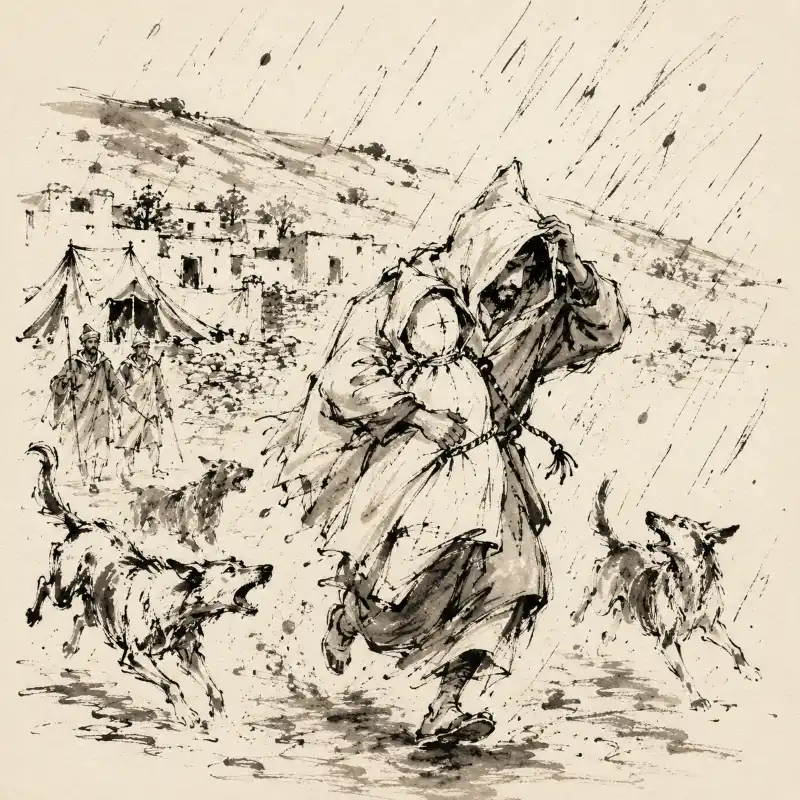
At last, it rains. A man caught out in open country pulls up his hood and runs towards the douar. The dogs bark, taking him for a stranger. Among the Berabers of the Middle Atlas, this drenched fugitive has a name: Ali the Hooded One. Émile Laoust recorded his legend in 1920, in songs that almost no one sings today.
An effigy, not a doll
The name changes from village to village — Ali son of Ali among the Ichqern, ‘Addji the Hooded One among the Izayan, the same figure again among the Aït Seghrouchen and the Ibouhasousen. As for the exact origin of the character, Emile Laoust is candid: he admits that he himself lacks information.
A ritual led by men
With Taghonja, it is the women and children who lead the procession. Here, it is the men.
Yet the ritual itself remains identical in every respect: the effigy is carried around the douar, the procession stops before each tent, the participants are sprinkled with water, and offerings are collected for a communal meal. Only the effigy changes — and the words sung to it.
The songs of a fugitive
It is through these songs that the true character of Ali emerges. He is not a god being implored: he is a man being acted out, caught by surprise, pursued, drenched.
The Izayan tell us:
“The rain chased him towards the douar! The dogs devoured him, and the little dog finished him off!”
Among the Aït Seghrouchen, the rain becomes a domestic deluge:
“We are drowning in water! Messaoud, bring the pickaxe!”
Among the Aïth Ibouhasousen, the rain must touch Ali:
“Ali, Ali the Hooded One! Touch him, O Rain!”
It is difficult not to smile at these lines: Ali, hood pulled up, short of breath, dogs at his heels, seems less a god than a villager caught unawares by the storm — and perhaps it was precisely there, in that almost comic familiarity, that the force of the charm lay. To describe the rain striking was already to call it down.
A mystery left unresolved
Émile Laoust offers no explanation for the presence of this strange male figure. He merely notes that rites involving a male effigy seemed at the time to be confined to the Berabers of the Middle Atlas, whereas elsewhere it was almost always a female figure — Taghonja, the Bride of the Rain — that was carried in procession.
The mystery deepens among the Aït Seghrouchen: Laoust collected songs of Ali the Hooded One there, but a few pages later also describes a procession led by women around a tislit n unzar, a “Bride of the Rain”. Two figures, male and female, thus appear within the same ritual world, without Laoust being able to tell us how they related to one another. Ali therefore remains what he already was for the ethnographer in 1920: a legendary figure …
“…about whom we lack information”.
Emile Laoust
Further reading: Rain rites in Amazigh country: Anzar, Taghonja and the magic of water
Also discover: Taghonja, the Bride of the Rain
Editor’s note
This article is based on the chapter “Le Temps, l’Atmosphère, le Ciel” in Émile Laoust’s Mots et choses berbères (1920).
Ali the Hooded One has none of Taghonja’s fame, and with good reason: the rite remained confined to the Middle Atlas, far from South-East Morocco. We publish it here for its documentary rarity — and because a drenched fugitive, chased by the dogs of a village that does not recognise him, has something universal about him that reaches beyond his region of origin.
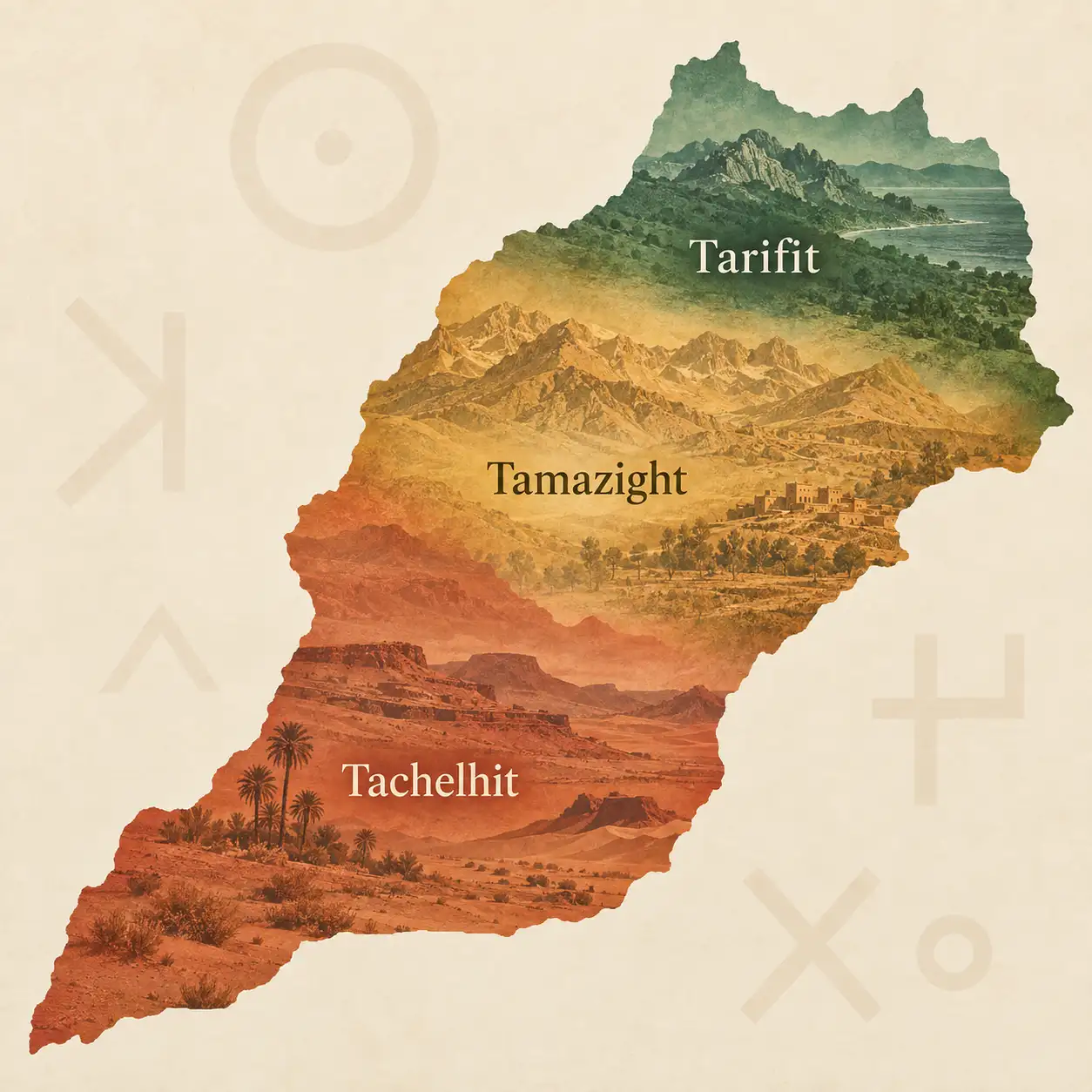
One final note on terminology: the term “Berabers”, which Laoust uses to refer to these tribes of the Middle Atlas, belongs to the Berberist scholarship of his time. It groups together Tamazight-speaking populations of the Middle Atlas and central High Atlas, as opposed to the Chleuhs of the Souss and Anti-Atlas, who speak Tachelhit. A classification from another age, but one found throughout early Berberist literature — and therefore one that needed to be placed in context here.
Explore all features in: The Berber world
Share your knowledge of the Amazigh world
More fragments from the Berber world

Leave a Reply