Ahwach, Morocco’s Amazigh tradition
In the courtyards of southern Morocco’s kasbahs, when the tambourines begin to sound and voices rise into the night, something ancient stirs. Ahwach is not simply a dance — it carries the living memory of Amazigh communities, their poetry, their loves and their endurance, distilled into a single ritual. What follows is an attempt to help keep that memory alive.
Overview
- What is Ahwach?
- How does an Ahwach unfold?
- Poetry at the heart of Ahwach.
- Ahwach, the expression of intimacy.
- The costumes of Ahwach.
- The instruments that give Ahwach its rhythm.
- The role of the Glaoua in Ahwach.
- Ahwach through the eyes of travellers of the past.
What is Ahwach?
Ahwach is one of the great cultural traditions of the Amazigh communities of southern Morocco. Deeply rooted in the rural world, it is found mainly in the High Atlas, Anti-Atlas and Souss regions. It brings together song, poetry, movement and percussion.
It is a collective dance involving both women and men within the same choreography.
Ahwach does not, however, refer to a single form. Rhythms, the arrangement of the dancers, instruments, songs and the respective roles of men and women can vary considerably from one region, valley or community to another.
Both dance and collective expression, it is also a means of transmitting words and memory. Long passed down primarily through oral tradition, Ahwach carries the experiences, feelings, rivalries, memories and stories of a community.
How does an Ahwach unfold?
In the past, Ahwach was performed in a square at the heart of the village, known in Amazigh as the Assarag or Assais, a large space intended for collective ceremonies.
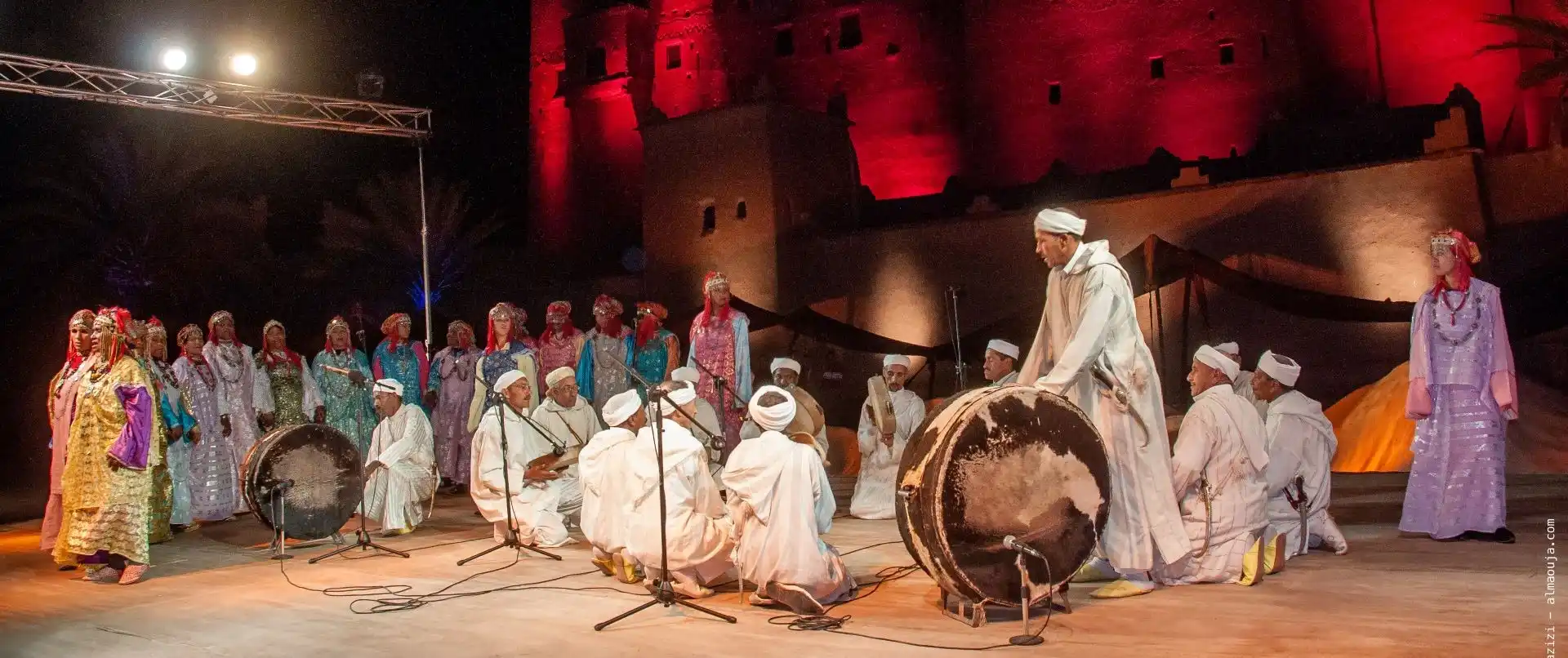
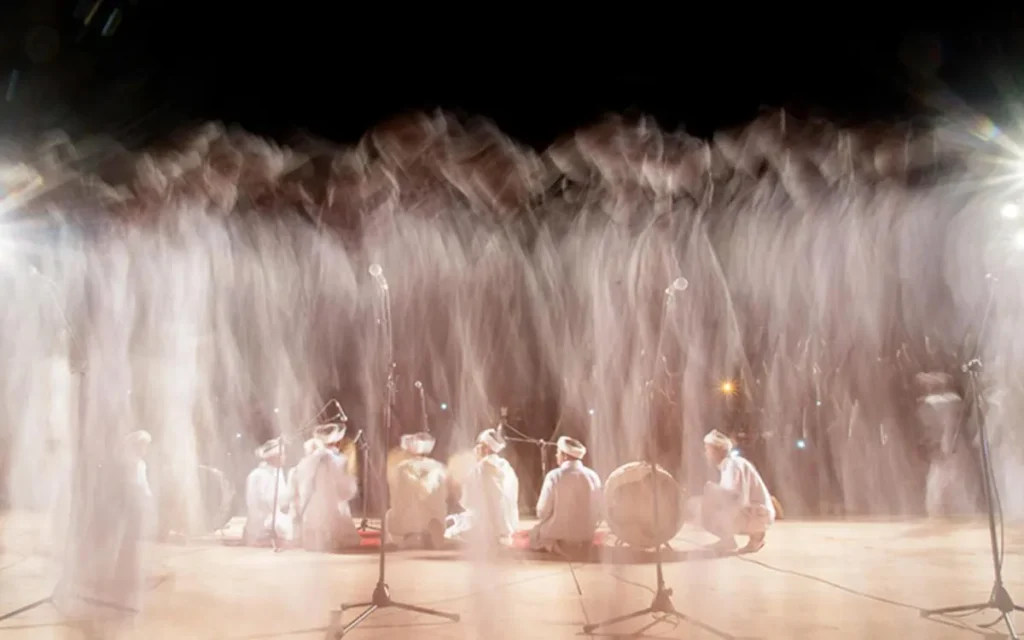
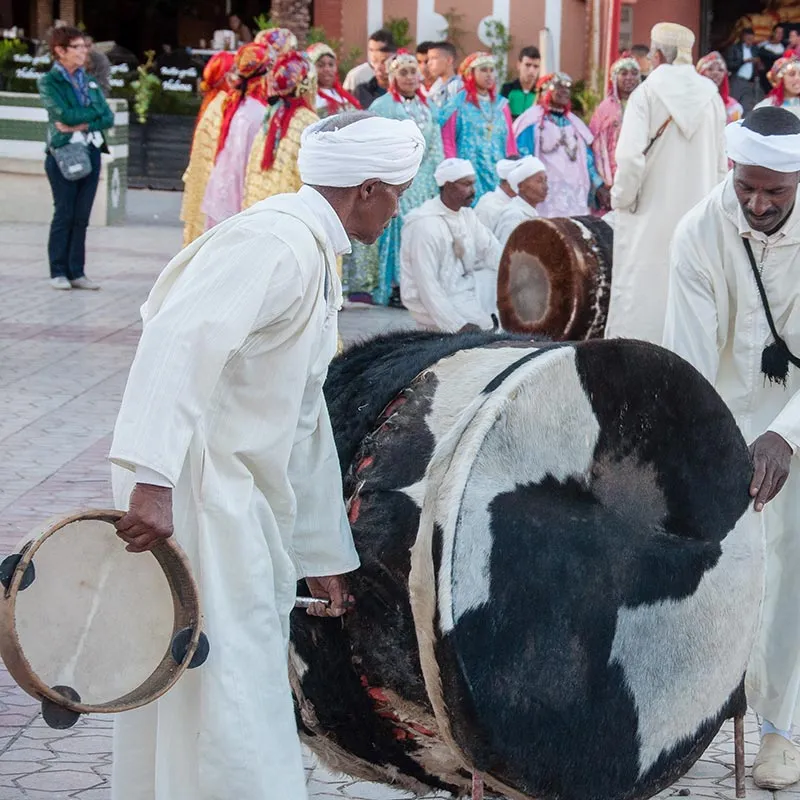
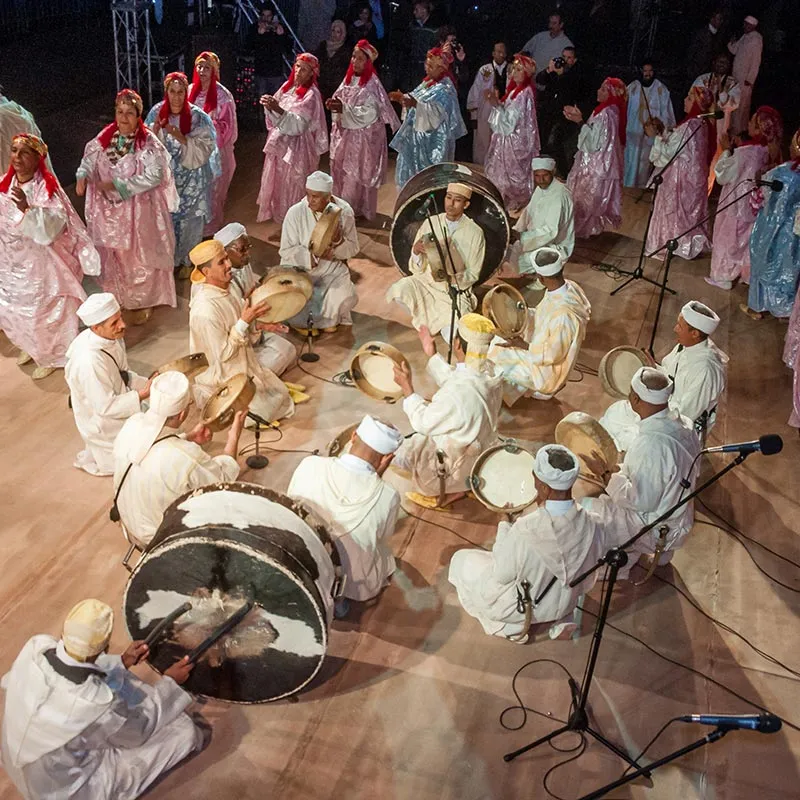
In the forms of Ahwach described around Ouarzazate, the men, dressed in white djellabas and wearing turbans, take their places carrying tambourines and drums. One of them raises a hand to his mouth to give greater resonance to his voice and begins a powerful, haunting chant: this is the Anksalim, which announces the beginning of the Ahwach.
The women, dressed in white, pink or blue robes, their heads covered with fringed scarves and adorned with jewellery, then take their places around the group. Tambourine beats punctuate the opening chant while ululations mark the introduction. The dance begins slowly, then the rhythm gradually builds.
To the swaying of the dancers, whose bodies move to the beat of the percussion, poetry is added. Women and men then compete in composing verses, moving effortlessly from memory to seduction, from the search for origins to the outpourings of the heart, from intimate speech to criticism.
The movement of bodies and the movement of words eventually merge into a single rhythm.
Poetry at the heart of Ahwach
In the past, great Ahwach festivities were organised, bringing together several tribes. Each was represented by a storyteller. The honour of the community then depended on the talent of its poet and his ability to “defeat” his opponents. Each storyteller-singer was thus confronted with the challenge of improvisation, and the best among them received the title of poet, anddame in Amazigh, in honour of the community he represented.
At the beginning of an Ahwach performance, poets would dare to provoke their opponents by pretending not to know them. It was a common stratagem for triggering the duel, as the following verse demonstrates:
Igh Iharka yan izam iffagh tissental.
Ar ikkat s lbaroud as isslla kiwan.
A dour isker tissemzay i mattak issen.
Agh nnit a lmounad achkou niwi fllak.
Agh nnit i oujbad awrak infergh lmenchar.
Agh nnit a yazerg lhmoul rsan fllak.
Yan izdan imendi nss atmen i wyyad.
Face me! Do not hide!
Fire hard so that everyone can hear you!
Beware of appearing small before your own people!
Hey, amateur! You are within my reach — I will get you.
Pull the saw properly. Take care not to bend it.
Oh mill, you bear heavy loads. Beware!
Ahwach, the expression of intimacy
For Amazigh women as well as men, Ahwach is a space for expression and emancipation. It is an opening onto freedom, dreams, intoxication and fantasy… for bodies catch fire in a mystical ritual in which the dancer-singers create their ideal world. Each person, woman or man, is driven by the powerful desire to affirm their individuality through the magic of words, born of an inexhaustible inspiration.
Ahwach is a privileged moment for expressing the passions of the heart. Love appears in all its forms: betrayal, separation, the beginnings of affection and memories of love flow freely from the mouths of lovers. Yet the conservative framework of tribal society and concern for morality lead those involved to use figurative language, with frequent recourse to analogy. Only those who know how to read such words — and the man or woman for whom they are intended — can easily decipher the hidden message.
Igh ourta inni yan awal anguiss itguiwir.
Igh ourta chrriguent as mkkar tnt igna yan.
Ouada d gnnough adagh youkern ifoulan.
Wala tasmi ingha guingh laman.
Tassank as ttaggat yan trit irak.
Tasa nou assen ougguigh kiyyi anguiss oufigh.
Isso kan aggiss ttazzal oura ettenouallat.
Ddimma nnek afas nga i tassa tannalin.
A ghghad izouren s lbelght ami tousaaent.
A gghad ihwan ami douchkant f oudar nes.
Llah oualem llah ouaelm nnigh nekki.
Mra ssinhg i sra ddigrou laz i tamment.
Ikout nhsar adad i nou four tint irouh.
Attamment nou lilil dou ghroum nk a kerziz.
Adagh ifka ouhbib ifk lqoul i wyyad.
Words can be controlled before they are spoken.
Things can be sewn before they are torn.
It was my sewing companion who stole my thread.
And the needle too. He betrayed me.
Look into your heart! The one you love cherishes you too.
There is only you in my heart.
You travel through it without tiring.
I love no one but you.
The first to try on the slippers finds they do not fit.
The patient one will find their proper point.
Perhaps it will be me.
Had I known that after honey there would be hunger,
I would never have dipped my finger into it.
It is colocynth honey and sour bread
that my beloved made me taste, while giving her promise to another.
At first, the singer evokes his burning passion for his beloved. He then expresses his disappointment at seeing her leave with another, comparing love to honey and betrayal to colocynth. He draws upon elements of nature that are very familiar in the region. The first symbolises happiness and satisfaction through its sweet taste, while the second represents discomfort and suffering because of its bitterness.
The costumes of Ahwach
The costumes and accessories worn during Ahwach play a full part in the staging of the dance.
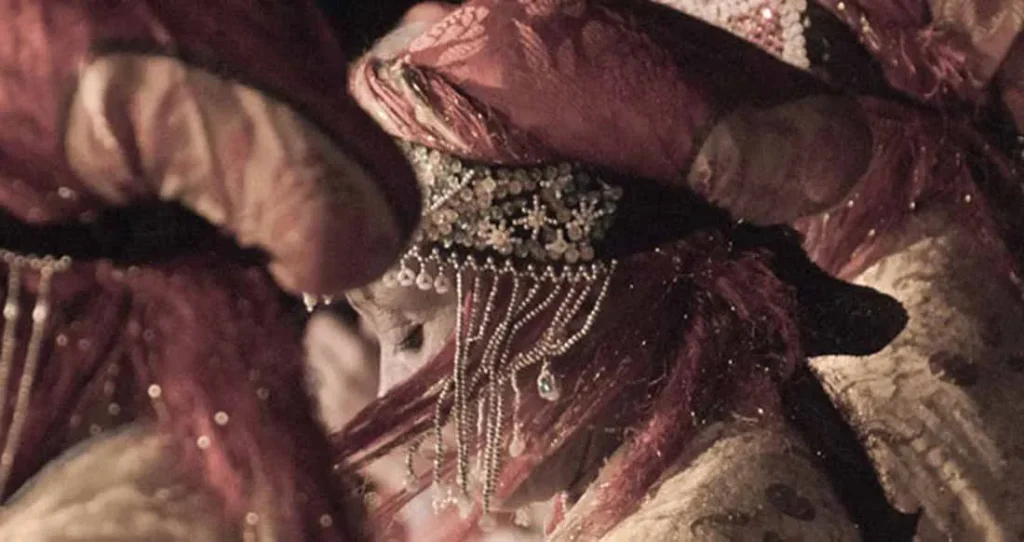
Women use different garments and ornaments to enhance their appearance. The Tatterft, a cloth around six metres long, may be white, blue or pink. The hair is covered with a traditional red scarf known as Leqtib. The Talhzamin n’Tammassin serves as a belt, while a piece of cloth called Tassebnit is worn as a band across the forehead.
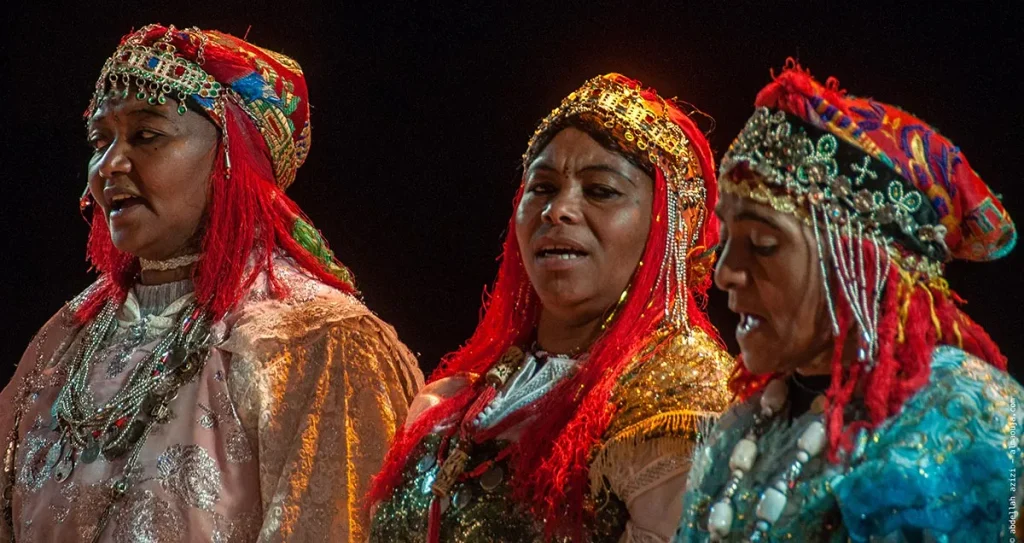
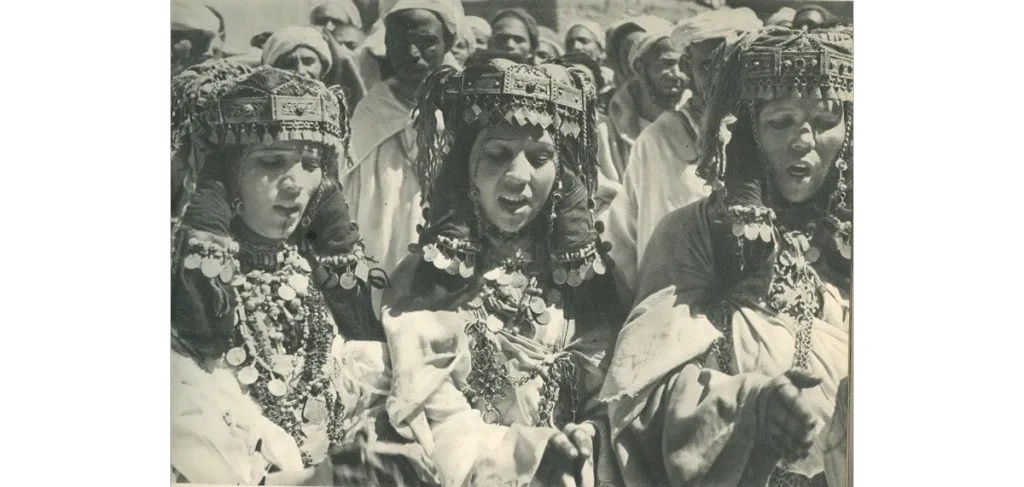
Jewellery, often made of silver or bronze, completes the costume. Fibulae, or Tikhllalin, the plural of Takhlalt, literally “thorn”, are linked by a chain from which various ornaments may hang. They are also used to fasten the Tatterft at the shoulders.
The Lalwah are triangular pieces of silver fixed to the braids. The Tazra is a necklace decorated with coins known as Talwizin.
To complete their adornment, women may outline their eyes with kohl and place sprigs of basil in their hair.
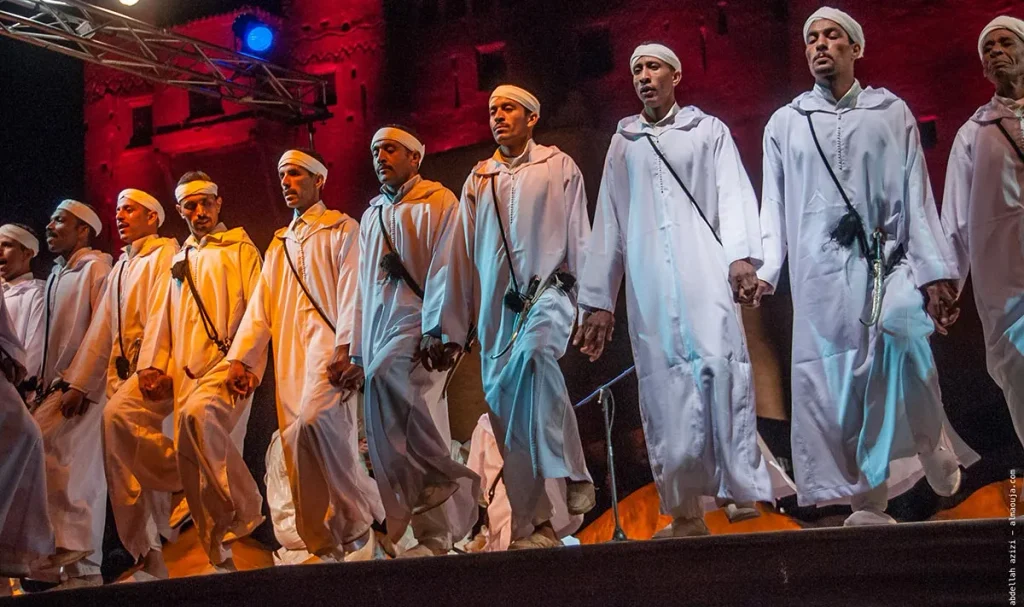
Men’s clothing is more restrained. They generally wear white djellabas and turbans, together with white or yellow babouches. Daggers and bags may be worn across the shoulder.
The instruments that give Ahwach its rhythm
The instruments used in Ahwach belong mainly to the percussion family. Some are played with the hands, others with sticks.
In the forms described around Ouarzazate, percussion is traditionally played by men.
La taguenza
The taguenza, or tambourine, consists of a frame covered with a single membrane, generally made from goatskin or sheepskin. The skin is stretched over a wooden frame and struck with the hands.
The instrument may be fitted with one or more strings producing a buzzing sound. Its name may be connected with this particular sound, known as iguenzi.
Le dendoum
The dendoum is a cylindrical double-headed drum. One of its membranes is struck with a stick or a piece of tubing. Traditionally, animal skins are stretched over the body of the drum.
Often placed at the centre of the formation, it helps establish both the musical rhythm and the cadence of the dance.
Some sources link its other name, ganga, to Gnawa musical traditions and attribute to them a role in its introduction into certain forms of Ahwach. This connection should, however, be treated with caution.
Le naqouss
The naqouss is a metal percussion instrument struck with sticks. Today it may be made from a repurposed piece of metal, such as a brake drum.
Its place within Ahwach varies according to region and ensemble.
The role of the Glaoua in Ahwach
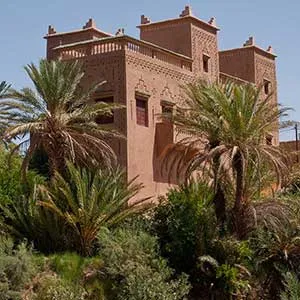
Ahwach is first and foremost a popular tradition associated with the collective celebrations of Amazigh communities. Yet in the Ouarzazate region it also acquired a more official and spectacular dimension during the era of the great Glaoua caïds.
Accounts left by travellers in the early twentieth century reveal the importance given to these performances in the great kasbahs of Telouet, Taourirte and Tifoultoute.
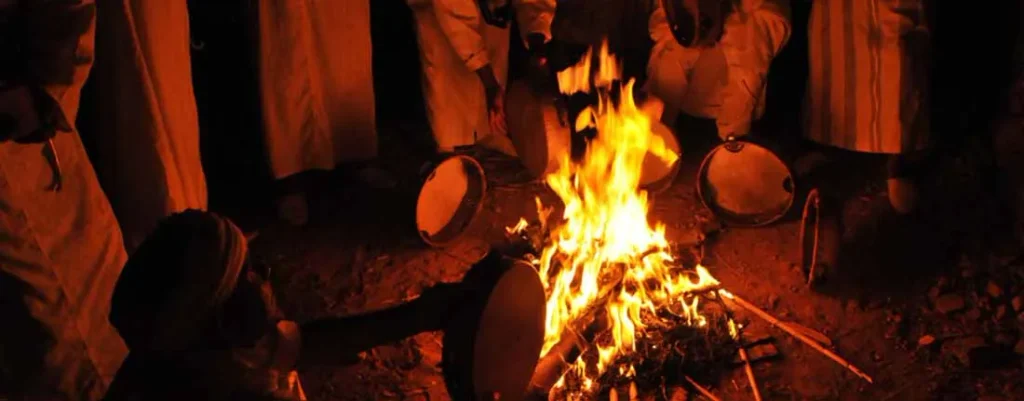
The caïds could summon large troupes for festivities, receptions or the arrival of distinguished guests. Within the great inner courtyards, music, fire, costumes and the sheer number of participants all contributed to the spectacular nature of the Ahwach.
The women of the household could watch the performances from windows or spaces overlooking the central courtyard, while the dancers and musicians occupied the space below.
These Ahwach performances organised in the Glaoua kasbahs probably contributed to the reputation of certain troupes from the Ouarzazate region.
They also left behind several remarkable written accounts.
Explore further: The Glaoua saga
Ahwach through the eyes of travellers of the past
During the 1930s, several travellers and writers witnessed Ahwach performances held in the great kasbahs of the Ouarzazate region.
Their texts are now valuable testimonies to the places, costumes, instruments, rhythms and staging of these festivities. They also carry the vocabulary, representations and at times the fantasies of their period.
They should therefore be read in this double light: as documents recording a form of Ahwach that has now disappeared, but also as European perspectives produced within the context of the Protectorate.
Jean Ravennes: Ahwach in the kasbah of Taourirte
Jean Ravennes describes an immense night-time celebration organised by Si Hammadi El Glaoui. Palm fires, hundreds of women, percussion and singing transform the courtyard of the kasbah into a spectacle that seems to fascinate him as much as it unsettles him.
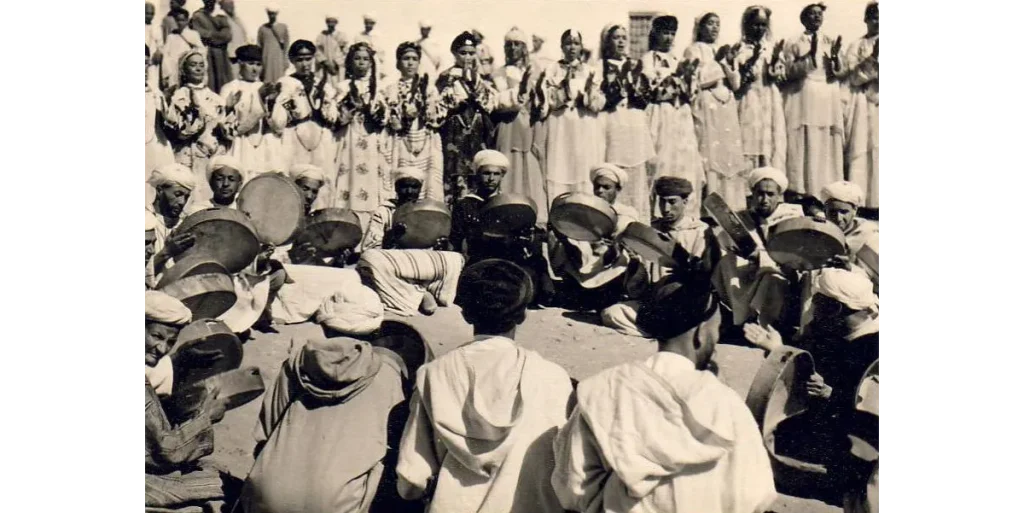
“Si Hammadi, master of Ouarzazate, has reserved the place of honour for us; tea is served by his black eunuchs in splendid tableware. Below, fellahs constantly feed fires of palm fronds whose reflections lick the gigantic red walls of the dwelling; around the fires, seven or eight hundred women are arranged, a fabulous vision of gaudy finery in the night, crimson fringed scarves, long multicoloured dresses drawn in by golden belts. They sing and dance; the dialogue of voices, now shrill, now hoarse like muffled cries among the dunes, follows the haunting rhythm of musicians crouched over great deep-sounding drums; and their dance is no more than a swaying of the hips, unchanging and sensual.
Little by little this rhythm enters you, disturbs you; without noticing, you too begin to sway; helped by the unreal, phantasmagorical quality of the spectacle, the eyes close; one falters, overcome by an inexplicable intoxication that weighs upon the head, and one must flee, flee as quickly as possible in fear of the mysterious temptation. Until daybreak, the fire Ahwach will continue, in a kind of delirium, the songs growing stronger, the twisting of the bodies expressing with increasing violence the call to sensual pleasure, while behind the grilles of the only window pierced high in the wall, the women of the harem, clustered together, will send out their ululations like cries of death.
Antinea, Antinea always! A brief madness of one night for these wretched serfs of the land of hunger and thirst…”
Source: Jean Ravennes, Aux portes du Sud – le Maroc, Éditions Alexis Redier.
Marcel Homet: a night of Ahwach in Taourirte
A few years later, Marcel Homet gives a lengthy description of an Ahwach he says he witnessed in the kasbah of Taourirte.
His account is particularly detailed: the arrival by torchlight, the welcome by Si Hammadi, the arrangement of the musicians and dancers, the costumes, the gradual acceleration of the rhythm and the role played by fire in the staging.
His interpretation of the spectacle is deeply marked by the representations of his time, but his description preserves many valuable details.
“… Ever since I entered I have been rubbing my eyes vigorously to convince myself that I am not dreaming. I am in the kasbah of Taourirt in Ouarzazate, one of the finest in southern Morocco. It belongs to the Glaoui, whose very old brother, now at the respectable age of eighty-five, has just done me the honours.
It is the ahouach, the ancient fire dance, that we are to see this evening, celebrated in the deepest courtyard of the most imposing burg.
Before the gate, twenty torchbearers, after bowing to Colonel Chardon and myself, surrounded us and escorted us into the building.
In the final courtyard, the khalifa was waiting for us, dignified in the immaculate folds of his burnous trailing on the ground. Then came the customary greetings: alternating questions and answers in Arabic, solemnly pronounced with a hand upon the heart, ending, as fingers are kissed, with the double murmur: Amdoullah (Praise be to God!).
Then the khalifa Si Hammadi, this old man whom de Foucauld mentions in his imperishable Reconnaissance au Maroc, precedes us towards chairs he has had prepared, his own modestly remaining a few metres behind.
The spectacle is compelling! In the middle of the courtyard is a brazier which an attentive boy constantly feeds. Beside it, around fifteen seated men hold various musical instruments between their knees, playing softly: tom-toms, tambourines, one-string violins, while the leader, armed with an enormous mallet, sets the rhythm by striking with all his strength upon a barrel covered with sheepskin.
The men sing quietly and slowly, a kind of canticle, a lingering melody reaching back into the depths of vanished ages, the prayer of a grateful humanity towards the sacred element that allows it to live.
On the other side of the fire stand fifty young women, unveiled, for the Berbers do not veil themselves. They are arranged in a single line. All wear long embroidered muslin dresses concealing, as the Koran requires, the charms of their bodies. Yellow silk veils are tightly wrapped around their heads, while from their ears, their foreheads and down their necks hang long necklaces bearing dozens of coins, joining the bracelets covering their arms.
With their bronzed faces tattooed in blue on the forehead, nose and cheekbones, these women stand out curiously against the darkness of the wall before which they are to dance. For the moment they hold a hieratic pose. Motionless and upright in their immaculate veils, they raise their joined hands, dyed red with henna, to the level of their faces in that eternal gesture of prayer which all religions borrowed from ancient humanity.
Slowly, as the music quickens its pace and the men’s song rises into the still air, they begin to move. First their feet sketch out a slight dance step, then the hips begin to sway, finally the whole torso leans slightly forward, while the hands clap against the beat, following the rhythm of the tambourine players.
Each period is punctuated by a drawn-out ‘La! La! La!’ Even the children inside the circle try to dance. The smallest, brought by their mothers, wander familiarly around our legs, and nothing could be more touching than the sight of two of them, one six months old, the other six years, the latter carrying the former close to the fire.
But the music quickens. One sees the white turban of the leader plunge frenziedly into the circle of musicians. The blows become faster, more violent; the men’s voices fall silent, replaced by those of the women, who move rapidly. Then, one after another, two dancers enter the circle. They are young, pretty, almost elegant despite the long dresses that envelop them tightly. One senses nevertheless, from their more supple and nimble movements, that they must possess slender bodies, ready for love which, even in our so-called refined civilisations, has always preceded the voluptuous dance of the ancients. With quick small steps they approach us, swaying their hips and staring fixedly at us, then with a sudden movement they flee to the other end of the courtyard. Finally, exhausted, they collapse beside the fire that bathes them in its warm light. But their companions have not stopped; on the contrary, the dance is now driven by a movement so rapid that it can scarcely be followed.
Suddenly, a gong cracks. The women immediately become still and, in a charming gesture of modesty, place their joined hands over their faces, leaving visible only their large dark eyes ringed with kohl.
After a moment, the same rhythm begins again. The fire, once more replenished, sends its long red and yellow flames into the air, illuminating the watchtower built above the gate forty metres away. Soon, Bengal lights flare on all sides. There are green, red and yellow ones, casting a fantastical light over the narrow, towering courtyard. And the ahouach continues, tirelessly taking up once again the verses of its eternal songs.
The tambourines begin once more to moan softly, the men to sing while the women sway.
Always against the beat, the piercing songs rise. Once again the age-old rite seizes its celebrants to their very depths, carried away by their mystical faith.”
Source : Marcel Homet, Méditerranée, mer impériale, Éditions NRC, 1937.
Henry Bordeaux: Ahwach in La Revenante
In his novel La Revenante, published in 1932, Henry Bordeaux likewise transposes a scene of Ahwach into the world of a great Glaoua kasbah. He describes in particular the circle of female dancers, the central fire and the gradual acceleration of the rhythm.
This is a literary text rather than an ethnographic account, even though it draws upon the author’s journey through Morocco.
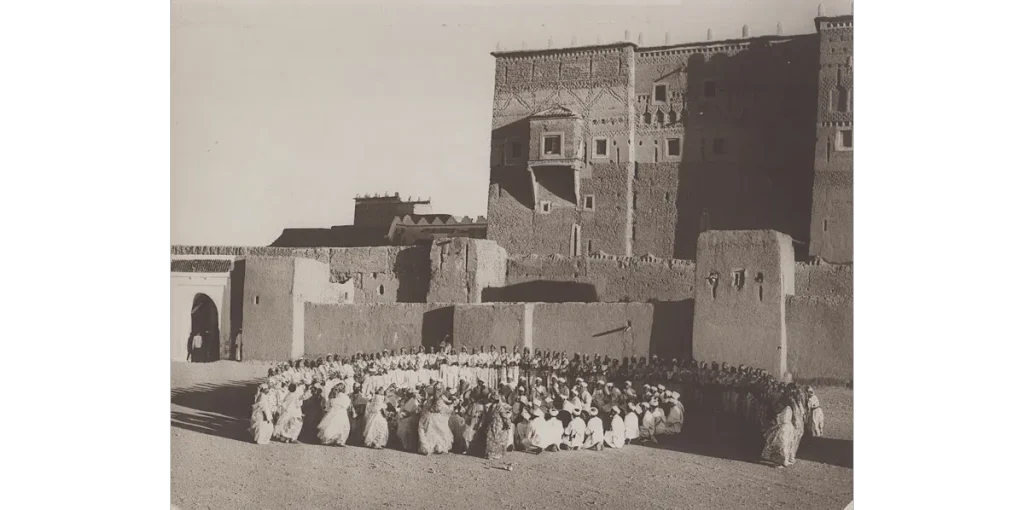
“… On entering by night the immense kasbah of the Glaoui, whose enormous façades and crenellated towers she could barely make out against the night sky, she had clearly noticed the preparations for a fire in the vast inner courtyard. Joined together in an immense circle, an almost motionless farandole, the women of the ksar are there in countless numbers, dressed in their finest attire. They uniformly wear a transparent gauze tunic over white, cream, pink, orange or pale-blue dresses, their heads wrapped in multicoloured scarves in the form of diadems and enhanced by a golden crown or a jewel, their braids entwined with coloured wool. This circle fills the entire perimeter of the patio. At the centre, the fire of constantly replenished palm fronds casts a bright glow into the dark night…
The orchestra occupies the main position beside the fire. Their legs folded beneath them, the musicians occasionally warm their tambourines over the flames or frenziedly shake the copper objects upon which they strike with all their strength. The regular rhythm, first in four beats, then in three, eventually works upon the nerves through its monotony. At times the tambourines crack like whips or burst like gunshots…
But now, to reinforce the orchestra, the circle of women has divided into two semicircles which take turns singing verses. The choruses alternate, answer one another, repeat the same theme or modify it by transposing it to a lower or higher pitch. One or another of the singers, overexcited or feeling capable of a solo, sometimes lets out a series of piercing cries that break the melancholy of the refrain and may express either weariness of life or the power of desire. Yet elbow to elbow, hip to hip, linked to one another by nothing more than the call of bodies drawn close together, the dancers never cease turning slowly, very slowly, swaying forwards and backwards in a rhythmic movement corresponding to the music and clapping their hands in time.
Most of them are black. Their raised hands against the pale dresses form patches of shadow. A few Berber women, bronzed or even almost white, stand out in brightness among their companions.
Then, as in a ballet, two stars detach themselves from the troupe, whose circle immediately reforms behind them. Exaggerating the movement slightly, they thrust one knee forward as though in a genuflection and thus move somewhat faster, better illuminated by the proximity of the fire, their heads held high, almost thrown back, their bearing proud, as though conscious of playing a more important role; and after completing their inner circuit, they return to their places, to be replaced a little later by others…”
Source : Henry Bordeaux, La Revenante, Plon, 1932. Roman.
Key points
- Ahwach combines collective dance, song, poetry and percussion within the Amazigh cultures of southern Morocco.
- It is not a single fixed form: rhythms, songs, movements, instruments and the composition of the groups vary from one territory to another.
- Poetry plays an essential role in Ahwach, whether through verbal contests, love, memory or criticism.
- Costumes, jewellery, instruments and gestures all form an integral part of the performance.
- In the Ouarzazate region, the great Glaoua kasbahs hosted particularly spectacular Ahwach performances in the early twentieth century, several of which were recorded by travellers of the period.
Explore Ahwach further
Poetry, collective memory, criticism and transmission: several SEM articles explore in greater depth the different dimensions of this Amazigh tradition.
Discover South-East Morocco