The rock art heritage of south-eastern Morocco
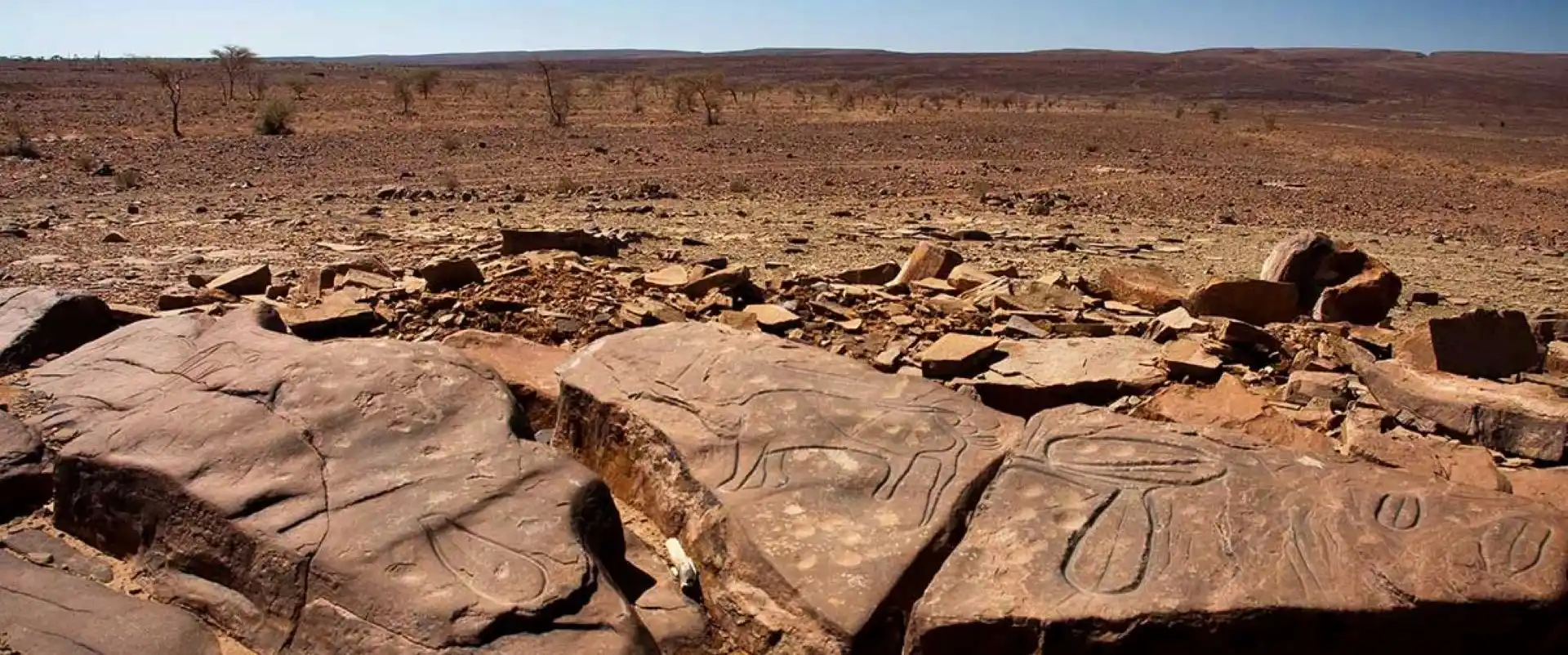
On the cliffs and stone slabs of the Drâa, Saghro and Tafilalet, thousands of figures bear witness to people who travelled through these lands long before the appearance of towns, ksour and kasbahs. Wild animals, herds, horsemen, weapons, chariots, geometric signs and inscriptions form an immense open-air heritage. From Foum Chenna to Aït Ouazik and Taouz, several of these sites can now be discovered by travellers, provided their fragility is fully respected.
Overview
- What is rock art?
- Dating rock engravings.
- The Drâa Valley, a major rock art region.
- Rock art sites to discover in south-eastern Morocco.
- What rock engravings reveal.
- Techniques used to create rock engravings.
- Other major rock art regions of Morocco.
- Protecting a fragile heritage.
What is rock art?
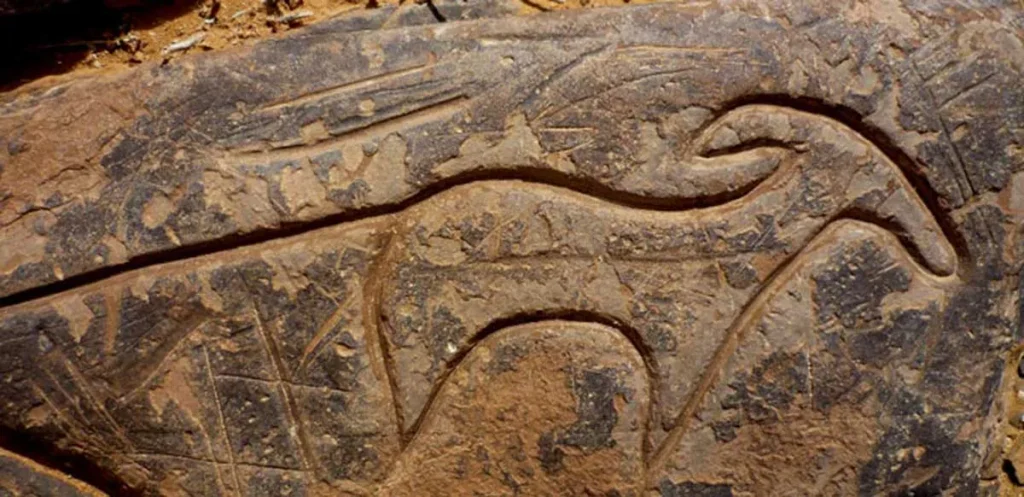
Rock art refers to representations made directly on rock, most often in the open air. In Morocco, these are mainly engravings produced by incision, pecking or polishing, although a few sites also contain paintings.
Several hundred rock art sites have been recorded across the country. Two major areas contain a large proportion of this heritage: the plateaux of the High Atlas and the pre-Saharan regions of southern Morocco. As early as 2020, the National Centre for Rock Art reported more than 500 known sites throughout the kingdom.
South-eastern Morocco contains some of the richest groups. They are particularly numerous along the Drâa Valley, around Tazzarine, on the foothills of Jbel Saghro and as far as the Tafilalet.
These engravings should not, however, be regarded as the pages of a story that we can now read with certainty. They tell us about the animals that were present, certain human activities, weapons and means of transport. The meaning of a scene, symbol or geometric motif, on the other hand, often remains difficult to establish.
Elephants, rhinoceroses, giraffes, antelopes, ostriches and bovids also remind us that the landscapes of southern Morocco once experienced climatic conditions very different from those of today. Taken together, these representations bear witness to long environmental and human transformations that unfolded over several millennia.
Dating rock engravings
Giving a precise age to an engraving made on rock exposed to the open air is particularly difficult.
Unlike an object discovered within an archaeological layer, engraved rock generally cannot be dated directly. Researchers therefore establish relative chronologies by comparing styles, engraving techniques, superimpositions, the animals depicted and certain objects whose periods of use are better known.
The patina that gradually forms over the surface of an engraving provides another clue. A very dark engraving may be older than a lighter figure carved over it, but the colour of the rock alone is never sufficient to assign a date.
Researchers therefore distinguish several broad stylistic groups. Some early engravings mainly depict wild fauna. Others reflect pastoral societies in which bovids become omnipresent. Later come horses, horsemen, weapons, chariots and Libyco-Berber inscriptions, followed by representations of the dromedary.
These categories make it possible to construct a chronology, but that chronology remains debated. In Moroccan rock art, there is still no absolute consensus regarding the date of the earliest manifestations.
It is therefore more accurate to speak of several millennia of rock art than to assign all the engravings to a single period.
The Drâa Valley, a major rock art region
Long before the palm groves, earthen villages and great kasbahs that characterise the Drâa Valley today, human groups were already moving through this region.
More than a hundred rock art sites have been documented along the Drâa and in the surrounding territories. The engravings are scattered across cliffs, sandstone outcrops and the rocky landforms bordering the valley.
The first scientific references to this rock art appeared at the end of the nineteenth century. Research became more systematic during the twentieth century, particularly through work carried out from the 1960s and 1970s onwards.
The sites reveal very different periods and ways of life: hunters, pastoralists, horsemen and populations already using writing successively left their traces on the same rocky surfaces.
The superimpositions can be particularly revealing. One figure may have been engraved over a much older representation, turning some rock faces into true palimpsests of stone.
Rock art sites to discover in south-eastern Morocco
Several important groups can be discovered by travellers. Their degree of accessibility, however, varies considerably. These are rarely developed tourist sites in the conventional sense: tracks, a lack of signage and the scattered nature of the engravings often make the company of a local guide advisable.
Foum Chenna, the major rock art site of the Drâa
West of Tinzouline, between Ouarzazate and Zagora, the valley of Foum Chenna contains one of the most impressive groups of rock engravings in the Drâa Valley.
Its entrance lies around seven kilometres from Tinzouline. The engravings are distributed along both sides of the valley, mainly on the rock faces overlooking the wadi.
During an initial survey carried out in the early 1950s, researchers counted around 3,000 figures spread over almost a kilometre.
Horsemen, horses, dromedaries, ostriches, antelopes, dogs and scenes of hunting or confrontation make up much of the imagery. Foum Chenna is also remarkable for its many Libyco-Berber inscriptions.
These characters belong to ancient forms of Amazigh writing, related to the writing systems from which Tifinagh, still used today, developed.
The presence of engravings with different patinas and the numerous superimpositions show that the site was visited and engraved during several different periods.
Visiting the site: Foum Chenna is reached by several kilometres of track from the Tinzouline area. The site continues to be included in local excursions. As track conditions can vary, it is best to enquire locally beforehand, while a guide is particularly useful for locating the main groups of engravings without wandering unnecessarily across the site.
Aït Ouazik, between Tazzarine and Jbel Saghro
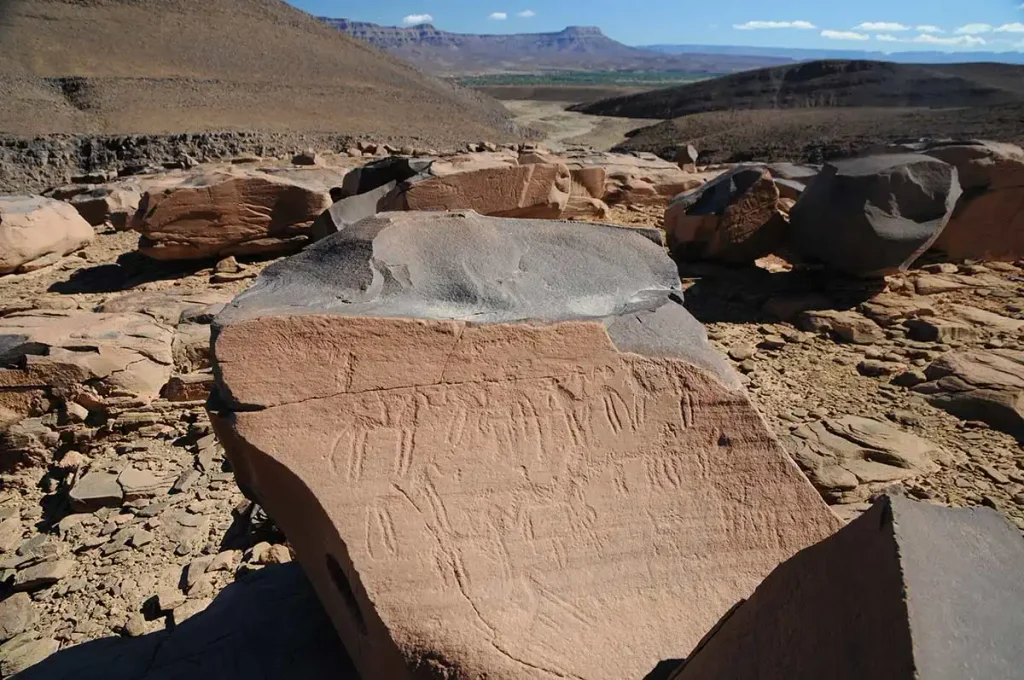
South-west of Tazzarine, Aït Ouazik is one of the most spectacular and accessible rock art sites in south-eastern Morocco.
In a landscape that is now mineral and arid, elephants, rhinoceroses, giraffes, antelopes, ostriches and other animals appear whose presence seems almost unreal in the environment of today.
Some of the engravings belong to the so-called Tazina style, recognisable in particular by the delicacy and elegance of certain animal representations. Other, later figures reflect changes in populations and ways of life.
The site also contains numerous geometric forms. Some have been interpreted as traps or devices connected with hunting, although their precise function remains debated.
The engravings of Aït Ouazik thus provide exceptional evidence of the long human and environmental history of the Tazzarine region.
Visiting the site: access is from the village along a track crossing a landscape of canyon and rocky plateaux. The site is still visited and local accompaniment is available. As with all rock art sites, the condition of the track should be checked locally before setting out.
Taouz, the engravings of the Tafilalet
At the other end of south-eastern Morocco, beyond Merzouga, the Taouz area also possesses a remarkable rock art heritage.
Several sites are scattered around Jbel Ouafilal and the valley of the Oued Ziz. They were already being studied during the first half of the twentieth century.
Animals, human figures, geometric motifs and Libyco-Berber inscriptions can be seen here, along with several schematic representations of two-wheeled chariots.
These chariots are among the most distinctive motifs of the area. Their presence is a reminder that, as early as protohistory, the Tafilalet formed part of vast zones of movement linking the Sahara and North Africa.
The rock art heritage is not confined to the immediate surroundings of Taouz. At Jdaïd, farther south, other engravings appear close to the remains of an ancient settlement and funerary monuments.
Visiting the site: the Taouz sites are far more scattered than those of Aït Ouazik or Foum Chenna, and signage remains limited. Some excursions offered from Merzouga include visits to them, but a guide who knows their precise locations is strongly recommended.
Msemrir and the mysterious “wall of discs”
Farther north, in the upper Dadès Valley, the surroundings of Msemrir contain a very different group of rock art.
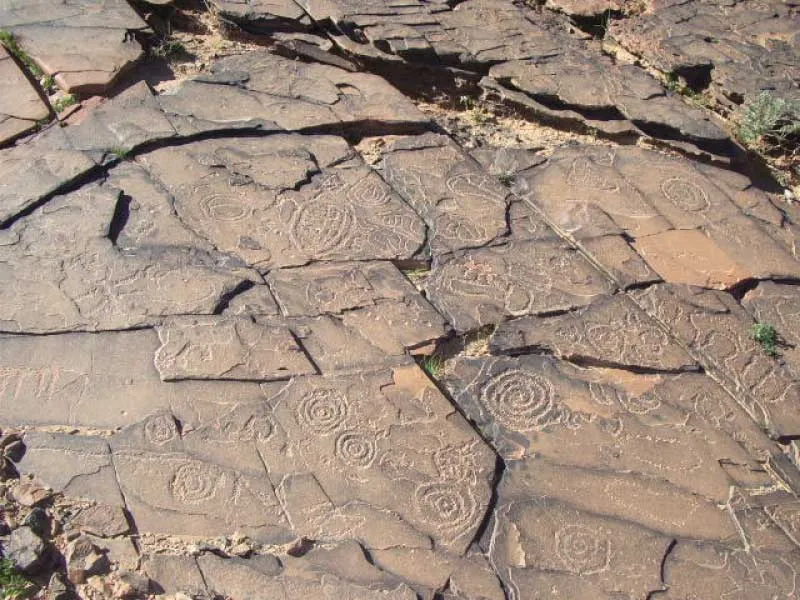
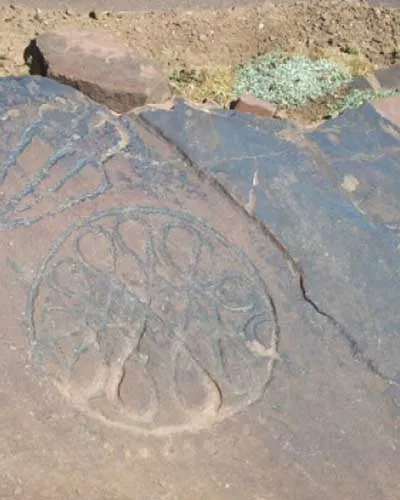
A large rock face in the Oussikis area bears several dozen circular motifs, sometimes described as “discs”, together with Libyco-Berber inscriptions.
This site is far less familiar to travellers than Foum Chenna or Aït Ouazik. It nevertheless reminds us that the rock art of the South-East is not confined to the desert regions of the Drâa and Tafilalet, but extends into the valleys of the eastern High Atlas.
It is more a site for research and specialist discovery than a developed tourist attraction. Before attempting to reach it, it is best to enquire locally about access and current conditions.
What rock engravings reveal
The first great richness of rock art lies in its extraordinary bestiary.
Elephants, rhinoceroses, giraffes, antelopes, felines, ostriches and cattle appear on the rocks of southern Morocco. These animals did not necessarily all live there at the same time, but their presence reveals the profound climatic and ecological variations experienced by the Sahara during the Holocene.
The evolution of the representations also accompanies changes within human societies.
Wild fauna dominates some of the earlier groups. Herds of cattle then become particularly important. Later appear horses and horsemen, dogs, weapons, chariots, scenes of confrontation and, finally, dromedaries.
Human figures are sometimes extremely schematic. Elsewhere they carry shields, spears or other weapons that allow comparisons to be made with known archaeological objects.
Finally, Libyco-Berber inscriptions mark a major change: the image no longer stands alone. Written signs begin to accompany people and animals.
These engravings therefore bear witness less to a single civilisation than to different populations who travelled through the same territories over thousands of years.
Source: prehistoire-du-maroc.com
Techniques used to create rock engravings
Several techniques could be used, sometimes on the same figure.
Pecking involves repeatedly striking the surface of the rock to create a succession of small hollows. The resulting line is generally irregular.
Incision, by contrast, allows a line to be cut directly into the surface of the rock.
Polishing involves repeatedly rubbing the line in order to deepen and smooth it. Some engravings therefore display particularly clean and regular grooves.
Over time, the surface of the rock changes. A patina or natural varnish may gradually cover the engraved areas. The study of these transformations, together with the techniques used, superimpositions and subjects represented, helps researchers establish the relative order in which the different figures were created.
Other major rock art regions of Morocco
The South-East is only one part of a heritage spread across much of Morocco.
In the High Atlas, Oukaïmeden and the Yagour plateau form two major groups. At Oukaïmeden, the engravings are distributed across several sites. Igountar, also known as Tifina, lies around three kilometres from the present-day resort and is considered the richest site in the area. Weapons, human figures, bovids and geometric motifs can be seen there.
The Yagour also contains particularly dense groups of engravings associated with the high pastures of the massif.
Farther south-west, the province of Tata likewise contains an exceptional number of rock art sites. Imaoun, Tiggane, Oum La Leg, Adrar Metgourine and Assif Tadakoust all bear witness to this richness.
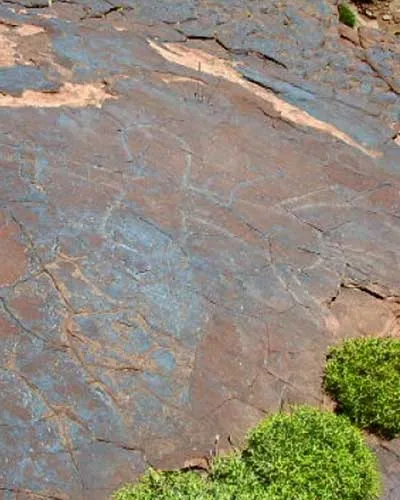
At Assif Tadakoust, near Aït Ouabelli, more than two hundred engraved slabs lie alongside funerary monuments. The site is now included in projects to enhance and promote the rock art heritage of the province of Tata.
This diversity shows that there is no single, homogeneous Moroccan rock art tradition, but rather a multitude of traditions, periods and territories connected by long histories of human movement.
Source: prehistoire-du-maroc.com
Protecting a fragile heritage
A rock engraving cannot be restored in the same way as a building.
Once a line has been hammered, scratched or covered over, part of the archaeological information is permanently lost. Natural erosion acts slowly on the surfaces, but human visitation can accelerate their deterioration in a matter of moments.
In Morocco, sites, inscriptions and antiquities are protected in particular by Law No. 22-80 concerning the conservation of historic monuments and sites, inscriptions, works of art and antiquities.
The National Centre for Rock Art, established in Agadir in 1994, contributes to the inventory, study and protection of this heritage.
Preservation also depends on the behaviour of every visitor. An engraving should never be traced over with chalk, wetted to enhance its contrast, rubbed, moulded, moved if it is on a loose stone, or altered by adding a new line.
Photography and observation are enough.
The fragility of these works is also part of their singular character. Unlike objects displayed behind glass in a museum, they remain within the landscapes in which they were created, sometimes several thousand years ago.
In the silence of a Drâa valley or on a plateau of the Tafilalet, this direct relationship between stone, landscape and time is perhaps the best way to understand the value of the rock art heritage of south-eastern Morocco.
Key points
- Morocco has several hundred rock art sites, concentrated mainly in the High Atlas and the pre-Saharan regions.
- South-eastern Morocco contains major groups in the Drâa Valley, around Tazzarine, in the Saghro and the Tafilalet.
- Foum Chenna, Aït Ouazik and Taouz are among the principal sites that can be visited by travellers, although accessibility and signage vary.
- The engravings were produced at very different periods. Dating relies on several types of evidence — styles, techniques, superimpositions, animals, depicted objects and patina — and some chronologies remain debated.
- Wild animals, herds, horsemen, chariots and Libyco-Berber inscriptions reflect changes in climate, populations and ways of life over several millennia.
- This open-air heritage is extremely fragile: no engraving should ever be touched, wetted, traced over or altered.
Use our contact form.
We will be happy to answer your questions.
More to Explore

Discover South-East Morocco