


Why do Tuareg men veil their faces, while women do not?
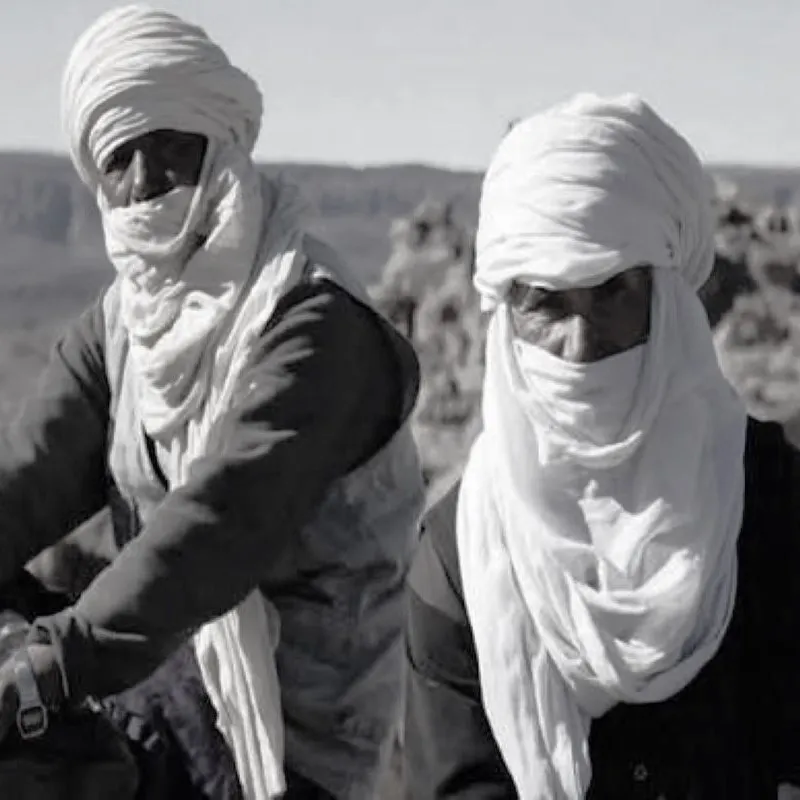
Among the Tuareg, the facial veil known as the tagelmust traditionally belongs to men. Women, by contrast, leave their faces uncovered. The Saharan climate explains part of this practice, but certainly not its essence. The tagelmust is also a sign of age, restraint, respect and belonging to an Amazigh society whose codes differ markedly from those of the northern Maghreb.
Who are the Tuareg, these Amazigh people of the Sahara?
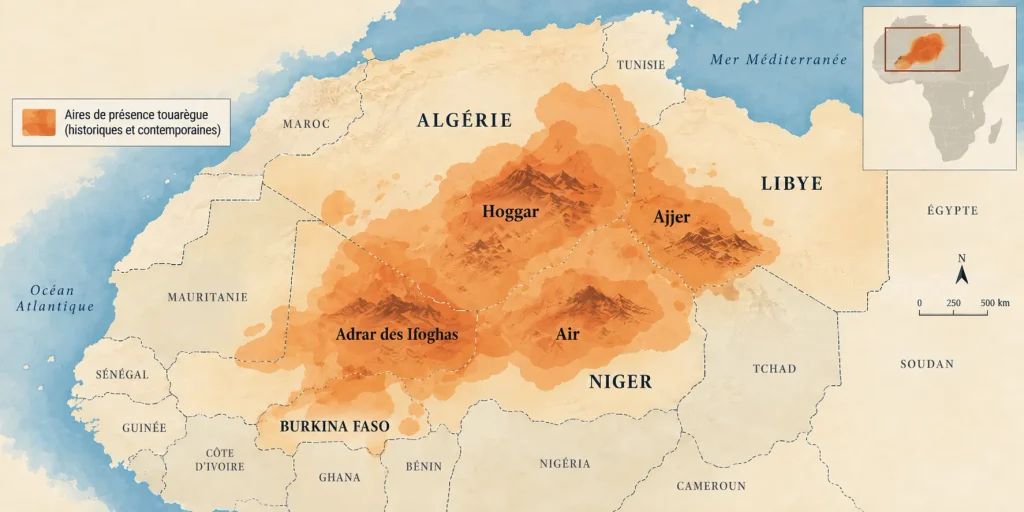
The Tuareg belong to the wider Amazigh world, but their historic territory lies beyond Morocco, across the central Sahara and the Sahel. They are not a single tribe, but a collection of groups and confederations established notably in the Hoggar and Tassili n’Ajjer, the Aïr, the Adrar des Ifoghas and the Sahelian regions that now extend across Algeria, Libya, Niger, Mali and Burkina Faso. Their territory, long structured around pastoral routes, confederation territories and caravan trails, was later divided by colonial boundaries and then by the borders of modern states.
In the West, the Tuareg have often been nicknamed the “Blue Men”, a reference to indigo-dyed cloth whose colour could stain the skin. The expression, widely popularised by travel writing and the imagery of the Sahara, is not exclusive to them, however: it has also been applied to other nomadic peoples of the desert.
Their languages — Tamasheq, Tamajaq or Tamahaq depending on the region — belong to the Berber language family. The Tuareg have also preserved the use of Tifinagh in forms particular to their own culture. For centuries, pastoral mobility and participation in trans-Saharan trade shaped a society adapted to movement across immense territories.
Another characteristic has long attracted the attention of ethnologists: among many Tuareg groups, traditional descent is matrilineal. A child belongs to the mother’s lineage, and the tent itself is traditionally a woman’s possession, passed down through the maternal line. This does not mean, however, that Tuareg society is a matriarchy: descent, property, family authority and the exercise of power are not the same thing.
And it is within this Muslim society, with its own distinctive codes, that we encounter an inversion that often surprises outsiders: it is the men who conceal their faces.
Read more: Tifinagh: from stone to digital, the living alphabet of the Amazigh world
The tagelmust, a veil marking entry into the world of men
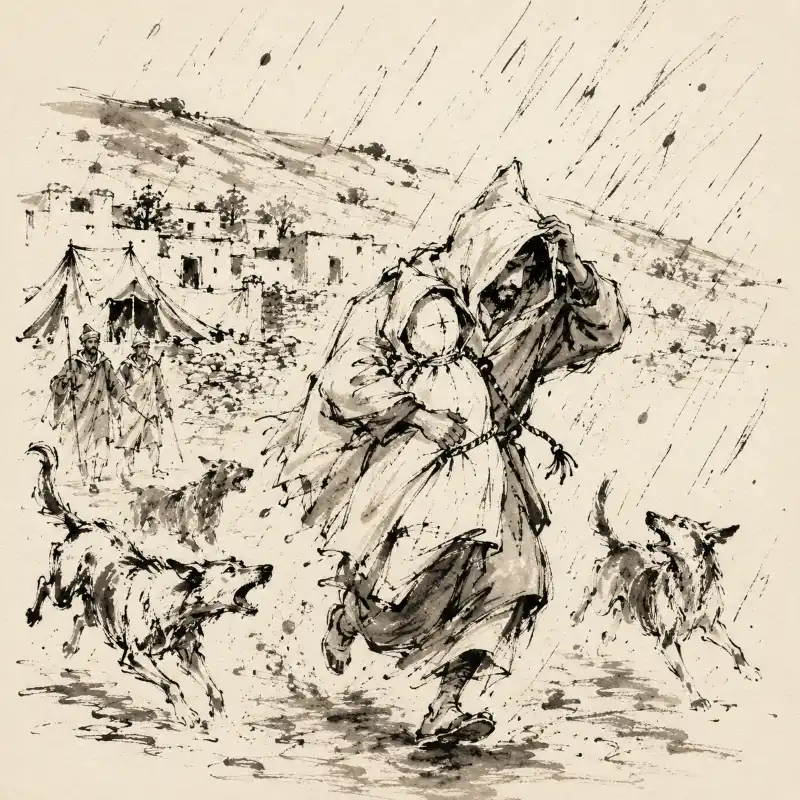
The tagelmust is both turban and facial veil. Wrapped around the head, it may leave only a narrow opening around the eyes. In ethnographic descriptions of the Hoggar, a young man traditionally begins wearing it as he approaches adulthood: putting on the veil for the first time can itself mark the transition to adult manhood.
Women may cover their heads with cloth, but their faces remain uncovered.
Its importance is such that some Tuareg have referred to themselves as Kel Tagelmust, “those of the veil”. The garment therefore became far more than protection from the desert: it became a sign of Tuareg male identity itself.
The word belongs to an ancient Berber lexical family. Tagelmust — ⵜⴳⵍⵎⵙⵜ — is related to agelmus, a word used in several Atlas dialects for a hood. From Morocco to the Sahara, the same root, GLMS, thus refers to something that covers or wraps the head.
Sand and sun do not explain everything
The most obvious explanation appears to be the desert itself. The cloth does indeed protect against the sun, wind, sand and drying effects of the desert air. Yet ethnologists have long pointed out the weakness of a purely climatic explanation: why would women living beneath the same sun not cover their faces as well?
Anthropologist Jeremy Keenan, who studied the Kel Ahaggar during the 1960s and 1970s, noted that men might keep their veil on in camp, in the presence of others, and even in situations where protection from sand made little sense. The precise origin of the custom remains uncertain despite its antiquity.
The explanation must therefore be sought elsewhere.
Veiling the face as a sign of restraint
Among the Tuareg, the male veil forms part of a social language of modesty, reserve and respect.
Its position may itself change according to the person being addressed. Geographer Edmond Bernus observed that a young man might leave more of his face visible among companions, then immediately raise his veil in front of someone to whom he owed deference. Other studies have noted this particular restraint in the presence of elders, strangers or relatives by marriage, especially a mother-in-law.
A covered face therefore does not simply say: “I am protecting myself.” It may also say: “I know how to keep the proper distance between myself and another person.”
The Smithsonian Institution summarises this dimension by associating the male veil and women’s head coverings with a broader Tuareg value of reserve, linked to a person’s status and to the different stages of life.
So why do women not veil their faces?
This is perhaps where the subject becomes most interesting.
The answer is not that Tuareg women are subject to fewer rules of modesty. Those rules are simply expressed through different signs. In the traditional system, the facial veil became an attribute of the adult man: it marks his restraint, his status and the way he enters into relationships with others.
The important place occupied by women within Tuareg kinship systems, and their often matrilineal character, makes this reversal particularly striking. It would, however, be unwise to turn this directly into the “cause” of the male veil. Ethnologists themselves have never established a single, certain origin for the custom.
Ultimately, the tagelmust reveals something more interesting than a simple exception in dress. The same idea — modesty — can be inscribed very differently upon bodies and clothing from one society to another. Among the Tuareg, it is traditionally the face of the adult man that the cloth invites to remain partly withdrawn.
Sources
- Jeremy H. Keenan, “The Tuareg Veil”, Revue de l’Occident musulman et de la Méditerranée, 1974.
- Edmond Bernus, “Incongruités et mauvaises paroles touarègues”, Journal de la Société des Africanistes, 1972.
- Hélène Claudot-Hawad, “Nomadisme chez les Touaregs”, Encyclopédie berbère, 2012.
- Hélène Claudot-Hawad, “Peau (en touareg)”, Encyclopédie berbère, 2015.
- Corinne Cauvin-Verner, “Les Hommes bleus du Sahara, ou l’autochtonie globalisée”, Civilisations, 2008.
Explore all features in: The Berber world
Share your knowledge of the Amazigh world
More fragments from the Berber world

Leave a Reply