


Yaz, the Amazigh sign of the free man
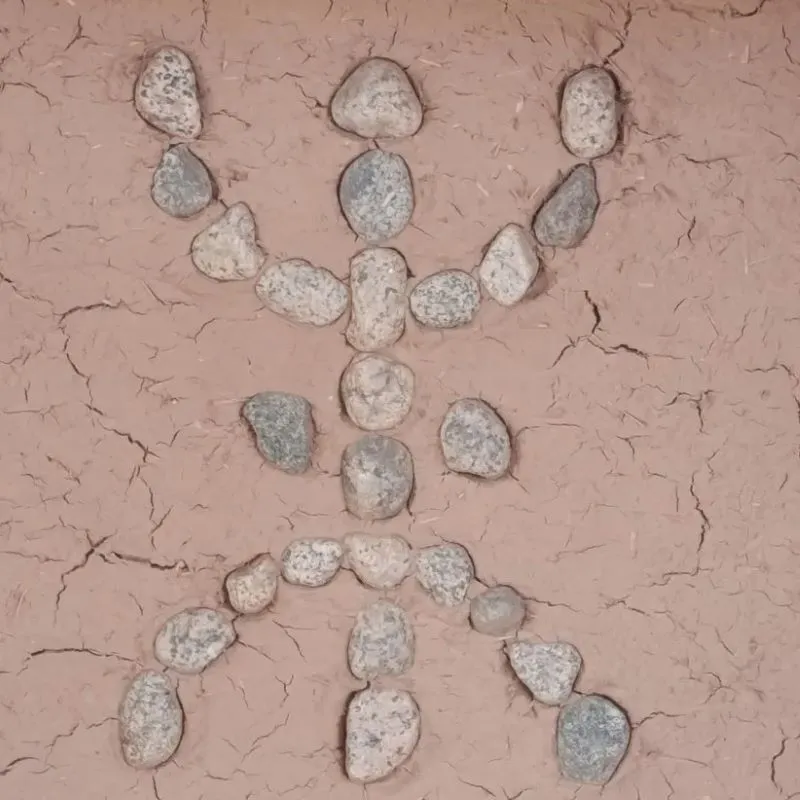
It takes only a few stones set into an earthen wall: a vertical line, two arms and two legs spread open. The ⵣ, or yaz, is first and foremost a letter of the Tifinagh alphabet. But it has become much more than that: the silhouette of a man standing upright, a sign of freedom and resistance, and undoubtedly today one of the most immediately recognisable symbols of the Amazigh world.
First, a letter
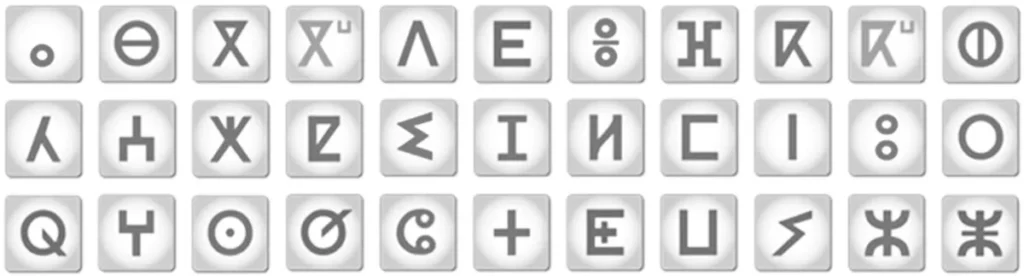
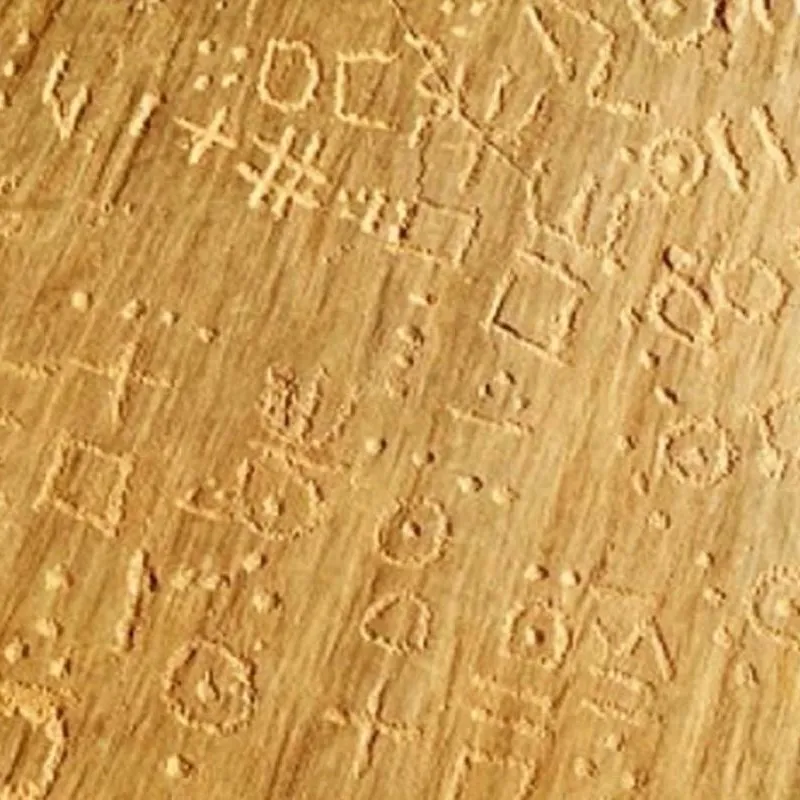
Tifinagh itself belongs to a much older history. The so-called Libyco-Berber scripts are attested in North Africa from Antiquity and are generally considered to be the ancestors of present-day forms of Tifinagh, although their exact origins remain debated. While their use gradually disappeared across much of northern Africa, the Tuareg preserved a living tradition of the script in the Sahara.
In the twentieth century, with the Amazigh cultural revival, these characters once again emerged from the realm of ancient inscriptions or Tuareg usage. Neo-Tifinagh became a reclaimed script, then modernised and standardised. In Morocco, Tifinagh was officially adopted in 2003 as the script for the Amazigh language.
Read also: The Tifinagh, the Berber singularity engraved in time
A man rises within the letter
And yet, one only has to look at the ⵣ for another reading to appear.
A vertical axis forms the body. Two lines open upwards like arms. Two others spread towards the ground like legs. A man is standing.
It is this resemblance that gives the yaz its symbolic power. The man depicted does not bow; he occupies the space, his feet on the earth and his arms open. The sign can then become the image of the free human being, of the one who remains standing, master of himself and attached to his land.
But the history of the script must be distinguished from that of the symbol: there is no evidence that those who carved the ancient Libyco-Berber inscriptions already gave the corresponding sign this meaning of ‘free man’. The anthropomorphic interpretation belongs above all to the contemporary cultural reappropriation of Tifinagh.
From a written character to an Amazigh emblem
From the 1960s, and especially the 1970s, movements for Berber cultural revival made Tifinagh one of the signs of a reclaimed identity. Around the Berber Academy, founded in Paris, ancient characters were taken up and adapted into what would come to be known as Neo-Tifinagh. The ⵣ gradually acquired a particular status: from a simple letter, it became an emblem.
The transformation was completed when the yaz appeared at the centre of the Amazigh flag, adopted in 1997 by the World Amazigh Congress. Its three horizontal bands evoke the great landscapes of the Amazigh world: blue for the sea and sky, green for the mountains and fertile lands, yellow for the Sahara. At the centre, the red ⵣ represents the free human being standing upright; red is generally associated with life, resistance and the bond uniting the Imazighen across these different territories.
A letter of the alphabet thus became capable of linking populations scattered from the Canary Islands to the Siwa Oasis, from the mountains of Morocco to the Tuareg territories of the Sahara.
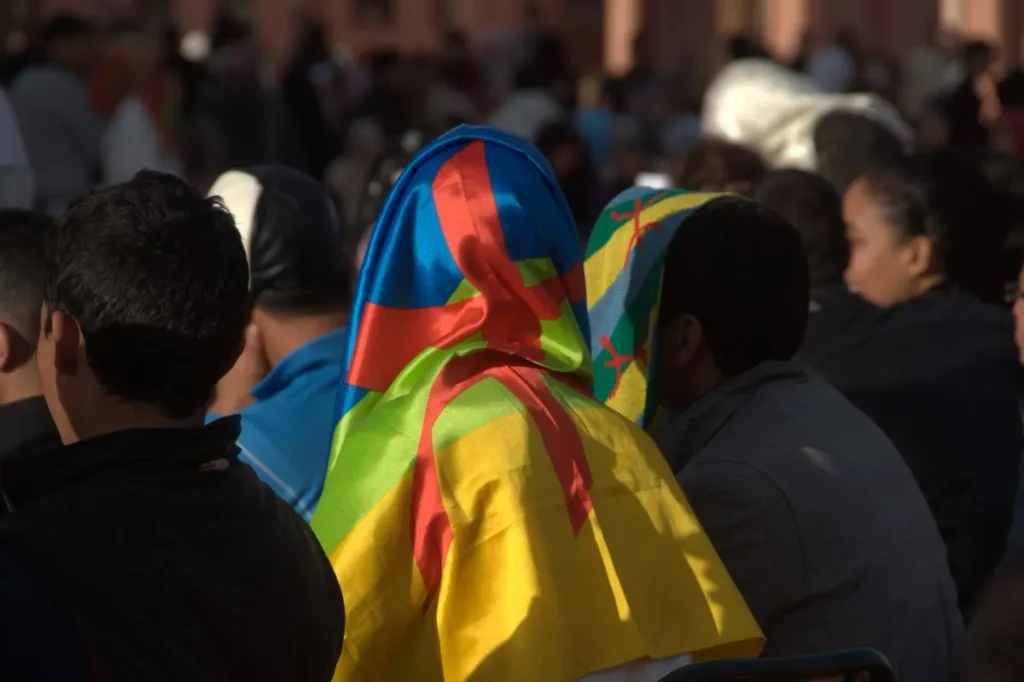
‘Free man’: a symbolic truth more than an etymology
Almost everywhere, one reads that Amazigh literally means ‘free man’. The expression is beautiful, and today it is inseparable from the ⵣ symbol. Historically, however, things are more complex.
The linguist Salem Chaker points out that the etymology of the word Amazigh remains uncertain. The ancient root from which this ethnonym may derive no longer exists as a living word in present-day Amazigh languages. Meanings such as ‘free’ or ‘noble’ did indeed exist in certain Berber societies, particularly where they served to distinguish groups of different social status, but nothing proves that this was the original meaning of the word. The interpretation is an old one — it appears notably in Leo Africanus — but it cannot be regarded as an established etymology.
None of this diminishes the power of the symbol. Perhaps even the opposite.
The ⵣ does not necessarily transmit to us, intact, the meaning that people may have given it two thousand years ago. It also tells us what modern Imazighen have chosen to make of a script inherited from their history. They recognised a human silhouette in this letter, then a standing man in that silhouette, and in that standing man a way of expressing freedom.
On a flag, a piece of jewellery, a façade or simply in a few stones taken from the earth of a wall, the yaz has thus become much more than a ‘z’.
A letter that became a body.
Read also: Berber or Amazigh: the origin of a word and the history of a name
Explore all features in: The Berber world
Share your knowledge of the Amazigh world
More fragments from the Berber world

Leave a Reply