The art of Berber rugs
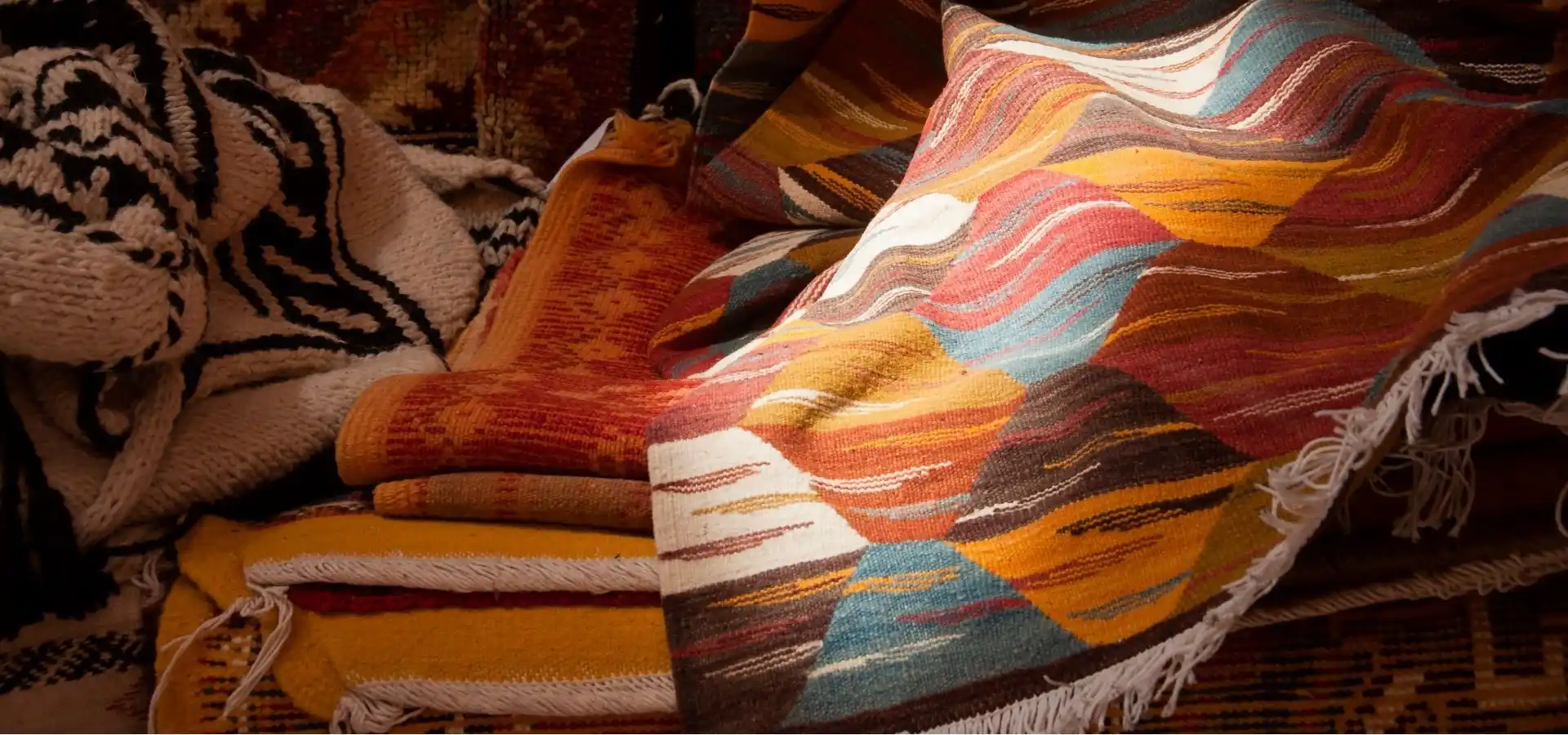
Far more than a decorative object, the Amazigh rug has accompanied the daily life of Moroccan families for generations: it provides warmth, furnishes homes, accompanies ceremonies and sometimes carries the memory of a territory or a lineage. Woven mainly by women, it is also a body of knowledge, a language of forms and colours, and a living heritage that continues to evolve.
From the Atlantic plains to the mountains of the High Atlas, each region has developed its own techniques, materials and visual repertories. This article offers an introduction to this textile world before focusing on one of the most remarkable traditions of southern Morocco: that of the weavers of the Siroua and the Aït Ouaouzguite.
Overview
- Rugs: a story as old as time.
- Two major rug-making traditions in Morocco.
- Rugs from the Amazigh territories.
- The rugs of Amazigh women.
- From wool to the loom.
- Knotted, flat-woven, hanbel or Glaoua: understanding the techniques.
- Jebel Siroua and the rugs of the Aït Ouaouzguite.
- Colours and dyes.
- A geometry reflecting the Amazigh world.
- Rites and beliefs surrounding the loom.
- A living heritage in transformation.
Rugs: a story as old as time
The rug has long been an essential part of human life. The use of wool goes back several millennia. The oldest knotted carpet discovered to date is the famous Pazyryk carpet, found frozen in a burial mound in the Altai Mountains of Siberia and dated to the 5th century BC. Its remarkable degree of sophistication suggests, however, that it already belonged to a much older textile tradition.
Utilitarian before it became decorative, the rug has long accompanied human societies: it protects against the cold, insulates from the ground, helps organise domestic space and sometimes accompanies the movements of pastoral or nomadic populations.
Over time, this woollen floor covering became an everyday object while also carrying the cultural singularities of those who created it. In Morocco, both in the imperial cities and in the Amazigh territories of the mountains and plateaux, rug weaving developed into an art in its own right, alongside the great textile traditions of Europe, Persia and Asia.
In Morocco, the Arabic word zarbia and the Amazigh term tazerbyt are commonly used for rugs or carpets. The word qtifa is also found, particularly for thick, high-pile rugs woven in some mountainous regions.
Two major rug-making traditions in Morocco
In Morocco, the art of rug making developed through several traditions.
Major urban centres such as Rabat, Fez and Médiouna saw the emergence of workshops influenced by the decorative arts of the Mediterranean and the East, heirs to centuries of circulation between the Maghreb, Al-Andalus and the Middle East. Their compositions are often more symmetrical, more codified and more closely linked to urban workshop traditions.
Alongside these urban productions, another tradition developed in the Amazigh territories of the Middle Atlas, High Atlas, Anti-Atlas and the plateaux of southern Morocco. Produced within the home, these rugs first met the needs of everyday life before becoming objects of exchange and, later, commerce.
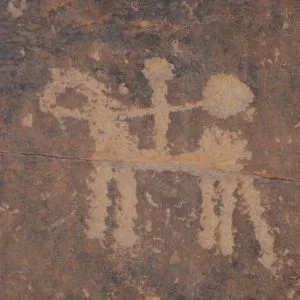
Some researchers have drawn comparisons between the geometric forms found on Amazigh rugs and motifs present in North African rock art. Such correspondences are difficult to interpret as evidence of direct historical continuity over several millennia, but they do evoke the depth of the cultural landscapes within which these traditions developed.
Rugs from the Amazigh territories
Weaving, sometimes referred to as azetta, is above all a traditional rural art practised by the women of nomadic or semi-nomadic peoples. It is therefore, quite naturally, an art of the Berber tribes. Belonging to one of the three great Berber groupings — the Masmuda, Zenata and Sanhaja — each tribe developed, through its history and migrations, its own aesthetic and technical style of rug weaving.
More than a utilitarian craft, weaving thus became a standard-bearer for the name of each of these tribes, expressing their respective qualities: simplicity, rusticity and restraint, but also a liveliness marked by good humour and an almost naïve melancholy.
The Berber rug is therefore an echo of the territories that received these tribes, gradually becoming, and particularly since their sedentarisation, a setting for their identity.
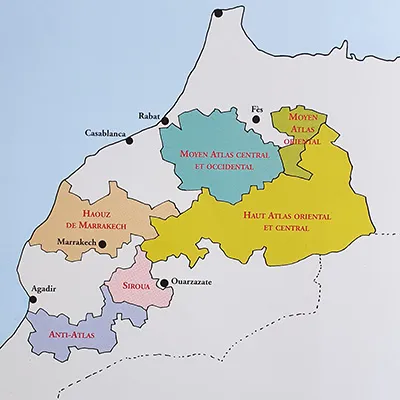
The art of Amazigh rug weaving differs across the Moroccan territories surrounding the Atlas ranges:
- Rugs of the Middle Atlas and the Meknes–Rabat region: Zemmour, Zaer, Zayane, Beni M’Tir, Aït Sgougou, Beni Mguild and other traditions.
- Beni Ouarain rugs from the Middle Atlas, often large white rugs decorated with fine black or brown geometric motifs.
- Rugs of the High Atlas and Jebel Siroua.
- Rugs of the Anti-Atlas.
- Rugs of the Haouz around Marrakesh, produced by rural groups such as the Rehamna, Hmar, Oulad Bousbaa, Ahmar and Chiadma.
Each territory has its own materials, formats, densities and colour preferences.
Read also: Tifinagh: from stone to digital, the living alphabet of the Amazigh world
The rugs of Amazigh women
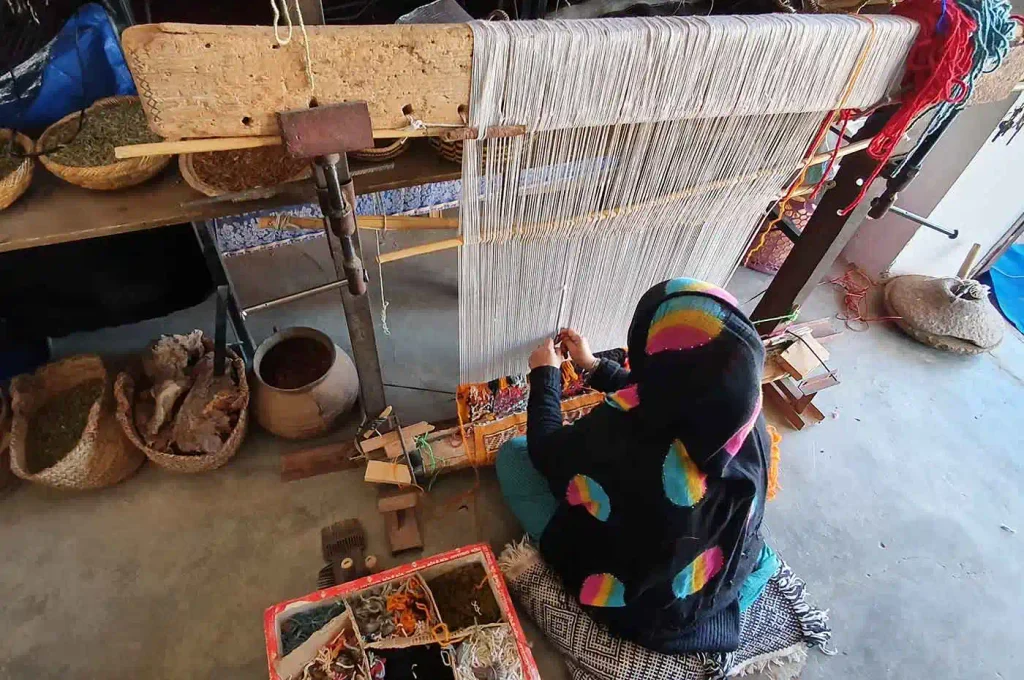
Weaving is above all a body of knowledge held by women, particularly those living in the countryside and mountains of the Atlas. From mother to daughter, techniques for preparing wool, dyeing and weaving are passed on together with decorative repertories in which enigmatic abstract geometry may mingle with Tifinagh signs and representations inspired by daily life, animals, birds or camels.
Rug weaving remains a vital activity for many rural or pastoral families, for whom it can provide an important source of income. The loom often occupies a central place in the home and accompanies the major stages of family life.
The rug is therefore an essential household object: it provides warmth, serves as bedding, defines living spaces, may form part of a dowry and can also represent a reserve of value for the family.
From wool to the loom
Before becoming a rug, wool passes through many stages.
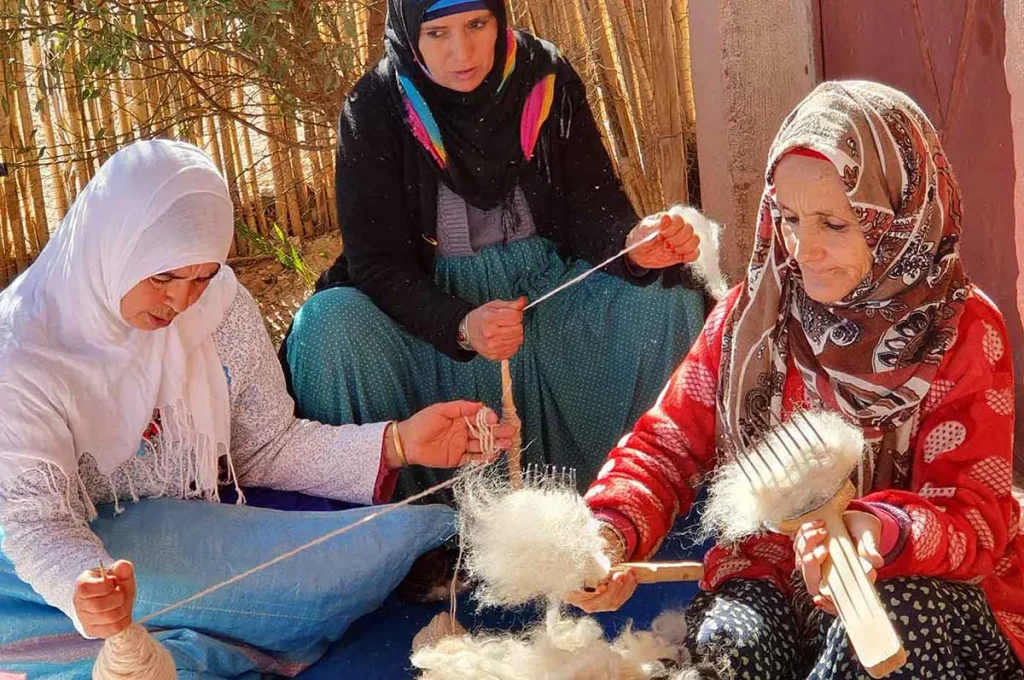
After the sheep are shorn, the wool is washed and dried. It is then carded to align the fibres before being spun, traditionally with a spindle.
The yarn can then be left in its natural colour or dyed using plant and mineral pigments, or, more recently, synthetic dyes.
Warping then prepares the structure of the rug on the loom before knotting or weaving itself begins.
A large rug can therefore require several months of work, depending on its size, density and complexity.
Knotted, flat-woven, hanbel or Glaoua: understanding the techniques
Not all Moroccan rugs are made using the same technique.
Knotted rugs have a thick pile created by knots tied around the warp threads.
Hanbels are flat weaves without pile, lighter and often more flexible.
In parts of the High Atlas and Siroua, mixed techniques are also used, combining flat weaving, knotting and decorative cord work. The rugs commonly known as Glaoua are among the best-known examples.
Jebel Siroua and the rugs of the Aït Ouaouzguite
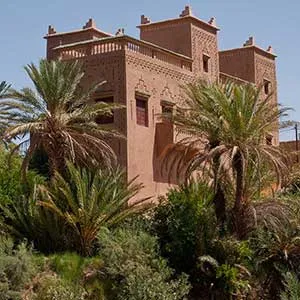
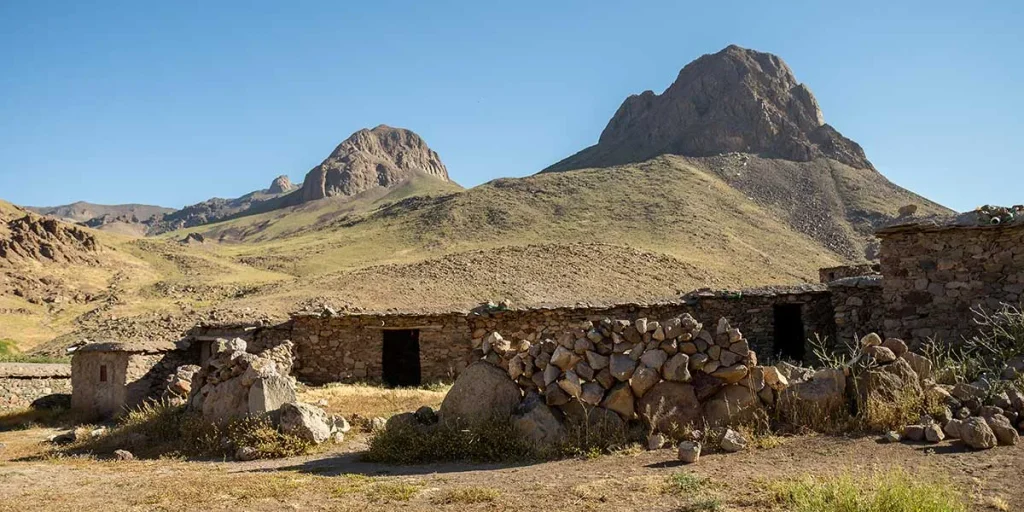
Between Tazenakhte and Taliouine, around 85 km south of Ouarzazate, lies one of Morocco’s major centres of Amazigh rug production. This is the territory of the Aït Ouaouzguite confederation, bringing together Amazigh communities of the High Atlas and Jebel Siroua.
Once partly nomadic, these communities have long since become settled while maintaining an important pastoral tradition.
Emblematic of the High Atlas, Aït Ouaouzguite rugs have long been appreciated for their suppleness and lightness, linked to the quality of the wool, but also for the richness of their colours and the dyeing skills preserved by local weavers. They often have an elongated form corresponding to the dimensions of the rooms for which they were intended.
Read also: The Tazenakhte rug: tradition, art and beauty
Aït Ouaouzguite rugs are characterised by an extensive decorative repertory incorporating numerous motifs and symbols.
The name Glaoua is also associated with a particular textile tradition of this region and refers to the Glaoua territory of the High Atlas, historically dominated by the powerful El Glaoui caïds until Moroccan independence. Some of these textiles combine geometric compositions with decorative forms also encountered more broadly in the architecture and material culture of southern Morocco.
Ouaouzguite rugs can be distinguished according to the weaving technique used.
- The tazerbit uses symmetrical knots tied around two warp threads.
- The High Atlas Glaoua rug combines three techniques: knotting, flat weaving and decorative cord work.
- The zanifi are flat tapestry weaves incorporating cord work and were once also used for carrying grain.
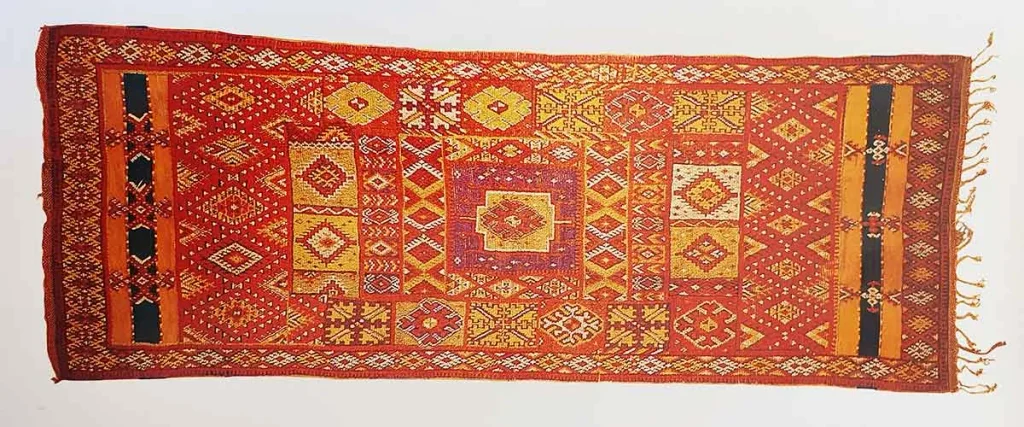
H. Crouzet Collection – Source: Maroc, Tapis des tribus, Edisud
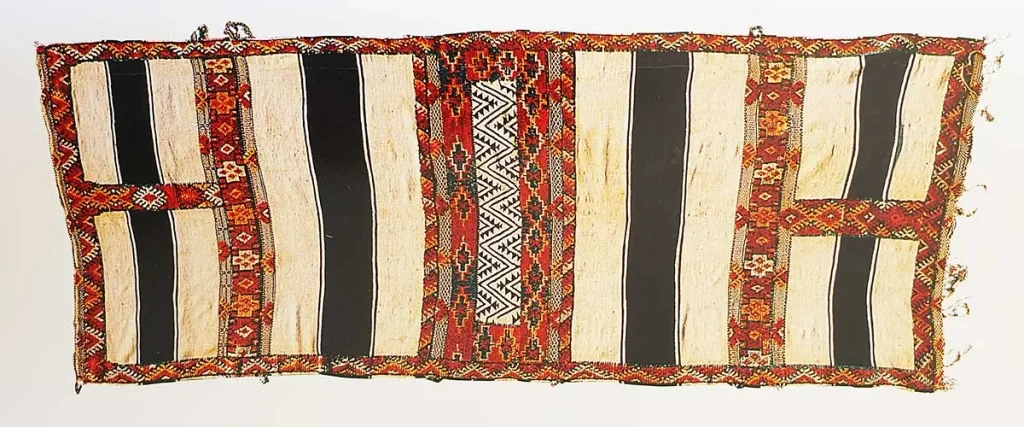
H. Crouzet Collection – Source: Maroc, Tapis des tribus, Edisud
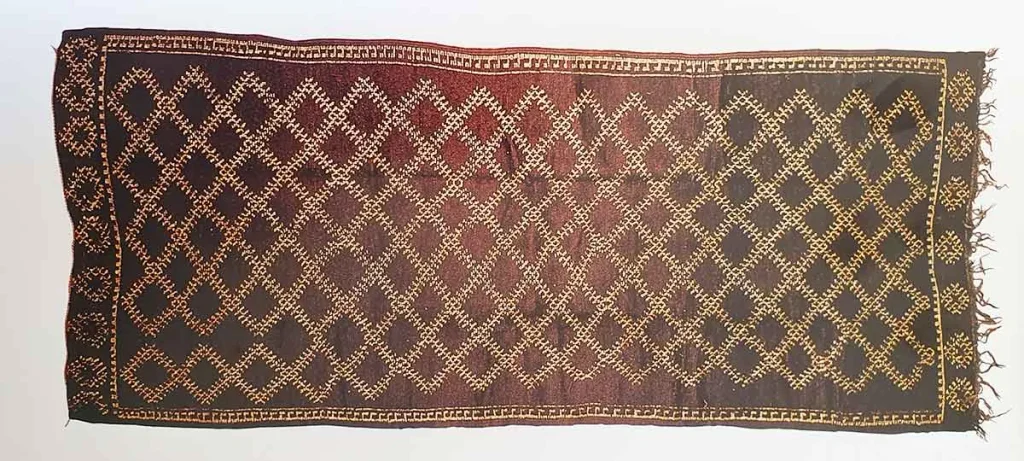
H. Crouzet Collection – Source: Maroc, Tapis des tribus, Edisud
Colours and dyes
Traditionally, Amazigh women dyed the wool themselves using plant and mineral substances. In some local traditions, the woman carrying out the dyeing would first purify herself by taking a ritual bath.
Blue was obtained from indigo, known locally as nila.
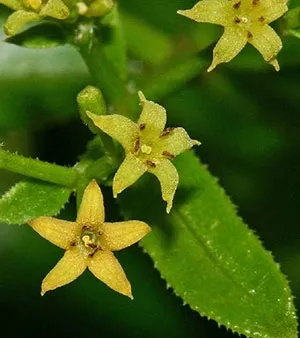
Yellow was obtained from a type of broom known as achfoud, which grows wild throughout the Siroua massif. Its yellow flowers were gathered and dried in the sun before being used as dye. A mordant was required to fix the colour to the wool fibres: alum, locally known as azarif, a mineral also found in the Siroua.
Red was obtained from madder, known locally as taroubia, which grows wild in the region. Its roots were collected and dried in the sun before being used as dye. Alum was again employed as a mordant.
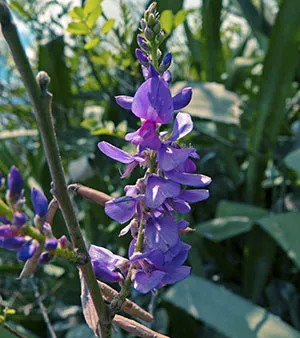
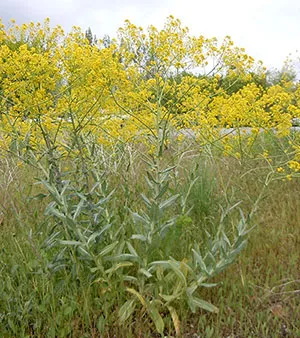
Other substances were used in preparing dye recipes. Henna, cultivated in the Drâa Valley, was frequently employed, as were powdered apple-tree bark, dried date pulp, turnip, dried fig, forge slag, soot and slaked lime.
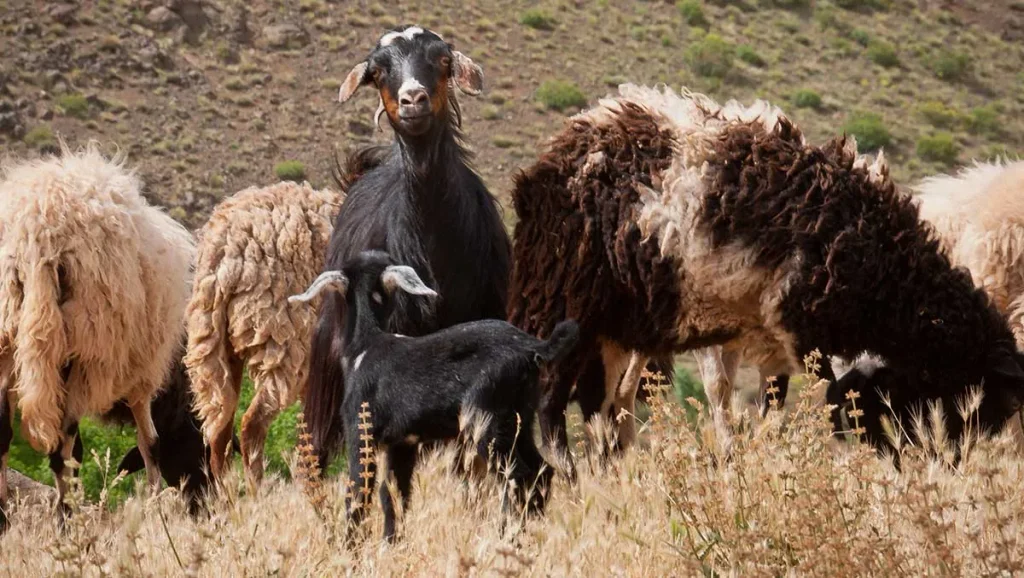
The reputation of Siroua rugs owes as much to the skill of the weavers as to the quality of the local wool: long, strong fibres particularly suited to natural dyes, together with a spontaneous palette of whites, creams, greys and browns that has long contributed to the visual identity of the region’s textiles.
For several decades, synthetic dyes have become widely incorporated into these traditional practices, sometimes profoundly changing older colour palettes.
A geometry reflecting the Amazigh world
The decorative repertory of Amazigh rugs is deeply connected to the cultural environment of the women who weave them. Motifs circulate, change, are borrowed and reinterpreted, reflecting both local traditions and the long history of exchanges that have shaped southern Morocco.
The repertory of Ouaouzguite rugs includes an extensive range of motifs and symbols. Alongside geometric forms appear floral and animal designs and figures inspired by the natural environment, the sun, moon and stars.
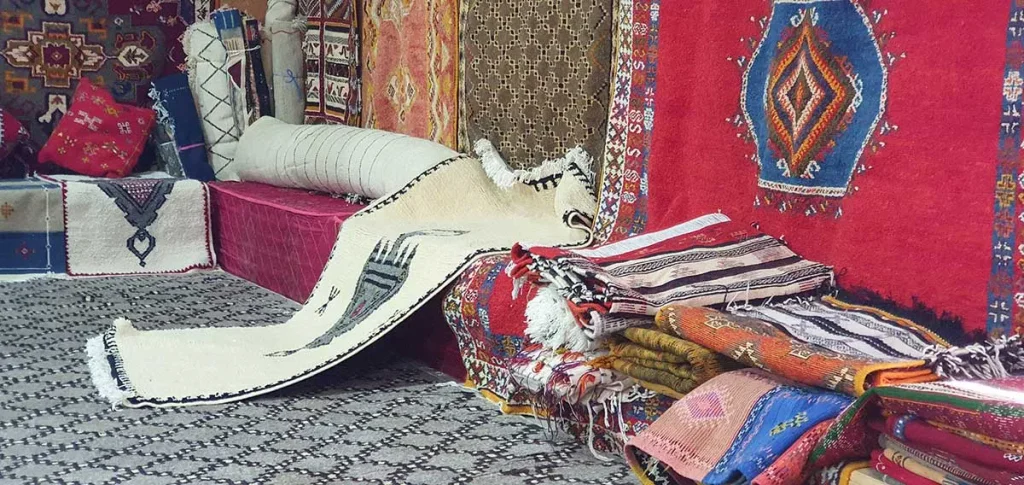
Many interpretations have been proposed for these motifs, particularly around fertility, femininity, masculinity, marriage, birth and family life. Such readings should not, however, be treated as a fixed code shared by all Amazigh weavers.
- The X sign, for example, has sometimes been interpreted as a female figure, while the chevron has been associated with the same symbolic repertory. The diamond is frequently connected in published interpretations with femininity, fertility or motherhood. Bands, bars, ladders and fishbone forms have in turn sometimes been associated with masculine symbolism.
- The cross has been interpreted in some contexts as a sign of union, while the double-hooked diamond has been associated with birth.
- A teapot shown in profile may evoke hospitality and conviviality, both central to domestic life.
- Butterflies represented by two triangles, as well as flowers and stars, may be associated with beauty, while zigzag lines can evoke water, snakes or protective boundaries according to context.
- Certain cross-shaped geometric compositions also recall decorative forms encountered in the earthen architecture of southern Morocco.
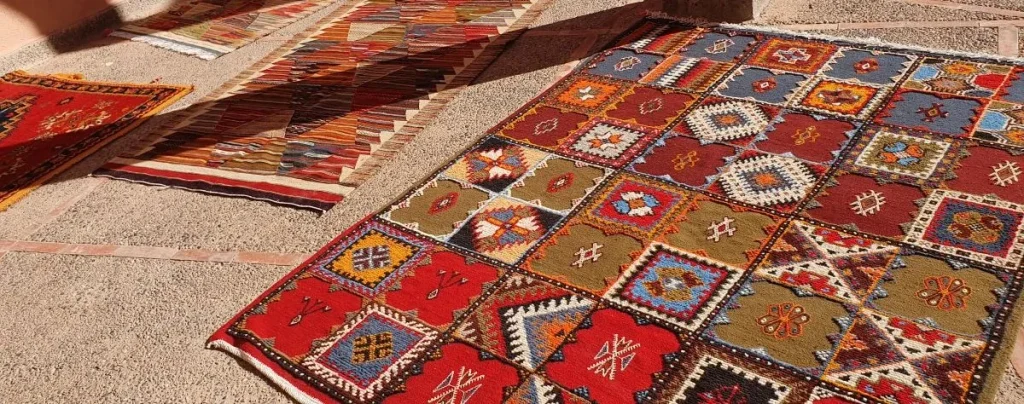
Care is nevertheless required when attempting to interpret these forms too systematically. Their meanings may vary according to region, family, period or even the individual craftswoman.
The Amazigh rug may therefore be better understood not as a form of writing but as a shared visual vocabulary, leaving considerable room for memory, inspiration and personal creation.
Read also: The Aït Ouaouzguite rug, a standard-bearer of the women’s art of the Siroua
Rites and beliefs surrounding the loom
Rug weaving has long been accompanied, in some communities, by a series of rituals and practices.
From shearing to warping, the wool is handled with particular care, according to customs passed down from one generation to the next. Some accounts describe freshly shorn wool being placed in a discreet corner of the house.
On the eve of dyeing, women might expose the different dye baths to starlight in order to ward off harmful forces. The weaver would fumigate the wool ready to be dyed and keep it out of sight before purifying herself as she would for her daily prayers.
At dawn the following day, she would return to the dye bath and begin her work after pronouncing Bismillah — “In the name of God”.
Once the rug was completed on the loom, cutting the warp threads could itself give rise to different rituals. In some traditions, only the weaver was allowed to perform this operation, with the door remaining closed until it was finished.
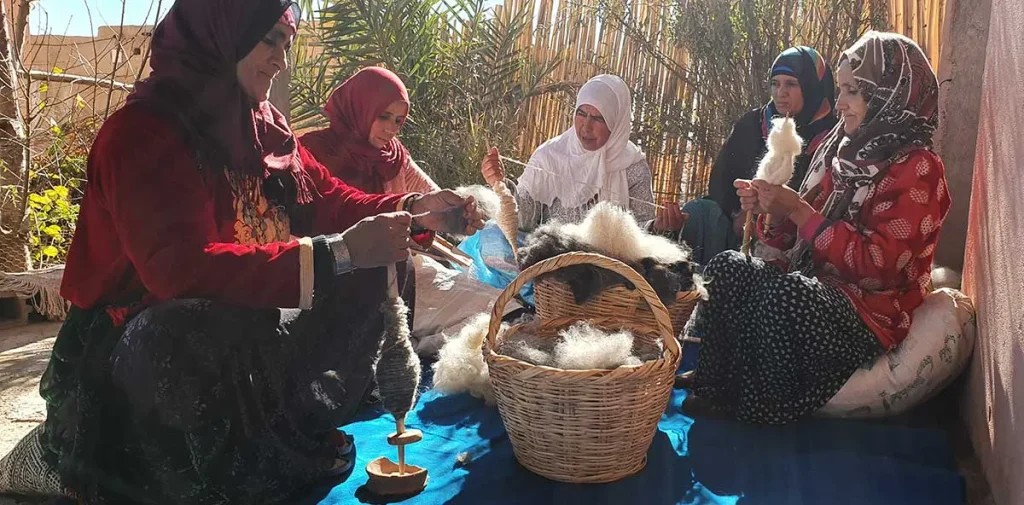
The weaver’s chant
Turn, turn, my spindle,
My spindle of fine polished wood,
Turn faster and faster,
So fast that you might escape my eyes…
Turn! You will have no need to slow
For my nimble fingers will feed you
As you whirl
And will ask no mercy…
Turn, turn, my long spindle!
Wind the white silken thread,
The soft wool best suited to the weft…
Turn, turn, my little spindle!
Wind the strong white thread,
The coarse wool required for the warp…
White fleece, wind yourself
For the good of all those in the house!
Neither now nor later upon the warp beam,
When my daughter passes three times beneath the azetta…
Spin, spin more quickly through my fingers,
White wool weighing down my spindle!
For the household, what could be more precious?
O white, grey or black wool, may your baraka be upon us,
With the help of God, the Compassionate, the Merciful!
Mririda N’Aït Attik – Les chants de la Tassaoute, translated into French by René Euloge
* Azetta: loom in Amazigh.
A living heritage in transformation
The art of Amazigh rug weaving does not belong to the past.
Sedentarisation, changing lifestyles, tourism, access to international markets and the development of cooperatives have profoundly transformed the conditions under which rugs are produced.
Some traditions have weakened, while others are experiencing a genuine revival, driven by the craftswomen themselves, by local cooperatives and by growing interest in Morocco’s textile heritage.
Read also: The Aït Ouaouzguite rug, a standard-bearer of the women’s art of the Siroua
Key points
- Amazigh rug weaving is above all a women’s craft, traditionally passed down from mother to daughter within rural and pastoral communities.
- Morocco has developed many regional weaving traditions, distinguished by their wool, techniques, formats, colours and decorative repertories.
- Around Tazenakhte and Jebel Siroua, the Aït Ouaouzguite are renowned for rugs combining high-quality local wool, distinctive colours and several weaving techniques.
- Knotted rugs, flat-woven hanbels and mixed-technique Glaoua textiles reflect different ways of working warp, weft, pile and decorative cord.
- The geometric motifs found on Amazigh rugs form a rich visual vocabulary, but their meanings should not be treated as a fixed symbolic code: interpretations vary according to place, period, family and weaver.
- Natural dyes once played a major role in the Siroua, although synthetic dyes and changing markets have transformed many practices.
- Far from being frozen in the past, Amazigh rug weaving remains a living heritage, continually reshaped by craftswomen, cooperatives, tourism and contemporary markets.
Use our contact form.
We will be happy to answer your questions.
More to Explore
Discover South-East Morocco