


Tachelhit, Tarifit and Tamazight: three languages or one?
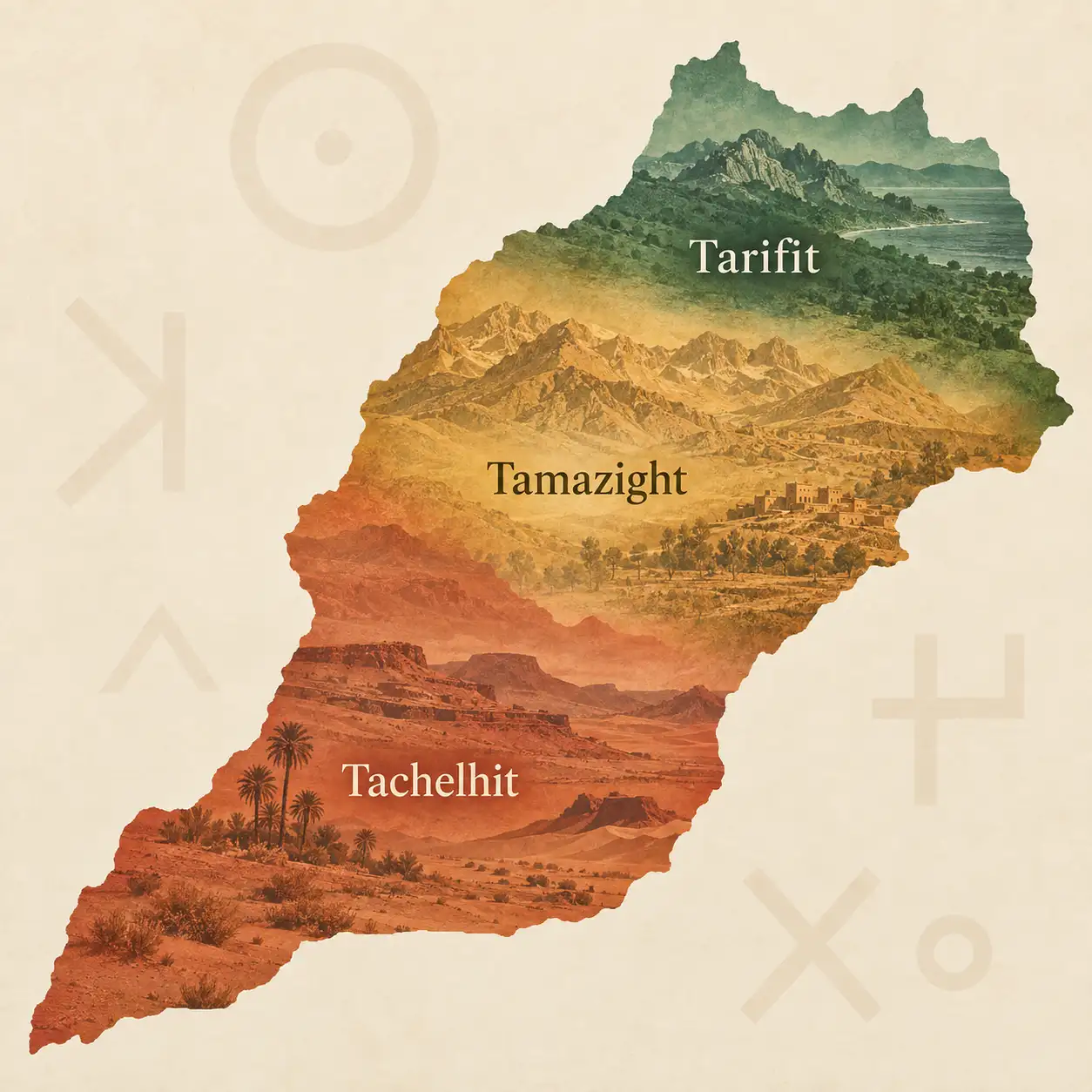
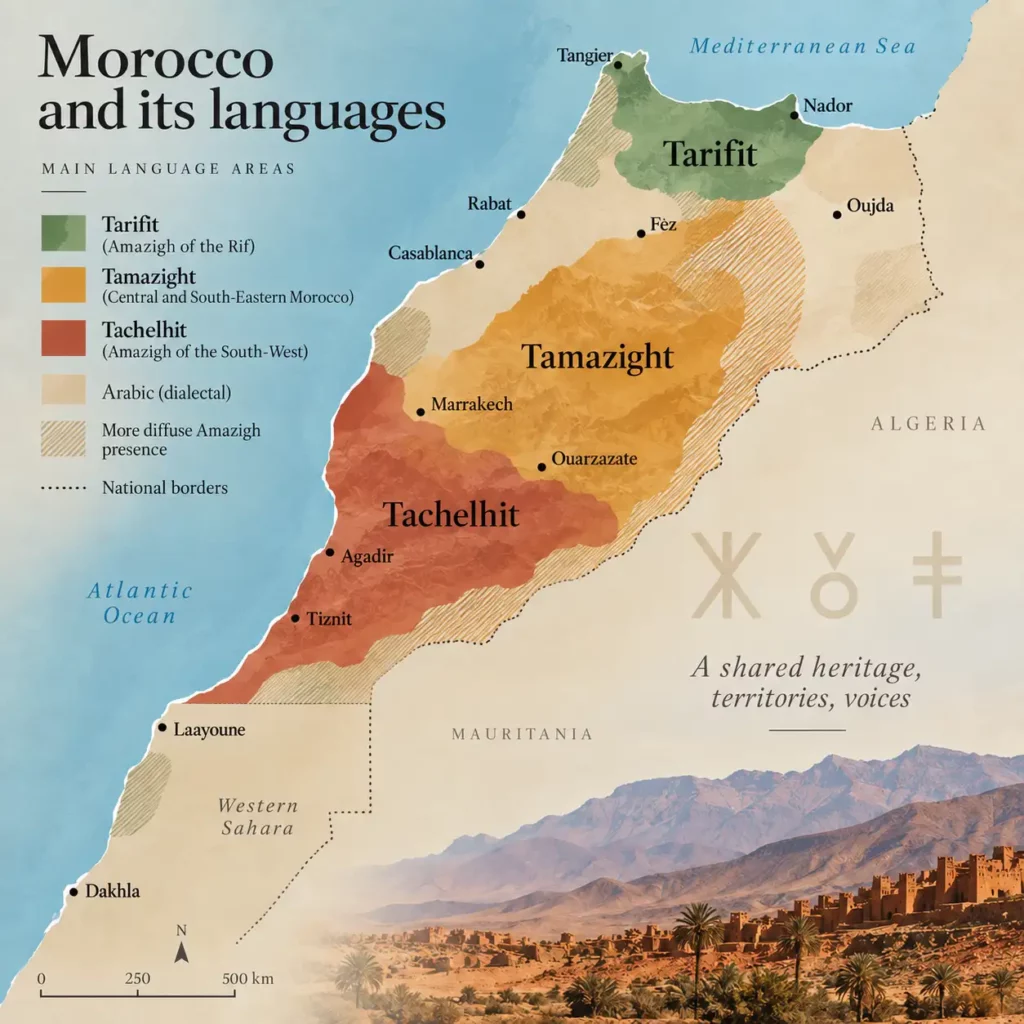
In Morocco, Tachelhit is commonly spoken in the South-West and the High Atlas, Tarifit in the Rif, and Tamazight in central Morocco and parts of the South-East. But are these three different languages, three dialects, or varieties of a single Amazigh language? The answer is less straightforward than it may seem — especially since the word Tamazight itself does not always refer to the same thing.
What do Tachelhit, Tarifit and Tamazight refer to?
Morocco’s Amazigh linguistic geography is generally described in terms of three major groups: Tarifit, spoken mainly in the North and the Rif; Tamazight, in central Morocco and several parts of the South-East; and Tachelhit, in the South-West and across much of the High Atlas. Each of these groups in turn includes its own local varieties.
This map should not, however, be imagined as three territories separated by perfectly clear linguistic boundaries. Ways of speaking vary within each of these broad areas, sometimes gradually from one valley or community to another.
The three groups share significant grammatical and lexical similarities. They belong to the same Amazigh branch of the Afro-Asiatic language family and share many fundamental structures. Yet centuries of evolution, geographical distance and contact with other languages have also produced differences in pronunciation, vocabulary and, at times, grammatical construction.
Why is the word “Tamazight” confusing?
Because it can refer to two different things.
In its broad sense, Tamazight is the name used for the Amazigh language, or even for the Amazigh languages and varieties as a whole. In this sense, Tachelhit and Tarifit are therefore forms of Tamazight.
But in Morocco, Tamazight also refers to a particular variety: the one spoken mainly in the Middle Atlas, central Morocco and certain parts of the South-East. In this second sense, Tamazight can therefore be distinguished from Tachelhit and Tarifit.
The contradiction is only apparent. The same word is being used both for the whole and for one of its components.
It is rather as if the name of a language family were also the name of one of its members. For readers discovering the Amazigh world, this double usage explains much of the confusion.
Can a speaker from the Rif understand a speaker from the Souss?
Not necessarily, at least not immediately.
A Tarifit speaker and a Tachelhit speaker will recognise related structures, roots and words, but phonetic and lexical differences can make spontaneous conversation difficult. Research into Morocco’s Amazigh varieties also shows that mutual intelligibility tends to decrease with linguistic and geographical distance; Tachelhit and Tarifit are among the cases where the differences can be substantial.
This does not mean, however, that these varieties are unrelated to one another. Regular correspondences can be found between their sounds, grammatical forms and a significant part of their vocabulary. A study of lexical equivalences between Morocco’s three major groups likewise found strong similarities between many forms.
Mutual intelligibility also depends on exposure. A speaker accustomed to hearing other Amazigh varieties through travel, television, music or school will naturally understand them better than someone whose linguistic environment has remained predominantly local.
So, three languages or three dialects?
This is where the answer becomes less clear-cut.
There is no universal boundary determining at what degree of difference two ways of speaking become two separate languages. Grammatical proximity, shared vocabulary and mutual intelligibility all matter, but they are not always sufficient. History, social usage and institutional choices also play a part.
Some major international linguistic classifications therefore list Tachelhit, Central Atlas Tamazight and Tarifit as separate languages, each with its own identification.
In Morocco, the institutional approach is different. IRCAM regards Tarifit, Tamazight and Tachelhit as the major varieties, or “geolects”, of Moroccan Amazigh, and has worked since its creation to bring them together within a common standard language. This standardisation is intended to be progressive and convergent, drawing on the elements shared by the different varieties rather than imposing one of them on the others.
Whether one speaks of “three languages” or “three varieties” therefore depends partly on the perspective adopted. The two descriptions can refer to different aspects of the same linguistic reality without either being necessarily wrong.
What is the standard Amazigh taught in Morocco?
Standard Amazigh is not simply the speech of one particular region that was chosen to become the language of the entire country.
Instead, IRCAM’s work has sought to build a common standard from Tarifit, Tamazight and Tachelhit: a shared orthography, terminology, vocabulary, grammatical rules and tools intended in particular for education and institutional use.
Ahmad Boukous, former rector of IRCAM, has described standard Amazigh as a macrolanguage encompassing Morocco’s three major groups.
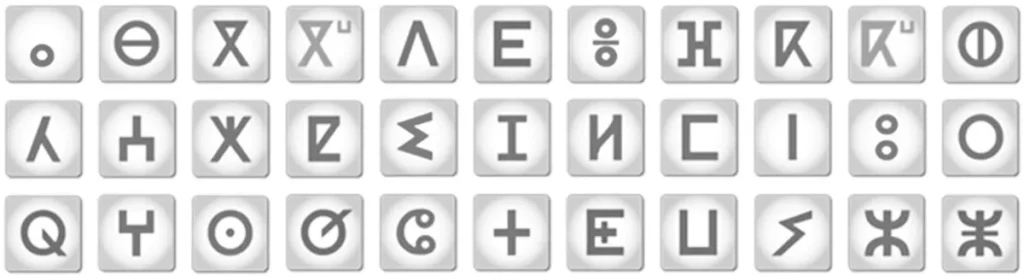
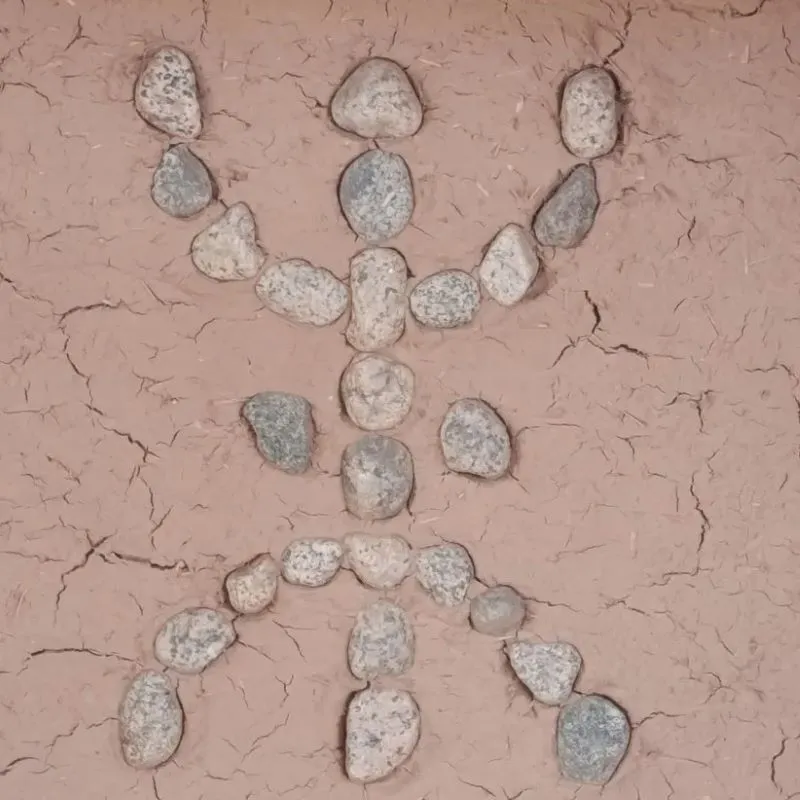
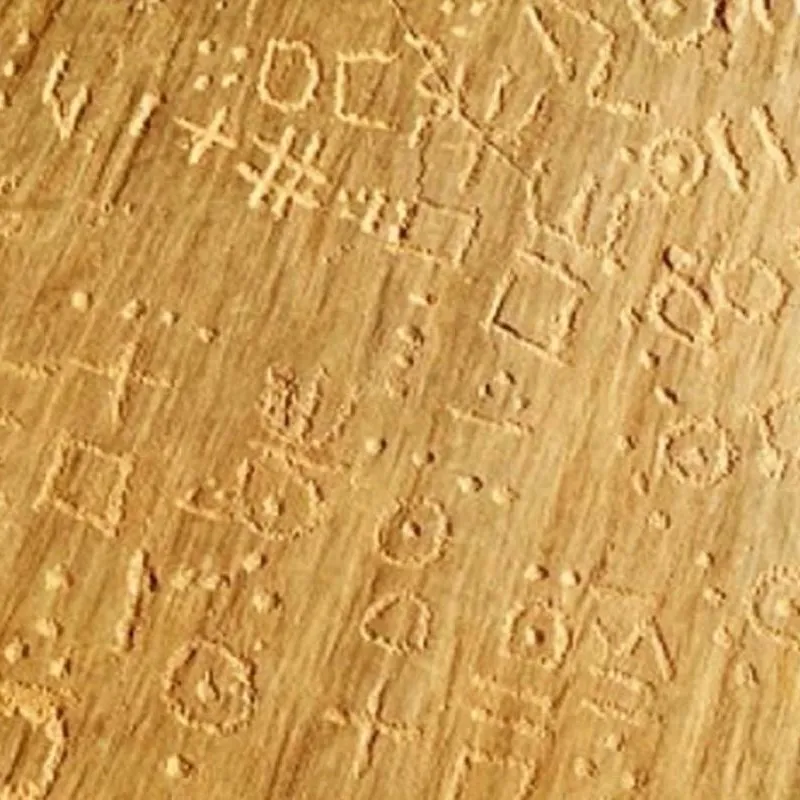
Another element now helps bring these three groups together: a common writing system. Since 2003, Tifinagh has been the official script adopted in Morocco for teaching Amazigh. The alphabet standardised by IRCAM contains 33 characters and can be used to write Tachelhit, Tarifit and Tamazight alike, despite their differences in pronunciation and vocabulary.
This standard language does not, however, make regional forms disappear. Someone may speak Tachelhit at home or in their village while learning to read and write a standardised form of Amazigh, as happens in many languages that combine a common written standard with strong regional variation.
Are Morocco’s borders also linguistic borders?
No. And this is where the map becomes even more interesting.
Amazigh languages existed long before the present political borders of the Maghreb. Some linguistic areas therefore extend from one country into another, while significant differences can occur within the borders of a single state.
Tarifit itself belongs to a broader linguistic area whose varieties extend eastwards beyond Morocco’s border. Tachelhit is also recorded beyond Moroccan territory alone.
Across North Africa, other names then appear: Kabyle, Chaoui, Chenoui, Mozabite, Tuareg, Nafusi and many others. All belong to the Amazigh linguistic world, but their relationships can no longer be understood solely through national borders.
Another question then begins: where does one Amazigh language end and another begin?
Explore all features in: The Berber world
Share your knowledge of the Amazigh world
More fragments from the Berber world

Leave a Reply