Ouarzazate, where light and landscapes become cinema
Long before the studios and monumental sets, filmmakers came to Ouarzazate looking for something else: clear light, immense horizons, mountains, mineral valleys and earthen architecture capable of standing in for worlds far removed from one another. From the 1960s onwards, film shoots multiplied, eventually giving rise to studios, workshops and specialised professions. Cinema profoundly transformed the image of Ouarzazate without ever defining the city on its own. Today, between ageing sets, heritage, new productions and projects for revival, this story is still being written.
Overview
- When southern Morocco became a film set.
- Light and landscapes, Ouarzazate’s first assets.
- From natural settings to major studios.
- Creating imaginary worlds Cinema jobs become local professions .
- Aït Ben Haddou, between real heritage and cinematic imagination.
- Productions that shaped the image of Ouarzazate.
- Visiting the film studios today.
- Is the story over?
When southern Morocco became a film set
Ouarzazate was not created by cinema.
When the first major international productions began looking towards southern Morocco, the town had already existed for several decades and served as an administrative centre for a vast territory stretching between the High Atlas, the pre-Saharan valleys and the desert routes.
What filmmakers discovered was not an infrastructure, but a landscape.
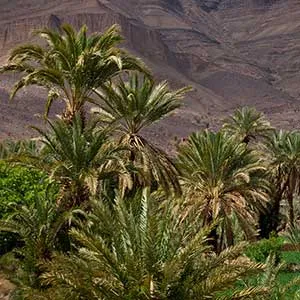
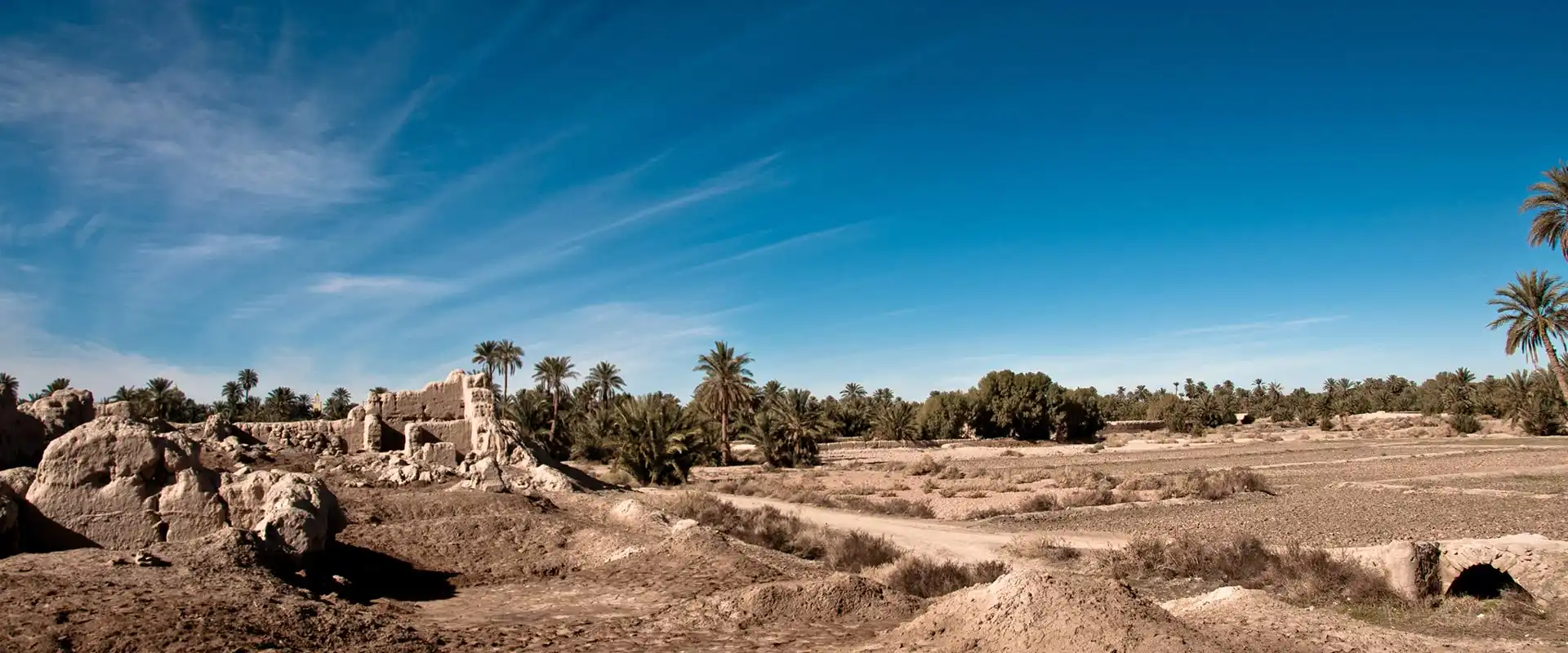
Almost bare plateaux, mineral mountain ranges, green valleys, desert expanses and villages built of earth offered an extraordinary variety of natural settings within a relatively small area.
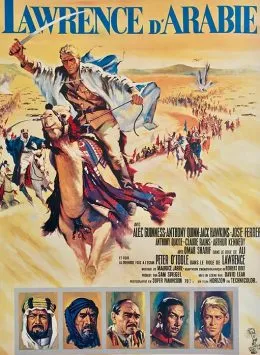
The filming of Lawrence of Arabia, directed by David Lean and released in 1962, was one of the defining moments in this relationship. Ouarzazate and its surroundings then gained a new visibility among international productions.
This was not yet a local industry.
Crews arrived with much of their own staff and equipment. The landscapes themselves were used essentially as vast open-air studios.
But something was beginning to take shape: a territory far removed from the major centres of production discovered that, in front of a camera, it could become almost anywhere else.
Light and landscapes, Ouarzazate’s first assets
Ouarzazate’s success in cinema cannot be explained by its desert alone.
Light has long been one of the qualities emphasised by professionals who came to film here. The dry air descending from the High Atlas, the small number of overcast days and the long hours of sunshine create particularly favourable conditions for exterior filming. A report on the local film industry described this combination of clear air, limited cloud cover and open landscapes as one of the reasons that originally attracted David Lean to the region.
But this light acts above all on an exceptionally varied geography.
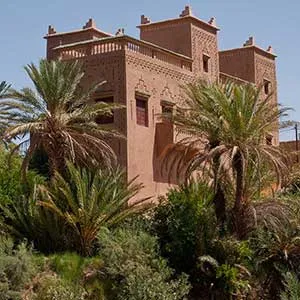
Within a few dozen kilometres of Ouarzazate, it is possible to move from the peaks of the Atlas to desert reliefs, from cultivated valleys to stone plateaux, from palm groves to kasbahs and ksour.
For a production, this diversity offers a considerable advantage: several different worlds can be created without having to move an entire crew over very long distances.
The landscapes of southern Morocco have thus stood in for Arabia, ancient Egypt, Palestine, Afghanistan, Tibet and completely imaginary kingdoms.
The region already possessed something no set designer could truly build: the scale of the landscape and the depth of the light.
From natural settings to major studios
For many years, cinema therefore used Ouarzazate mainly as an exterior location.
The creation of Atlas Studios in 1983 changed the nature of this relationship. Founded by Mohamed Belghmi a few kilometres from the town, the studios gave productions a permanent space in which to build, store, transform and reuse sets. The site now covers around twenty hectares.
The first major production hosted by the studios was The Jewel of the Nile in the mid-1980s. Other productions quickly followed.
During the 1990s, Atlas Studios also hosted several instalments of The Bible Collection, a major international series initiated by the Italian company Lux Vide. Beginning in Ouarzazate with Abraham in 1993, it continued notably with Joseph and Moses in 1995, followed by Samson and Delilah in 1996. Some of the biblical sets built for these productions were preserved or reused in the studios for many years.
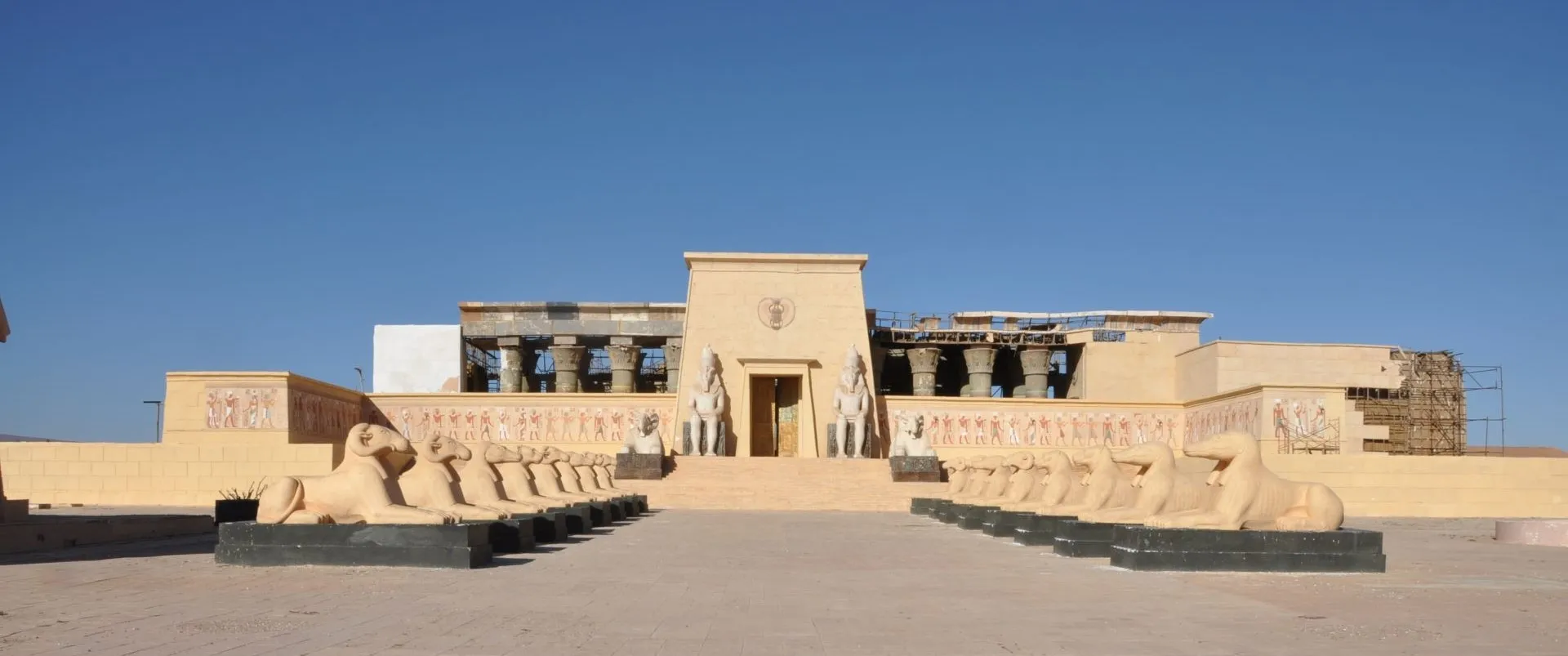
From then on, Ouarzazate was no longer simply a place where filmmakers came to shoot a landscape. The landscape required by the script could now be built there. Egyptian palaces appeared in the desert. Tibetan temples stood alongside streets meant to evoke Jerusalem or an ancient city. The same structures could be repainted, altered and then used a few years later to represent another country or another period.
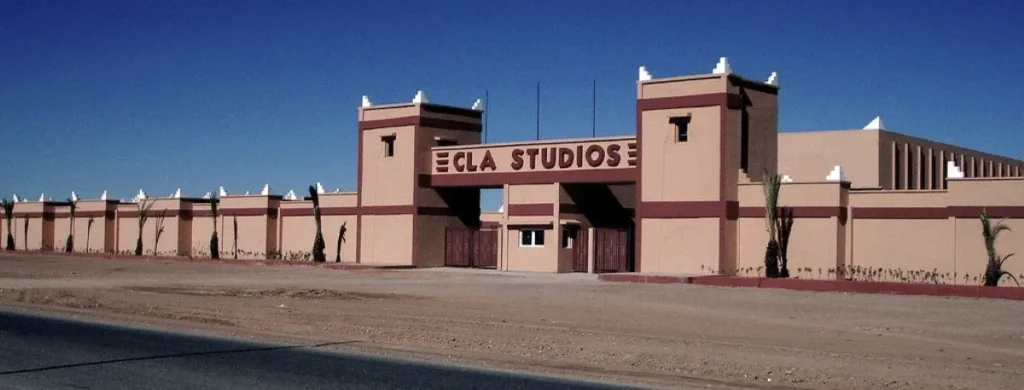
In 2004, another step was taken with the creation of CLA Studios. The project was born from a partnership between the Moroccan group Sanam Holding, the Italian producer Dino De Laurentiis — one of the major figures of international cinema — and Cinecittà Studios, heir to Rome’s famous film complex. Covering nearly 160 hectares, CLA offers large sound stages, workshops and vast outdoor areas capable of hosting several productions at the same time.
This connection with Cinecittà is significant: it shows that Ouarzazate was no longer seeking merely to exploit its natural landscapes, but to equip itself with infrastructure capable of competing with major international production centres.
The boundary between real landscape and manufactured landscape then became one of Ouarzazate’s defining characteristics.
Creating imaginary worlds
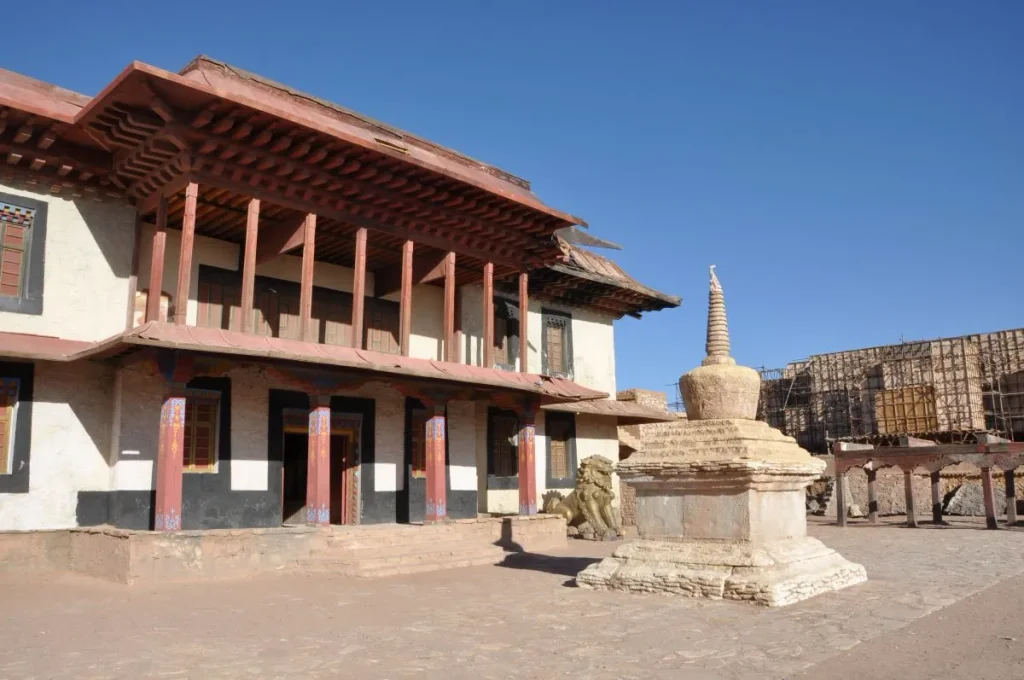
Visiting the studios reveals one of the most fascinating things about cinema: a set does not need to be real in order to appear convincing on screen.
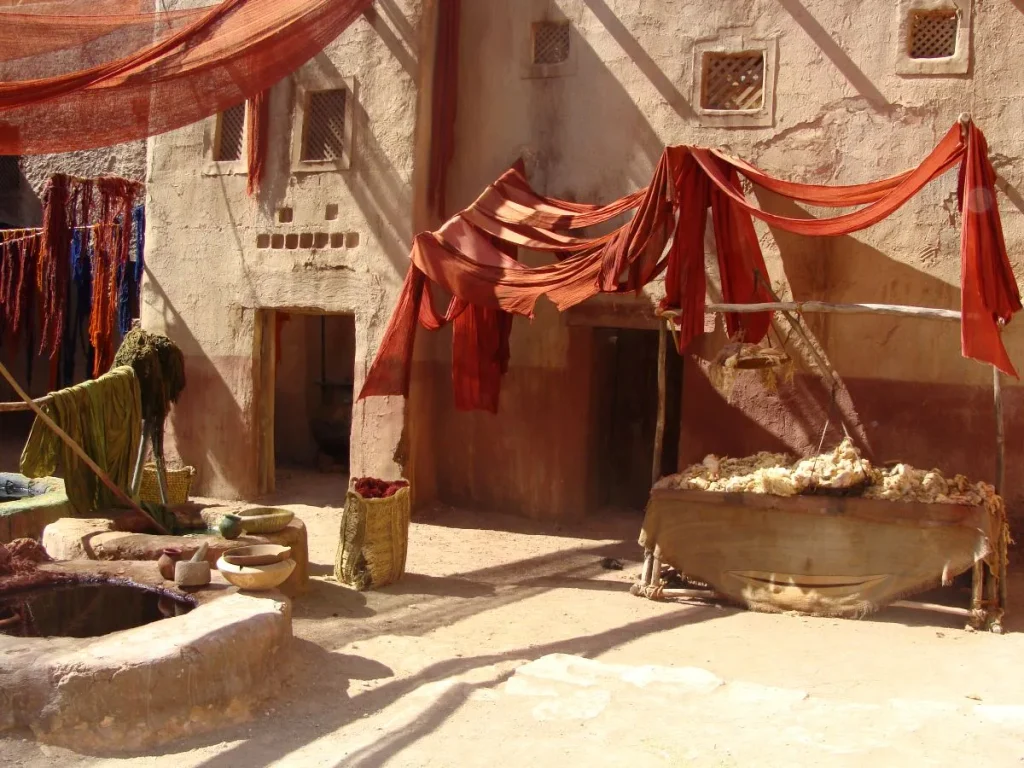
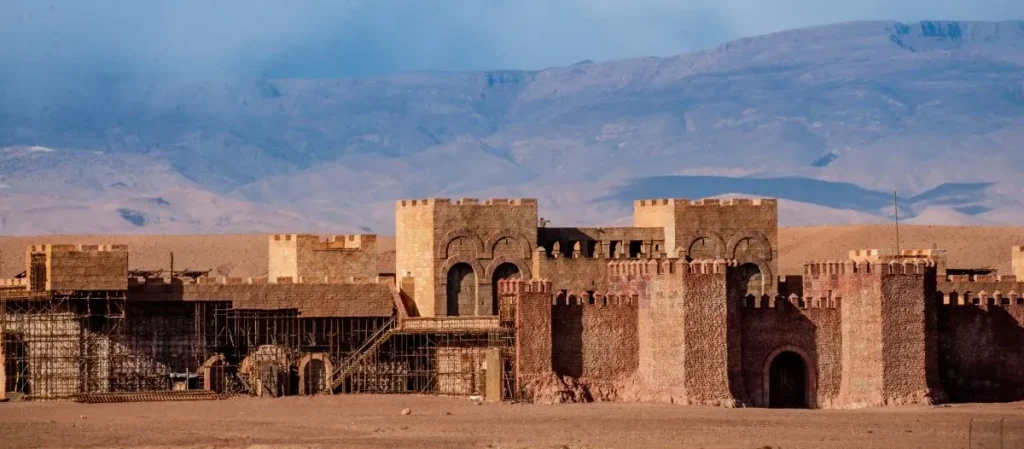
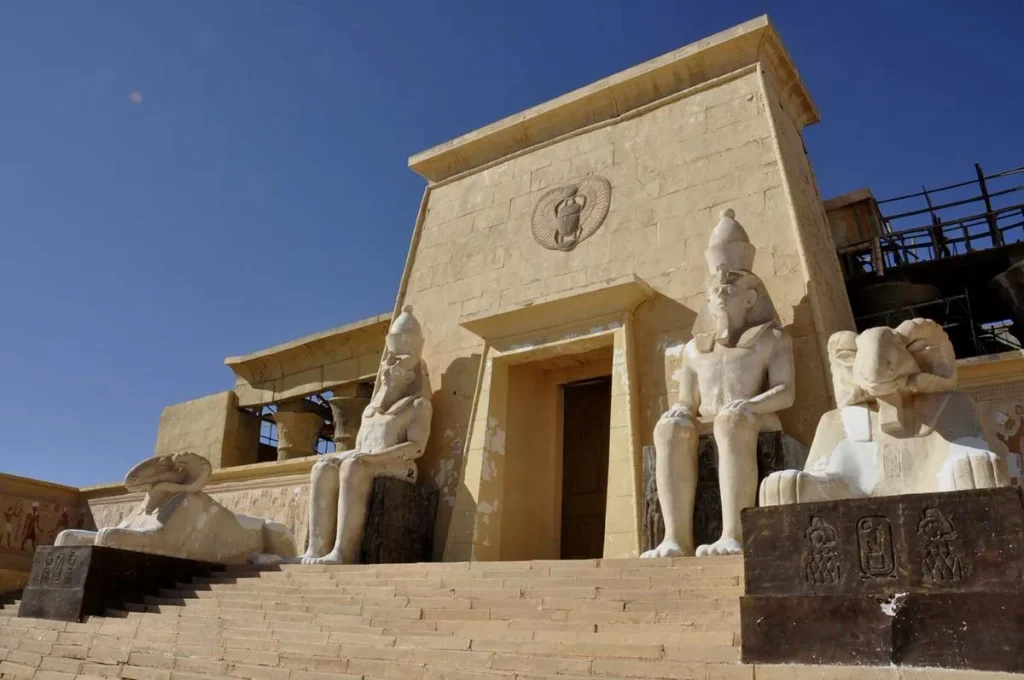
A monumental wall may be only a few dozen centimetres thick. A stone may be made of foam. A palace door may open onto nothing at all. Structures are designed to be seen from particular angles, lit in a particular way and then extended through framing or digital effects.
In Ouarzazate, this illusion becomes especially visible because some of the old sets remain in place after filming. Some are preserved and reused. Others are transformed. Still others slowly deteriorate under the sun, until they begin to resemble the ruins they were originally meant to portray.
The studios have thus become a curious archaeology of cinema: the remains of worlds that never existed.
Atlas Studios still contains sets evoking ancient Egypt, Tibet and different forms of Middle Eastern architecture. The site remains both a working production space and a place open to visitors.
Cinema jobs become local professions
Another transformation, less spectacular but probably more profound, gradually took place around the film shoots.
At first, many international productions arrived with a large proportion of their own crews. But as films succeeded one another, local people acquired skills.
Masons and craftsmen learnt how to build sets. Others became set carpenters, painters, prop makers, costume makers, drivers, production assistants, technicians or stunt performers. Thousands of people from the region have also worked occasionally as extras.
A report made in Ouarzazate in 2017 described metalworkers producing weapons and shields, seamstresses making costumes and tunics, and residents alternating their usual work with jobs on film sets. According to local studio managers, a very large proportion of those employed on productions had by then become Moroccan.
Cinema therefore created something the landscapes alone could never provide: a professional memory. With each new production, skills accumulated on earlier shoots could be reused and passed on.
That transmission also became institutionalised. In 2006, the Ouarzazate Specialised Institute for Cinema Professions (Institut Spécialisé dans les Métiers du Cinéma de Ouarzazate, ISMC) was created through a partnership between the Mohammed V Foundation for Solidarity and the Office for Vocational Training and Employment Promotion (OFPPT). The institute trains technicians and specialised technicians in the technical and artistic professions of cinema and audiovisual production.
Nearly twenty years later, the institute remains active. In 2024, its students were still presenting their films in the “Film School” competition at the National Film Festival in Tangier, while another of its graduates won the first National Youth Film Festival held in Ouarzazate.
The very existence of the institute is perhaps one of the most tangible legacies of several decades of film production: Ouarzazate has not only hosted films, it has gradually learnt how to train the people who make them.
Aït Ben Haddou, between real heritage and cinematic imagination
Around thirty kilometres from Ouarzazate, the ksar of Aït Ben Haddou illustrates better than anywhere else the ambiguity of this relationship between heritage and cinema.
The ksar is not merely a set. It is an ancient architectural ensemble built of earth, inhabited and transformed over centuries, and inscribed on UNESCO’s World Heritage List since 1987.
Yet millions of viewers have probably discovered it without knowing its name. On screen, its walls and towers ceased to belong to a ksar in southern Morocco and became ancient cities, oriental settlements or the settings of imaginary worlds. Cinema has therefore contributed to its international fame, but it has also created around the site a second identity made of fictional images.
That story continues.
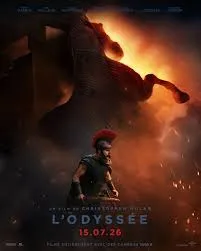
For Christopher Nolan’s The Odyssey, released in July 2026, Aït Ben Haddou was notably used to represent the ancient city of Troy.
The paradox is striking: a real architecture, born of a particular local history, becomes on screen the setting for stories that sometimes have no connection at all with Morocco.
This is also what makes Aït Ben Haddou such a singular place: it is possible to see at the same time the heritage that exists and the worlds that cinema has projected onto it.
Read more: Discover Aït Ben Haddou.
Productions that shaped the image of Ouarzazate
Many films and television series have been shot in the region. A few productions, however, marked different stages in this history.
Lawrence of Arabia, in 1962, revealed the power of southern Morocco’s landscapes to international cinema.
In the 1980s, The Jewel of the Nile accompanied the early years of Atlas Studios and symbolised the transition from a simple filming location to permanent production infrastructure.
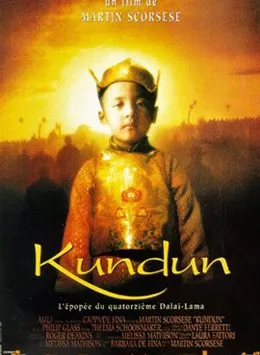
At the end of the 1990s, Martin Scorsese’s Kundun demonstrated just how far this capacity for substitution could go: southern Morocco became Tibet.
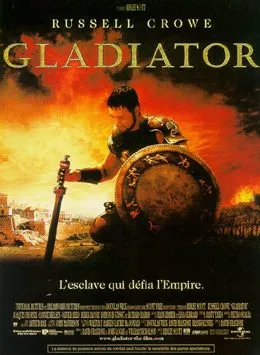
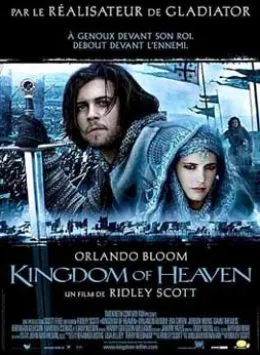
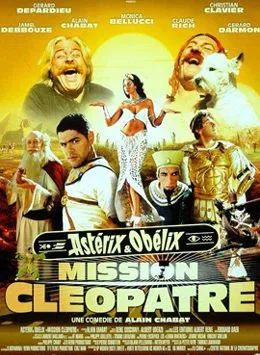
Then came the major historical productions of the turn of the century. Gladiator, The Mummy, Kingdom of Heaven and Asterix & Obelix: Mission Cleopatra left behind some of the sets that remain among the most immediately recognisable in the studios today.
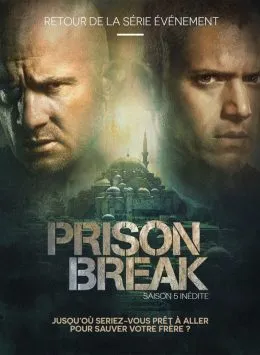
Television series continued this story, notably Game of Thrones and Prison Break, which in turn used the infrastructure and several locations in the region.
And in 2026, The Odyssey showed that the landscapes of Ouarzazate and Aït Ben Haddou could still enter the imaginary geography of major international productions.
What ultimately matters less than the length of this filmography is its diversity: the same territory has been used to tell stories set on several continents and thousands of years apart.

Visiting the film studios today
Cinema has itself become a tourist attraction.
Atlas Studios, located around five kilometres from Ouarzazate on the road to Marrakech, are open to visitors when filming requirements do not prevent access. Visitors can discover sets preserved or transformed over successive productions. At the same time, the complex remains in professional use.
The visit is most interesting when approached as a way of discovering how images are made, rather than simply as a collection of film memorabilia.
You can see how a façade becomes a city, how materials create the illusion of stone, or how the same space can move from one historical period to another with only a few changes.
The studios also reveal what distinguishes Ouarzazate from a simple natural filming location: several decades of sets, workshops and accumulated know-how have gradually taken root around the town.
Read more: Discover Ouarzazate: sights, history and surroundings.
Is the story over?
It would be tempting to tell the story of cinema in Ouarzazate as a kind of vanished golden age.
That would probably be just as misleading as continuing to present cinema today as the activity that entirely defines the town.
Major international productions now film in many different parts of Morocco, and Ouarzazate has experienced periods of intense activity as well as slower years. National statistics from the Moroccan Cinematographic Centre show substantial foreign production activity in Morocco, but do not by themselves justify attributing most of it to Ouarzazate.
The infrastructure, skills and professional memory accumulated locally nevertheless remain.
In June 2026, construction began on the Ouarzazate International Cinema City, on a 10.49-hectare site, with an announced investment of 240 million dirhams. The project includes a 3,000 m² studio, post-production facilities, training and innovation spaces, and a centre devoted to film tourism.
The inclusion of post-production facilities is significant: the authorities themselves acknowledge that part of the production chain for films shot locally has until now been carried out elsewhere.
Cinema in Ouarzazate therefore probably needs to be seen differently.
It is no longer simply the story of a town suddenly turned into the “Hollywood of the desert”, to use a phrase repeated for decades. It is the story of a territory discovered for its light and its landscapes, which then built studios, developed professions, created sets and left behind a strange collection of real and imaginary places.
And when the sun drops over the plateaux around Ouarzazate, the original reason behind this entire story is still visible.
The light is still there.
Key points
- The landscapes of southern Morocco and the quality of the light were what first attracted major international productions to Ouarzazate.
- Lawrence of Arabia in 1962 was one of the major turning points in this cinematic history.
- The creation of Atlas Studios in 1983 transformed Ouarzazate from a simple filming location into a genuine production centre.
- Film shoots gradually created local skills in set building, costume, production management, technical work and extras.
- The ksar of Aït Ben Haddou has a double identity: real architectural heritage and a setting associated with numerous international productions.
- The film studios now offer visitors a way to discover what happens behind the scenes and how imaginary worlds are created.
- Cinema remains present in Ouarzazate, but it no longer sums up the town’s contemporary identity or economy.
- The launch of the International Cinema City in 2026 reflects a desire to renew infrastructure and extend more of the audiovisual production chain locally.
A question? Something to share?
Use our contact form.
Discover South-East Morocco