


Aït: the word that draws the map of Morocco
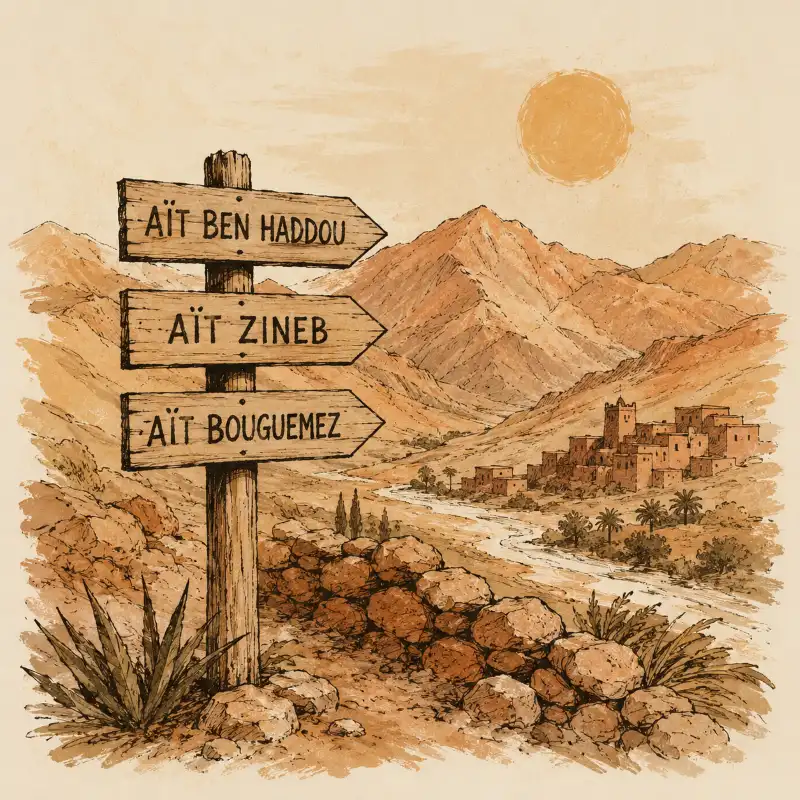
Aït Ben Haddou, Aït Atta, Aït Zineb, Aït Bouguemez… On maps of Morocco, these three letters appear again and again, at the beginning of the name of a village, a tribe, a valley or a territory. We see them so often that we almost stop reading them. Yet this small Amazigh word tells, by itself, something essential: a way of belonging to a group, of connecting oneself to an origin and of inhabiting a territory.
The children of…
The primary meaning of Aït — or Ayt — is ‘the children of’.
The linguist Salem Chaker defines it as the plural of several ancient Amazigh forms — u, w, ag — meaning ‘son of’. To say Aït X is therefore, first of all, to designate ‘the children of X’, in other words those who recognise themselves as the descendants of a common ancestor.
The word belongs to a very ancient vocabulary of kinship. Its present form probably derives from aw-t, constructed from aw, ‘son of’, to which an old plural marker was added.
Behind three letters that have become almost commonplace on road signs, a first image thus appears: that of a community defined by descent.
In the Arabic-speaking world of the Maghreb, the logic is familiar. In its use, Aït can be compared with Beni, Banu or Ouled/Oulad, which likewise appear in countless names of groups and places.
From family to territory
But this descent should not always be taken literally.
As groups formed, moved, forged alliances or occupied a territory, Aït came to mean more than genealogy alone. The ‘children of’ also became ‘the people of’, ‘those of’, the members of a community.
In Kabylia, for example, aït wexxam refers to the ‘people of the house’, in other words the household; at ufella, ‘those above’. The bond is no longer necessarily one of blood: it may become one of place, group or shared belonging.
It is this shift that helps explain why Aït is now so deeply present in the geography of Morocco. The name of a human group often came to designate the territory inhabited by that group, and sometimes eventually the village itself.
Kinship inscribed itself upon the map.
Aït, Ayt or At
Depending on the region and the system of transcription, the same word can take different forms.
Aït is the spelling that has become familiar in Morocco and in French-language place names. Ayt reflects its Amazigh form more directly and is now frequently used by linguists. In some regions, particularly Kabylia and the Mzab, the semi-vowel disappeared and the word is found in the form At.
Aït, Ayt, At: behind these different spellings lies the same ancient term.
This diversity also explains why two names constructed according to exactly the same logic can look different on a map of the Maghreb.
A word that crosses the Amazigh world
The principle extends far beyond Morocco.
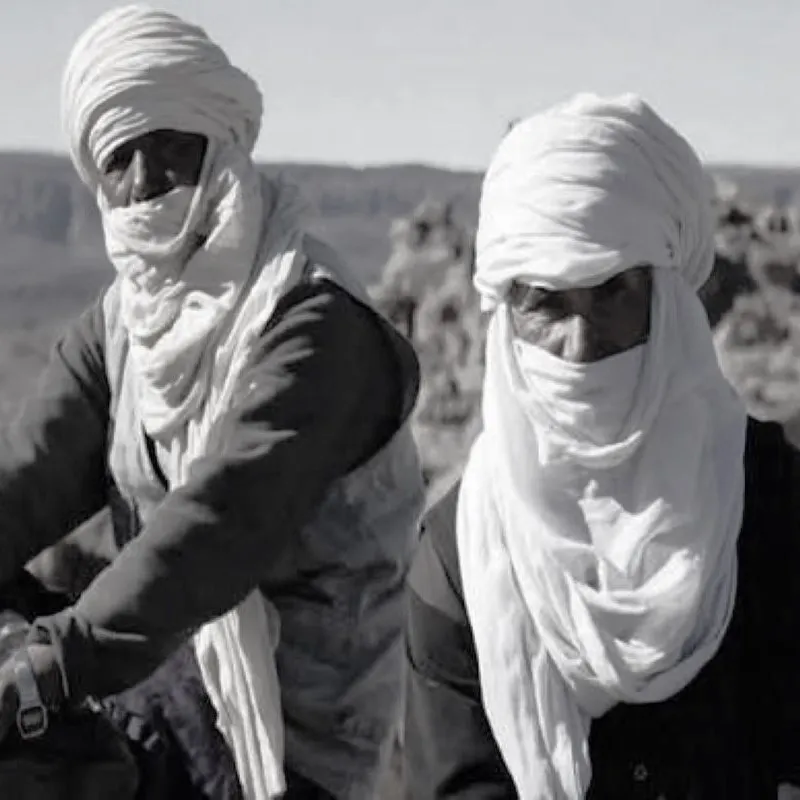
Forms corresponding to ‘son of’ and ‘children of’ belong to an ancient common stock of the Amazigh languages. Among the Tuareg, another construction became established for naming groups: Kel, meaning ‘the people of’. Thus the Kel Ahaggar are the ‘people of the Ahaggar’, and the Kel Ajjer those of the Ajjer.
The words differ, but the logic remains: to name people through that to which they belong — an ancestry, a community, a land.
Three letters on the map
Today, anyone travelling through Morocco encounters Aït everywhere, without necessarily knowing what they are reading.
Yet the word was there long before road signs and administrative maps. It recalls a time when territory was expressed first through the people who inhabited it, their alliances, their lineages and the memory of their ancestors.
Aït Ben Haddou, Aït Atta, Aït Zineb…
Each time, the same three letters open the name.
And behind them, one can still glimpse the same ancient formula: the children of, the people of, those who belong.
Explore all features in: The Berber world
Share your knowledge of the Amazigh world
More fragments from the Berber world

Leave a Reply