Dates of south-eastern Morocco: fruit of the oases and living heritage
In the valleys of the Drâa and Ziz, across the Tafilalet and the pre-Saharan oases, the date palm shapes the landscape as much as it feeds people. Domesticated several millennia ago and gradually spread across North Africa, it became one of the pillars of oasis agriculture and a defining feature of southern Morocco. From Mejhoul to lesser-known local varieties, its history tells a story of adaptation to arid environments, the transmission of ancient knowledge and the growing fragility of the oases today.
Overview
- The date palm lies at the heart of the oasis economy.
- Where does the date palm come from, and how long have people cultivated it?
- How does a date grow?
- Why are there so many varieties of dates?
- Tasting the dates of south-eastern Morocco.
- Why did Bayoud disease transform Morocco’s palm groves?
- Is water scarcity now threatening the oases?
- Where can you discover the palm groves and dates of south-eastern Morocco?
- Dates take centre stage in Erfoud.
- The date palm is part of our cultural heritage.
The date palm lies at the heart of the oasis economy
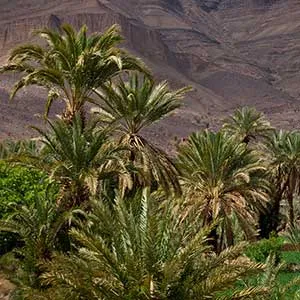
Seen from a distance, a palm grove can look like a forest of trees growing naturally around a source of water. Yet it is the result of patient human labour.
In the traditional oasis, the date palm forms the upper level of an agricultural system organised in several layers. Its crown filters the sun and creates a more favourable microclimate beneath it. Fruit trees can grow at an intermediate level, while cereals, lucerne, vegetables and other crops occupy the plots at ground level.
This multi-layered agriculture makes better use of space, available water and shade. The Food and Agriculture Organization of the United Nations still describes this superimposition of crops as one of the essential characteristics of traditional oasis systems.
The palm thus protects what grows beneath it, but its own presence depends on water brought to the plots through irrigation systems patiently built and maintained. It is this combination of water, palms, crops and human labour that creates the oasis landscape.
In south-eastern Morocco, it accompanies the Drâa, the Ziz and the oases of the Tafilalet in particular. The Drâa-Tafilalet region remains by far Morocco’s leading date-producing region: it accounted for 76% of the national production forecast for the 2025–2026 season.
Read more: The oasis carries the seeds of Morocco’s future — and the world’s
Where does the date palm come from, and how long have people cultivated it?
The date palm, Phoenix dactylifera, has accompanied human societies for several millennia, although its precise origin has long been difficult to establish.
Archaeological and genetic evidence available today points mainly towards the Near East and the Persian Gulf region. Wild populations of Phoenix dactylifera still survive in the mountains of Oman and may be close to the ancestors of domesticated date palms. Recent genomic research therefore considers domestication in this region to be the best-supported hypothesis, although the history of the species has proved more complex than a simple spread from a single centre of origin.
People probably ate the fruits of wild palms long before they began cultivating them. Remains discovered in the Arabian Peninsula show that dates were being exploited around 7,000 years ago, while other research places the use of wild fruits as early as the sixth and fifth millennia BC. Regular cultivation of the date palm is subsequently attested in Mesopotamia and the Gulf region from the fifth and fourth millennia BC.
This domestication marked an important stage in the history of arid regions. Growing date palms not only provided a highly nutritious fruit that could be stored easily, but also created beneath their shade the conditions needed for other crops. The development of the date palm and that of oasis agriculture are therefore closely intertwined.
Is the date palm native to Morocco?
In Morocco, the available evidence does not suggest that the cultivated date palm was locally domesticated in prehistoric times.
The archaeobotanical record instead points to a westward spread of cultivated date palms across North Africa. The earliest African evidence appears in Egypt several millennia BC; in Libya, cultivation is attested much later, during the first millennium BC. West of Libya, the evidence becomes more recent still.
In Morocco, the earliest archaeobotanical evidence currently reported comes from Volubilis, around two thousand years ago in Antiquity. Date stones later appear in medieval levels at Volubilis, Igîlîz and above all Sijilmâsa, in the heart of the Tafilalet.
Sijilmâsa is particularly important to the history of the date palm in south-eastern Morocco. Founded in the eighth century in the Tafilalet oasis, the city became one of the great crossroads of trans-Saharan trade. Medieval sources already describe a region covered in palms and renowned for the quality of its dates. In the twelfth century, Al-Idrissi mentions several qualities produced at Sijilmâsa; historical accounts show that the dates of the Tafilalet had long enjoyed a reputation extending far beyond the region.
Read more: Sijilmassa, the legendary city at the true heart of the Maghreb
A history more complex than simple importation
To say that the date palm was simply “imported from the East” would nevertheless be too reductive.
Genetic studies show that North African date palms now form a population clearly distinct from those of the Middle East. Part of their genetic heritage comes in particular from Phoenix theophrasti, a wild palm now found in Crete and parts of the eastern Mediterranean. In some North African varieties, this contribution may account for up to around 18% of the genome.
This means that palms introduced from the east diversified as they spread across North Africa, crossing with other Phoenix populations and being selected over centuries by growers.
The date palm of Morocco’s oases is therefore both the heir to a very ancient eastern domestication and the product of a long North African history of its own.
How does a date grow?
For several millennia, growers have learnt to work with one essential characteristic of the date palm, Phoenix dactylifera: male and female flowers grow on separate trees.
Without pollination, a female palm will not normally produce the expected bunches of dates.
In Moroccan palm groves, traditional hand pollination remains widely practised. When the female inflorescence opens, the grower places a few strands taken from a male palm among the female flowers to ensure fertilisation.
Repeated from palm to palm, this gesture is one of the most characteristic skills of date-palm cultivation. The National Institute for Agricultural Research still describes it as the oldest and most widely used technique in Moroccan palm groves.
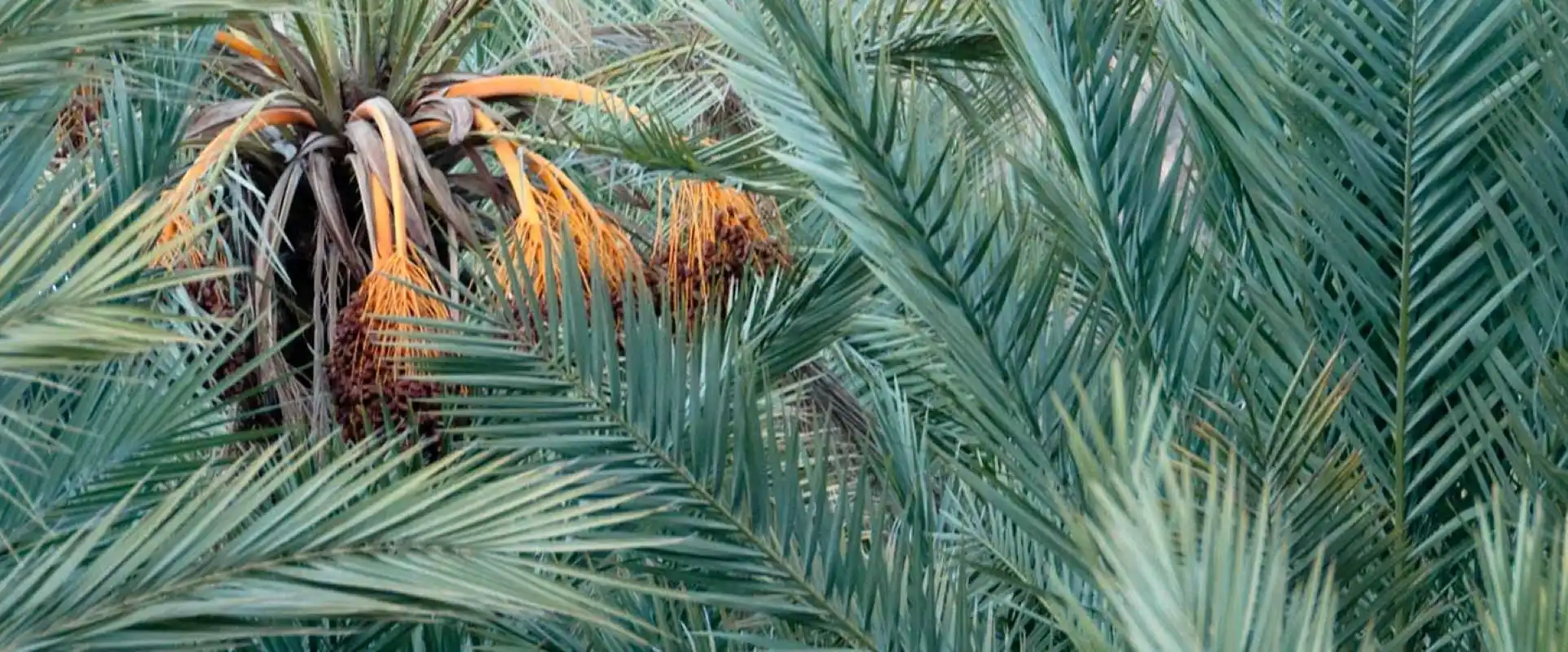
Flowering and pollination take place in spring. The fruits then develop gradually in bunches that can become very heavy. Their colour, texture and sugar content change as they ripen.
Depending on the variety and the region, harvesting begins at the end of summer and continues through autumn, sometimes later for the latest-ripening varieties.
The date bought in a souk is therefore the result of several months of monitoring, irrigation, pollination, care of the palm and, finally, harvesting.
Why are there so many varieties of dates?
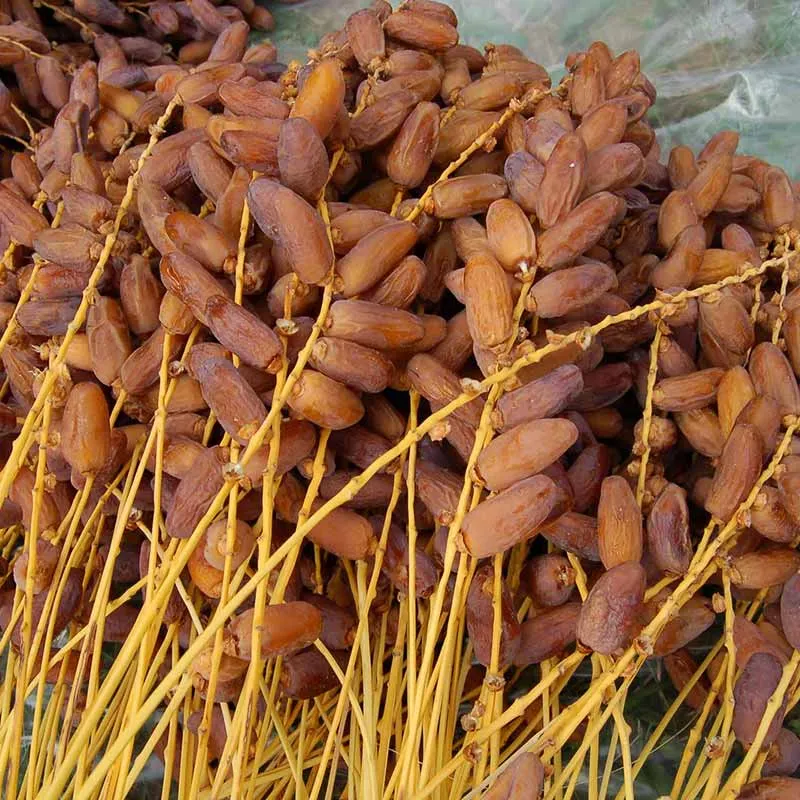
The diversity of Moroccan dates is remarkable.
In the Tafilalet area alone, the Regional Office for Agricultural Development records more than 450 varieties and clones of date palm.
Not all of them are selected varieties reproduced identically. A significant proportion of palms have grown naturally from date stones. These trees are commonly known as khalts or saïrs.
Each seedling has a different genetic make-up. Over generations, growers retained trees that displayed useful qualities: adaptation to the soil or climate, ripening period, resistance, productivity or fruit quality.
This long process of farmer selection partly explains the extraordinary diversity of Morocco’s palm groves.
It is also a fragile form of wealth. When an old palm belonging to a rare clone disappears, what is lost may be not only a tree but genetic heritage found nowhere else.
Tasting the dates of south-eastern Morocco
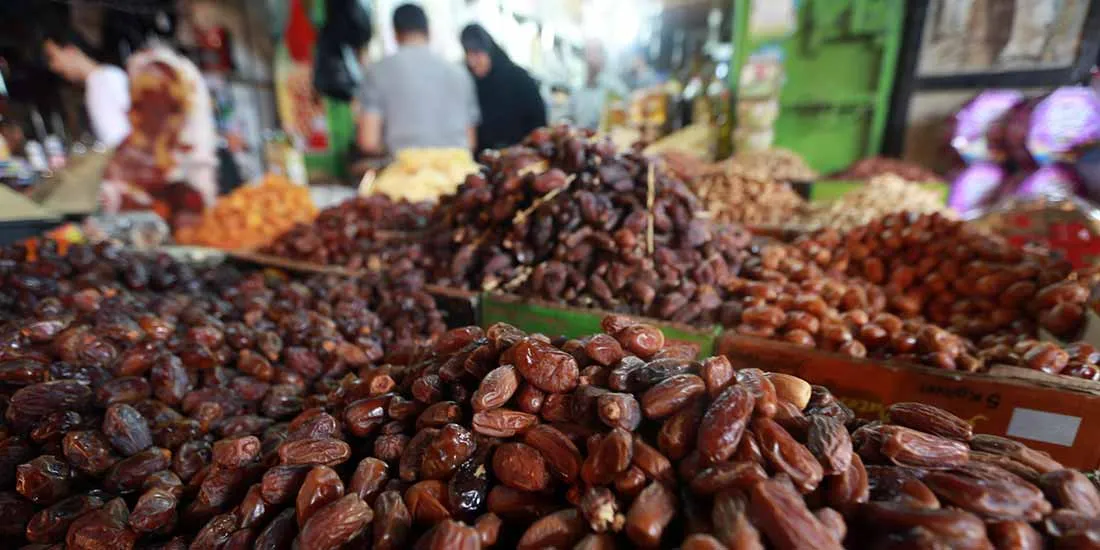
Among the hundreds of types of dates, a few names recur regularly in markets and palm groves.
Mejhoul
Large, fleshy and particularly prized, Mejhoul has become the most famous of Morocco’s dates.
Historically associated with the Tafilalet, it is now the subject of major plantations and propagation programmes. INRA describes it as one of the leading varieties of the Moroccan oases and has devoted a specific research and development programme to it.
Its commercial success should not, however, obscure the fact that it represents only one part of the extraordinary diversity of dates found in southern Morocco.
Boufeggous
Boufeggous is one of Morocco’s great traditional varieties. Its fruit is softer and its flesh relatively low in fibre.
INRA research places it, together with Mejhoul, among the varieties producing fruit of good commercial quality.
It is particularly widespread in the oases of Drâa-Tafilalet.
Jihel and Bouskri
Jihel and Bouskri also form part of the traditional heritage of Morocco’s palm groves.
Their fruits are firmer than Boufeggous and keep relatively well. They have long occupied an important place in the oases of the South, particularly in the Drâa.
Bouslikhane
Less familiar to foreign visitors, Bouslikhane remains important in the Tafilalet. It still accounts for a significant proportion of the palms recorded within the area managed by the Tafilalet agricultural development authority.
Najda
Najda tells a different story.
It was selected by Moroccan agricultural researchers to combine good fruit quality with resistance to Bayoud disease.
Propagated in particular through tissue culture, it has for several years formed part of programmes to restore palm groves. INRA presents it as one of the major achievements of its research into the date palm.
Tasting the dates of the South-East therefore also means discovering different textures, flavours and histories, far beyond Mejhoul alone, which now dominates the export market.
Why did Bayoud disease transform Morocco’s palm groves?
The recent history of Morocco’s oases cannot be understood without mentioning Bayoud disease.
This vascular disease, caused by a soil-borne fungus, attacks the date palm and can eventually kill it. It severely affected Morocco’s palm groves during the twentieth century and particularly damaged some high-quality varieties.
Mejhoul, Boufeggous and Bouskri are among the varieties susceptible to it.
For several decades, Moroccan agricultural research has therefore selected palms capable of resisting Bayoud while still producing good-quality fruit. Najda, Daraâouia, Sedrat, Al-Amal and Al-Fayda are among the genotypes developed or selected through this work.
The fight against Bayoud has also profoundly changed the methods used to propagate date palms, with the development of tissue culture making it possible to produce large numbers of genetically identified plants.
But Bayoud is no longer the only challenge.
Is water scarcity now threatening the oases?
The functioning of an oasis depends entirely on a balance between heat, soil, vegetation and the availability of water.
That balance is becoming increasingly fragile.
Prolonged drought, growing pressure on groundwater, the salinisation of some soils and increasing agricultural demand are affecting many palm groves.
Current research therefore focuses not only on the resistance of the palms themselves, but also on more water-efficient irrigation systems, salinity management and adaptation to water stress. INRA now regards climate change and pressure on water resources as among the main challenges facing Morocco’s oases.
The very theme chosen for the International Date Fair in Erfoud in 2025 was revealing: “Sustainable management of water resources: a basis for the development of date palms and oases.”
The issue goes far beyond the production of a fruit. When water becomes scarce, the entire oasis system is weakened: palms, lower-level crops, livestock, settlements and the communities whose lives depend on them.
Where can you discover the palm groves and dates of south-eastern Morocco?
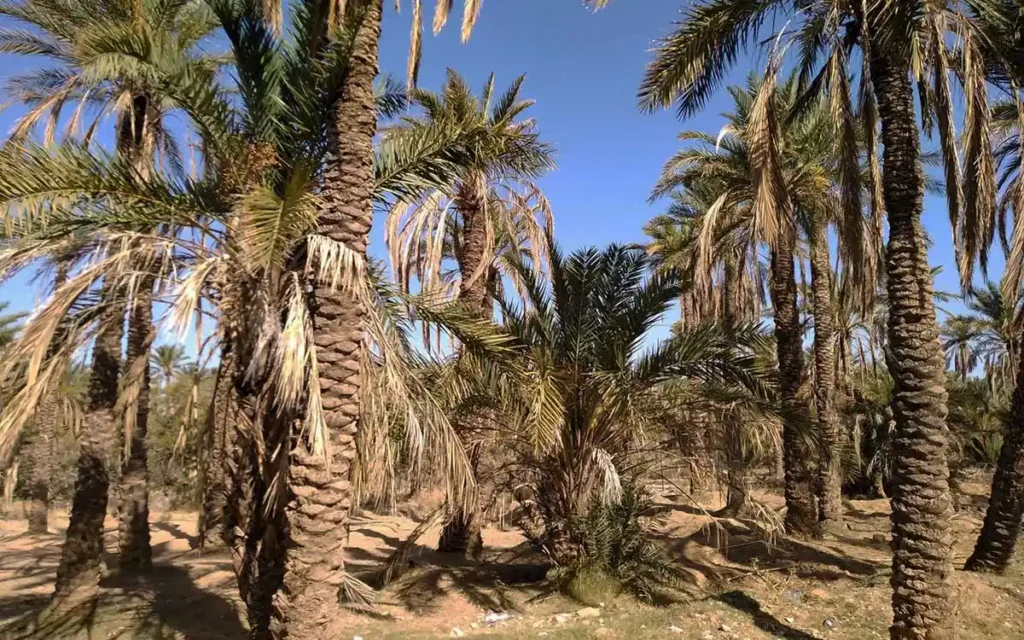
There is no need to visit a specialised plantation to discover the date palm. In several parts of the South-East, palm groves form an integral part of the landscape.
The Drâa Valley
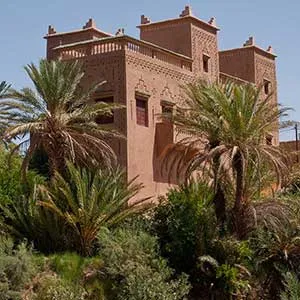
Between Agdz, Zagora and M’Hamid, the Drâa runs through a succession of palm groves, ksour and cultivated plots.
It is probably one of the best regions in which to understand how agriculture follows the river and how villages developed close to irrigated land.
In autumn, ripening bunches and the dates offered in the souks make the presence of the palm particularly visible.
The Ziz Valley and the Tafilalet
Farther east, the Ziz Valley, the palm groves of Aoufous, then Erfoud and Rissani lead into the heart of another major date-growing region.
Here, date cultivation is both ancient and deeply integrated into the contemporary economy.
The contrast can be striking between the densely planted plots of traditional palm groves and newer plantations, where palms are arranged in regular rows and irrigated using modern methods.
Skoura
Near Ouarzazate, the palm grove of Skoura is particularly useful for understanding the structure of a cultivated oasis.
Palms, olive trees, almond trees, cereals and market-garden plots mingle around a particularly dense landscape of earthen architecture.
Date production plays a less central role here than in the Drâa or Tafilalet, but the landscape illustrates the principle of multi-layered oasis agriculture with particular clarity.
Dates take centre stage in Erfoud
Autumn is naturally the season of the harvest and of the arrival of the different varieties on the markets.
In Erfoud, this period is also marked by the International Date Fair in Morocco — SIDATTES. The event brings together producers, cooperatives, researchers, institutions and businesses involved in date-palm cultivation.
The 2025 edition announced around 230 exhibitors and more than 90,000 visitors. A large rahba was devoted to displaying and selling dates and products derived from them.
For travellers, the interest goes beyond the fair itself: this is the time when the diversity of Moroccan dates becomes particularly visible on the stalls of Erfoud and the towns of the Tafilalet.
The date palm is part of our cultural heritage
The date palm provides far more than dates.
Its fronds, leaflets, fibres and other parts of the tree have long been used to make baskets, mats, ropes, roofing elements and everyday objects.
Its cultivation also has its own distinctive practices: planting offshoots, irrigation, pruning, pollination, tending the bunches and harvesting.
Knowledge of agriculture, crafts, collective practices and social customs has thus been passed down around the date palm.
This cultural dimension has received international recognition. Since 2022, “knowledge, skills, traditions and practices associated with the date palm” have been inscribed on UNESCO’s Representative List of the Intangible Cultural Heritage of Humanity, through a multinational nomination involving Morocco and fourteen other countries.
UNESCO highlights in particular the knowledge involved in cultivating the palm, crafts making use of its different parts, the social practices associated with it and their transmission between generations.
This recognition gives the date palm a significance extending far beyond its agricultural value. In south-eastern Morocco, it remains at once a food-producing tree, the living architecture of the oasis and a witness to a way of inhabiting arid lands.
Key points
- The date palm forms the upper level of oasis agriculture and helps protect the crops growing beneath its canopy.
- Drâa-Tafilalet remains Morocco’s leading date-producing region. Date palms have separate male and female trees; hand pollination remains an essential skill in the palm groves.
- Morocco’s oases contain remarkable genetic diversity: more than 450 varieties and clones have been recorded in the Tafilalet area.
- Mejhoul, Boufeggous, Jihel, Bouskri, Bouslikhane and Najda illustrate different histories and qualities.
- Bayoud disease has profoundly transformed Morocco’s palm groves, and researchers have spent decades developing resistant varieties.
- Water scarcity, drought and salinisation are now among the main threats facing the oases.
- Since 2022, the knowledge and skills associated with the date palm have been recognised by UNESCO as intangible cultural heritage of humanity.
A question? Something to share?
Use our contact form.
Discover South-East Morocco