


Why is the Amazigh year 950 years ahead?
When a new Amazigh year begins at Yennayer, its year number is 950 years ahead of the Gregorian calendar: 2026 thus becomes 2976. This figure might suggest that Amazigh people have been counting the years in this way for almost three millennia. That is not the case. North Africa’s agricultural calendar is ancient, but the present-day numbering of Amazigh years is a twentieth-century creation.
An agricultural calendar far older than its year numbering
For centuries, rural populations across the Maghreb organised part of their agricultural work according to a solar calendar derived from the Julian calendar. The names of several months still bear traces of this history: Yennayer, for instance, derives from the Latin Ianuarius, January.
This calendar helped mark the time for sowing and harvesting, periods of cold weather, and days regarded as favourable or dangerous for crops. Over time, it became enriched by local traditions, sayings, observations of the stars and practices specific to different regions of North Africa.
But the years were not numbered from some ancient Amazigh ‘year zero’. The practice of writing 2976, 2977 or 2978 today belongs to a much more recent history.
Read more: Yennayer, the Amazigh New Year
Why was 950 BC chosen?
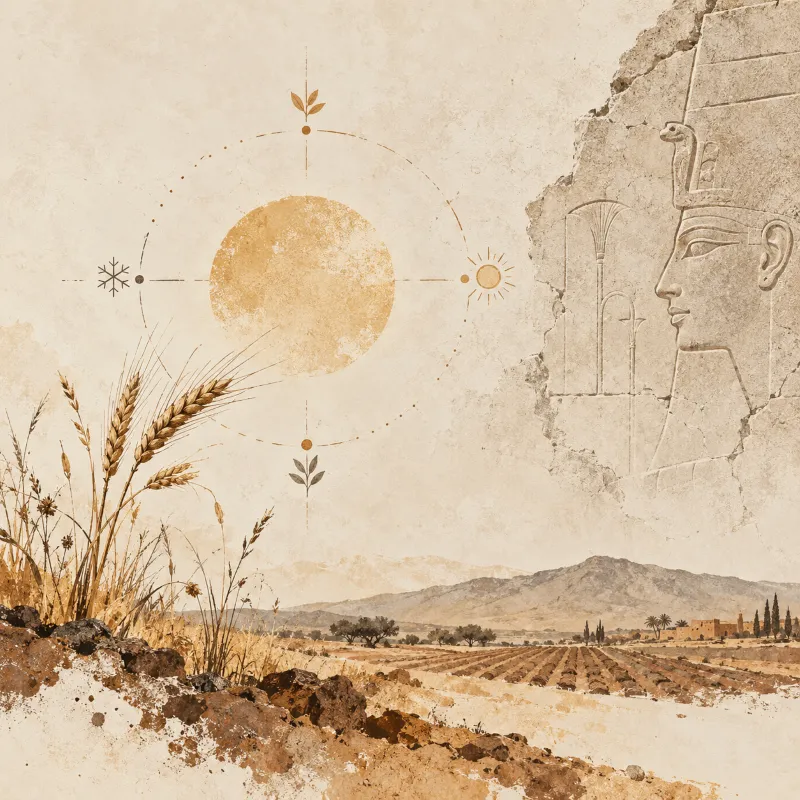
The starting point adopted for the modern system is 950 BC, approximately associated with the accession of Sheshonq I to the throne of Egypt.
Sheshonq came from Libyan populations that had been settled in Egypt for several generations. He became pharaoh and founded the Twenty-second Dynasty. His Libyan origins led the creators of the modern Amazigh calendar to regard him as one of the earliest historically documented figures who could be associated with the Libyco-Berber world.
The date of 950 BC should, however, be understood as a conventional reference point. Current Egyptological chronology generally places the reign of Sheshonq I at around 945 to 924 BC. The intention is therefore not to claim that an ‘Amazigh era’ literally began on a particular day in the year 950 BC.
A system of year numbering created in the twentieth century
The idea of giving the Amazigh calendar its own year numbering emerged within Berber cultural circles in Paris during the second half of the twentieth century.
It is chiefly associated with Ammar Negadi, a Chaoui intellectual and cultural activist. In 1980, he published a calendar bearing the year 2930, calculated by adding 950 years to the Gregorian date.
The principle is simple: 1980 + 950 = 2930. In the same way, 2026 becomes 2976, 2027 becomes 2977, and so on.
This new system gradually spread far beyond the circles in which it had first appeared. Today it is widely used during Yennayer celebrations and in publications devoted to Amazigh culture.
An ancient calendar, a modern era
To say that we are in the year 2976 of the Amazigh calendar does not therefore mean that a continuous count of years has been handed down since the time of Sheshonq.
Two histories meet here.
The first is the much older history of North Africa’s agricultural calendars, its seasons, Yennayer and the rural knowledge associated with the annual cycle.
The second is that of an Amazigh era created in the twentieth century, which chose Sheshonq as its historical and symbolic point of reference.
The distinction matters: the recent origin of the year numbering does nothing to diminish the antiquity of the calendrical practices onto which it was grafted. Rather, it tells us how a culture can take up ancient traditions and, in a new age, give them another framework through which to count time.
Read more: Rites and legends of Yennayer, the Amazigh New Year
Sources
- E.B., M. Gast and J. Delheur, ‘Calendrier’, Encyclopédie berbère, 1992.
- Jean-Pierre Laporte, ‘Sheshonq Ier et le “calendrier berbère”’, Encyclopédie berbère, 2019.
- Metropolitan Museum of Art, documentation on the reign of Sheshonq I.
Explore all features in: The Berber world
Share your knowledge of the Amazigh world
More fragments from the Berber world

Leave a Reply