


Riddle and enigma: a game of the mind in Amazigh tradition
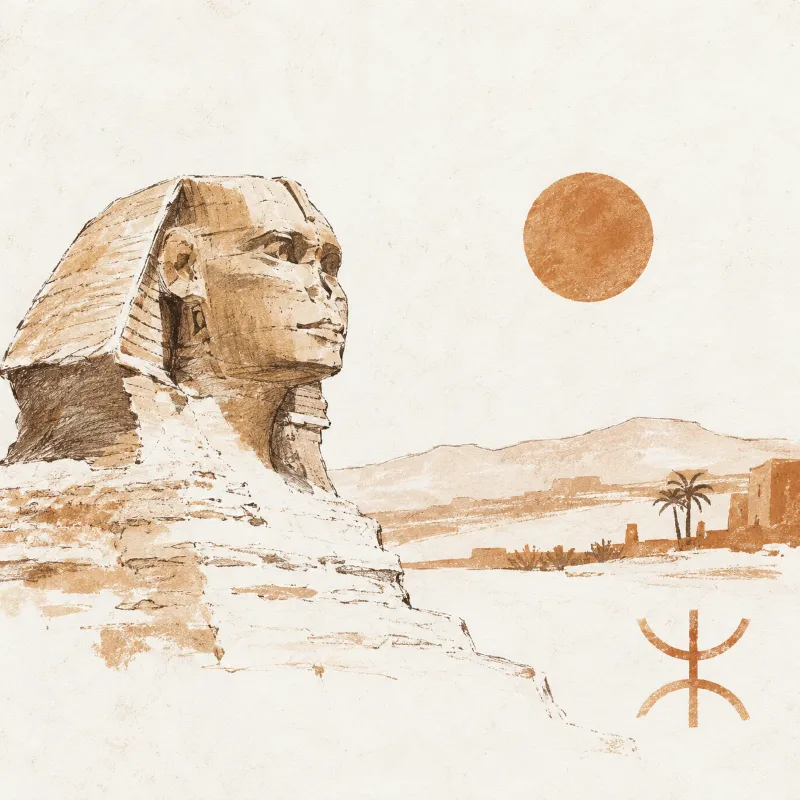
From the Sphinx of ancient Greece to riddles told during evening gatherings in Europe or Africa, human societies everywhere have delighted in concealing a familiar reality behind a few mysterious words. The Amazigh world is no exception. Yet enigmas and riddles are not merely games for passing the time: they teach people to observe, to use language skilfully and to see the world around them differently.
Riddle and enigma: two different forms of wordplay
A distinction can be drawn between the two terms. Moroccan linguist and philologist Abdellah Bounfour, in his study of Tamazight poetic genres included in the Encyclopédie berbère, distinguishes the riddle from the enigma according to three criteria: the function of the game, those who practise it, and its literary form.
The riddle is primarily a game of encoding and decoding: a familiar reality is described indirectly, and the listener must discover what lies behind the image. In Bounfour’s classification, it belongs mainly to the world of children and generally takes a prose form.
The enigma, by contrast, gives greater importance to the aesthetic quality and complexity of its formulation. It is an adult game, sometimes practised by accomplished poets, and takes a verse form. Bounfour sums up this final criterion unequivocally:
“There is no enigma that is not in verse.”
Abdellah Bounfour
This distinction is by no means absolute throughout the Amazigh world: terminology varies from region to region, and authors themselves have not always used the terms in exactly the same way. It does, however, show that we are dealing with several forms of verbal play rather than a single genre. A recent anthology of Berber poetry also points out that the genre of tiɣuniwin — the enigma — remains poorly documented and that classifications of Amazigh poetic genres are not always agreed upon.
The riddle: hiding what everyone knows
Among the Ayt Merghad of South-Eastern Morocco, Ahmed Skounti, professor of anthropology, collected a body of tineẓẓra — riddles transmitted in Tamazight — in the early 1990s.
One of them simply says:
“Two young girls supporting an old man.”
The image refers to the nomadic tent: the two upright poles supporting it become two young girls, while the long ridge pole takes on the features of the old man. Skounti himself uses this riddle again when describing the architecture of the tent.
The entire mechanism of the riddle is contained in these few words. Someone familiar with the tent sees its components every day; yet language transforms them until, for a moment, they become strange.
What is already known must suddenly be looked at differently.
The Encyclopédie berbère emphasises this close relationship between riddles and everyday life: the home, the human body, water, the sun, animals and familiar objects provide much of their imagery. The evening gathering thus becomes both a form of entertainment and a way of testing a child’s ability to recognise their own environment when it is presented indirectly.
The enigma: when language becomes a knot
With the enigma in the strict sense, the game moves into another register.
Émile Laoust had already recorded, in his Cours de berbère marocain, a formula used among the Ayt Ndhir: qqenx-ac, “I close it for you”, to introduce more complex enigmas using veiled expressions. His book in fact devotes several pages to these forms of wordplay.
The expression would later acquire particular significance in the study of Amazigh oral literature. Abdellah Bounfour links qqenx-ac with tiɣuniwin, the plural of taɣuni, “the act of knotting, of closing”. The image is striking: posing an enigma means closing or knotting language so that someone else may try to open it again.
Laoust also collected forms closer to the riddle. One begins:
“I have one for you: I carry words, but I do not speak.”
The answer is a letter.
Another says:
“I have one for you: I crossed the water without getting wet.”
The answer is a shadow.
These two examples still belong to the riddle: a familiar reality is concealed behind an image that has to be deciphered. With the versified enigma, however, the game becomes more elaborate.
These few examples also show why the boundary between genres must be handled with care. Laoust was primarily recording living forms of language and oral literature; later analysis gradually drew a clearer distinction between the prose riddle and the more elaborate, versified enigma practised by adults.
In the latter, it is no longer simply a matter of hiding an object behind an ingenious comparison. The composition itself matters: language becomes part of the game. The riddle primarily asks us to find; the enigma also invites us to admire the way in which the answer has been concealed.
Learning to think through play
There is nothing exclusively Amazigh about these games.
In many societies with strong oral traditions, riddles combine entertainment, learning and knowledge of the surrounding world. An ethnographic study among the Guji of Ethiopia, for example, shows children using riddles both to play together and to learn how to observe their social and natural environment.
The references vary from one culture to another. Here it may be a tent; elsewhere a plant, an animal, a tool or a natural phenomenon. Yet the mechanism is remarkably universal: take something everyone knows, conceal it behind another image, and challenge someone else’s intelligence to recognise it.
This is already what the riddle of the Sphinx does when it transforms the stages of human life into a creature that walks successively on four, two and then three legs.
Amazigh tradition adds a particularly evocative metaphor: the knot.
Language knots reality. It is for the listener to untie it.
Sources
- Azdoud, Driss & Peyron, Michaël, “Devinettes”, Encyclopédie berbère, vol. XV, 1995.
- Bounfour, Abdellah, Introduction à la littérature berbère. I. La poésie, Peeters, Paris-Louvain, 1999.
- Skounti, Ahmed, “Tineẓẓra. Devinettes des Ayt Merghad (Tamazight, Sud-Est marocain)”, Études et Documents Berbères, no. 10, 1993, pp. 129–134.
- Azdoud, Driss, Choix d’énigmes amazighes, IRCAM, Rabat, 2023, 262 pp.
- Bentolila, Fernand (ed.), Devinettes berbères, vols. 1–3, CILF, Paris, 1986.
Explore all features in: The Berber world
Share your knowledge of the Amazigh world
More fragments from the Berber world

Leave a Reply