


The aneflous, a figure of trust among the Berbers
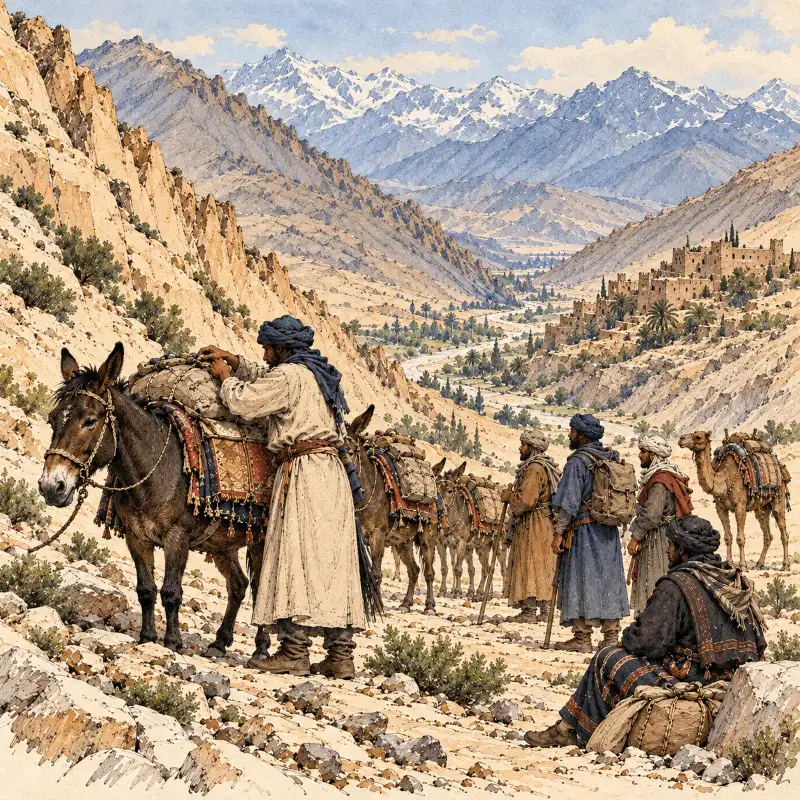
Before setting out for Marrakech, travellers waited for one man to load his animals first. This man, known as the aneflous, gave the signal for departures and halts. His very name evokes trust. In the accounts collected by Émile Laoust in the early twentieth century, this figure also appears at the beginning of agricultural work and other collective undertakings, where success depended as much on the actions performed as on the trust placed in the person who initiated them.
Émile Laoust calls this man the aneflous n-umuddu. In Mots et choses berbères, published in 1920, the French linguist and ethnographer describes him as both a guide and a bringer of good fortune. Travellers believe him to possess baraka, a blessing that should enable them to pass safely through territories where they fear encountering bandits.
The detail is remarkable: the caravan is set in motion by the gesture of a single man, in whom all the others place their trust.
A word that speaks of trust
The very name aneflous sheds light on this figure’s role.
Laoust traces it to the Amazigh root FLS, associated with the notions of faith and trust. He cites, in particular, the verb efles, meaning ‘to have faith in, to trust’, and taflest, meaning ‘faith, trust’. He explicitly rejects any connection with the word flus, meaning ‘money’.
This linguistic relationship is also found in later studies. In his Dictionnaire des racines berbères communes, Mohand Akli Haddadou records the root FLS in connection with the notions of faith and trust. More recently, Miloud Taïfi, in his Dictionnaire raisonné berbère-français. Parlers du Maroc (2016), defines aneflus as an ‘honest, trustworthy person’.
Another meaning deserves attention. In his Cours de berbère marocain, published in 1921, Laoust also translates aneflous as ‘arbitrator’, deriving it from the verb fles, to trust.
This last definition opens up another perspective. An arbitrator is someone to whom people agree to entrust a decision or the resolution of a dispute. Their authority does not necessarily derive from force or imposed power, but from the confidence placed in their judgement.
This does not mean that the aneflous accompanying caravans exercised a judicial function. Laoust’s accounts do not allow us to make such a claim. But the relationship between these different meanings reveals a shared field of associations: the aneflous is, above all, a man who can be relied upon.
The man who ploughs the first furrow
To understand this figure, we must leave the caravan routes for a moment and turn to the fields.
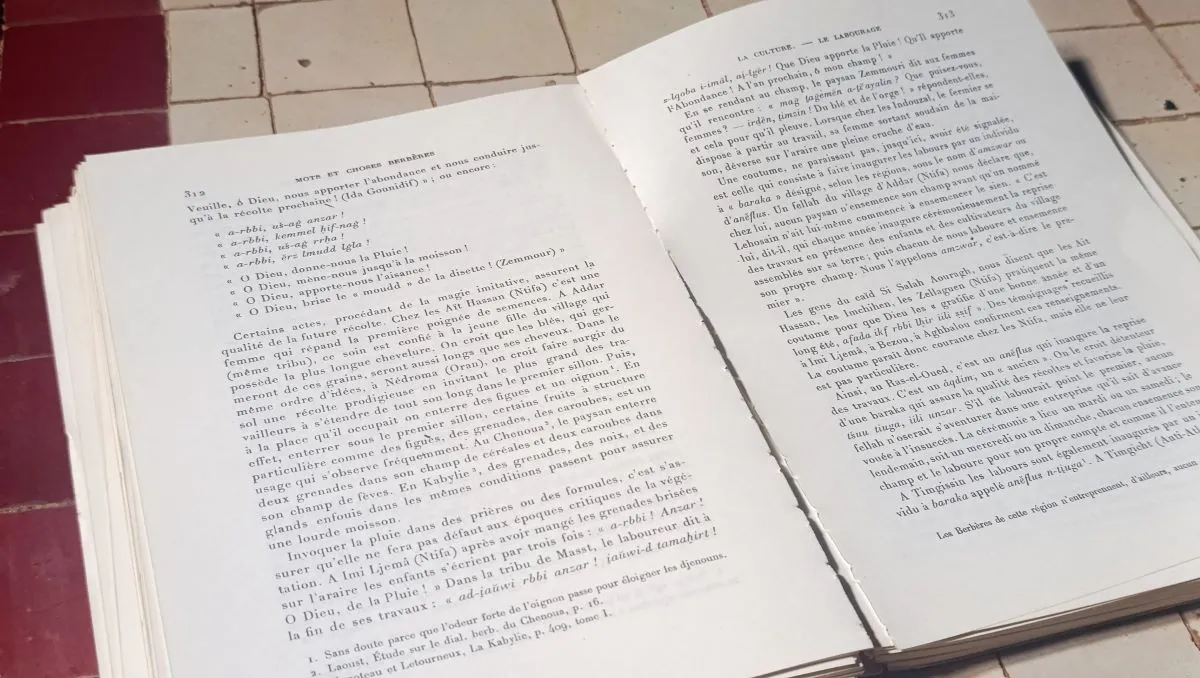
Laoust recounts that in Addar, among the Ntifa, no farmer begins sowing his land until a man named Lehosain has inaugurated the work. The villagers gather in his field, together with the children, to witness this first act of cultivation. Only then does each farmer return to plough and sow his own plot.
This man is called amzwar, ‘the first’.
In Ras-el-Oued, the person entrusted with opening the ploughing season bears another name: aneflous. He is an elder, an aqdim, whom the farmers believe to possess a baraka favourable to the harvest and the rain. Here too, no one wishes to begin before him.
Laoust also records the presence of an aneflous who inaugurates the ploughing at Timgissin, in the territory of the Tlit, between the Jebel Bani and the Foum Zguid region.
These accounts reveal local variations, yet the same principle seems to connect them: the beginning of certain undertakings is entrusted to a person whose intervention inspires confidence and is expected to favour their success.
The first furrow is therefore more than an agricultural operation. It also marks the moment when a collective activity can begin.
Trust in the face of uncertainty
What farmers hope for in a good harvest, travellers hope for in a journey free from danger.
In both situations, the future remains uncertain. The rains may fail, the seeds may not germinate, travellers may encounter difficulties along the way. In the eyes of those who must face these risks, practical skill alone is not always enough to ensure the success of their undertaking.
The aneflous stands at this boundary between human action and uncertainty.
His baraka is not necessarily that of a saint. Laoust reports that certain individuals were believed to have received from God a particular gift for bringing success. Their presence reassured those embarking on an undertaking whose outcome could not be guaranteed.
This trust also has a very practical dimension. On the road to Marrakech, the aneflous directs the collective movement. He gives the signal to set off and the signal to stop. The other travellers follow his example when loading and unloading their animals.
Belief and practical organisation thus come together in a single figure, although Laoust’s account alone does not allow us to determine the precise extent of his authority.
Trust does not remove the need for action. On the contrary, it allows action to begin, giving each person the assurance that the others will follow.
The one who begins for others
Laoust’s note provides two further examples.
During a military expedition, an aneflous marches at the head of the fighters. He carries the standard and fires the first rifle shots. He is believed to possess a baraka capable of protecting him and favouring victory.
At large gatherings of singers from friendly tribes, another aneflous gives the signal for the singing to begin with his tambourine.
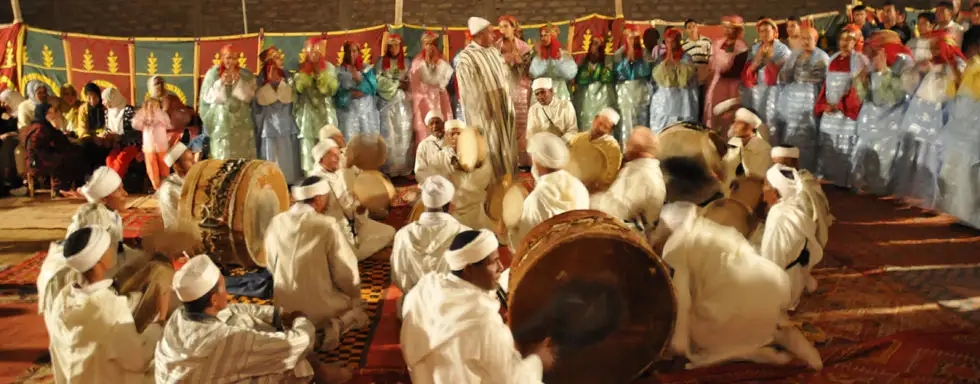
The opening gesture changes according to the circumstances. Here, a furrow; there, an animal loaded for the journey; elsewhere, a rifle shot or the first beat of a tambourine. In each of these examples, one individual performs an action that the others await before undertaking their own.
Laoust goes further in his interpretation. He imagines that these figures might be the heirs of ancient religious officiants, or even ‘agrarian kings’ whose rituals once ensured the prosperity of their communities. But this genealogy remains conjectural. Nothing in the accounts presented allows such a historical continuity to be demonstrated.
Nor is it possible to conclude that all Amazigh communities recognised an identical institution, or that the different functions described were performed by the same type of figure everywhere and at every period.
What Laoust allows us to glimpse is both more modest and more tangible: in certain contexts, a collective undertaking did not begin simply when everyone was ready. It awaited the intervention of a man recognised as having the capacity to lead the way.
And the etymology of the word lends these scenes a particular depth. Perhaps it is not because he begins that the others trust him, but because they trust him that they allow him to begin.
Sources
- Émile Laoust, Mots et choses berbères. Notes de linguistique et d’ethnographie, dialectes du Maroc, Paris, Augustin Challamel, 1920, Chapter VII, pp. 313–315, particularly the note on p. 314. Digitised edition on Gallica.
- Émile Laoust, Cours de berbère marocain. Dialectes du Sous, du Haut et de l’Anti-Atlas, 1921, section on agent nouns, anX form, entry aneflous.
- Mohand Akli Haddadou, Dictionnaire des racines berbères communes, entry FLS, p. 56. Consult the dictionary.
- Miloud Taïfi, Dictionnaire raisonné berbère-français. Parlers du Maroc, Rabat, IRCAM, 2016, entry FLS1. Publication details from IRCAM.
Explore all features in: The Berber world
Share your knowledge of the Amazigh world
More fragments from the Berber world


Leave a Reply