


Tifinagh: a symbol of Amazigh culture through the ages
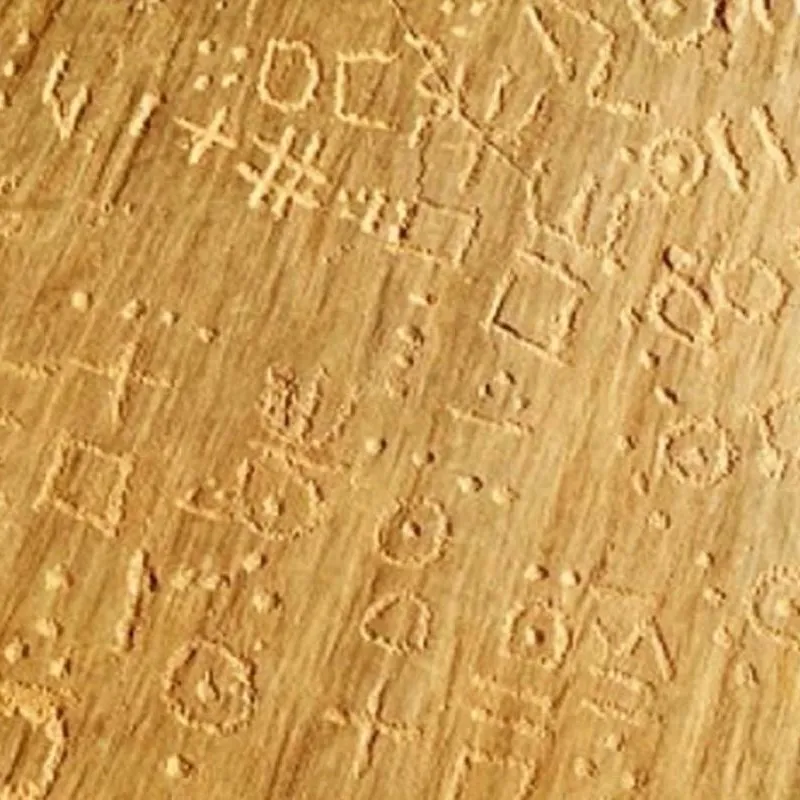
From ancient Libyco-Berber inscriptions to the Tifinagh taught in Morocco today, this script has a long history that remains partly mysterious. Preserved for centuries, notably in the Tuareg world, it has become one of the most visible symbols of contemporary Amazigh culture.
A script rooted in ancient North Africa
The history of Tifinagh is linked to that of the ancient Libyco-Berber scripts, attested in North Africa since Antiquity. Their geometric signs appear in inscriptions carved into stone, sometimes alongside representations of people or animals, from the Maghreb to the Sahara.
These ancient alphabets existed in several regional variants, traditionally distinguished in particular as eastern and western Libyco-Berber. Their exact history, chronology and the relationships between their different forms nevertheless remain the subject of research.
The Tifinagh later used in Saharan regions, particularly among the Tuareg, belongs to this long graphic tradition. It is therefore one of the rare North African writing systems whose use has continued across the centuries in successive forms.
Where does Tifinagh come from?
The origin of the Libyco-Berber alphabets remains debated.
For a long time, many scholars favoured the hypothesis of Phoenician or Punic influence, linked to ancient contacts between North African populations and the Carthaginian world. Others have argued for an essentially local development, possibly shaped by outside influences.
None of these hypotheses is sufficient on its own to explain what was probably a more complex history. Similarities between certain Punic and Libyco-Berber characters have fuelled the debate, while other signs appear to reflect developments specific to North African societies.
The etymology of the word Tifinagh itself is also uncertain. A popular interpretation connects it with tifi, meaning ‘find’ or ‘discovery’, and nnegh, ‘our’, giving the poetic meaning ‘our discovery’. This attractive explanation, however, is not considered proven. Another hypothesis links the term with the word ‘Punic’, again without any definitive certainty.
From the Tuareg world to modern Tifinagh
While the use of ancient Libyco-Berber scripts disappeared from much of the Maghreb, Tifinagh survived in the Sahara, particularly among Tuareg populations. There it continued to be used for inscriptions, messages and various forms of written expression, preserving an ancient graphic tradition.
In Morocco, a new stage began at the start of the twenty-first century. In 2003, Tifinagh was adopted as the official script for the Amazigh language. The Royal Institute of Amazigh Culture — IRCAM — then developed a standardised alphabet of 33 characters, intended notably for education.
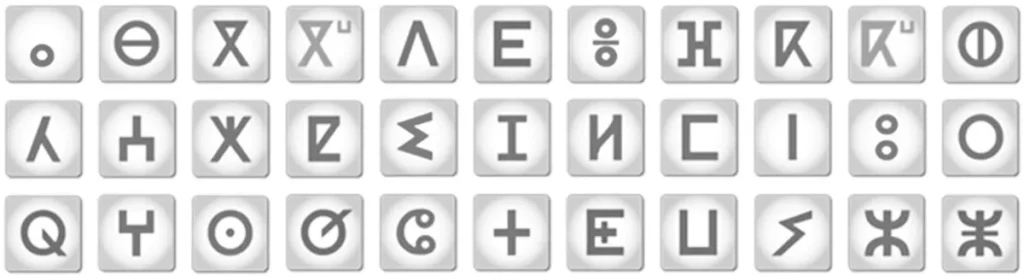
Its inclusion in the Unicode Standard in 2005 subsequently enabled its use in computer systems and digital tools. The Unicode block also includes characters used for other forms of Tifinagh, particularly Tuareg variants.
An alphabet that became a symbol
The recognition of Amazigh as an official language of Morocco in 2011 gave Tifinagh a new visibility. Moroccan legislation subsequently confirmed its adoption for writing and reading the Amazigh language.
It can now be seen in education, on public buildings, in signage, the media and many digital formats.
Yet its significance goes far beyond its practical function as an alphabet. Tifinagh has become one of the most immediately recognisable symbols of contemporary Amazigh identity. This symbolic dimension is all the more powerful because it is rooted in a much older graphic tradition.
Between ancient inscriptions, Tuareg continuity and contemporary revival, Tifinagh thus connects several periods of Amazigh history, even though not every stage of that history is yet fully understood.
Read also: Tifinagh, the Berber singularity engraved through time
Explore all features in: The Berber world
Share your knowledge of the Amazigh world
More fragments from the Berber world

Leave a Reply