


The Idols of Taliza, two forgotten divinities of Ashura
In a small locked temple in Taliza, two wooden idols sleep throughout the year. Only one festival brings them out: Ashura. In 1920, Émile Laoust gives a striking description of the ritual — a sacrifice, a strangely unclothed man amid the jeers of the crowd, a great bonfire, and two divinities whose identity he himself is still trying to understand.
A sacrifice, a bonfire, a night apart
Emile Laoust also notes several indications of the possible agricultural origin of the sacrifice: the cow is bought with the proceeds from grain collected on the threshing floors at the time of threshing, and a comparable ceremony was still observed among neighbours of the Aït Isaffen, at the end of the harvest.
Daoud Ou Brahim, the strange high priest
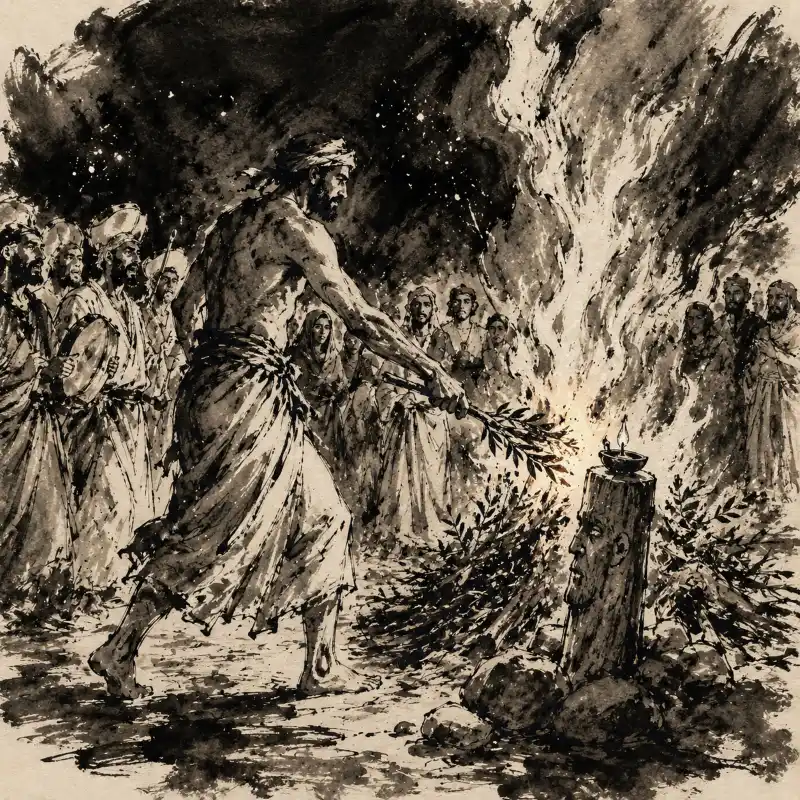
The following evening, a man named Daoud Ou Brahim appears, whom Laoust compares to “some high priest of a lost cult”. He enjoys a singular privilege: each year, he alone may light the Ashura bonfire with an olivewood brand that he has prepared himself several days beforehand.
His role requires him to appear that night largely naked, stripped to above the navel; it is even said that he is forbidden to remove his body hair, contrary to Muslim custom. Greeted with shouts and jeers, he nevertheless walks impassively between the two lines of men and women, the burning brand in his hand.
He first sets fire to the dry grasses piled up in the square. The flames light up his body; the “first” women of the village — those whose sons bear the name of the Prophet — then leap three times over the fire, each time uttering a wild cry.
Laoust himself admits that the meaning of this first part of the ceremony largely escapes him.
The first idol, the one of fire
Daoud Ou Brahim then returns home to put on his finest clothes. During his absence, an attendant is given the key to the small temple where the two wooden idols are kept, and where they remain hidden from the village except during these festivities.
The first is a simple cylindrical piece of fig wood, around eighty centimetres long, with a small stick fixed obliquely at one end. The inhabitants call it “the finger”. Legend attributes a sacred origin to the wood from which it was made: a pious pilgrim is said to have brought it back from Mecca long ago.
The attendant removes the idol from its niche and vigorously rubs it with green barley — or, depending on the season, with a plant growing in the irrigation channels. For Laoust, this green colour may recall the agricultural character of the divinity, the renewed vigour of vegetation, or the fertile forces of spring.
A small lamp is lit, then a new procession forms. The attendant carries the idol on his shoulder; behind him comes Daoud Ou Brahim, now dressed in white, still holding his olivewood brand. Tambourines and songs accompany the procession to the great bonfire.
Alone, the man whom Laoust now calls the high priest approaches it and sets it alight with his sacred brand. He then repeats three times:
“There is no divinity but Allah.”
The idol is then erected facing the flames, in a pile of stones, with its small burning lamp placed upon it.
Smoke, omens and the evil cast away
Around the fire, everyone watches the first smoke. Its direction foretells the year to come: if it is blown eastwards, the year will be good; if towards the west or north, it will be bad.
As the flames rise into the night, young and old, men and women, run three times around the bonfire, always to the right, while repeating a formula whose opening words had already lost their meaning for the people of Taliza in Laoust’s time:
“Ater Oumater! Everything turns around the world!”
Laoust himself wonders about these words, already obscure, and very cautiously puts forward the hypothesis of a very ancient solar rite.
This is also the moment chosen by wives who have not yet experienced motherhood to slip their ring over the idol’s “finger”. They leave it there for a moment before taking it back, hoping in this way to break the supposed spell keeping them childless.
Then, as the fire dies down, one final gesture remains: each person throws onto the embers a handful of the snails gathered by the children during the day, saying:
“Depart with your evil!”
The crowd then returns to the village in a mood of sadness and contemplation that contrasts with the cries, songs and jeers of the outward procession.
The second idol, the Bride of Water
The festivities begin again at dawn the following morning. The young men go down to the river to bathe and splash one another ritually: the rites of fire give way to those of water.
A woman named Aïcha Laser then enters the small temple and brings out the second idol. It bears the name Taslit, the “Bride”. More clearly anthropomorphic than the first, it consists of an almond-wood stick ending in two small pieces of wood representing legs.
Aïcha Laser washes it with water from the river in which the young men have just bathed, then dresses it in rich fabrics. The idol is carried to the public square, where it presides over the women’s dances and songs until evening.
Its role ends there. At the end of the day, it returns to its niche and will not emerge again until the following Ashura.
Two figures, one mystery
Laoust suggests that these two idols may be understood as two complementary figures. The first would be a male divinity associated with the rites of fire; the second, the Taslit, would preside over the rites of water, another element of fertility. But he never presents this identification as certain.
With caution, he draws a parallel between the two figures of Taliza and the couple formed elsewhere by Tlgonja and Anzar, the Rain: in some rituals, the two effigies form a united couple and are invoked together; in Taliza, by contrast, the two idols appear separately and each receives its own acts of devotion.
For Emile Laoust, rain rites, fertility rites and rites linked to the renewal of vegetation thus seem to belong to the same symbolic world, of which, by the beginning of the twentieth century, he was already finding only scattered fragments.
And that is perhaps what makes the ceremony of Taliza so fascinating: when Laoust describes it in 1920, the gestures are still being performed, the two idols still emerge from their temple, the chants are still being spoken — yet part of their meaning has already been lost.
Read also: Taghonja, the Berber bride of rain
Read also: Ali the Hooded One, fugitive of the rain
Editor’s note
This article is based on the chapter “Le Temps, l’Atmosphère, le Ciel” in Émile Laoust’s Mots et choses berbères (1920).
What Laoust encountered at Taliza was not simply a piece of local folklore: it was a system built around two figures, fire and water, corresponding point by point to that of Anzar and Taghonja. Read alongside the other articles in this series, it allows a single Amazigh cosmology to emerge behind different names and different villages.
Explore all features in: The Berber world
Share your knowledge of the Amazigh world
More fragments from the Berber world

Leave a Reply