


The berber fibula: between tradition and symbol
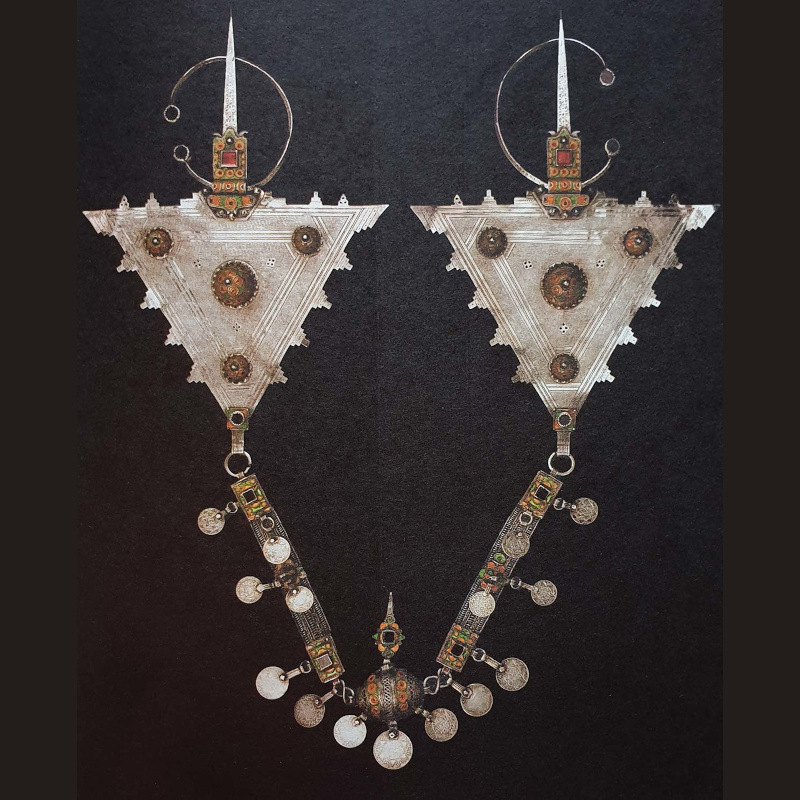
From a simple clothing pin to the centrepiece of a bride’s dowry, the Berber fibula is far more than an ornament. Across the Maghreb, this Amazigh jewel — known by different names depending on the region — has been used to fasten garments, has been associated with the fertility of the herd, and has carried the memory of entire lineages. This is the story of how a simple piece of metal became one of the most enduring symbols of Berber culture.
A single object, many names
Long before the appearance of the metal fibula, thorns and pins were already used to fasten garments. In prehistoric North Africa, bone pins are attested from Capsian and Neolithic contexts. The earliest known metal fibulae in North Africa appear in the Bronze Age, notably at Béni Messous, near Algiers. Similar objects are later found in ancient Egypt and the Near East, and among the Etruscans, Greeks and Romans, who used them to fasten garments. Vikings wore disc-shaped brooches to secure their cloaks. The fibula is therefore an almost universal object. What distinguishes it in the Berber world is the density of meaning it eventually came to carry.
Far more than a clasp
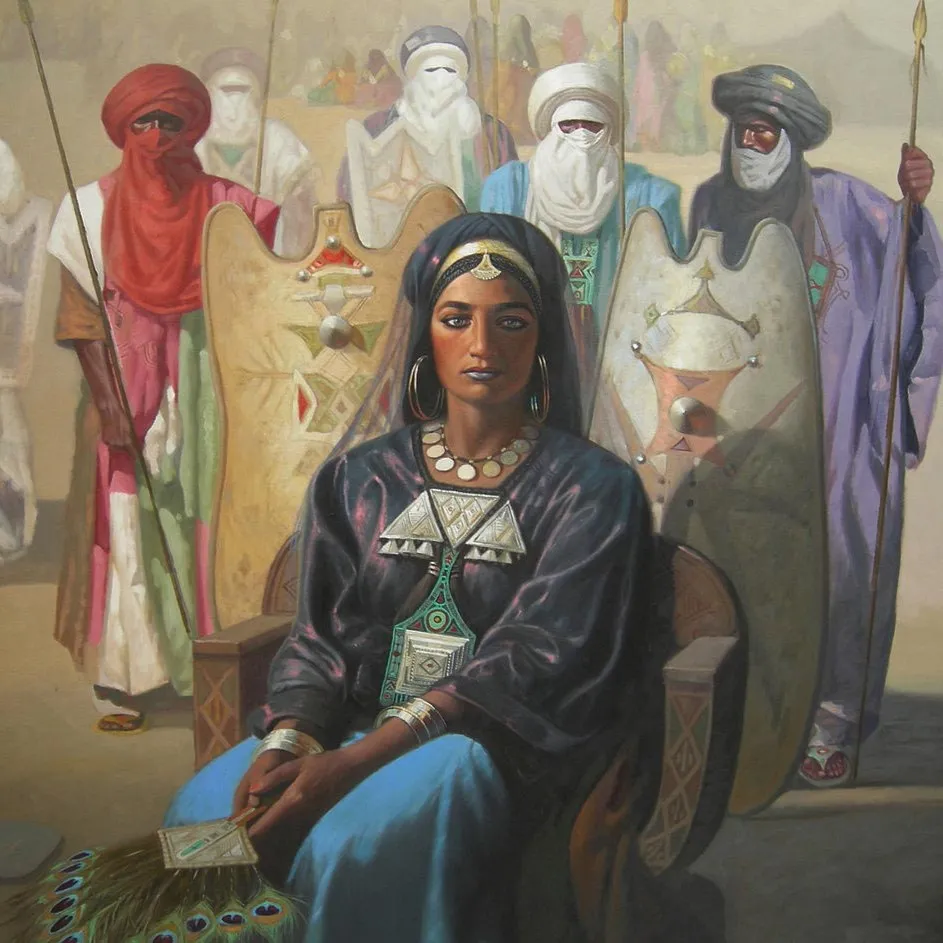
Its primary purpose is practical: the fibula holds fabric in place against the body. Berber women wear it in several ways — in the hair to secure a headscarf, on the chest as a decorative piece, or in pairs at the shoulders to hold the tasselmamt, that broad panel of cloth draped across the back. Simple, effective, indispensable — a safety pin elevated to the rank of jewellery.
Émile Laoust gives a particularly concrete picture of this in his book Mots et choses berbères, published in 1920. Among the Ntifa, he records the term tazerzit, plural tizerzai, derived from rzi, “to pin”. Wealthier women used silver fibulae to hold their garments at the shoulders; poorer women simply replaced them with long thorns. Between the plant thorn and the silver jewel, exactly the same gesture remains: fastening the cloth.
But what, then, is the meaning of the Berber fibula? There is no single answer. Depending on the region and the context in which it is used, it may be a marker of belonging, a sign of wealth, a piece of dowry, an object passed down through the family and, at times, a vehicle for symbolic protection. Its meaning therefore lies less in any isolated symbol than in the place it occupies in the lives of women and of the community.
But the fibula quickly transcends its utilitarian function. In certain communities of the western High Atlas, a recorded ritual thus associated the object with animal fertility: when a young heifer entered a household for the first time, the mistress of the house placed a silver fibula on the threshold. The animal had to step over it as it passed through. The gesture symbolically associated the fibula with the animal’s fertility and the prosperity of the household. A simple jewel — and yet a mediator between the material world and a realm of protective representations.
Read also: Tifinagh, from stone to digital, the living alphabet of the Amazigh world
Tribal marker, piece of dowry
It is perhaps in its social dimension that the fibula most fully reveals its depth. As architect and researcher Salima Naji writes in Les Cahiers du Musée Berbère, the fibula visually embodies the feminine in its most fundamental attributes. It is first and foremost a marker of tribal belonging, a visible sign of the wealth and standing of the tribe to which its wearer belongs.
This social weight reaches its height in the wedding ritual. The pair of fibulae forms the centrepiece of the dowry — the lqimt — provided by the father to accompany his daughter. It is not chosen at random: its materials, its size, its ornaments speak of who one is, where one comes from, what alliance is being sealed. To wear one’s mother’s fibula is to wear the identity of one’s lineage.
In certain Berber families, ancient fibulae are passed down from generation to generation as a family inheritance. They carry with them the memory of the women who owned them and may retain, depending on local practices and traditions, a protective or symbolic value.
Émile Laoust takes this social reading of jewellery even further. Among the Ntifa whom he observed in the early twentieth century, wealth was expressed more through jewellery than through clothing itself. The jewellery intended for a bride was even inventoried by weight: the quantity of silver literally became the measure of its value.
What the materials say
The Berber fibula comes in a wide variety of forms — lozenge, circle, triangle, crescent — depending on the region and the era. But it is the materials that reveal its full symbolic complexity.
Silver dominates. It is the noble material of Berber jewellery and has been associated, depending on the region and the tradition, with different protective or symbolic values. The silversmiths who specialised in this work mastered techniques of casting, repoussé and granulation passed down through generations. They held a particular social position: both indispensable and set apart, sometimes belonging to distinct communities within Amazigh society.
Red coral holds a place of its own. Obtained through Mediterranean trade, it served not only as decoration: protective virtues against the evil eye were traditionally attributed to it. Combined with semi-precious stones and geometric motifs — spirals, lozenges, dots — it could contribute to the protective dimension attributed to the jewel.
Geometric motifs may also carry protective or symbolic meanings, but their significance varies considerably according to region, period and use. It would therefore be misleading to interpret them as a single, immutable Amazigh code.
Émile Laoust, in Mots et choses berbères (1920), offers a valuable nuance here. By the early twentieth century, he considered that Berber jewellery had already largely lost its former magico-religious function and was no longer systematically worn as a talisman. He nevertheless observed that certain symbolic meanings remained very much alive: an ornament could signal motherhood, accompany marriage or take part in rites connected with fertility. Amazigh jewellery therefore belongs neither to mere decoration nor to a single, fixed symbolic language: its meanings change with practices, territories and periods.
A craft under threat
Today, the Berber fibula faces a paradox. It attracts growing interest in the worlds of fashion and design — Western designers draw inspiration from it, tourists seek it out in the souks, and online platforms offer industrial copies produced far from the Maghreb, reproducing its forms while detaching them from their history.
Meanwhile, the silversmiths who still master the traditional techniques of silver jewellery are becoming fewer. Ancient fibulae leave Berber families for the antique dealers of Marrakech or private European collections. Transmission is breaking down, silently.
This is precisely why the fibula deserves better than a place in a display case or an ethnic fashion photograph. It deserves to be understood for what it is: an object-world, where body, family, tribe, memory and the invisible all come together.
Also in The Berber World: : The art of feminine hairstyles among the Aït Atta — another perspective on adornment and identity in the Amazigh world.
Sources
- Salima Naji, “Une esthétique de la protection”, in Les Cahiers du Musée Berbère, no. 1, Jardin Majorelle, Marrakech.
- H. Camps-Fabrer, “Fibule”, Encyclopédie berbère.
- Cynthia Becker, “Amazigh Kabyle brooches (fibulae)”, Smarthistory.
- Émile Laoust, Mots et choses berbères. Notes de linguistique et d’ethnographie, dialectes du Maroc, Paris, Augustin Challamel, 1920.
Explore all features in: The Berber world
Share your knowledge of the Amazigh world
More fragments from the Berber world

Leave a Reply