


The luzia: when chance shared out the meat
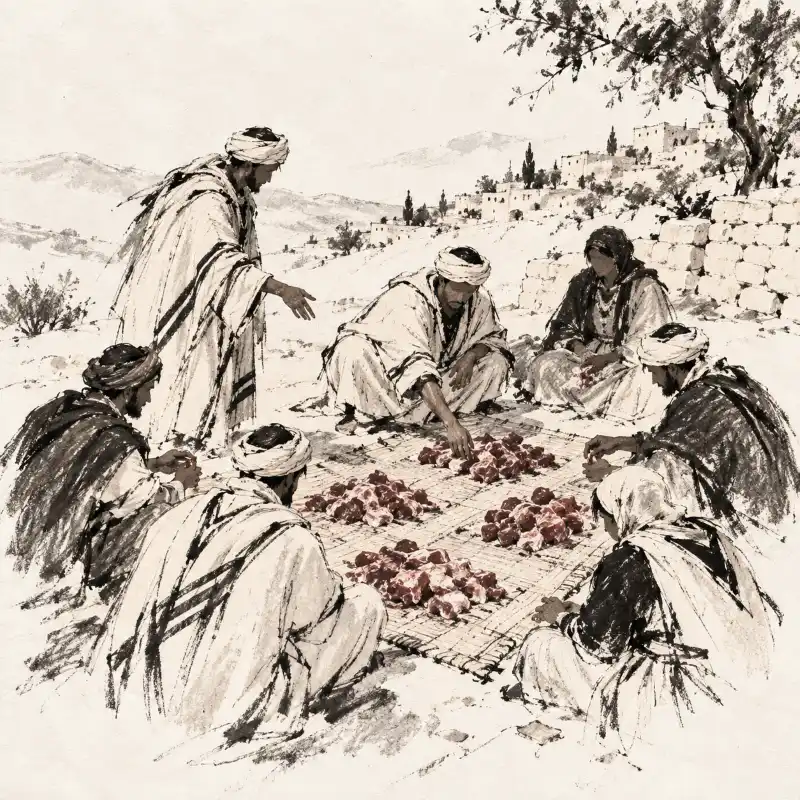
On a mat, pieces of meat have already been arranged into portions. No one will choose their own. A small stick, a stone and chance will decide. In Mots et choses berbères, Émile Laoust described this ancient communal practice known as luzia in 1920, a custom in which sharing meat also meant organising trust between people.
A small stick to prevent disputes
The animal has been bought jointly, slaughtered and cut up. The butcher has prepared the portions, taking into account the number of people in each household. The tripe has been prepared separately.
When everything is ready, he calls out:
“ha Ihir-àd ikemmël! skrât ilan-nnun !”
Mots et choses berbères – Émile Laoust
“There, it’s done! Get your sticks ready for drawing lots!”
Each person has a marker they can recognise: a small stone or a piece of wood, either long or short.
One man stands apart, his eyes closed. The markers are mixed together, then placed one by one on the portions.
No one can therefore point to the piece they would prefer.
Laoust himself explains the reason for this procedure: in this way, “all disputes are avoided”.
In the luzia, chance does not replace fair sharing: it protects it. The portions have already been prepared; the drawing of lots simply prevents personal preference from giving rise to suspicion.
Buying together before the money has been paid
But sharing the meat is only part of the arrangement.
Even before the animal is purchased, the seller demands that one man act as guarantor for the entire group. Laoust calls him the damen.
“kfâl-i ma-ii-l-ëdman iqàridn-inu !”
Mots et choses berbères – Émile Laoust
“Find me a damen!”
The guarantor gives his word. He takes responsibility for the others’ payments and, when the agreed deadline arrives, goes from house to house collecting the money.
It may even happen that the meat has long since been eaten while some portions remain unpaid for. Anyone experiencing difficulties then asks the damen to wait until the next market, where they hope to sell something to settle their debt.
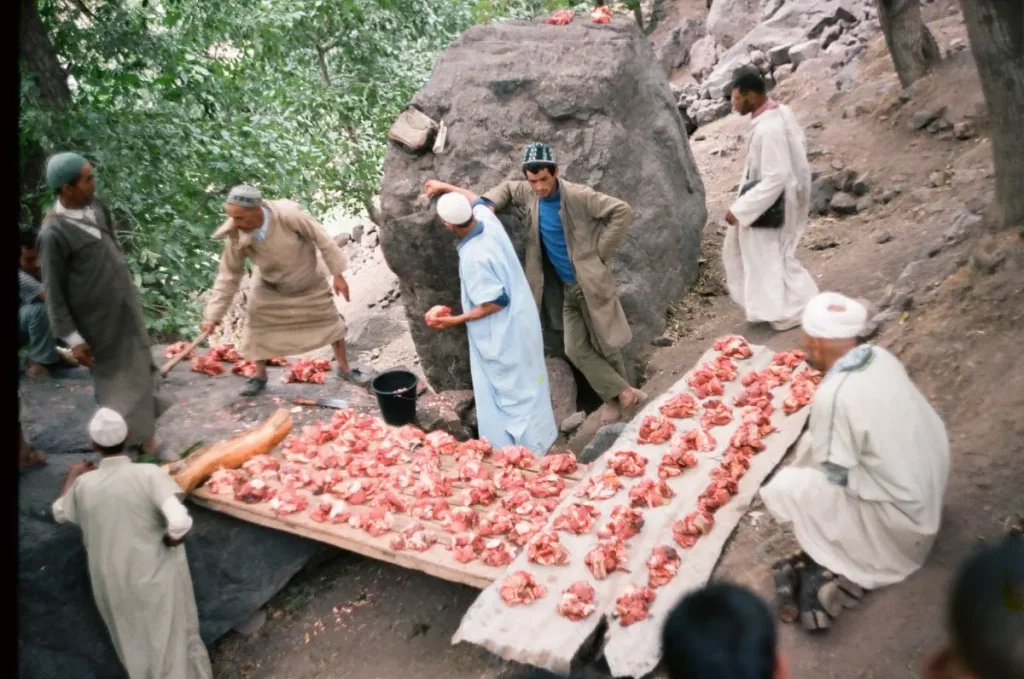
Behind the meat, a system of trust
The luzia might seem to be nothing more than an old way of buying an animal collectively.
Laoust’s account reveals much more.
The seller must be able to trust someone. The households must be consulted. The portions must be prepared fairly. Chance rules out personal preferences. And the guarantor carries the debt until payment is made.
Through a few pieces of meat laid out on a mat, an entire system of social relationships comes into view.
The ceremonial form described by Laoust largely belongs to the past. Yet in some parts of Morocco, the collective purchase and sharing of meat still exist today in simpler forms.
The mat, the little sticks and the drawing of lots have sometimes disappeared.
The need to come to an agreement, to share — and to trust one another — remains very much alive.
Further reading: The luzia: buying together, sharing meat and keeping one’s word.
Sources
- Main source: Émile Laoust, Mots et choses berbères, 1920, Chapter III, “La nourriture” (Food), pp. 100–104.
Explore all features in: The Berber world
Share your knowledge of the Amazigh world
More fragments from the Berber world


Leave a Reply