


The gazelle in Morocco: when an animal told the story of the world
A gazelle appeared on the path: should the traveller continue or turn back? In Moroccan folk beliefs, its movements could foretell good or bad fortune. But the gazelle also featured in fertility rituals, inspired poets, embodied the beauty of both women and men, and even lent its name to Jewish families. Behind its grace lay an entire world of meanings.
When the gazelle decided the course of a journey
Encountering a gazelle in the morning was considered a good omen. But if a traveller startled a herd, it was wise to watch carefully which way the animals fled: if they ran to the right, the journey promised to be favourable. If they ran to the left, it was better to abandon the trip. Even their number mattered: an odd number brought good luck, while an even number foretold the opposite.
These beliefs are recorded by André Goldenberg in his Bestiaire de la culture populaire musulmane et juive au Maroc (Bestiary of Muslim and Jewish Folk Culture in Morocco), published in 2000. They belong to a world in which a chance encounter with an animal could be interpreted as a warning. The natural world thus became a language through which people sought to read their destiny.
The gazelle held a special place in this world. A symbol of beauty and speed, it was also associated with fertility, protection and baraka, the beneficent spiritual power that folk tradition attributes to certain beings, places or objects.
In Alnif, milk for gazelles carved in stone
In the arid regions of southern Morocco, Goldenberg describes traditional practices linking the gazelle to fertility rituals and hopes for rain.
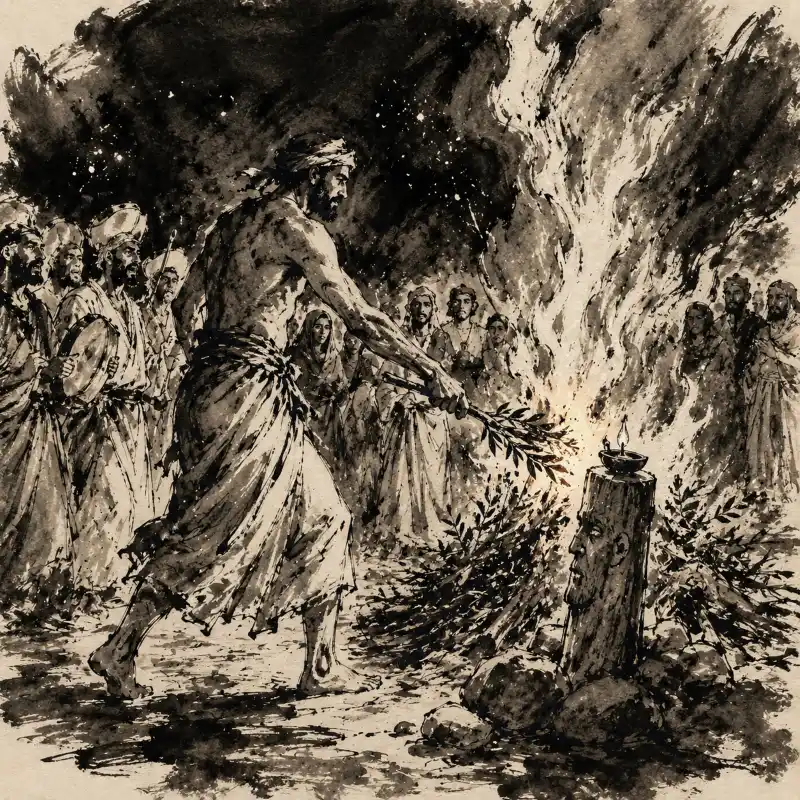
An account collected in 1973 from a man originally from Alnif describes a remarkable custom: at the beginning of Ennaïr, milk was poured over rock engravings depicting gazelles.
Ennaïr, whose name derives from the Latin Ianuarius, refers to the first month of the Julian calendar, long used in rural North African societies. It marks the renewal of the year and remains associated with the traditions of the agricultural calendar.
The connection is therefore far from insignificant: at the beginning of the year, milk, the quintessential symbol of nourishment, was offered to animals carved into the rock and associated with fertility.
Yet a mystery remains. Did this practice preserve an ancient belief, or had successive generations reinterpreted rock figures whose original meaning had long been forgotten? Nothing establishes a direct continuity between the people who made the engravings and the ritual recorded in 1973.
From the protected gazelle to the gazelle as protector
In folk tales, the gazelle is more than a sign to be interpreted. It sometimes becomes a character endowed with human qualities.
A legend associated with Sidi Ahmed Tijani (1737–1815), a Sufi master born in what is now Algeria and founder of the Tijaniyya order, which spread from Fez into West Africa, tells of a gazelle pursued by a falcon that sought refuge with the saint. He drove the predator away with a gesture, and the rescued animal remained by his side from then on.
Terrified, she sought the saint’s protection.
Elsewhere, the roles are reversed. In a legend from south-western Morocco, a gazelle feeds a child abandoned in the forest, saving him from the dangers posed by wild animals. A song from the Chleuh (Tashelhit-speaking Amazigh) poetic tradition celebrates this episode:
Now let us speak again of the little child.
A gazelle passing by caught sight of him.
Even as she grazed, she knew when to take him back in the evening,
Even as she grazed, she knew when to suckle him.
The little child! It was the gazelle who saved his life.
Our Lord God protected him from the jackal and the leopard;
He protected him from the hyena.
Our Lord was his guardian.
The gazelle can thus be both a vulnerable creature seeking the protection of a saint and a maternal figure capable of saving a human life.
The gazelle, an image of beauty in women and men
But it is in songs and poetry that the gazelle truly reigns supreme. Its grace, its eyes, its slender figure and its swift flight make it a favourite image of beauty and romantic desire.
In melhoun, Morocco’s urban tradition of popular poetry, the beloved woman becomes a gazelle, and her gaze a formidable weapon:
Among the gazelles, I love
The one who flees,
Whose slender figure outshines the cypress.
Her enchanting beauty
Brings delight to life.
The eyes of this gazelle
Shoot arrows
At her lovestruck admirer.
Yet the comparison is not reserved for women. Goldenberg also reproduces verses in which a woman praises a man’s elegance, gentleness and agility:
My lord and master, Youssef,
May Allah prolong his days,
Is like the gazelles of the desert,
Slender and of medium height,
With eyes both fiery and gentle;
Like the gazelles, he is agile and tireless…
The animal thus embodies qualities that can be attributed to both sexes. In Moroccan Arabic, ghzal and ghzala can also be used to describe a handsome man or a beautiful woman.
The linguist Paulette Galand-Pernet showed how the same Amazigh word, aznk°d, could refer to a marvellous gazelle in an ancient hunting poem and to a beautiful woman in a later reinterpretation. The words had changed little, but their meaning had shifted from the realm of the marvellous to that of love.
Gazelles in names, carpets and everyday objects
The gazelle has also left its mark on Moroccan Jewish surnames. The name Azencot, along with its many variants, has been linked to the Amazigh word azenkadh, meaning gazelle, although tribal or geographical origins are also possible.
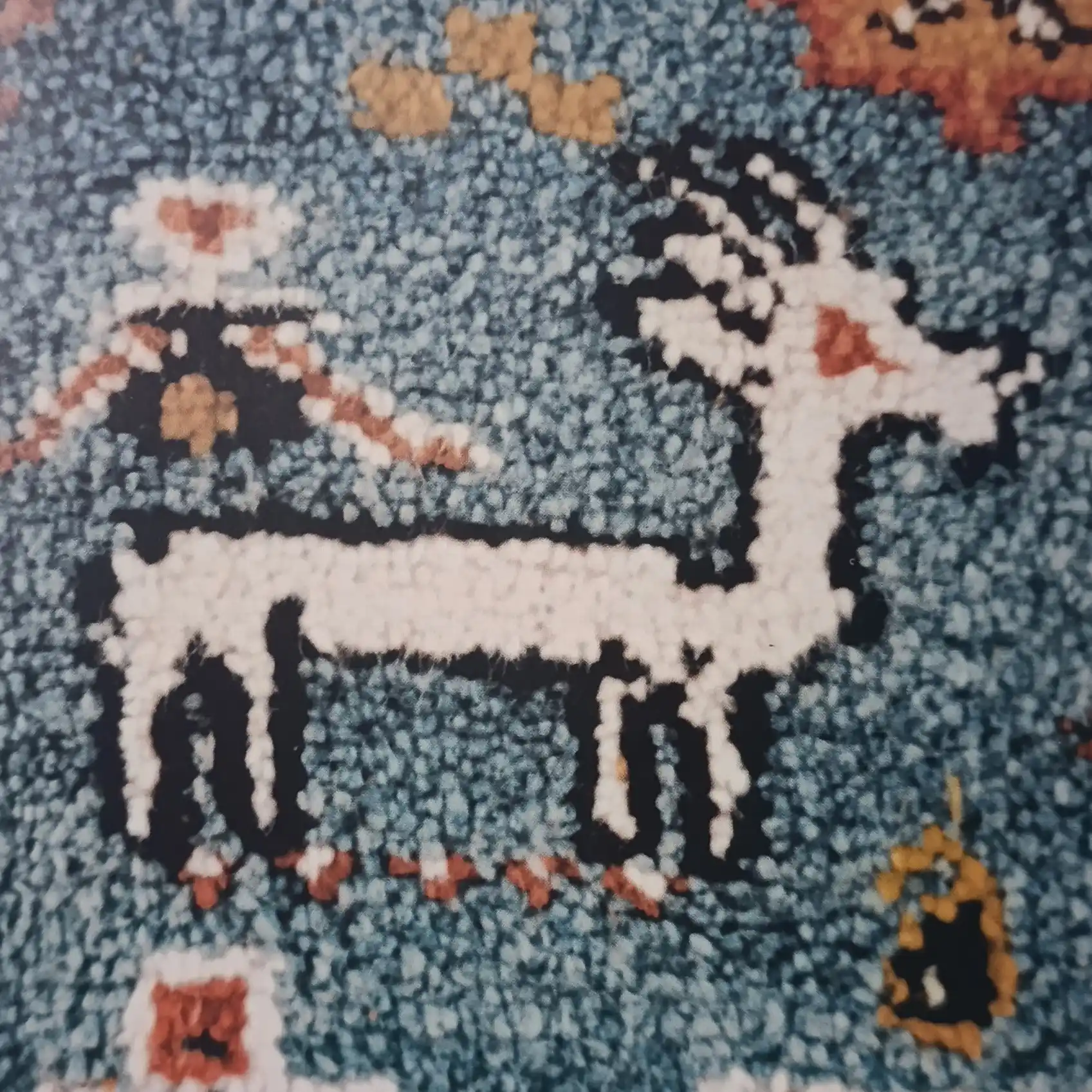
Its silhouette appears in the crafts of south-eastern Morocco. Goldenberg reproduces a carpet made by the Aït Ouaouzguite, photographed in 1972 at a craft cooperative in Ouarzazate, on which several white gazelles stand out against a blue background. Representations of the animal’s horns, eyes or legs also appear in motifs used in jewellery, tattoos, pottery and textiles.
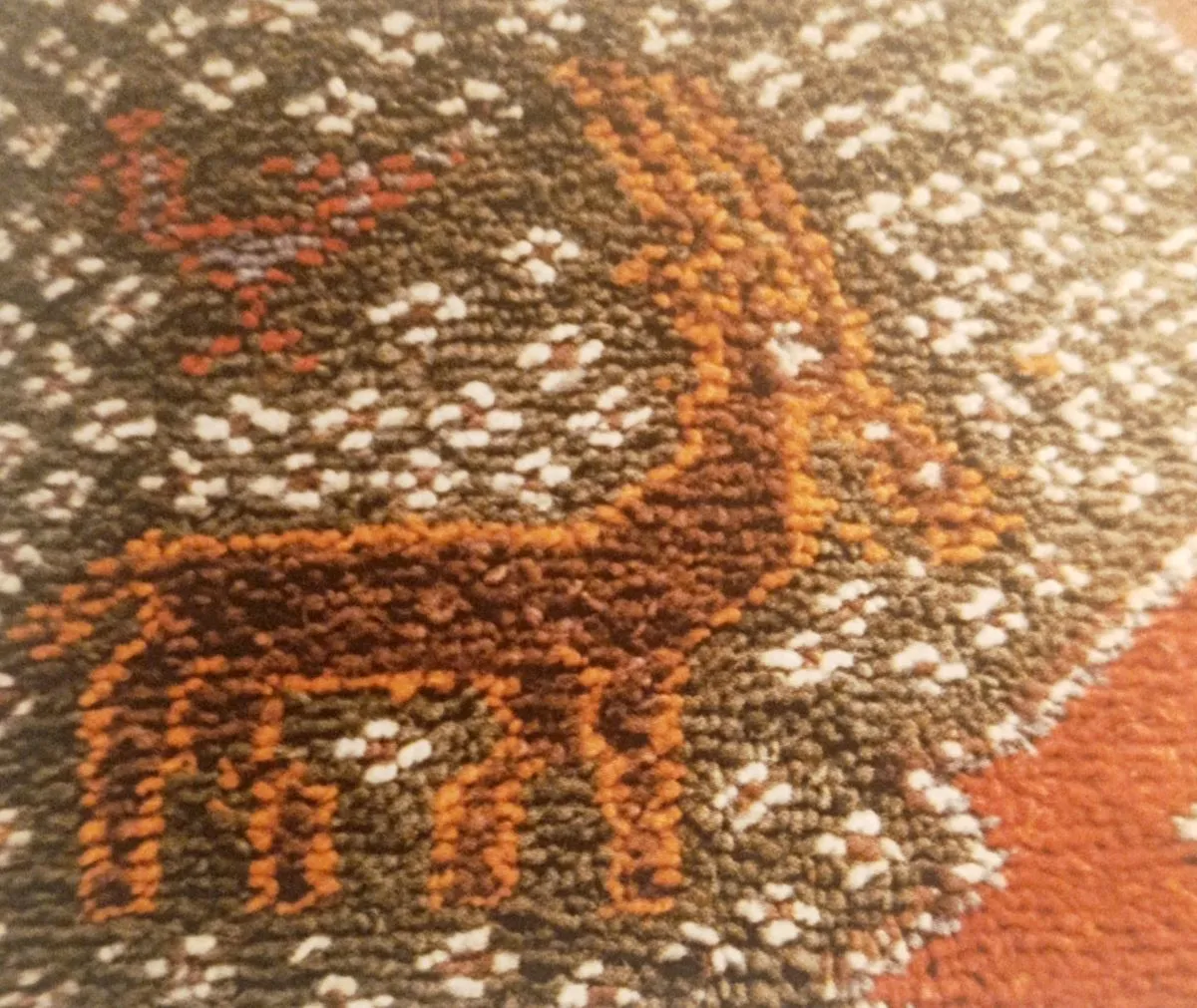
The image has even made its way into modern life: chocolate and soap labels, commercial brands, postage stamps and nature conservation campaigns have continued to make use of the animal’s distinctive silhouette.
From rock engravings to carpets, from songs to family names, the gazelle appears across very different traditions and periods. It would be misleading to assign a single meaning to all these representations.
Yet they all reveal the remarkable place a wild animal could occupy in the human imagination: a creature onto which people projected their fears, their hopes, their ideals of beauty and even their own destiny.
Sources
- André Goldenberg, Bestiaire de la culture populaire musulmane et juive au Maroc, Édisud, 2000, “La gazelle”, pp. 63–68. The legend of Sidi Ahmed Tijani appears on p. 64; the poetic extracts are reproduced on pp. 66–68.
- Paulette Galand-Pernet, Recueil de poèmes chleuhs, I – Chants de trouveurs, Klincksieck, Paris, 1972. Cited by Goldenberg for the song of the child rescued by a gazelle.
- Paulette Galand, “Philologie et littérature berbères”, Annuaire de l’École pratique des hautes études, 1969, pp. 133–134.
- ANU – Museum of the Jewish People, “Azencot – Origin of surname”.
Explore all features in: The Berber world
Share your knowledge of the Amazigh world
More fragments from the Berber world

Leave a Reply