


The dromedary, from patience to unseen forces
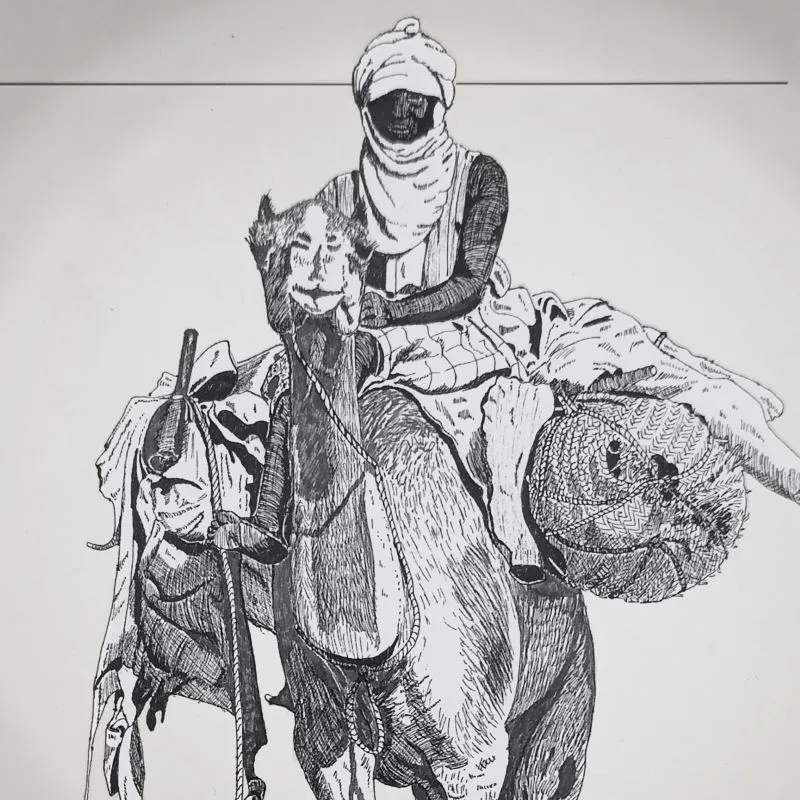
It carried goods across the Sahara, accompanied pilgrimages and embodied patience. Yet the dromedary could also foretell death, carry away a town’s misfortunes or lend its feet to a feared supernatural creature. In Morocco’s folk beliefs, proverbs, songs and traditional arts, this familiar animal of the southern landscapes reveals a remarkably contradictory character.
A one-humped camel, master of the desert routes
The animal owes its reputation for endurance to its extraordinary adaptation to arid environments. Contrary to a widespread belief, its hump does not store water but a reserve of fat, which can be drawn upon when food is scarce. Its broad feet make it easier to move over soft ground, while its body is adapted to minimising water loss.
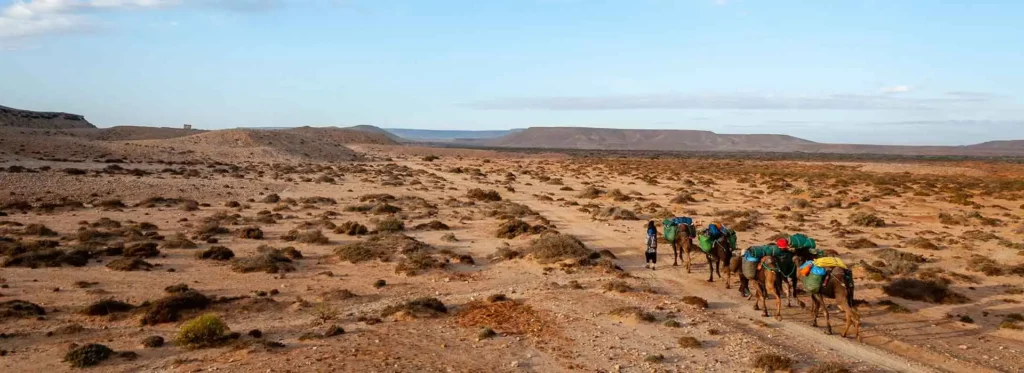
These qualities made the dromedary an essential part of Saharan history. For centuries, camel caravans linked the oases of southern Morocco to markets beyond the desert, carrying salt, textiles, precious goods and, in a trade whose violence must not be forgotten, enslaved people.
Rather than always crossing the Sahara in a single journey, animals and caravans often travelled from one oasis to another, relying on grazing grounds, water sources and the knowledge of experienced caravan drivers.
This close relationship with the animal explains its presence in languages, traditions and even place names. Goldenberg mentions Aïn Imel, meaning the camel’s spring, and Tizi n’Talghemt, the pass of the she-camel.
A providential animal bearing baraka
The dromedary occupies an important place in the Muslim religious imagination. The Qur’an itself presents livestock as one of the remarkable gifts of Creation:
God has provided you with livestock, some to ride and some to eat. They bring you other benefits and carry you towards your destinations, just as ships carry you across the water.
Qur’an — 40:79–80, adapted translation.
Its material value thus goes hand in hand with its religious significance. A source of food, a mount and a beast of burden, the dromedary could also become a bearer of baraka, the beneficent spiritual power believed in popular tradition to protect people and favour healing or prosperity.
Goldenberg records several traditions in which the camel appears alongside saints or plays a protective role. In folk tales, a saint may even take the form of a camel to drive away evil spirits.
But this closeness to the sacred could also find expression in collective rituals, sometimes spectacular in nature.
Among the Aïssaoua and Hmadcha, Moroccan Sufi brotherhoods, certain participants in ceremonies once imitated the behaviour of camels. Goldenberg describes these figures, known as jmâl, who walked on all fours, grazed on thorny plants and reproduced the animal’s movements and attitudes.
The physical power of the dromedary thus became part of ritual performance, much like the lion, the jackal and other animals imitated in the practices of religious brotherhoods.
The camel that carried away human misfortunes
The dromedary’s protective role also appears in ancient rituals in which the animal was believed to drive away evil.
Goldenberg reports that, during epidemics, a camel would sometimes be led through a town before being killed: the animal was believed to absorb the misfortunes afflicting the community.
He also mentions camel sacrifices performed during certain moussems, religious and popular gatherings associated with the shrines of saints.
At the moussem of Moulay Brahim, in the High Atlas, members of the Marrakech tanners’ guild once led a camel through the city’s neighbourhoods before taking it to the saint’s shrine for sacrifice. According to the belief recorded, the animal carried away the sins of the city. Goldenberg notes that these rituals were still being practised in the 1980s.
The dromedary could thus symbolically take upon itself the evils of humankind, then disappear with them.
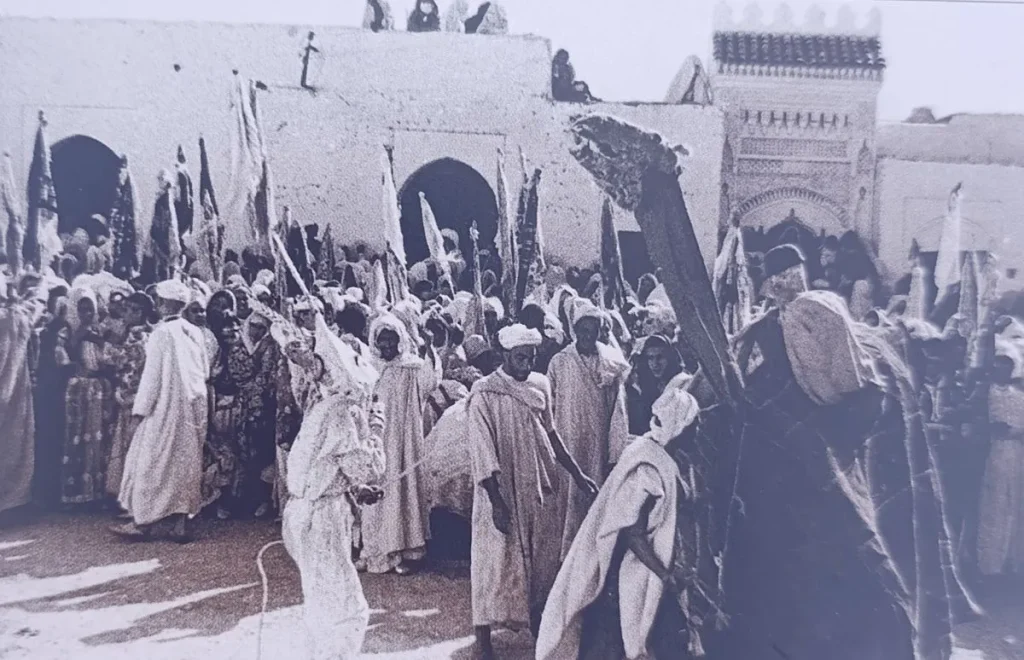
Another, even more unusual custom is mentioned at Tamkasselt, in the Drâa Valley between Agdz and Zagora. During Ashura, a long palm frond wrapped in palm fibres formed a swaying torch known as alghoum, the camel.
The animal was thus present even in the objects and gestures of popular celebrations.
Between bad omens and frightening creatures
Yet the camel’s baraka did not erase another, far more unsettling aspect of its character.
In certain traditional interpretations of dreams, a white camel foretold happiness. A black camel, by contrast, could be associated with death. The animal thus became a messenger of a destiny that the dreamer sought to decipher.
Its appearance could even be borrowed by supernatural beings.
Goldenberg recalls a version of the legend of Aïcha Kandicha, a feared jnniya, or female jinn, in Moroccan folklore. She appeared as an irresistibly beautiful woman, but her camel’s feet betrayed her true nature. Her beauty lured her victims before this animal feature revealed what she really was.
The dromedary, a protector in some beliefs, here becomes the sign of a deceptive human appearance, concealing a being from the unseen world.
This contrast reminds us how animals in folk traditions escape any single interpretation: the same creature may bring blessings and inspire terror.
A giant mocked in proverbs
The dromedary was not, however, always treated with reverence. In the Moroccan proverbs collected by Goldenberg, its power, size and apparent nobility readily lend themselves to mockery.
The camel never sees its own hump.
It would be hard to find a better image of someone incapable of recognising their own faults.
Elsewhere, the animal embodies an authority indifferent to others. The camel leading a caravan gives little thought to those walking behind it.
But proverbs also pay tribute to the experience of those who know their animals:
The camel has its plan, and the camel driver has his.
Behind this saying lies an entire philosophy of the relationship between humans and animals. The camel driver gives the orders, but cannot necessarily control the intentions of a creature reputed to be difficult.
Popular language could even turn the animal’s grandeur into an insult. Goldenberg notes that calling someone a “camel” or a “son of a camel” was considered a serious offence.
How could such a valuable animal become a symbol of stupidity or coarseness? Perhaps because people knew it well enough to admire its endurance without attributing every virtue to it. The dromedary, like its masters, had its faults.
The patience of caravan drivers, poetry and riddles
In contrast to this sometimes ridiculous or frightening figure, the dromedary becomes a lesson in patience in traditional songs.
A poem quoted by Goldenberg contrasts the horse’s haste with the camel’s slow, steady pace:
But the camel walks slowly,
Through day and night.
Do not hurry!
Learn patience!
Here, success depends not on speed but on perseverance, a quality essential to long journeys through desert regions.
The Chants des caravaniers du Sous (Songs of the Caravan Drivers of the Sous) express another dimension of this existence. Caravan drivers possess neither the wealth of townspeople nor the comforts enjoyed by those who own gardens and houses. Their domain lies elsewhere:
We, the caravan drivers,
From Chants d’amour et de guerre de l’Islam — F. Toussaint.
Have nothing but the sky and the sands.
Yet after the heat of the day,
Comes the coolness of the night.
Why should we complain?
In Amazigh oral tradition, the dromedary also becomes a character in riddles. Goldenberg quotes a riddle from the words of an ahouach, a collective poetic and musical tradition of the south-western Atlas: a camel suckling a hare. Behind this absurd image lies, according to the explanation recorded, the figure of the caïd, a local authority.
These poetic games remind us that the camel’s presence in popular languages extends far beyond the vocabulary of desert life. It also provides a way of speaking about people, power, virtues and shortcomings.
From rock engravings to the carpets of southern Morocco
The silhouette of the dromedary also runs through the visual arts.
It appears in North African rock art, particularly in the Anti-Atlas. Yet not all animal engravings belong to the same period: depictions of dromedaries are generally associated with the more recent historical phases of Saharan rock art, often described as Cameline or Libyco-Berber. They therefore postdate many prehistoric engravings of wild animals.
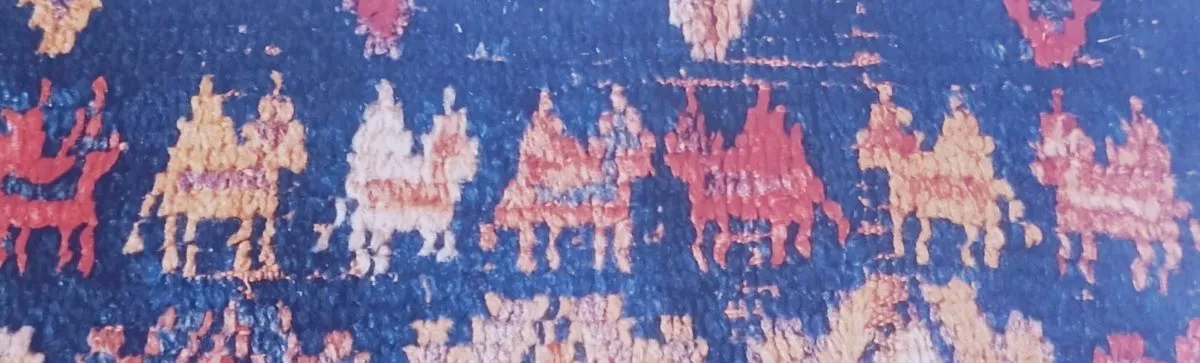
The animal also appears on carpets made by the Aït Ouaouzguite around Taznakht. Goldenberg reproduces several compositions in which camels, sometimes accompanied by their young, stand out in brightly coloured patterns. Its silhouette can also be found in embroidery, jewellery and certain khamsas, the protective hand-shaped amulets.
In the 1960s, children in Meski, near Erfoud, were still making camel figures from woven palm leaves, while other craftspeople produced figurines intended for travellers.
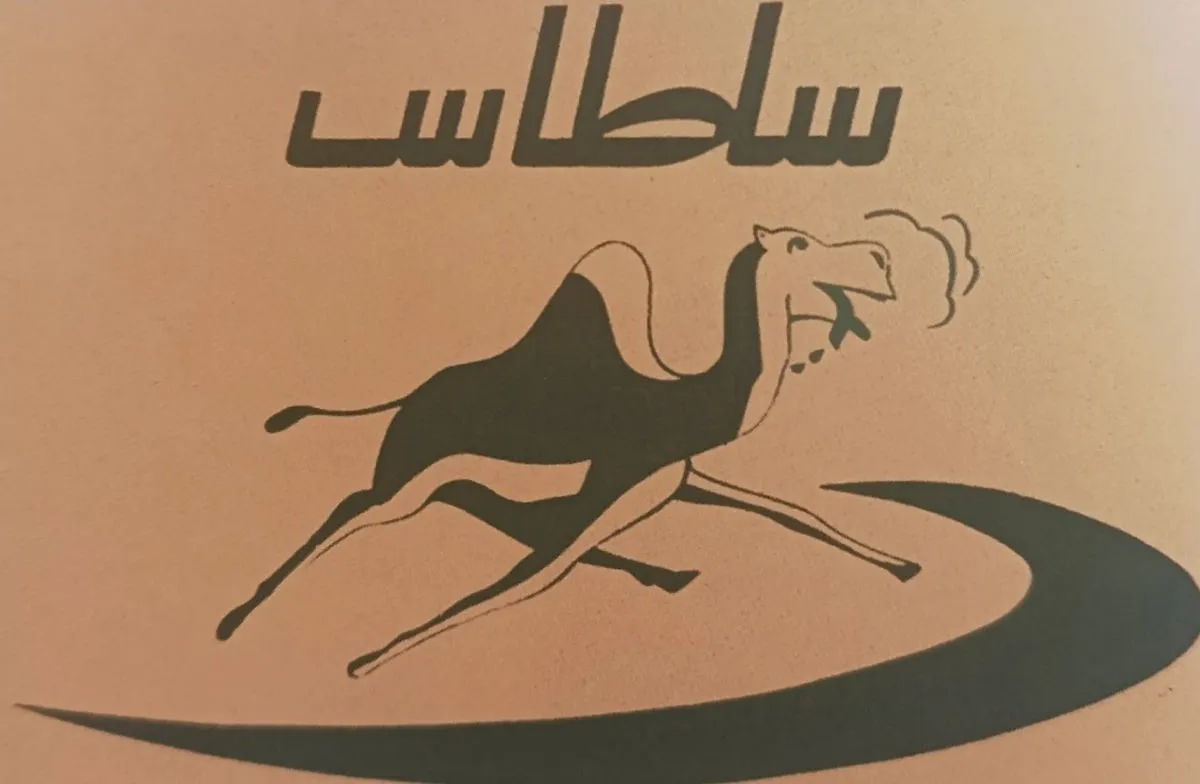
The animal even made its way into modern life. In 1978, the SATAS transport company, whose coaches served routes across southern Morocco, used a leaping dromedary as its emblem. Motorised transport had replaced the caravan, but the latter survived in the image chosen to represent the company.
From rock engravings to coach company logos, from carpets to riddles, the dromedary carried far more than the loads entrusted to it by caravan drivers.
A working animal and a sign of wealth, a figure of baraka and sacrifice, a model of patience but also an arrogant or comical character, it reflected the contradictions of the people who lived alongside it.
And perhaps that is what makes it so distinctive: in a world where it was indispensable, the dromedary did not need to be perfect to become legendary.
The practices and beliefs described here come from traditions recorded by Goldenberg, mainly through historical accounts and ethnographic sources. They should not be regarded as universally shared or necessarily still practised today. The proverbs and poetic extracts have been translated into English from the French versions reproduced in his book.
Sources
- André Goldenberg, Bestiaire de la culture populaire musulmane et juive au Maroc, Édisud, 2000, “Le chameau”, pp. 26–30. Main source for the beliefs, traditions, stories, proverbs, songs and illustrations discussed in this article.
- Bernard Faye, Le dromadaire, Camelus dromedarius, Bois et Forêts des Tropiques, no. 307, 2011, pp. 79–84.
- CIRAD, Physiologie générale du dromadaire, on the function of the hump and adaptations to arid environments.
- Crossroads Regions: The Sahara, Oxford University Press, on the organisation of trade networks and caravan routes.
- Le chameau et l’Afrique du Nord romaine, Annales. Histoire, Sciences Sociales, on the history of the dromedary in North Africa.
Explore all features in: The Berber world
Share your knowledge of the Amazigh world
More fragments from the Berber world

Leave a Reply