


Amazigh proverbs: honey, sheep and pottery tell the story of the world

Collected in the early 1980s among the Aït Ayyach communities of the Upper Moulouya, around Midelt, twenty Amazigh proverbs speak of caution, effort, mutual support and wastefulness. Behind their few words emerges a world of flocks, seeds, bees, sieves, bendirs and pottery: images rooted in a particular territory, yet capable of saying far more than they appear to tell.
The proverb: experience condensed into a few words
In his introduction, Bentolila emphasises one essential point: a proverb does not live solely on the pages of a collection. Its true place is in everyday use and exchange.
In just a few words, it becomes possible to offer advice, criticise, warn or take a stand without having to develop a lengthy argument. The proverb draws its authority from experience passed down and shared. It allows words that seem to come from long ago to be applied to a new situation.
Its strength also lies in its form. A proverb may play on rhythm, repetition, metaphor, humour or an enigmatic image. Bentolila even draws a parallel between the proverb and the riddle: both readily take objects and realities from everyday life and make them express something else.
A bee then speaks of effort. A flock teaches caution. A sieve reminds us that not everything can serve every purpose. A broken jug becomes a lesson against waste.
But some of these images only reveal their full meaning when we understand the world from which they emerged.
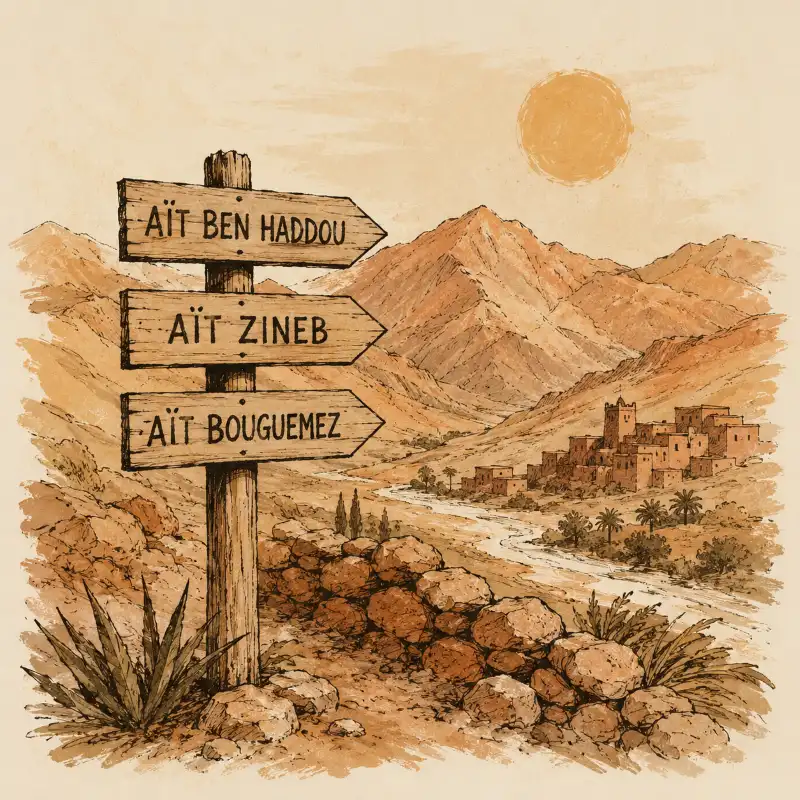
The Aït Ayyach, between Midelt and the Upper Moulouya
Twenty proverbs associated with the Aït Ayyach communities of the Upper Moulouya appear in the collection. They were recorded in 1982 and 1983 by Najem-eddine Soughati and Youssef Aït Lemkadem. The Aït Ayyach are also known as the Aït Ayyach of Midelt.
These communities traditionally depend mainly on agriculture and the rearing of sheep and cattle. Their territory lies in the Moulouya valley, around Midelt, between the High Atlas and the Middle Atlas.
The speech of the Aït Ayyach belongs to the Tamazight of central Morocco.
This is the shortest of the eight collections brought together in Proverbes berbères. Yet it is enough to show just how closely a proverb can be connected to the environment in which it circulates. The soil, frost, animals, food and household objects are not mere background details: they provide the images through which human behaviour is understood.
A selection of Aït Ayyach proverbs
“Shearing before May means slaughtering the flock.”
Talasa qbl mayyu, taṛuẓi n umuggu.
Proverbes berbères
Here, the proverb springs directly from pastoral experience.
In the Upper Moulouya, frost can still occur late in the year. Shearing sheep too early therefore exposes them to the cold.
But the warning soon extends beyond the flock: one must know when to wait before acting, and avoid making an irreversible decision too hastily.
The cold of the Upper Moulouya thus becomes a lesson in caution.
“White soil needs plenty of seed.”
Asal aməllal, ifsan i ddan.
Proverbes berbères
Poor soil requires more seed than fertile land. Not every seed will germinate, so the chances of success must be multiplied.
The proverb transforms this agricultural observation into a much broader principle: when conditions are difficult, a single effort may not be enough.
The expression is brief, but behind it lie the soil, the sowing season and a whole body of practical knowledge of the environment.
“Whoever wants honey must endure the bees’ stings.”
Wnna yran tamnt isbṛ i-tuqqas n tẓizwa.
Proverbes berbères
The meaning of the image is almost immediate: what is desirable may come at a price.
In the commentary accompanying the collection, honey represents what one seeks to obtain; the stings represent the difficulties one must accept in order to achieve it.
The strength of the proverb lies precisely in this economy of words: there is no need to explain at length that success sometimes requires effort. The bee and the honey are enough.
“Legs cannot carry an empty stomach.”
Ur da ttasin iḍaṛ adis ixwan.
Proverbes berbères
The stomach nourishes the legs; the legs carry the stomach.
The authors see in this relationship an image of reciprocity: when one element ceases to fulfil its function, the whole becomes unbalanced.
A simple observation of the body thus becomes a way of speaking about relationships between people: one cannot continually receive without giving, nor ask without offering something in return.
“Donkey skin is no good for a bendir drumhead.”
Ur da tgəṛṛaf tallunt s ubəṭṭan uɣyul.
Proverbes berbères
The bendir is a drum whose membrane must be sufficiently thin and supple to produce the desired sound. Donkey skin is unsuitable for this purpose.
The proverb thus reminds us that merely occupying a position does not mean one is capable of fulfilling its function. The authors apply it particularly to those who are unable to uphold the reputation of a group or family.
Behind the social judgement remains a concrete image: an instrument only sounds right when its material is suited to its purpose.
“You cannot draw water with a sieve.”
Ur da ttagm tbuṣyyart aman.
Proverbes berbères
The image seems almost absurd — and that is precisely what gives it its force.
A sieve has holes because it is designed to sift flour. Asking it to hold water would mean ignoring its very nature and purpose.
The commentary in the collection extends this obvious truth to human roles: every task requires particular abilities.
The most ordinary object thus becomes a small lesson in the need for a person to be suited to the function they are expected to perform.
“Just because your father is a potter doesn’t mean you should break the jugs.”
Ur idd ġas iga ybbaš aqddar at ṭraẓt iqdah.
Proverbes berbères
Someone who possesses something in abundance might be tempted to stop recognising its value. A potter’s son might break the jugs, knowing that more can easily be made.
The proverb says exactly the opposite: abundance does not justify waste.
And once again, no abstraction is needed. A trade, a father and a few jugs are enough to make the lesson clear.
A territory transformed into language
These proverbs show how a language transforms a familiar environment into images capable of moving from one situation to another.
Shearing sheep comes to speak of haste. Poor soil speaks of perseverance. Honey and bees speak of effort. The sieve speaks of individual abilities. Pottery speaks of waste.
Perhaps this is where part of the proverb’s power lies: in beginning with an intensely local reality to express an experience that can be understood by people living far from the place where the saying first emerged.
Sources
- Fernand Bentolila (ed.), Proverbes berbères. Bilingue français-berbère, L’Harmattan-Awal. Corpus VII: Najem-eddine Soughati and Youssef Aït Lemkadem, “Proverbes Ayt Ayyach de la Haute Moulouya”. Proverbs collected during the summers of 1982 and 1983.
Explore all features in: The Berber world
Share your knowledge of the Amazigh world
More fragments from the Berber world


Leave a Reply