


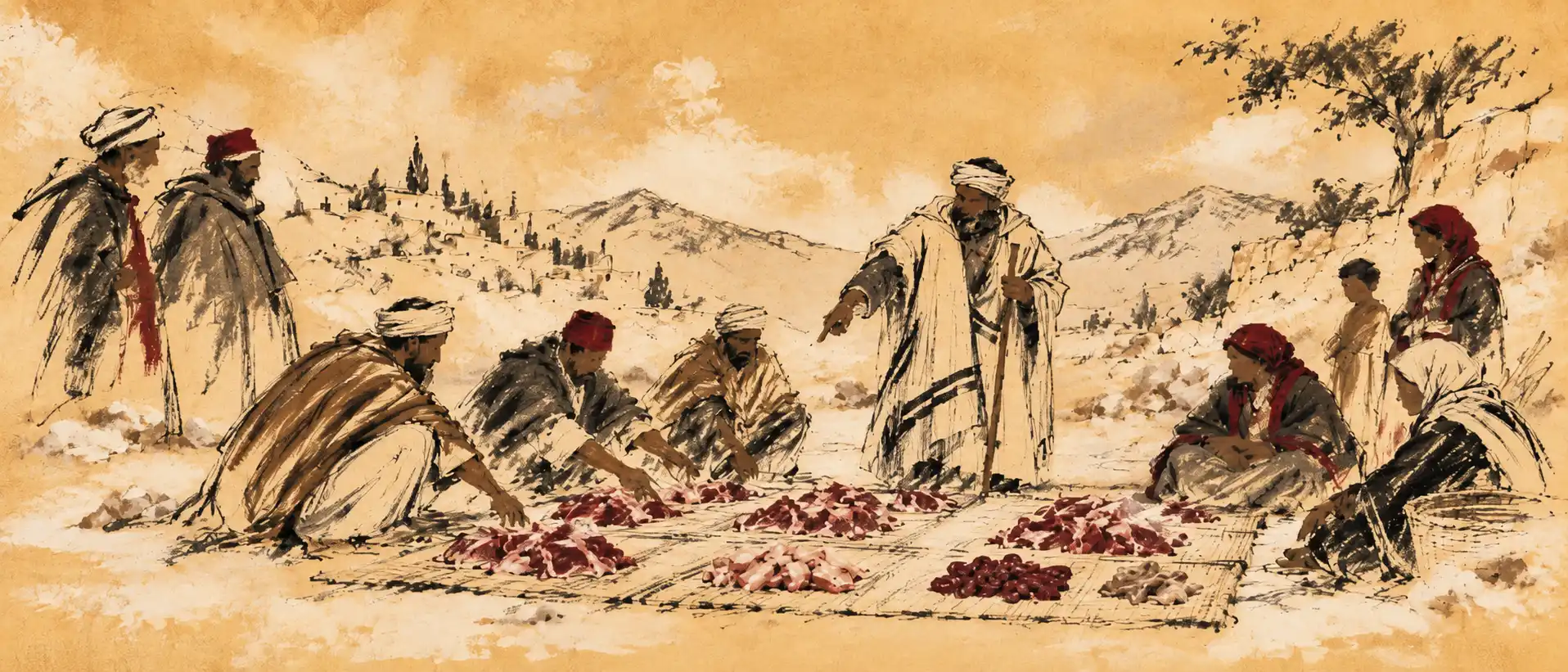
An animal bought by several people, portions of meat allocated by lot, and payment sometimes deferred under the responsibility of a guarantor. In Mots et choses berbères, published in 1920, Émile Laoust describes the luzia in exceptionally precise detail. Behind this collective way of obtaining meat emerges an entire system of trust, fairness and obligations between members of the group.
An old practice that has not entirely disappeared
The luzia is not an exclusively Amazigh practice. Comparable forms are documented elsewhere in North Africa. Yet it is both old and widely attested in several Berber societies, to which the account collected by Laoust belongs.
Laoust does not say when or where the luzia first appeared. Nor was he its first witness. In Morocco, Edmond Doutté described an ouzîa among the Rehâmna as early as the beginning of the twentieth century: the inhabitants of the same village bought an animal collectively, each family paid its share, and the portions were allocated by lot. The practice was therefore documented before the publication of Mots et choses berbères, although the sources do not allow us to date its origins.
The highly codified form described by Laoust now largely belongs to the past. The principle of collectively sharing meat, however, has not disappeared. As recently as March 2026, practices known as ouzia were organised in the Rif, notably among the Igzennayen and in Al Hoceima Province, in a context now more closely associated with solidarity and religious festivals.
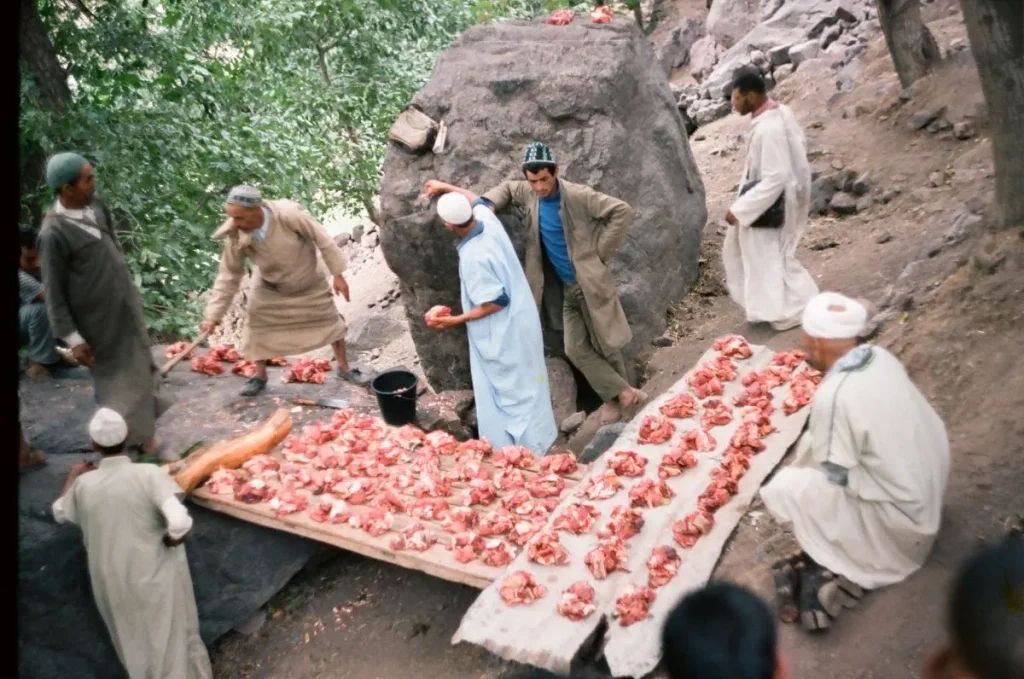
In a village of South-Eastern Morocco, collective purchases of meat still occasionally take place between several people. The ceremonial described by Laoust — going from house to house, the little sticks and the drawing of lots — has disappeared, but the organisation has not become entirely informal. One man still directs the sharing, acts as guarantor for the operation and then collects the money from the participants. It would be excessive to claim that this is the luzia of 1920 surviving unchanged; the functional continuity is nevertheless striking.
An old practice that has not entirely disappeared
Laoust does not say when or where the luzia first appeared. Nor was he its first witness. In Morocco, Edmond Doutté described an ouzîa among the Rehâmna as early as the beginning of the twentieth century: the inhabitants of the same village bought an animal collectively, each family paid its share, and the portions were allocated by lot. The practice was therefore documented before the publication of Mots et choses berbères, although the sources do not allow us to date its origins.
The highly codified form described by Laoust now largely belongs to the past. The principle of collectively sharing meat, however, has not disappeared. As recently as March 2026, practices known as ouzia were organised in the Rif, notably among the Igzennayen and in Al Hoceima Province, in a context now more closely associated with solidarity and religious festivals.
In a village of South-Eastern Morocco, collective purchases of meat still occasionally take place between several people. The ceremonial described by Laoust — going from house to house, the little sticks and the drawing of lots — has disappeared, but the organisation has not become entirely informal. One man still directs the sharing, acts as guarantor for the operation and then collects the money from the participants. It would be excessive to claim that this is the luzia of 1920 surviving unchanged; the functional continuity is nevertheless striking.
On the mat, the portions of meat are ready. Each person has brought a small recognisable marker, a little stick or a stone. A man mixes them with his eyes closed, then places them one by one on the portions. Soon each family will be able to carry its meat home.
Yet it may not necessarily have paid for it yet.
This scene appears in the chapter of Mots et choses berbères devoted to food. Laoust reproduces an Amazigh text accompanied by his French translation and follows almost the entire operation he calls luzia, also transcribed as ouzâ in the translation: purchase of the animal, participation of the households, cutting up the meat, drawing lots, selling the hide and, finally, settling the money owed.
Everything begins with a question of trust.
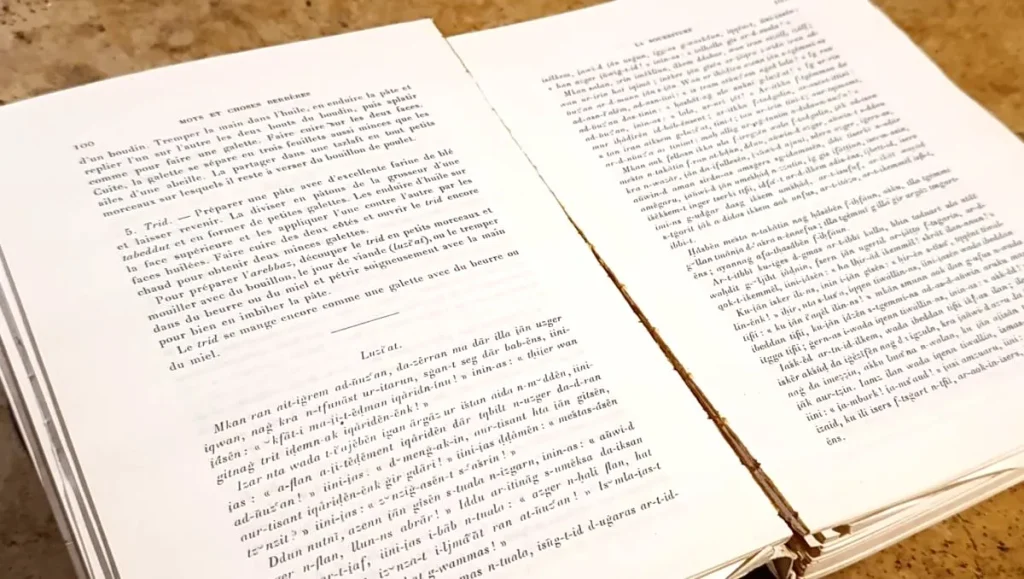
One man answers for everyone’s payment
The participants look for an owner willing to sell a bull or a cow that is not in calf. But the seller is not satisfied with a collective agreement. He requires one man to take personal responsibility for payment.
« kfâl-i ma-ii-l-ëdman iqàridn-inu ! »
Mots et choses berbères – Émile Laoust
“Find me a damen!”
The seller chooses from among the buyers the man who seems to offer the strongest guarantees. He agrees:
« d^meng-ak-in, aur-tisant hta iän gitsën, aur-tisant iqàridën-ënk gir gdäri »
Mots et choses berbères – Émile Laoust
“I stand surety for them for the payment of what is owed to you!”
The damen now occupies a central position. Several people buy together, but the seller knows whom to turn to if the money does not come in.
In the example reported by Laoust, the agreed price is twenty reals — in other words, twenty rials, the old Moroccan monetary unit then in use. This was not a fixed price for a luzia, merely the amount agreed in this particular transaction.
The Hassani rial was a Moroccan silver currency introduced under Moulay Hassan I. Its reference value was five French francs before the severe monetary disruption of the First World War and its disappearance in 1920.
A messenger is then sent to fetch the animal from pasture. The shepherd points it out among the herd; a rope is passed around its horns and the animal is led back to the buyers.
The agreement has been made. But the group of participants has not yet been definitively established.
Going from house to house
After lunch, one of the men goes to gather those who are to take part in the operation. Those who are absent are informed, and everyone must be able to give a clear answer.
Some agree:
« kasbâl-ag ula nukni g-luzi’al ! »
Mots et choses berbères – Émile Laoust
“Count us among you.”
Others decline:
« la la, ur-nri fat ! »
Mots et choses berbères – Émile Laoust
“No, not this time!”
Participation is therefore not automatic.
The messenger goes from house to house, and Laoust reports a remarkable detail: widows too are explicitly consulted.
« /an iran aikse/n g-lu zi’al, tini-t; /an ur-irin Zini-t; aur-tqimam/, ar-d-nuuz r a ar-tiniml: mah allig ur-ag-tnnim a-didaun-nuz’a ! »
Mots et choses berbères – Émile Laoust
“Let the woman who wishes to take part in the ouzà say so! Let the woman who does not wish to take part say so too! Do not come afterwards complaining and crying: Why did you not tell us? We would have done as the others did!”
The widows are therefore fully consulted as possible participants in the purchase. Before anything can be shared, it must first be known who is committing themselves.
Going from house to house serves an essential purpose: participation is made known to everyone, preventing any household from later saying that it had been forgotten.
Counting people before preparing the portions
Once the participants are known, the animal is led beneath a fig tree, slaughtered and prepared.
Laoust dwells on the butcher’s work: skinning, cutting up, gutting and then preparing the portions. He even describes how the hide is loosened by blowing air through an incision made in one of the legs.
But the essential moment comes with the sharing.
Households are not treated as identical units. Some contain eight or ten people; others only a couple. Laoust specifies that the reckoning is made “by households, or better still by heads”.
The number of people to be fed therefore enters into the preparation of the portions.
The pieces are laid out on a mat. The entrails are prepared separately. Laoust does not give details of how the quantities are calculated; what he does emphasise is the care taken to prepare the portions before they are allocated.
When his work is finished, the butcher announces:
« ha Ihir-àd ikemmël! skrât ilan-nnun ! »
Mots et choses berbères – Émile Laoust
“There, it is done! Prepare your little sticks for the drawing of lots!”
A little stick so that no one chooses their portion
Each participant has a marker he will be able to recognise: a piece of wood, long or short, or a small or large stone.
One man has remained apart. He returns with his eyes closed, receives the markers and mixes them in his hand.
Then the drawing begins.
One marker on the first portion. Another on the next. And so on until each portion bears its sign.
« ha-fnrnbarkî ! »
Mots et choses berbères – Émile Laoust
“Here is the winner!”
Each person then recognises his little stick or stone and takes away the portion that has fallen to him. The same procedure is repeated for the entrails.
Laoust himself gives the reason for the procedure: “all dispute is avoided”.
The butcher prepares the portions, but no one chooses directly which piece he will receive. Chance intervenes precisely where personal choice might give rise to suspicion.
The portion is not chosen. It is assigned.
The hide escapes the drawing of lots
Once the meat and offal have been distributed, something remains that cannot be shared in the same way: the hide.
It is sold at auction.
The dellal stands in the middle of the group and calls for bids. In the account, one person offers three reals, another four. The bidding continues until no one offers more. The sale is then closed.
The formula recorded by Laoust wonderfully captures the atmosphere:
« Igaib, ma du sirar ! ha{i z^nzig, haii kfig-as; irait ik’smën, igeinz-ii! »
Mots et choses berbères – Émile Laoust
“The absent man cannot be heard! It is sold! I give it to him! Come now! Let the man who is ashamed give me a wink!”
The highest bidder receives the hide with a wish:
« hdk a flan ! allait irni-k ! »
Mots et choses berbères – Émile Laoust
“Here you are! May God grant that you have made a good bargain!”
Laoust does not specify what subsequently becomes of the proceeds from the auction.
Taking the meat home does not mean it has been paid for
It is perhaps at this point that the luzia described by Laoust becomes most interesting.
The meat is already in the houses. Yet the money has not necessarily been paid. A deadline has been agreed. When it arrives, it is the damen who once again makes his rounds to collect the contributions.
Those who have the money pay. Those experiencing temporary difficulty may ask him to wait until the next market:
« … ar-d-ilkem ssûq, ai’urig kra n-tgausa, z~nzcg-t, aînrig-ak iqàridën-nk … »
Mots et choses berbères – Émile Laoust
“I shall go there and sell something, then bring you the money!”
Laoust thus distinguishes temporary hardship from refusal to pay. In the first case, additional time may be granted. In the second, the debtor may be summoned before the justice of the amghar, the local authority.
Sharing therefore does not erase the debt.
Trust has made it possible to buy before payment has been completed; but that trust rests upon a commitment for which someone — the damen — has agreed to answer.
Buying meat, but also organising trust
Reduced to its basic principle, the luzia seems very simple: several people buy an animal which none of them necessarily wishes or is able to purchase alone, and divide its meat among themselves.
The account preserved by Laoust reveals a much more elaborate mechanism.
A seller must accept the arrangement and a guarantor must pledge his word. Households must be informed and it must be established who is participating. The number of people to be fed must be taken into account, portions considered equitable must be prepared, and chance must intervene to prevent anyone from choosing his own piece. What cannot be divided must be sold. And then the money still has to be collected.
- Trust makes the purchase possible.
- Consultation determines who takes part.
- Calculation establishes the portions.
- Chance allocates them.
- The auction decides the fate of the hide.
- The guarantor carries the debt until payment.
Each stage therefore answers a different risk: the seller might not be paid, some households might be forgotten, the portions might be considered unequal, or the choice of pieces might be disputed. The luzia does not eliminate these risks: one after another, it gives each of them a rule.
This is perhaps what makes Laoust’s text so valuable. It does not merely preserve the memory of an old way of obtaining meat. Through a few hours in the life of a group, it reveals an economy in which a person’s word, personal reputation and responsibility towards others count almost as much as money.
When the dishes have left the mat, the luzia is not over.
The guarantor still has his rounds to make.
Read also: Rites and legends of Yennayer, the Berber New Year
Read also: The Harvest King: rites and legends of Berber wheat
Key points
- The luzia described by Laoust is the collective purchase of a bovine animal followed by the sharing of its meat.
- The seller requires a damen, a guarantor chosen for the trust he inspires and subsequently responsible for collecting the payments.
- Households are consulted, including widows, and everyone may choose whether or not to participate.
- The portions are prepared according to the number of people in each household.
- The portions of meat and entrails are allocated by lot using recognisable sticks or stones, in order to avoid disputes.
- The hide is sold at auction; Laoust does not specify what subsequently becomes of the proceeds.
- Payment may take place after the meat has been shared.
- Temporary difficulty may justify an extension, whereas refusal to pay may lead to an appearance before the amghar.
- This highly codified form belongs to a historical context, but different forms of collective meat purchasing or sharing still survive in Morocco.
Sources
Main source: Émile Laoust, Mots et choses berbères, 1920, Chapter III, “La nourriture”, pp. 100–104.
For the historical context: Edmond Doutté, Merrâkech, early twentieth century, passage devoted to food among the Rehâmna.

More to Explore

Leave a Reply