


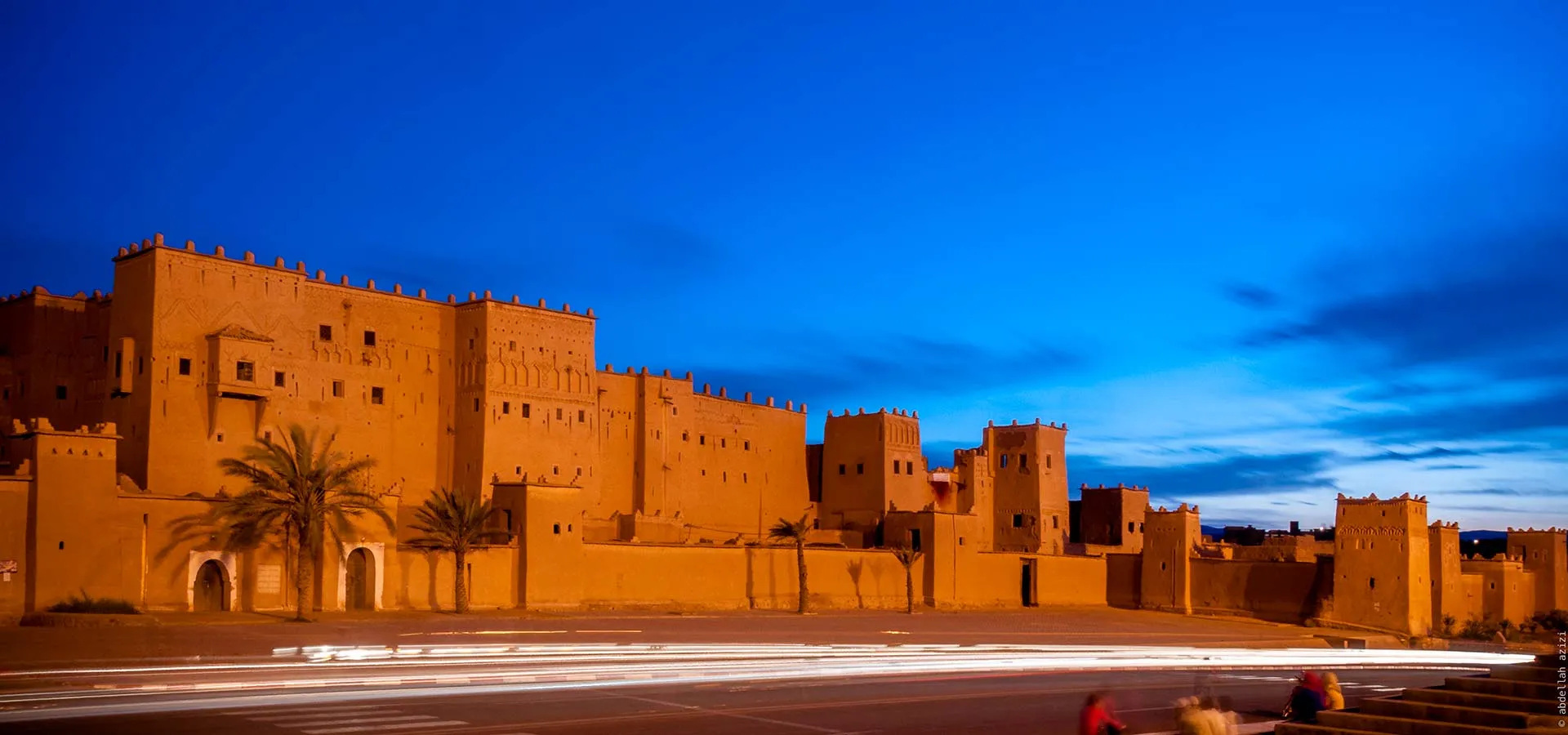
Once upon a time, the Kasbah of Taourirt
The Kasbah of Taourirt is one of the principal witnesses to the history of Ouarzazate. Long before the creation of the modern town, Taourirt was already a place of settlement and power established on the banks of the wadi. Its history brings together oral traditions, local rivalries, the rise of the Glaoua and the profound political and social transformations that followed.
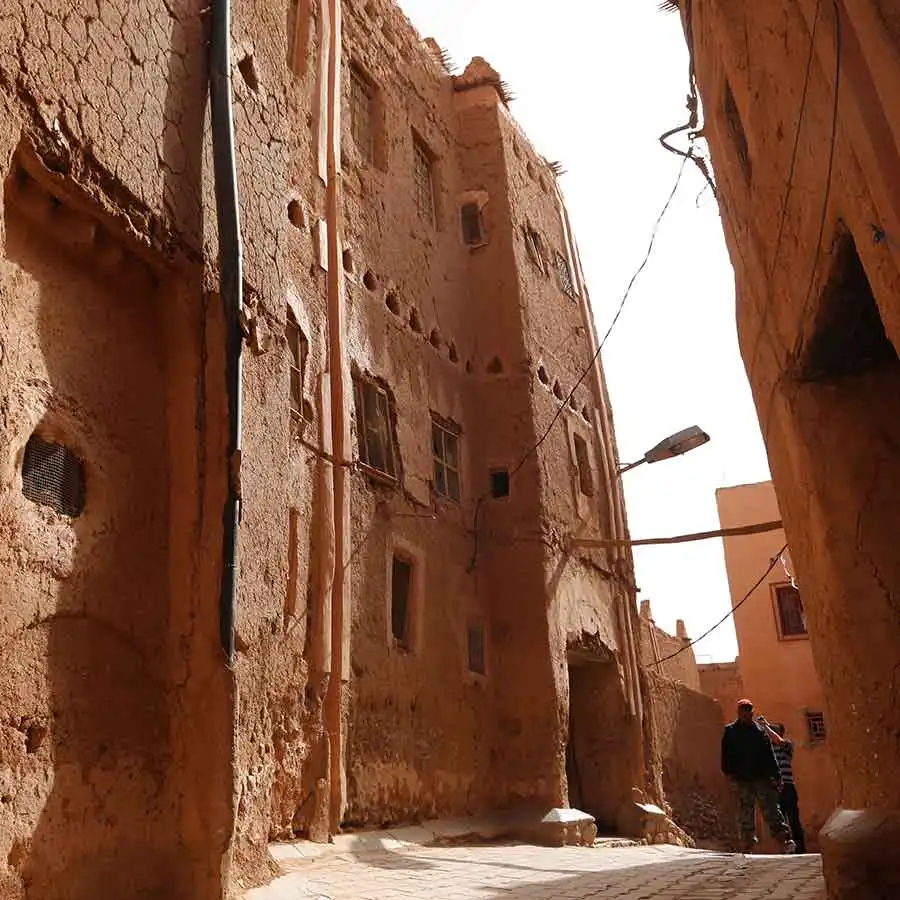
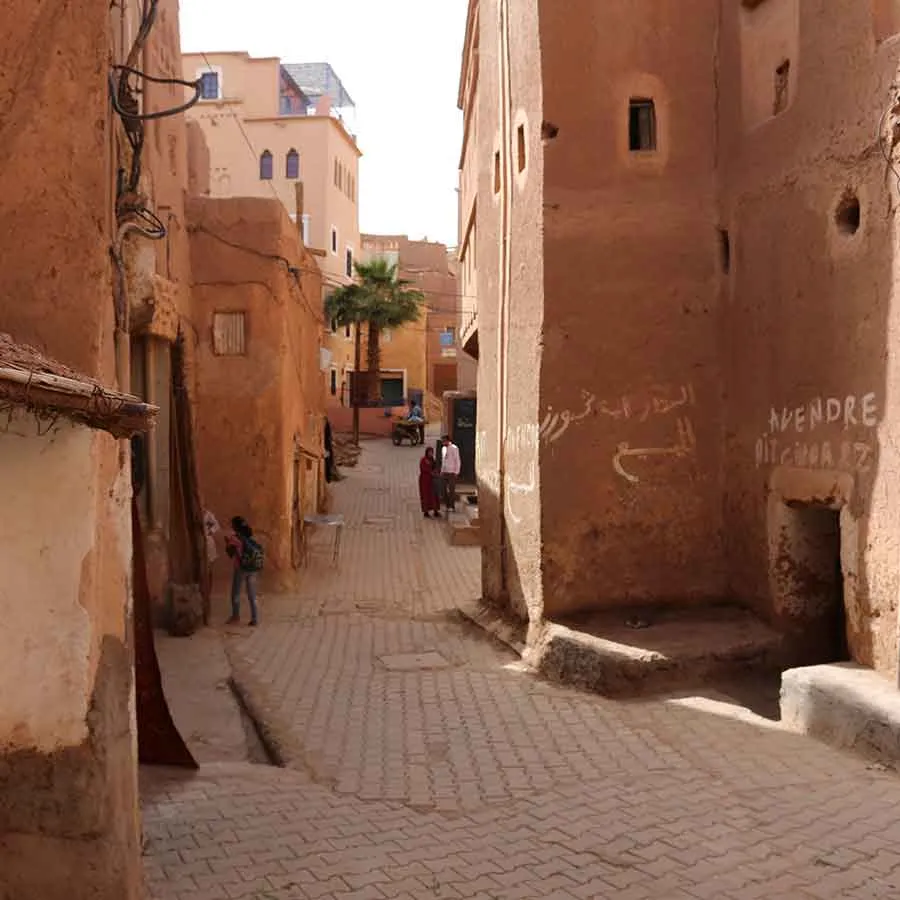
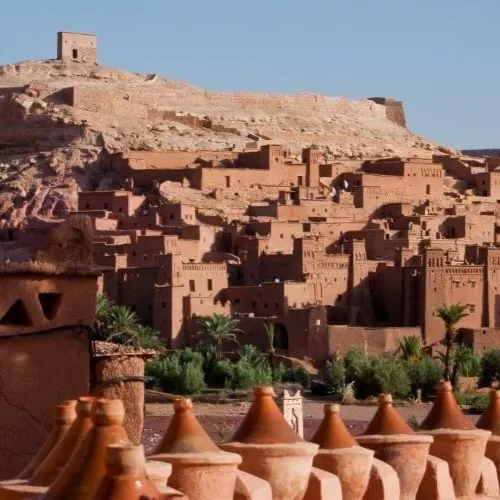
Yet Taourirt cannot be reduced to the monumental silhouette of its kasbah. Behind its earthen walls and towers lie an old village, houses, places of command and an entire human organisation. To understand Taourirt is to travel back towards the ancient heart of Ouarzazate and to read, in its architecture as much as in the memory of its inhabitants, part of the history of South-East Morocco.
From the gardens of Tassyart to the hill of Taourirt
Oral tradition recounts that the original settlement stood among the gardens bordering the northern bank of the Oued Ouarzazate. The place is said to have then been known as Ighrem n’Tassyart, the castle of Tassyart.
Tassyart is a word that has remained present in the local vocabulary associated with irrigation and the seguias, the channels that distributed water between the gardens. Older inhabitants could thus still speak of the “seguia of Tassyart” when referring to that of Taourirt.
According to legend, chorfa who had come from the Tafilalet or from the Naciria Zaouia of Tamegroute warned the inhabitants of the danger posed by floods from the wadi. Some elders also recounted that a voice had echoed through the night as the floodwaters roared: “Taourirt, Taourirt…!”, “the hill, the hill…!”, calling on the inhabitants to seek refuge on the nearby height.
The story belongs to legend, but it perhaps preserves the memory of a time when floods could violently burst beyond the riverbed and reach the inhabited areas along the wadi. The families of Tassyart are said to have moved up onto this higher ground and established a new Tighremt n’Tourirte, the castle on the hill. Taourirt would retain that name to this day.
Over time, other families joined the community. Some came in particular from Foum Zguid and the Middle Drâa, driven by famine, war or epidemics.
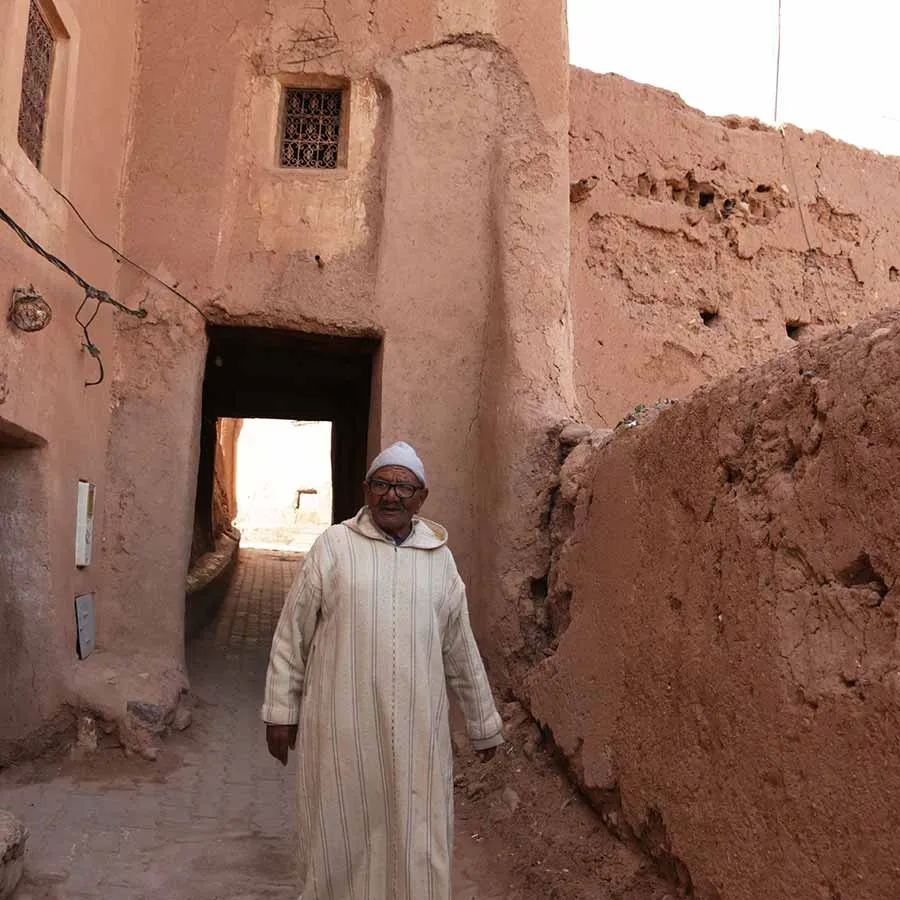
Before the Glaoua, the power of the amghars
Taourirt did not begin with the Glaoua. Before their arrival, it was already part of an older political and tribal geography.
It belonged to the Aït Ouaouzguit confederation and was governed by an amghar, a secular chief chosen from within the community. Local memory has notably preserved the name of Amghar Âabbou.
The inhabitants are said first to have built him a relatively modest house near the gate known as tassendert, before providing him with a residence more suited to his status at Tigmi n’Izrgan, literally the “house of the stone mills”. It would later become Tigmi n’Oumghar, the house of the community chief.
Located within the Taourirt complex, this residence was distinguished by relatively restrained architecture and decoration drawing on local colours and forms. Above all, it reminds us that before becoming the emblematic residence of the Glaoua, Taourirt already possessed its own places of power.
Research into the architectural development of the site likewise confirms an old and complex history: the earliest surviving parts of the complex date back to the seventeenth century, and several phases of construction preceded the arrival of the Glaoua at the end of the nineteenth century.
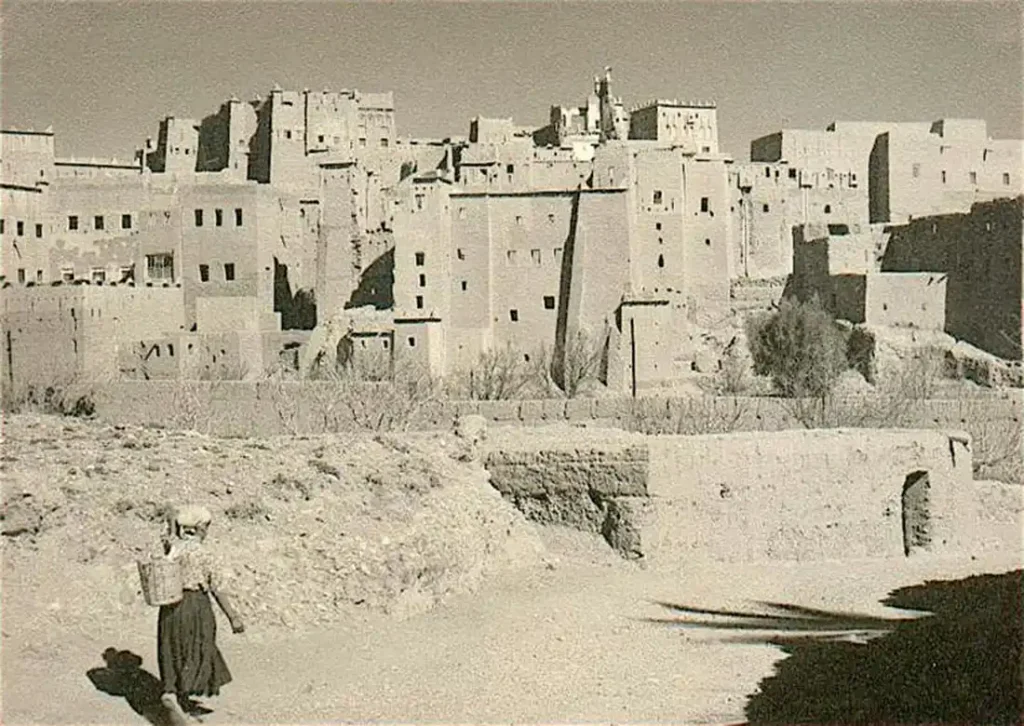
The arrival of the Glaoua opens a new era
During the final decades of the nineteenth century, the political balance of the region changed profoundly.
The Glaoua, established at Telouet, gradually extended their influence southwards. Taourirt, strategically located between the High Atlas, the Dadès and the Upper Drâa, became one of their principal strongholds.
According to the tradition recorded in Taourirt, the succession of the former amghars was marked by violent confrontations. After Amghar Âabbou, his son Amghar Ahmad and then Mohamed ou Hmad ou Âabbou successively exercised power. The weakening of these former local authorities gradually opened the way for the establishment of the Glaoua.
Around 1882, Si Hammadi El Glaoui, brother of Si El Madani El Glaoui, settled in Taourirt. He would remain there until his death in 1937. The Getty Conservation Institute likewise identifies this period as a decisive stage in the transformation of the architectural complex.
But this establishment did not take place without resistance.
After the death of Sultan Moulay Hassan I in 1894, several tribes of the region, including the Aït Ouarzazate, rose against Glaoui power. The kasbah and village of Taourirt were besieged for almost two years before reinforcements from Telouet allowed Si Hammadi to regain the upper hand.
The growing military superiority of the Glaoua relied in part on their possession of modern weapons. In 1893, on his return from a harka towards the Tafilalet, Sultan Moulay Hassan had left Si El Madani El Glaoui a Krupp cannon, shells and modern rifles in recognition of the hospitality he had received at Telouet. This piece of artillery, which became one of the symbols of the growing power of the Glaoua, was later installed at Taourirt.
A short distance from the kasbah also stood Tameghzazte, another centre hostile to Glaoui authority, whose disappearance would further strengthen Taourirt’s control over its immediate surroundings.
Read also: The saga of the Glaoua tribe
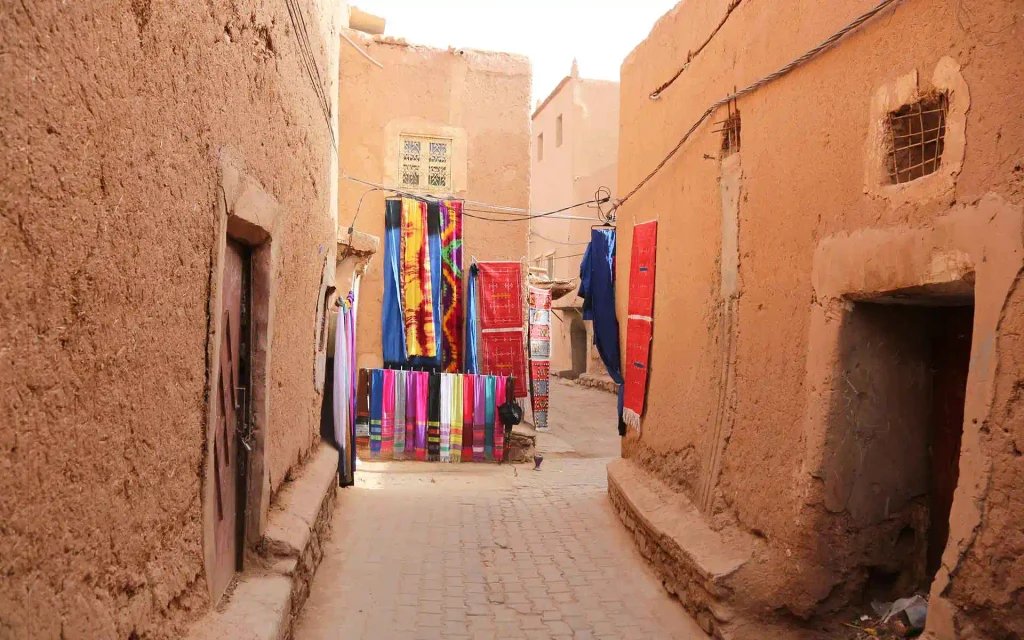
A kasbah transformed into a city of power
The arrival of the Glaoua did not simply mean a change of rulers. It profoundly transformed Taourirt itself.
What is commonly called today the Kasbah of Taourirt is in fact a far more complex ensemble than a single isolated palace. The ksar formed an earthen village, while the tighremt, or fortified residence, constituted the heart of caïdal power.
From the end of the nineteenth century onwards, Si Hammadi greatly enlarged the complex. Research carried out by the Getty Conservation Institute and CERKAS shows how a group of older buildings was gradually transformed into a vast defensive and administrative residence.
The palace contained spaces intended for the caïd’s family, but also accommodation for servants, stables, workshops, wells, baths and areas connected with economic activity. The caïdal residence itself was organised around a central courtyard and incorporated a double-wall defensive system protecting the interior of the building.
From the outside, earthen architecture often retains a striking sobriety: massive volumes, towers, geometric lines and walls coloured like the surrounding soil. Inside, the spaces reserved for power become far more refined. Painted or carved ceilings, geometric decoration, plasterwork, woodwork and wall paintings reveal a world very different from that of the simplest dwellings.
This juxtaposition of domestic, military, economic and residential spaces explains why Taourirt gradually became more than a rural fortress. It developed into a genuine centre of command in the Ouarzazate region.
The Glaoua between conflict, alliances and marriage
The Glaoua did not, however, build their domination through force alone.
Alongside military power came a far more flexible diplomacy. To consolidate their authority and reduce the risk of rebellion, the caïds also sought to build relationships with the families of Taourirt and local notables.
Marriage alliances played an essential role in this policy.
Lalla Sfia Hmad, Lalla Ijja Hmad and Lalla Ghanima, all from important local families, were thus married to members of the Glaoui family. After the death of Mohamed ou Hmad ou Âabbou, Si Hammadi married his widow, Lalla Sfia Hmad, while another member of the Glaoua family married Lalla Ijja Hmad, the amghar’s sister. Family ties thus extended and consolidated political conquest.
These marriages tell a history of power less visible than walls and cannons, but just as decisive: that of a conquering family gradually seeking to become part of the society it ruled.
Once their authority over the region was firmly established, Taourirt acquired such military, political, economic, architectural, cultural and demographic importance that it came to possess the characteristics of a small town, more urban than rural.
Read also: Telouet, birthplace of the Lords of the Atlas
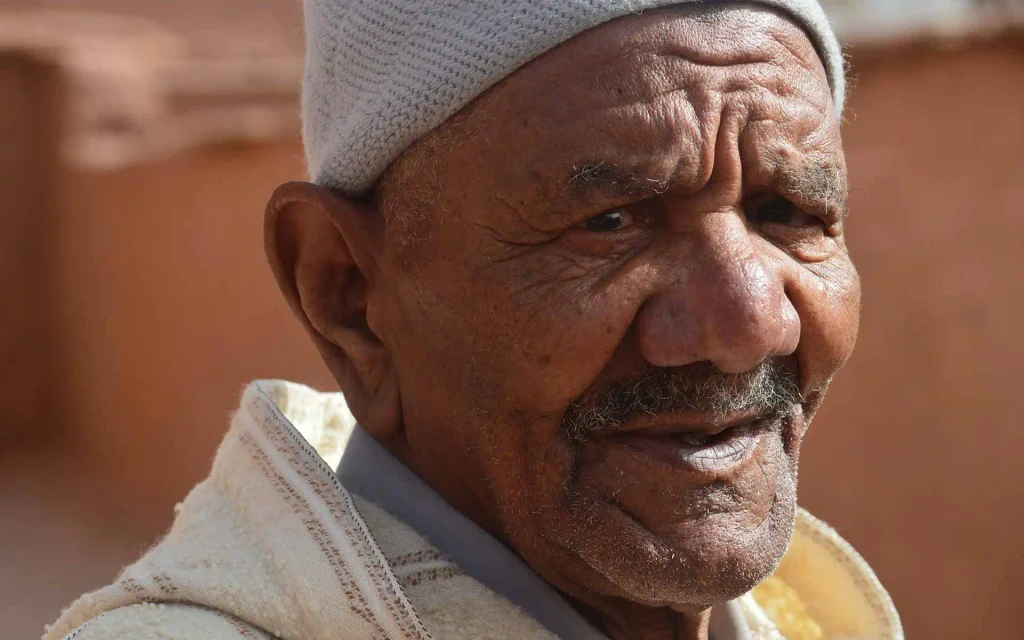
1956: the end of a power, the beginning of a heritage
Si Hammadi El Glaoui died in 1937. Mohamed ben Hammadi succeeded him, followed by Boubker ben El Madani and finally Mohamed El Mahdi ben Hammadi, who governed Taourirt until Moroccan independence in 1956.
In the meantime, another Ouarzazate had appeared.
From the late 1920s onwards, the Protectorate authorities developed a new military and administrative centre nearby. The military post, government services, infrastructure and later the neighbourhoods of the modern town gradually took shape outside the old nucleus of Taourirt.
In 1956, the disappearance of Glaoui power brought the kasbah’s political function to an end. The vast complex entered another period of its history, while Ouarzazate continued to expand around the twentieth-century centre.
Listed as national heritage as early as 1954, Taourirt did not disappear with the world that had brought it to prominence. Its palace, ksar, earthen houses and the memory of its inhabitants gradually became witnesses to an Ouarzazate older than the modern town.
Saving a fragile earthen architecture
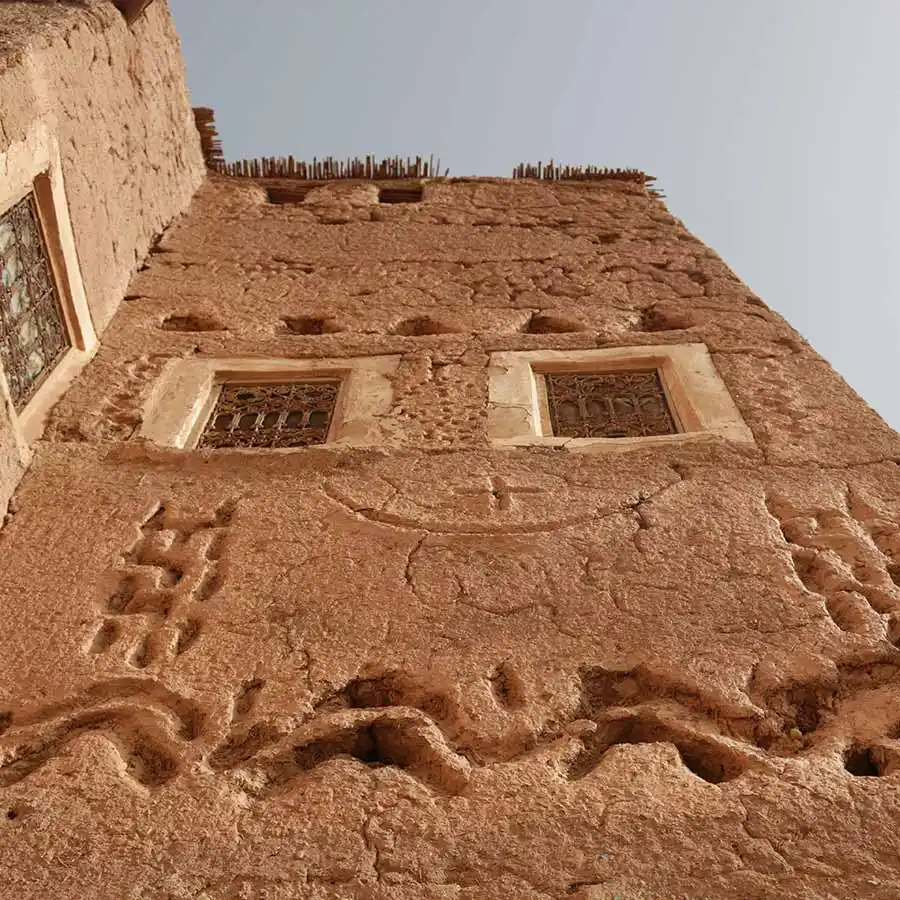
Building in earth allows structures to blend almost naturally into the landscapes of southern Morocco. Yet this architecture remains vulnerable to water, lack of maintenance, unsuitable alterations and abandonment.
In Taourirt, the gradual disappearance of former functions was accompanied by significant deterioration in many of the buildings. Some sections were deeply altered during the second half of the twentieth century, while the Stara quarter underwent increasing residential densification.
Created in Ouarzazate in 1989, CERKAS — the Centre for the Conservation and Rehabilitation of the Architectural Heritage of the Atlas and Sub-Atlas Regions — became involved in safeguarding the complex. In 1992, it notably carried out a census of the inhabitants of Stara, the first stage in a long period of work on a neighbourhood that represented almost 40% of Taourirt’s total area.
From 2011 onwards, this process entered a new phase through a partnership between CERKAS and the Getty Conservation Institute. For five years, until 2016, the two institutions studied the entire kasbah in order to develop a comprehensive conservation and rehabilitation methodology that could also serve as a model for other earthen-architecture sites in Morocco and North Africa.
The project was not simply a matter of repairing walls. It sought to document the different phases of construction, identify original areas and later alterations, stabilise the most fragile sections, analyse materials, preserve wall paintings, maintain local building skills and consider possible new uses.
The approach also took into account the neighbouring ksar, the natural environment of Taourirt and its place within the contemporary town. This was one of the project’s major challenges: how can a monument be conserved without isolating it from the territory that produced it?
At the same time, work to rehabilitate Stara began in 2013. After more than fifty families had been rehoused, experienced mâalems, particularly from the Aït Atta, worked to restore the volumes and techniques of traditional earthen architecture using sun-dried bricks, clay, reeds, timber and traditional roofing.
The Getty–CERKAS project resulted in an important Conservation and Rehabilitation Plan for the Tighermt — or Kasbah — of Taourirt. Research and fieldwork were conducted between 2011 and 2016; the French edition of the plan was published in 2018.
As early as 2014, however, those responsible for the project were stressing a difficulty that went far beyond restoration: saving Taourirt also meant finding a function for it and succeeding in integrating it into the development of the town. Questions of management, appropriation by local inhabitants and its place within visitors’ routes were already central to the discussions.
The earthquake of 8 September 2023 offered a brutal reminder of the vulnerability of this architecture. Further consolidation and restoration work followed. In 2026, new tourism and cultural development projects were again launched around the Kasbah of Taourirt: more than a decade after the first reflections by the Getty and CERKAS, the question of the future of this historic heart therefore remains fully open.
Taourirt, the historic heart of Ouarzazate
Today, the kasbah appears almost absorbed by the town. Avenue Mohammed V runs past its walls, modern neighbourhoods surround it, and urban development has profoundly transformed the landscape in which it was built.
Yet Taourirt remains an essential key to understanding Ouarzazate.
The present-day town does not possess an old medina around which it gradually developed. It emerged in the twentieth century beside several much older centres of settlement. Taourirt is one of these centres, and probably the most important surviving witness to the Ouarzazate that existed before Ouarzazate.
This is why discovering it should not end with the few decorated rooms of the former caïdal residence.
One must also look at the houses of the ksar, walk through its lanes, observe the relationship between the kasbah and the wadi, and imagine the gardens that once occupied its banks. Only then do the walls recover their meaning: they are no longer the spectacular backdrop of an isolated monument, but the centre of a territory that was once inhabited, cultivated, crossed, governed and defended.
Perhaps this is how Taourirt reveals itself most fully: not as a surviving relic set down in the middle of the modern town, but as the historic heart from which part of the history of Ouarzazate can still be told — and explored on foot.
— our 2014 report from the Stara restoration site with Mohamed Boussalh, then director of CERKAS.
— on the challenges of conservation, management and the integration of Taourirt into the town.
Plan your visit
See our Discover Ouarzazate guide
Key points
- Taourirt existed before the modern town of Ouarzazate: the earliest surviving parts of the complex date back to the seventeenth century.
- Oral tradition traces its origins to Ighrem n’Tassyart, a settlement established close to the gardens and the wadi before its inhabitants moved to the hill of Taourirt.
- The Glaoua established themselves here in the late nineteenth century, and Si Hammadi El Glaoui gradually transformed Taourirt into an important centre of regional power.
- The kasbah was far more than a palace: residences, service areas, workshops, stables, wells, baths and economic functions formed a complex ensemble at the heart of the ksar.
- Glaoui domination relied as much on alliances as on force, notably through marriages with local families.
- After 1956, Taourirt lost its political function, while the modern town of Ouarzazate continued to develop nearby.
- CERKAS and the Getty Conservation Institute carried out a major conservation programme between 2011 and 2016, designed also as a model for other forms of earthen architecture.
- Taourirt remains today the principal historic heart of Ouarzazate: understanding it means looking beyond the palace to the ksar, the wadi and the older landscape surrounding it.

For more than twenty years, Éric Anglade has lived in a village of South-Eastern Morocco, where he explores and documents the region’s history, heritage, and living traditions. He founded sudestmaroc.com as a space for sharing fieldwork and cultural insight, bridging local knowledge with global perspectives. He also works alongside women carpet-weavers to help sustain their craft and welcomes travellers at Le Jardin de Yuda, his guesthouse envisioned as a meeting place for exchange and transmission.
More to Explore

Leave a Reply