


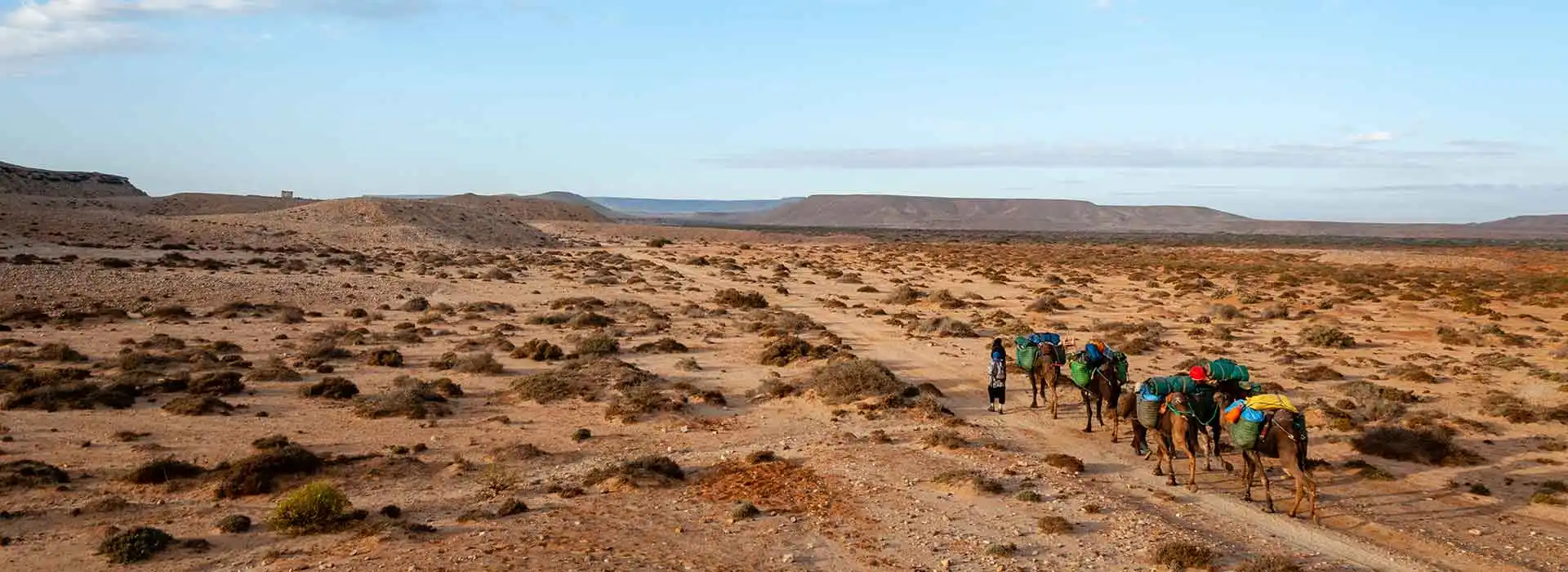
Discovering Morocco as in the days of the caravans of old
In 2019, adventurer Alice Morrison set out to follow the course of the Drâa on foot, with a caravan of camels, from Skoura all the way to the Atlantic. A journey of 1,364 kilometres and 78 days, through oases, the Sahara and ancient memories, in an intimate confrontation with water, nature and time.
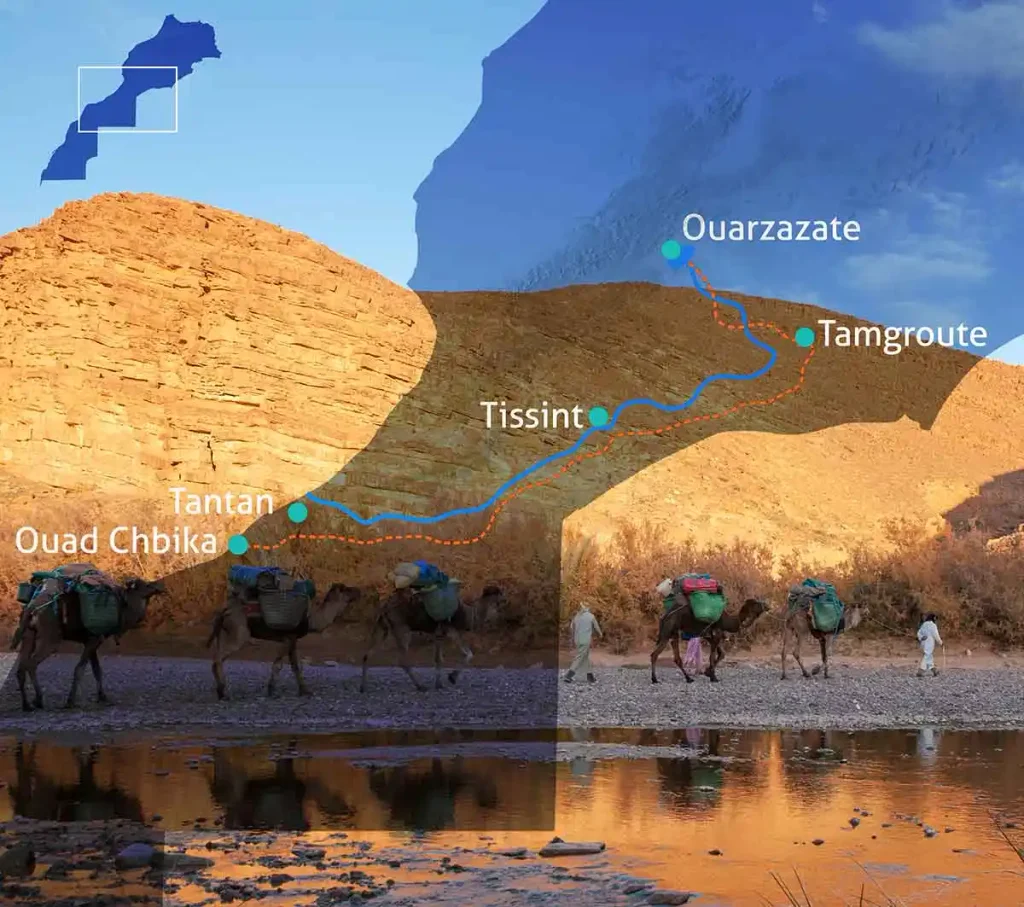
It was therefore in January 2019 that the first stage of this crossing of Morocco began, a journey that would include two others in the months to come. Alice had placed water at the heart of the first design of her dream: to follow the water along the course of the Drâa, from the Atlas ranges, past the oases and fortified villages of the valley that bears the same name, the Drâa Valley, through the endless expanses of sand of the Sahara Desert and as far as Foum Drâa, near the town of Tan-Tan, where the waters of the river mingle with the salt waters of the ocean. A route of almost 1,364 km which Alice would experience stage after stage and which would require 78 days of walking at the pace of the camels, with the kind and efficient support of the team from the Désert et Montagne Maroc agency: Brahim the team leader, Brahim the guide and cook, and Addi the assistant camel handler, together with five camels. An incredible adventure into the depths of Morocco, that Morocco where Nature demands of the human being who crosses it respect, humility and admiration.
The Skoura palm grove
The caravan sets out from the Skoura palm grove, a vast expanse of palm trees 50 km from Ouarzazate, renowned for its many earthen kasbahs. For Alice, it is an opportunity to discover the traditional irrigation system specific to the oases, a Khtagha, a genuine underground aqueduct dug from the slopes of the Atlas Mountains several kilometres away. This ancestral network, also known in Arabic as Foggara, or Qanât in Persian, channels underground the water needed to irrigate the oasis and is monitored through wells dug at regular intervals. These openings form small mounds of earth on the ground, in the centre of which lies the well that makes it possible to check the proper flow of the precious liquid without which crops could not grow in the gardens of this luxuriant palm grove.
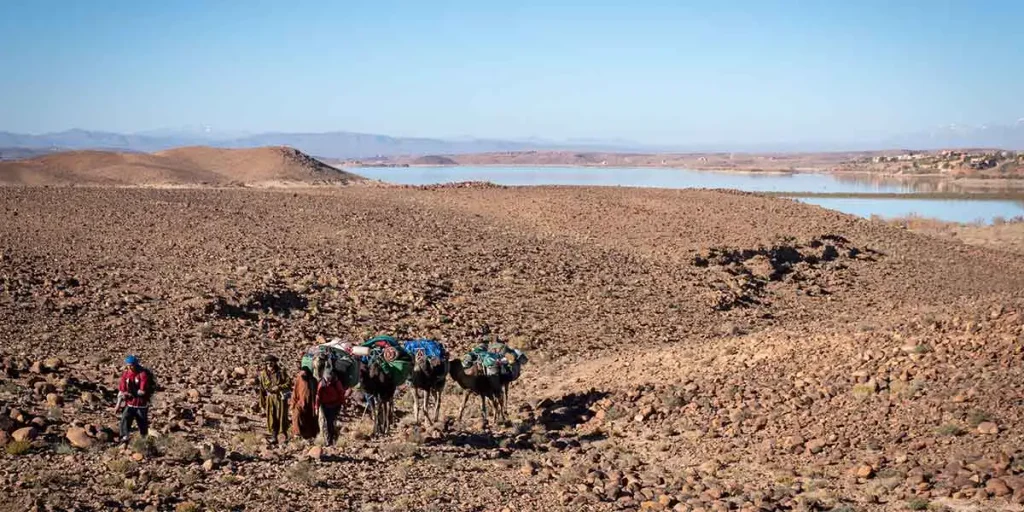
Lake Ouarzazate
The first stop is on the shores of Lake Ouarzazate, which gathers the waters of several rivers, including the Dadès and Imini oueds; both have their sources in the high snow-covered peaks of the Atlas ranges, such as those of Tizi-N’Tichka, east of Djebel Toubkal, or the M’Goun, at altitudes of between 3,000 and 4,000 metres. From this magnificent lake, which offers visitors a panorama of tranquillity, the Drâa regains all its strength and sets off again down the valley to perform its work of irrigation for the many villages that border it, flowing as far as the dunes of the Sahara before becoming more discreet throughout its journey, almost invisible beneath the sandy ground, until its future encounter with the vast waters of the ocean.
The second oasis crossed by the caravan is Tamnougalte, where a large fortified village, a ksar, probably built in the 18th century, extends across the landscape. At its heart, the village contains an imposing kasbah once inhabited by the caïds responsible for governing the surrounding territories, a region formerly known as Mezguita and which then functioned as a genuine Berber-speaking emirate.
Then, near the village of Tinzouline, in Zagora Province, comes the opportunity to admire traces of Morocco’s prehistoric past: the rock engravings discovered at the Foum Chenna site, depicting both domestic and wild animals, horsemen armed with shields and spears, scenes of combat and scenes of hunting.
Alice’s caravan then arrives at the village of Tamgroute, 15 km from Zagora and renowned since the 18th century for its pottery workshops, among the oldest in Morocco. The craftsmen, who pass their know-how from generation to generation, make a typically rural pottery here whose distinctive feature is its green glaze. Tamgroute brings together several ksour, fortified villages, the best known of which is the Zaouïa Naciria, home to an old library containing works from Arab-Muslim culture, including scientific books, works on mathematics, astronomy and pharmacopoeia, among them a book by Pythagoras translated into Arabic 500 years ago, as well as literary works and many religious books.
Read: Tamegroute: green pottery and the Naciria Library
Crossing the desert
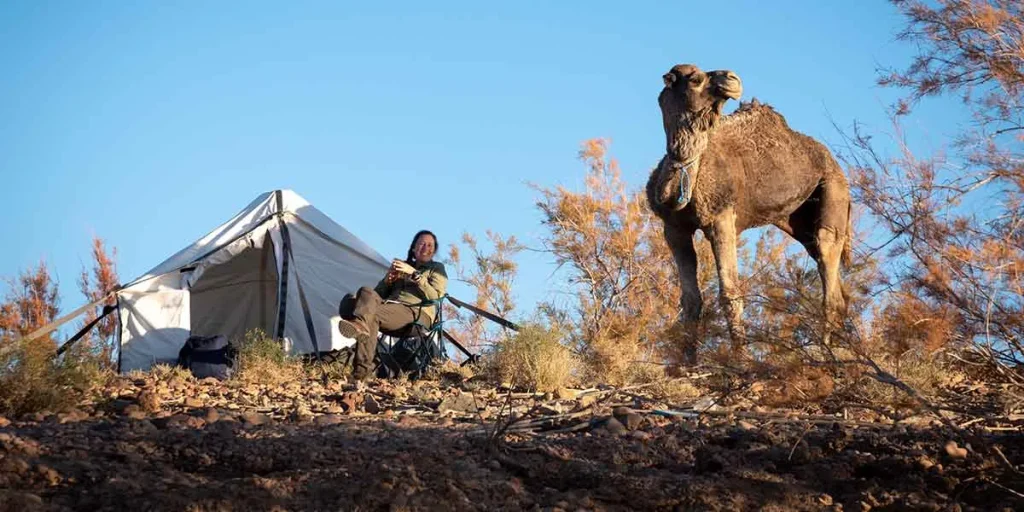
At last the desert appears, with its first dunes, where the plains begin to be covered with sand. At the edge of the douar known as Ouled Driss, meaning “the son of Driss”, a small fortified village dating from the 17th century at the gates of M’Hamid El Ghizlane, the expedition plunges into the Sahara. A new rhythm takes hold. The day seems paced, along the thread of each stage, by simple gestures that have become essential in these places: waking at sunrise, the camp being folded onto the backs of the indispensable camels, walking beside them until the next halt before the end of the day, unloading the burden from the camels’ backs to let them rest, the camp unfolding once again and, finally, the moment for tea, the moment for the bodies to rest and for the souls to find peace.
Lost in the desert, the tomb of the marabout Sidi Naji is a place of pilgrimage for nomads. Legend tells that this holy man possessed as much devotion as the desert has grains of sand. His tomb has the particularity of being very large, which over time has given rise to mythical stories about the existence of a distant age when giants inhabited these lands.
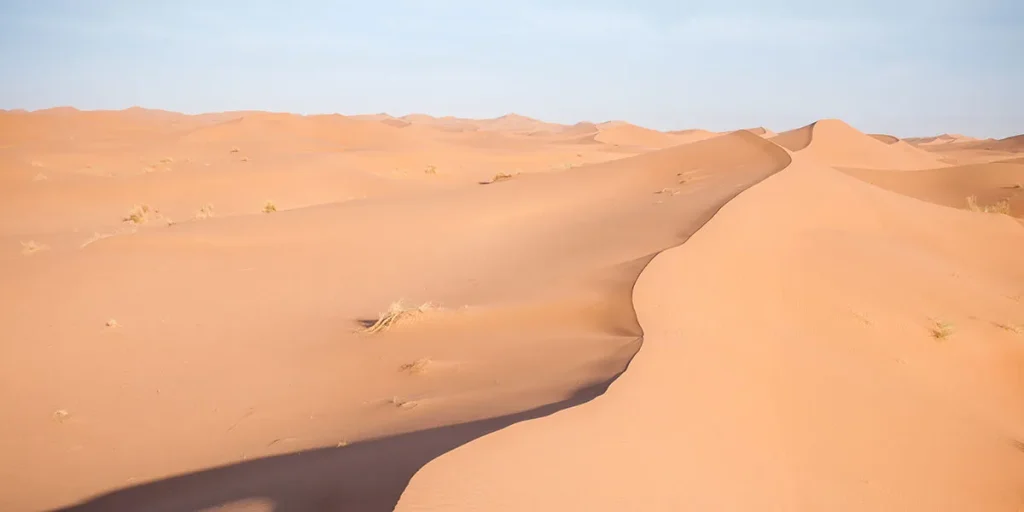
A new joy that at last finds expression
The erg of Chigaga then opens before Alice’s eyes, like a sea of sand scattered with waves of dunes. For her begins the encounter with the kingdom of the most profound simplicity. Where there is nothing other than the sky, a burning blue, and the sand, the colour of vivid gold. Where everything is clear, in a fullness of light. Where everything can be seen because here, thanks to this great emptiness, the eye has all the space it needs to see nothing but the details, the rare plant emerging from the sand, the insect seemingly lost but nevertheless living its life, the singular shape of the crest of a dune. A new joy finds expression, the joy of at last being able to concentrate on the infinitesimal details of the living world.
The desert suddenly gives way to a sea of black stones polished over millennia, from which volcanic spurs rise here and there, offering the walker a magnificent panorama of the surrounding desert. This is Jbel Bani, and this too is Jbel L’Mdor. Wild donkeys can still be encountered in these places, sometimes gazelles, a rare form of life resisting the harshness of nature.
Passing through the village of Tissint becomes an act of homage, for the great explorer Charles de Foucault stayed there for a time in 1884 during his pioneering crossing of Morocco. This young French officer, aged 24, had in fact left France a year earlier on behalf of the Société de Géographie, with the intention of discovering southern Morocco, still very poorly known at the time. He began his journey in June 1883 accompanied by a rabbi. Throughout the journey, he recorded observations and sketches in a tiny notebook. Alice is following in the footsteps of this first great explorer, who ended his life as a hermit in a mountain of the Algerian Sahara.
The caravan often crosses landscapes where one senses that water, once present, no longer comes. One senses that human beings will gradually withdraw even further from these places, which will then inevitably be covered with sand. Here it becomes clear that the climate is changing, and even if we do not really know why, we feel how radical the upheaval of life will be.
“The difference between a place where there is water and another where water is absent is probably the difference between heaven and hell.”
Alice Morrison
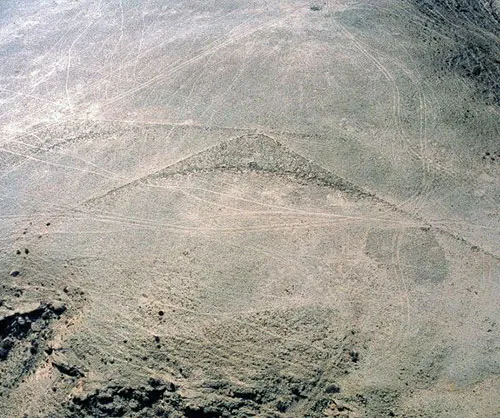
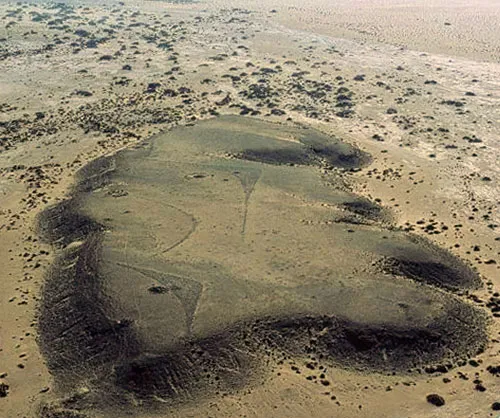
Once the expedition reaches the region of the oued Chibka, the world of the desert finally meets that of the sea, the majestic waves of sand preparing to vanish into its bluish reflections. But here on the expedition’s route, in Tan-Tan Province, and just before its end, the still desert landscapes contain one of the finest traces of the pre-Islamic period: a site clearly used for ceremonial purposes, bringing together several dozen tumuli or tombs and monuments made of stones laid out on the ground in the shape of antennae or wings. No one knows the exact meaning of these configurations, which can only really be seen from the sky, but their sacred dimension leaves no room for doubt. More than 7,000 years ago here, a civilisation now vanished and wholly unknown stood alive and addressed the sky.
Along the way, the caravan, like every other caravan before it, stops for a short while beside a water reservoir filled by the rains, which are more frequent here during the year as the ocean shore draws closer. Known as Tanutfi because of their small size, these reservoirs allow the team to refill their containers and water bottles. The camels drink in turn, and the walk resumes its slow and steady rhythm.
A dream that needed to be lived
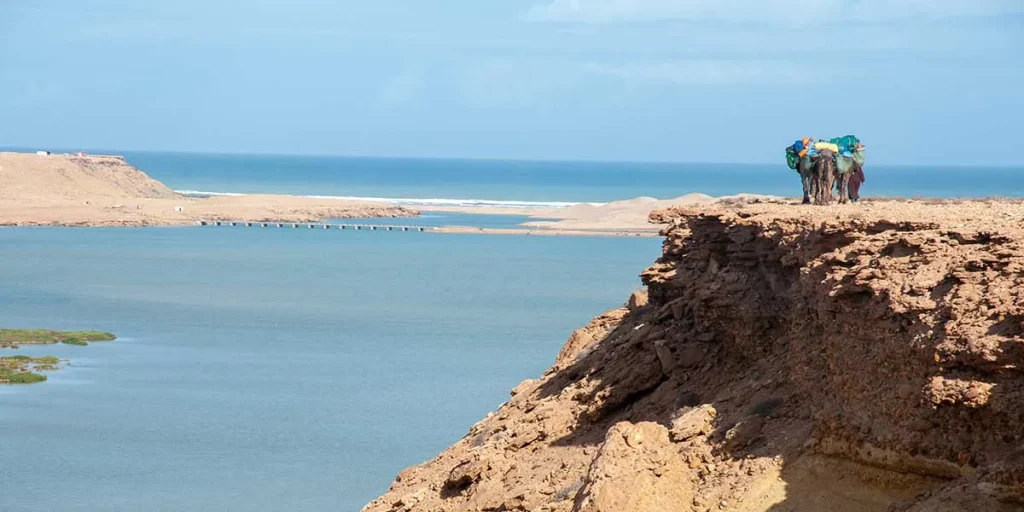
At last the expedition reaches the fine sandy beaches at the foot of the cliffs. It is the encounter with the Atlantic and its infinite horizon. Fishing boats stand ready to replace the caravans. Alice and her companions have reached the end of their long adventure. Accompanied by their camels, they continue walking through dunes of sand, sometimes still just as imposing and soaring into the distance, but already the scents are no longer the same, the iodine gradually fills the air, breathed in with a welcome delight after those weeks of aridity, all those days spent walking across dried-out ground. For Alice, this first stage will remain engraved within her for ever, because everything she has lived has been lived through every fibre of her body and her being, in an alliance imposed by this confrontation with Nature and its inescapable power.
Of course, it is as an echo of the madness of the present times that this dream took on its full meaning in this fierce and yet so candid choice finally to take the time to watch life flow within its first and, without doubt, final setting: Nature still. To take the time to admire Morocco in its most authentic beauty and richness. To take the time to observe one’s own life, to look at one’s existence from the distance that allows understanding, reconciliation with oneself.
Alice Morrison acknowledges it: she wanted to live an experience with the intention of changing herself, that is to say, to allow the superfluous and everything that no longer had any reason to be to die away within her, and to allow what was calling for growth to grow within her. A dream that needed to be lived.
Crédit Photographie : Abdellah Azizi
www.azifoto.com
An expedition organised by Désert et Montagne Maroc
The route

For more than twenty years, Éric Anglade has lived in a village of South-Eastern Morocco, where he explores and documents the region’s history, heritage, and living traditions. He founded sudestmaroc.com as a space for sharing fieldwork and cultural insight, bridging local knowledge with global perspectives. He also works alongside women carpet-weavers to help sustain their craft and welcomes travellers at Le Jardin de Yuda, his guesthouse envisioned as a meeting place for exchange and transmission.
More to Explore

Leave a Reply