
Tamegroute: green pottery and the Naciria Library
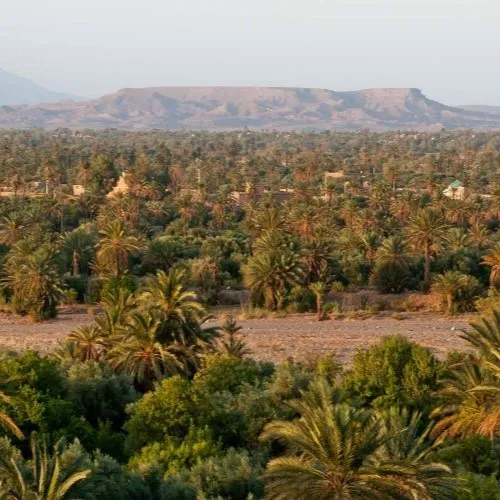
One of the most expansive oases in southern Morocco, where date palms, earthen kasbahs and oasis traditions compose a landscape shaped by water over centuries.
The sudestmaroc.com view
Tamegroute ne se livre pas comme un site spectaculaire. Sa force est plus discrète. ElTamegroute does not reveal itself as a spectacular monument or attraction. Its appeal is more subtle. It lies in the encounter between earth, fire, ink and memory.
On one side, potters preserve a craft immediately recognisable by its irregular green pieces, shaped by clay, glaze and firing. On the other, the Zaouia Naciria reminds us that the Drâa Valley was not merely a corridor leading towards the desert, but also a place of learning, transmission and spiritual authority.
To visit Tamegroute is to encounter a place where craftsmanship, Sufism, caravan routes and the written memory of southern Morocco come together.le tient dans la rencontre entre la terre, le feu, l’encre et la mémoire.
Why visit Tamegroute?
Tamegroute occupies a distinctive position in the Drâa Valley. Located south of Zagora, on the road towards M’Hamid El Ghizlane and the Sahara, it was long associated with caravan traffic, spiritual exchange and religious learning.
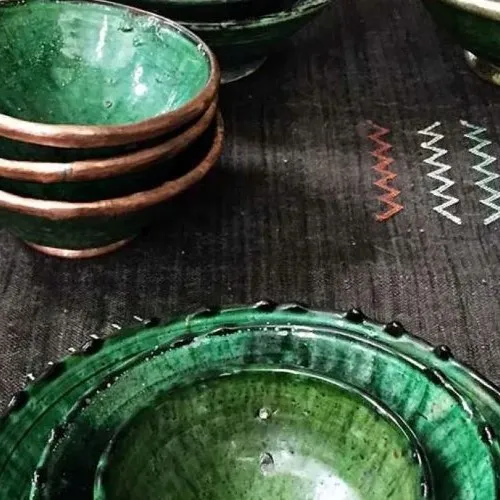
Today, the village is known above all for two things. The first is its green pottery, one of the most recognisable crafts of southern Morocco. Bowls, dishes, cups, vases and tiles bear the deep, sometimes uneven green glaze for which Tamegroute is famous.
The second is the Zaouia Naciria, an important Sufi institution whose library holds a remarkable collection of ancient manuscripts. These works bear witness to a time when the Drâa Valley was connected to the great centres of Islamic learning, from the Maghreb to the Mashreq.
Tamegroute was therefore far more than a village of craftsmen. It was also a place of passage, hospitality and influence. Standing on the old caravan route, it welcomed merchants, pilgrims, students, scholars and travellers from many different horizons.
The very name Tamegroute recalls this role as a place of passage. According to a commonly cited interpretation, the name is of Amazigh origin and refers to a place one visits, passes through or stops at. By extension, Tamegroute came to be regarded as one of the last inhabited stopping points before the desert — a place to rest before or after the crossing.
To visit Tamegroute is to discover this dual heritage: that of the craftsman’s hand and that of written memory.
What to do in Tamegroute?
Discover the pottery workshops and their craftsmen
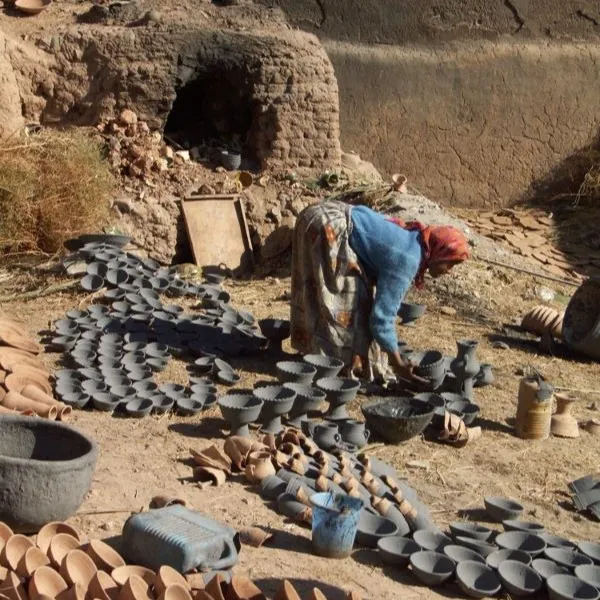
The pottery workshops offer the most accessible and visually engaging introduction to Tamegroute. Visitors can observe the different stages of production: preparing the clay, throwing the pieces on the wheel, drying, glazing and finally firing them in traditional kilns.
Tamegroute pottery is instantly recognisable by its green glaze. The colour is never entirely uniform. It varies from one piece to another according to the firing and the effects of the glaze. This irregularity is part of its appeal: every object bears the marks of both fire and hand.
Most of the pieces are objects for everyday use: bowls, plates, serving dishes, cups, jars, vases and tiles. Smaller pieces are easier to carry and often make more practical souvenirs than large dishes or fragile vases.
Local tradition also links this pottery to influences from Fez. Tamegroute’s craft is said to have been enriched by techniques brought by craftsmen from the imperial city, at a time when the Zaouia Naciria attracted scholars, travellers and skilled artisans. Passed down through families of potters, this tradition of green-glazed ceramics gradually became one of the village’s most recognisable signatures.
Beyond the possibility of buying a piece, much of the interest lies in simply watching the potters at work. Tamegroute reminds us that craftsmanship is not merely the production of decorative objects. It is also a way of passing on a material, a technique, a family memory and a relationship with the land.
Some workshops and local operators also offer introductions to pottery making. Depending on the workshop, this may involve simply trying the basic gestures, taking part in a session guided by a potter, or joining a longer course in which participants work the clay, shape a piece and sometimes learn basic decoration techniques. Duration, prices and arrangements vary, so it is worth enquiring in advance if you would like to practise the craft rather than simply observe it.
Some workshops in Tamegroute offer introductory pottery sessions.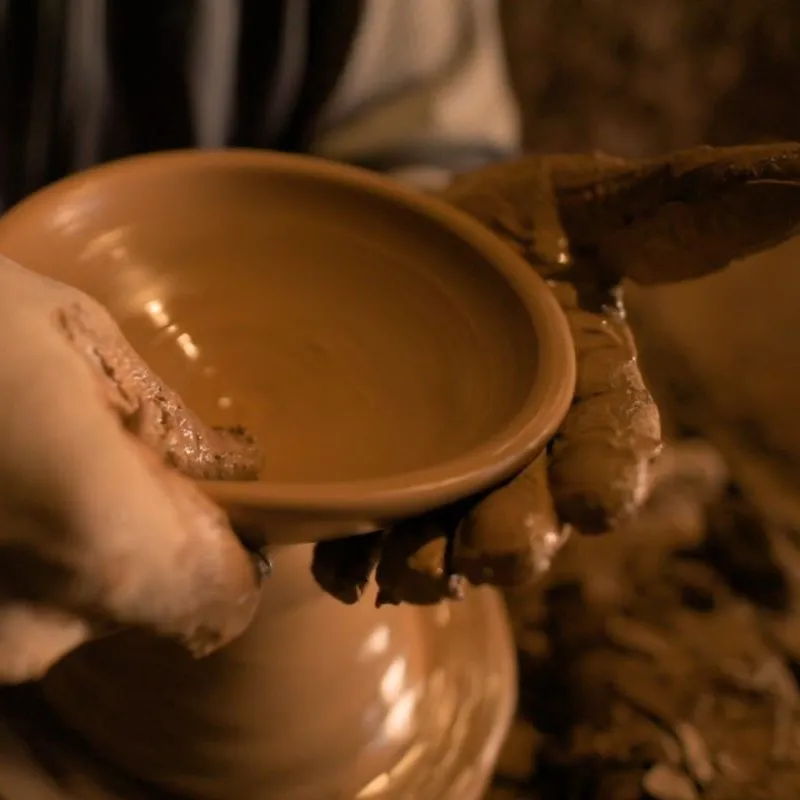
Visit the library of the Zaouia Naciria
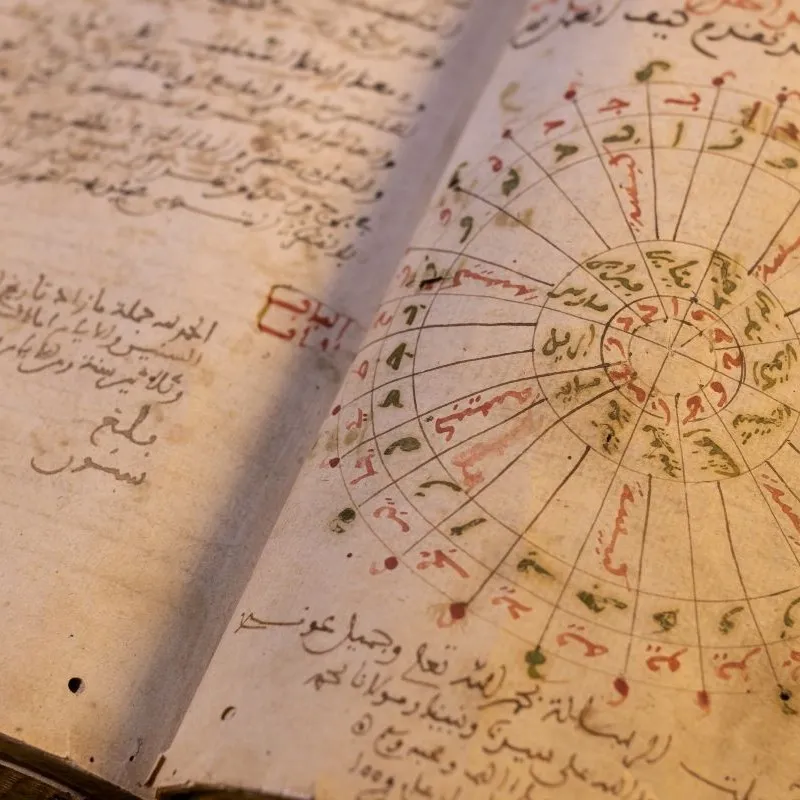
The library of the Zaouia Naciria is the other major reason to stop in Tamegroute. It houses several thousand ancient manuscripts covering not only religion, but also law, medicine, astronomy, science and scholarly literature.
It is therefore more accurate to describe it as a manuscript library rather than simply a Quranic library. The Quran and religious sciences naturally occupy an important place in the collection, but its significance extends far beyond them. The library bears witness to a broad written culture engaged with the knowledge of its time.
The Zaouia Naciria was founded in the sixteenth century, in 1575, by Abu Hafs Omar Ben Ahmed El Ansari. It later acquired its name and much of its influence through M’hammad Ben Nacer, a major seventeenth-century Sufi figure. Under his leadership, the zaouia became one of the principal spiritual centres of southern Morocco.
A library was later established there in the seventeenth century by Ahmed Naciri. It helped extend Tamegroute’s influence far beyond the Drâa Valley, attracting scholars, ulema and students who came to consult, copy and transmit valuable works.
Visiting the library nevertheless requires a little practical preparation. Access depends on the zaouia’s opening hours, the presence of the custodian and local circumstances. It is advisable to check before travelling or to visit with someone familiar with the customs of the place.
Photography of the manuscripts may be prohibited or restricted. As in any religious site, respectful dress and discreet behaviour are recommended.
Read more: Sufism in Morocco, a bridge to the future
Check locally before planning a visit to the library.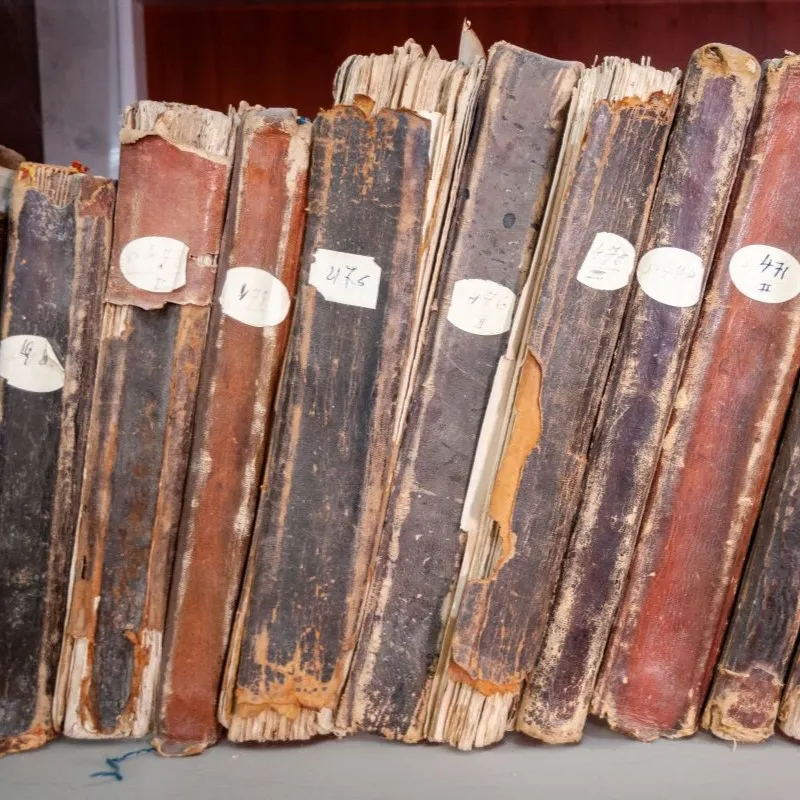
Understand the role of a zaouia
For visitors unfamiliar with the term, zaouia deserves some explanation. It comes from the Arabic zawiya, originally meaning a “corner” or “angle”, and later came to refer in the Maghreb to a religious institution associated with teaching, hospitality and spiritual life.
In Morocco, zaouias developed over the centuries and played a profound role in the social organisation of towns, oases and tribal communities. A zaouia was therefore much more than a place of prayer. It could include a mosque, a school, a library and accommodation for students, travellers or pilgrims, as well as agricultural or commercial property whose income helped support the institution.
Some zaouias also played an important economic and political role. In regions such as the Souss and the southern valleys, they could act as mediators between tribes, centres of religious authority, places of protection and sometimes as genuine counterweights to central power.
This is the context in which the Zaouia Naciria of Tamegroute should be understood. It was not an isolated monument but a living institution: a place of prayer, teaching, hospitality, transmission and influence at the heart of the Drâa Valley.
The Zaouia Naciria long played an important economic and political role.Read more: The Zaouia Naciria of Tamegroute: the origins of an institution
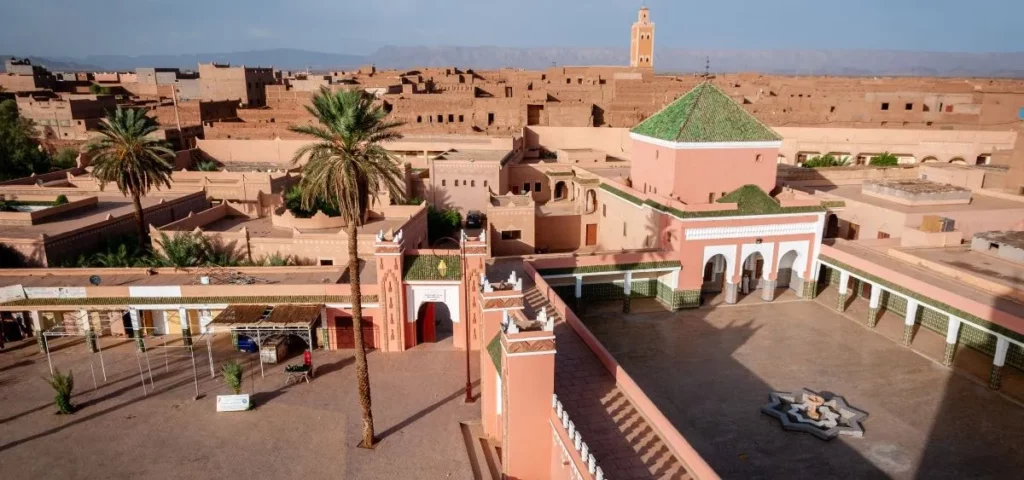
Walk through the earthen alleyways
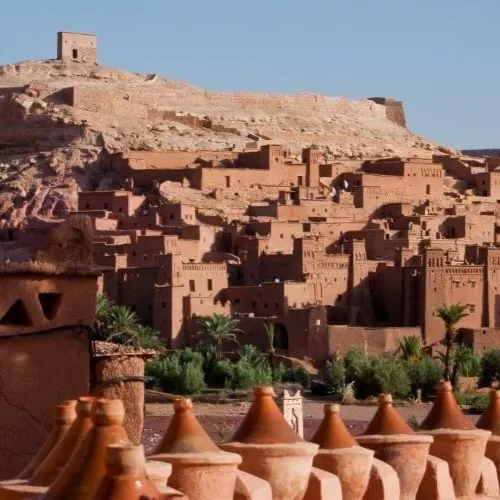
Beyond the workshops and the library, Tamegroute is also worth exploring on foot. Its narrow lanes reveal the earthen architecture characteristic of villages throughout the Drâa Valley: thick walls, confined passageways, deep shade and simple forms.
This is not an open-air museum but a living village. Visitors should therefore walk discreetly, avoid photographing residents without permission and take the time to observe the relationship between architecture, light and material.
Earth-coloured walls, old buildings, shaded passages and simple volumes create an atmosphere very different from that of the region’s major tourist sites. Tamegroute rewards patient attention rather than a hurried glance.
Taking the time to walk through the village is one of the best ways to appreciate the atmosphere of Tamegroute.Read more: Once upon a time in the ksar of Aït Ben Haddou, four Christian princesses …
Stop at the Tinfou dunes
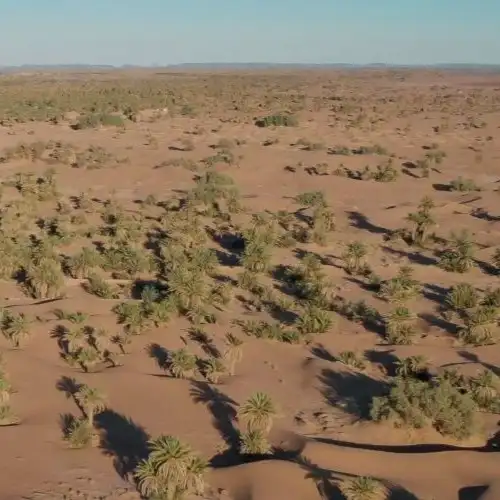
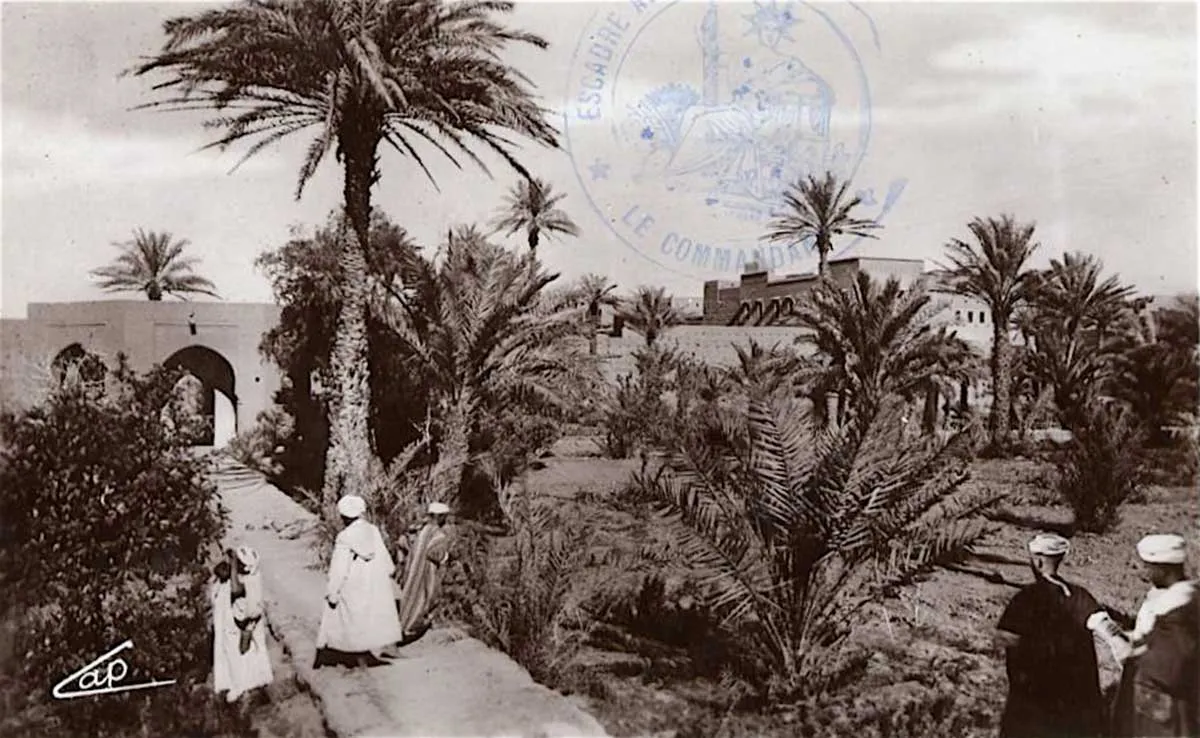
A few kilometres south of Tamegroute, the Tinfou dunes offer a first encounter with a true dune landscape. They do not have the scale of the great ergs around M’Hamid or Merzouga, but they can make an enjoyable stop for travellers who are not continuing farther into the desert.
The appeal of Tinfou is above all symbolic: here, the transition between the inhabited Drâa Valley and the more open landscapes of the pre-Sahara becomes tangible.
The Tinfou dunes offer a first glimpse of the great Saharan landscapes farther south.A lire : La palmeraie de Skoura, l’oasis par excellence
How to get to Tamegroute?
From Ouarzazate
From Ouarzazate, take the N9 national road towards Agdz, then continue through the Drâa Valley to Zagora. Tamegroute lies farther south, on the road towards M’Hamid El Ghizlane.
The journey takes around three hours from Ouarzazate, longer if you stop in Agdz, along the Drâa palm groves or in Zagora. Tamegroute is therefore best included in a full-day excursion or as part of a longer journey through the south.
From Zagora
From Zagora, Tamegroute is an easy excursion. The road is paved and follows the main route towards M’Hamid. The drive takes around twenty to thirty minutes.
For those staying in Zagora, the visit can easily be made in the morning: leave early, visit the pottery workshops, see the library if it is open, then return to Zagora or continue south towards Tinfou and M’Hamid.
Visiting with a local guide
A local guide can be useful, particularly for visiting the library and understanding the wider context of the Zaouia Naciria. The pottery workshops are easier to explore independently, although a knowledgeable guide can provide a deeper understanding of the techniques, kilns, glazing and family organisation behind the craft.
A guide is not essential, but can enrich the visit, particularly when it comes to understanding the role of the zaouia and the organisation of the pottery workshops.Beyond Tamegroute
Tamegroute fits naturally into a longer journey through the Drâa Valley. From Ouarzazate, the road passes through Agdz, the Drâa palm groves and Zagora before reaching the increasingly open landscapes of the south.
Beyond Tamegroute, you can continue to the Tinfou dunes and then towards M’Hamid El Ghizlane, the last major settlement before the Saharan tracks and Erg Chigaga. In the opposite direction, a visit to Tamegroute can be combined with Zagora, Amezrou and the villages of the Drâa Valley.
Tamegroute is therefore an ideal stop for adding cultural depth to a journey towards the desert. It reminds us that the road south is not merely a road through remarkable landscapes. It is also a route shaped by knowledge, Sufi traditions, craftsmanship and centuries of memory.
For more information: Contact us
Tamegroute in video
Planning a stay in Tamegroute?
Have a question or need more information?
Use our contact form.
We will be happy to help.