


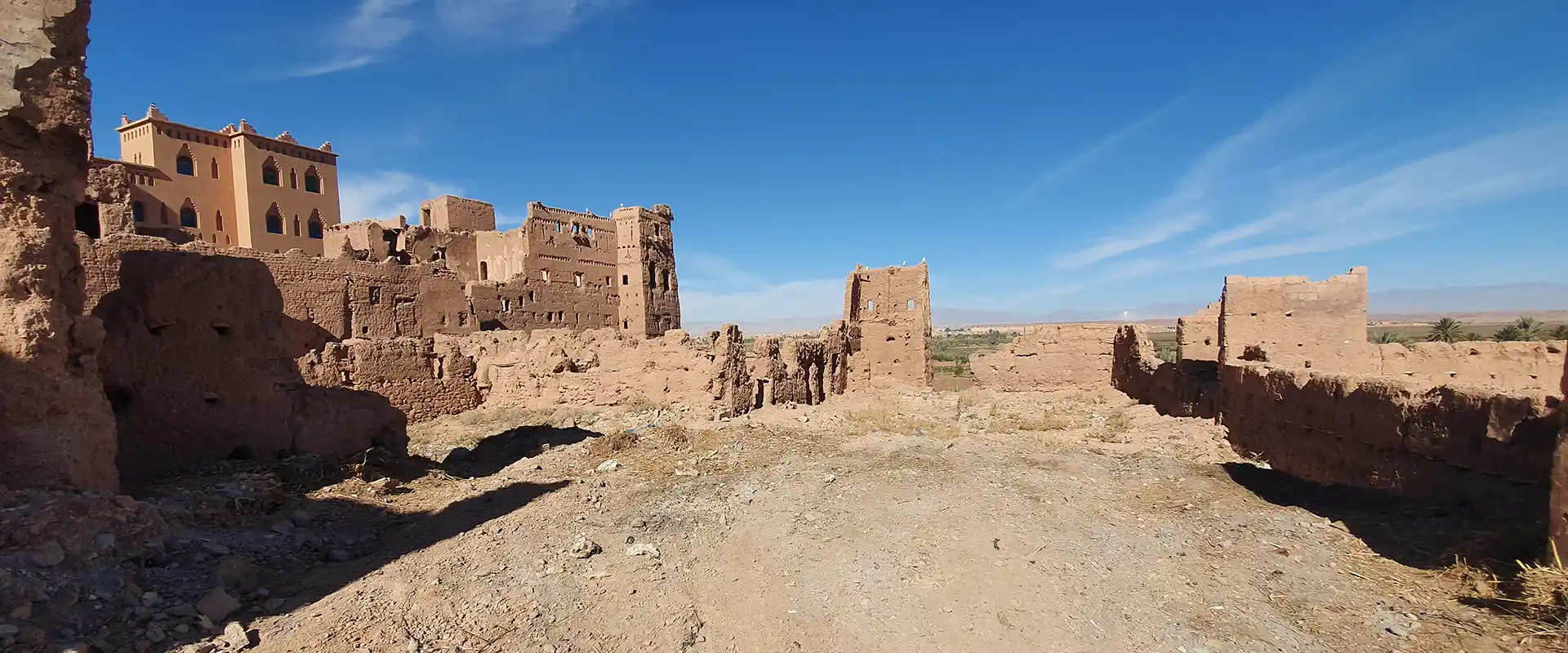
The Casbah of Telmasla, told by its elders
On a morning in 1963, buses arrived in Telmasla. The Jewish families of the old casbah loaded their trunks, said goodbye to their Muslim neighbours and left the village in tears. Ba Idar was there. Through his memories, an entire world re-emerges: a fortified village south of Ouarzazate where Muslims and Jews lived side by side, shared traditions and venerated the same saint — until the day one of its communities disappeared.
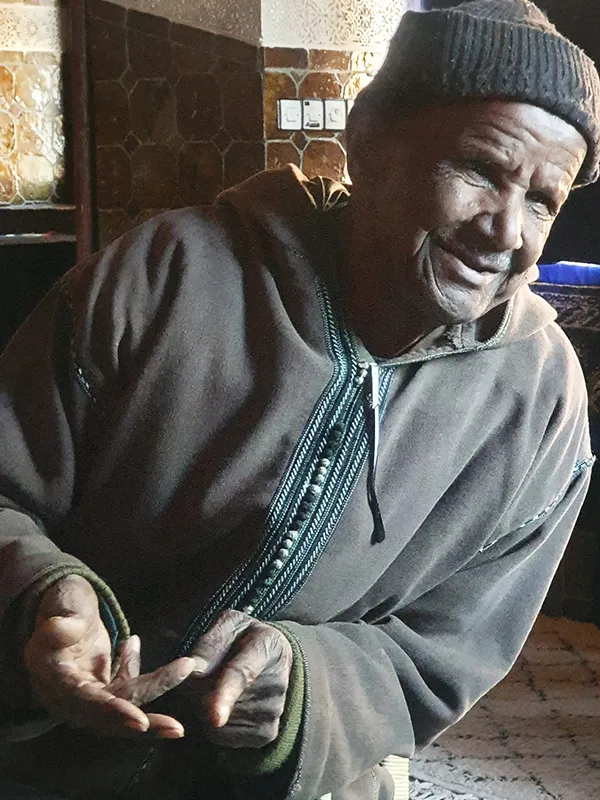
Ba Idar, an octogenarian born in Telmasla, turns back the clock and brushes the dust from the past. He takes us on a fascinating journey on the wings of stories that bring the life of his tribe back to life and recreate the setting of his village. It is the voice of a storyteller, marked by authenticity, generosity of spirit and the vividness of a memory in which an entire local and collective history remains engraved.
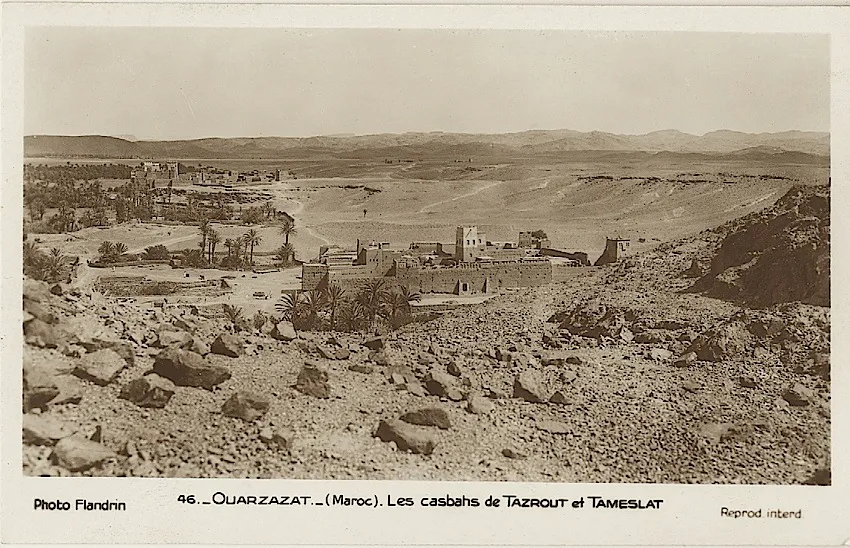
The political and social importance of the Casbah of Telmasla in the past
During the French Protectorate, the Casbah of Telmasla was a seigneurial fortress under the control of the Glaoua caïds, powerful Berber lords who dominated the territories south of the Atlas. The entire group of buildings was surrounded by a thick rammed-earth wall that protected the village from raids by enemy tribes.
A dignitary of the Glaoua family named Sidi Elhassane, who bore the title of Amghar, or village chief, resided in the fortress known as Tighremt N’Ou Glaou, or the Casbah of the Glaoui, a well-fortified private seigneurial residence.
This seat of authority governed several villages, including Talat, Tazrout, Tajda, Tiguemi Lejdid and Tabount, as well as the former douars of the Ouarzazate oasis that now lie beneath the waters of Lake Al Mansour Ad Dahbi, such as Tadmricht, Hbib, Ghalil…
The village chief owned property that afforded him a comfortable life. His social position was reinforced by his recognised authority. Far from the common image of the all-powerful caïd, the way in which he exercised control over the villagers did not appear oppressive. He showed an indulgent kindness towards the poorest inhabitants:
“Our women used to look for food for their livestock. A neighbouring tribe drove them out of its fields. Refusing to accept this humiliation, the Amghar (the village chief) ordered fields of alfalfa to be cultivated for the needy villagers. Besides, we had no qualms about picking succulent dates and fruit from his gardens to appease our hunger.”
Ba Idar
Telmasla was home to the only Machyakha, the office responsible for administering the other tribes on the southern bank of the Oued Ouarzazate. To this singular distinction was added the holding of Friday prayer, or Jumu’ah, in its mosque, bringing together Muslim men from the different douars.
This privilege was due to the considerable number of inhabitants living in Telmasla compared with other villages. The casbah was indeed home to 35 Muslim Amazigh/Shilha households and 20 Shilha families of Jewish faith.
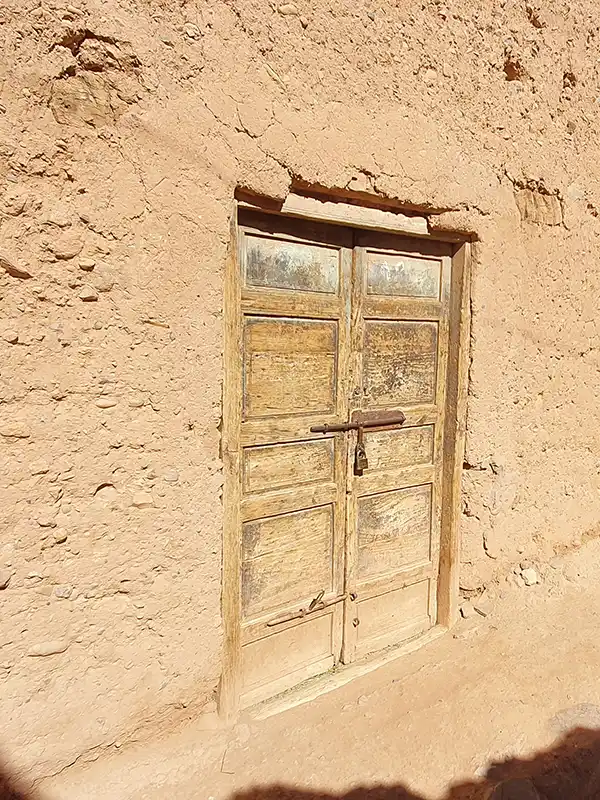
The Jews of Telmasla, a community rooted in its native land
The Jewish community of Telmasla was the largest in Ouarzazate. Its presence in the casbah went back to distant times, as shown by the extent of its property holdings, particularly fields, in Telmasla and the neighbouring villages.
“The Jews of Telmasla owned many fields, even in the villages of Tazroute, Ghalil, Hbib, Tadmricht, Talat…”
Ba Idar
Highly skilled craftsmen, these Jews distinguished themselves through silverwork, particularly for decorating daggers and silverware such as spoons, forks, sugar tongs, tea strainers… They also traded in agricultural produce, livestock and other basic goods.
“Meyer Mekhlouf owned a large herd of cattle. On the eve of the Agdez souk (70 km away), which was held every Thursday, I would drive, all by myself, a herd of 18 oxen and cows to be sold at this weekly market. I would leave Telmasla at sunrise and spend the night at Aït Saoun (40 km away). Finally, I would arrive the following morning at the Agdez souk with my herd safe and sound. All the animals would then be sold.”
Ba Idar
The Jewish population practised its religion in complete freedom. The head of the community was named Israël N’Ben Ichane. Another figure was Ait Lhazzan Braha, who led the sung prayers in the synagogue located at the heart of the casbah. The Jewish community had bought a plot of land in the neighbouring village of Tazroute to establish its Jewish cemetery, which remains well maintained to this day.
Muslim Shilha and Jewish inhabitants of Telmasla lived together in harmony and as good neighbours. Each respected the religious differences of the other.
“The Jews had their own dietary practices. They forbade mixing the utensils in which they prepared meat with those used for milk, as well as fats such as butter.”
Ba Idar
Yet various shared traditions united the two communities.
“Like us, the Jews fast and have almost the same mourning rituals.”
Ba Idar
They invited one another to the celebration of social ceremonies. Muslims and Jews of Telmasla venerated the same local saint, buried at the foot of a rock in the village of Tazroute.
“We all visited the tomb of the same saint. We Muslims call him Moulay Yaâcoub. The Jews give him the name Bardiîme.”
Ba Idar
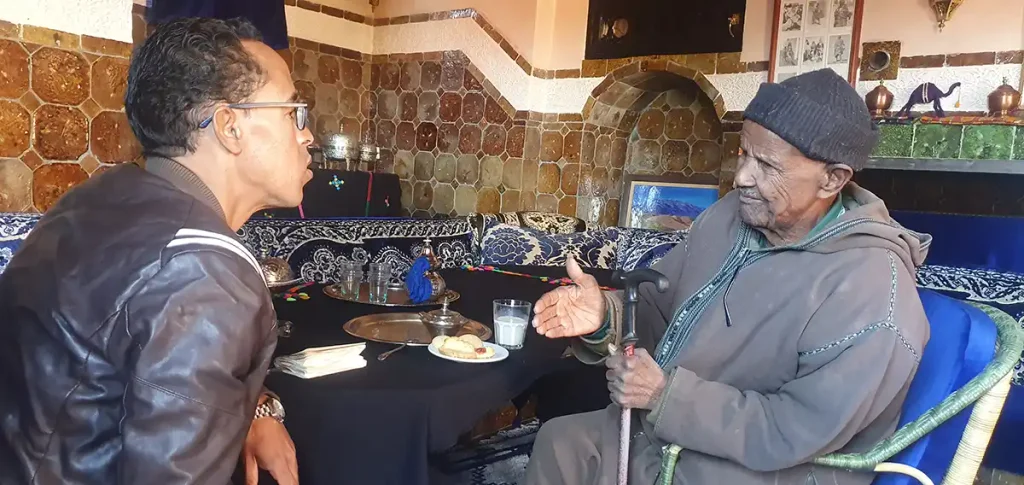
The two communities helped one another in order to ensure the cohesion of the tribe and maintain its social and economic vitality. Customary rules served as law, obliging everyone to honour their commitments towards others even when they did not share the same faith:
“We sometimes went through difficult times when we had no money. Our neighbours from the Jewish community would lend us the sums we needed. One day, during the feast of sacrifice, Aïd Al-Adha, I pretended not to have an animal to sacrifice. My neighbour Meyer Mekhlouf willingly gave me a fine fat sheep, a billy goat, tea, sugar, flour…”
Ba Idar
With their departure, our village almost collapsed
All the Jewish families left en masse, and reluctantly, in 1963. It was a sombre day, a heartbreaking moment marking the definitive uprooting of the Jews of Telmasla from their native land, the cradle of their ancestors.
“Buses arrived one morning. The Jewish families were loading their trunks. It was a very painful moment of farewell. They left in tears. With their departure, our village almost collapsed.”
Ba Idar
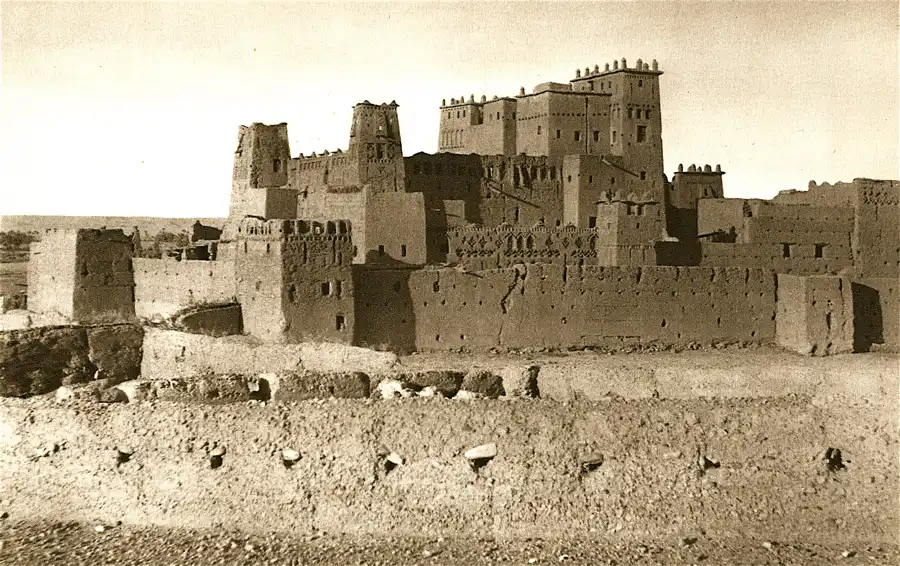
The names of former Jewish inhabitants of Telmasla remain engraved in tribal memory: Israel, Yaâqoub, Sellam, Ben Ichane, Braha, Soulika… Most of the first generation of Jews have since died. But the bonds tying them to their land of origin have endured despite this forced exodus.
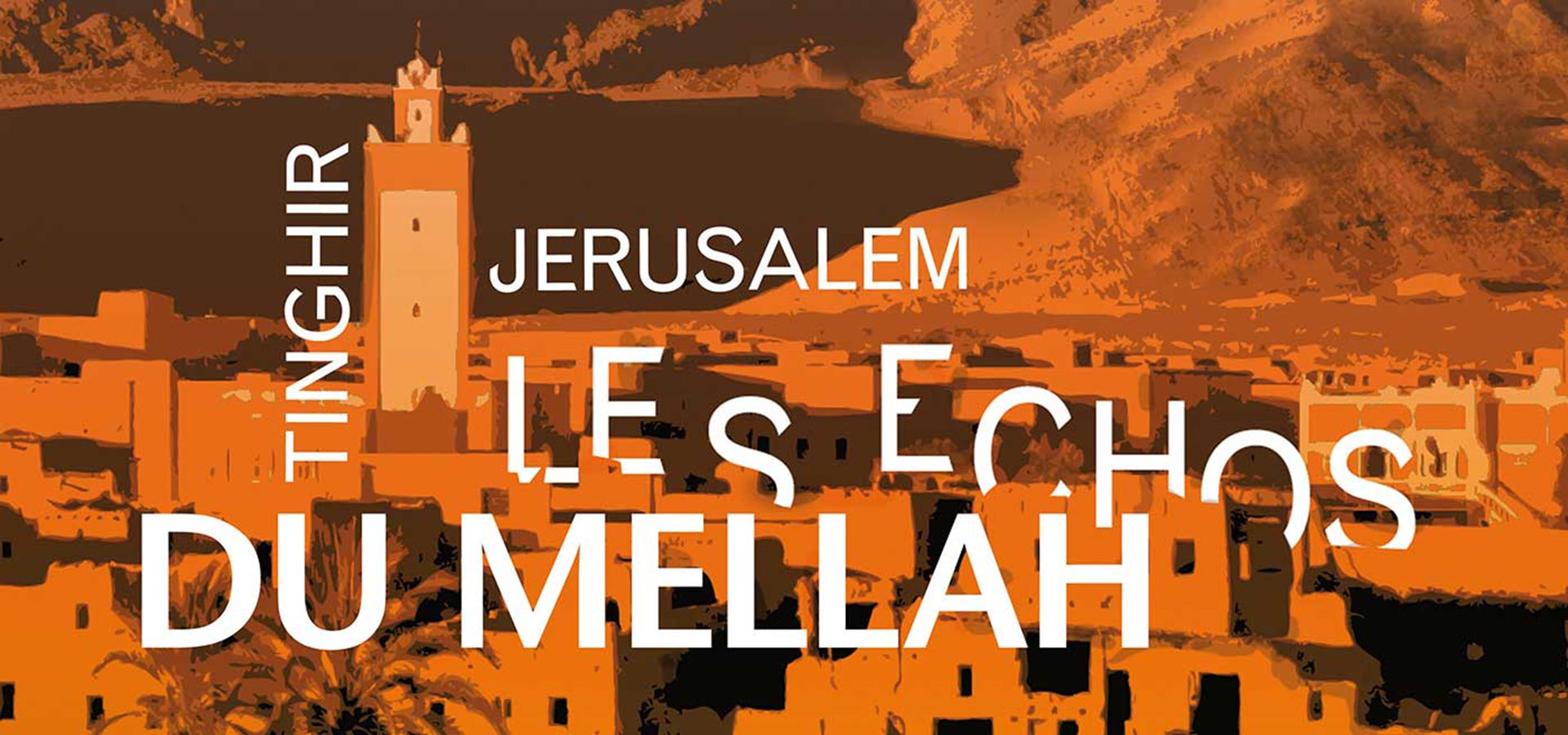
Read also: From Tinghir to Jerusalem, weaving Morocco’s universality
The Jews of Telmasla remain faithful to their roots. They return regularly to remember their parents in front of their former homes, to visit their mausoleums and the graves of their dead buried in the cemetery at Tajda, in the rural commune of Tarmigte.
Separated by time and distance, yet still united in their hearts. The occasional visits of Jews originally from Telmasla revive the bonds of familiarity with their village and their Muslim neighbours.
“The Ait Khellouf family were my friends. They sent me money several times after they left in 1963. Recently, their grandson, sent by his mother Soulika, came to visit me. I learnt from him that Meyer, Mekhlouf and Sissi Khellouf had all died. May Allâh have mercy on them and on all our dead.”
Ba Idar
Telmasla has lost its authentic architecture over time. Its walls, terraces and ceilings, once richly decorated, have been reduced to dust. The old ruined fortress still bears a few traces of the splendour of bygone days.
These dilapidated buildings and their inhabitants preserve the history of a village, a culture and an ancestral way of life.
Two old houses that once belonged to the Jewish Khellouf and Ait Bou Kyoud families have been converted into guesthouses. Dar Daif and Dar Bladi today embody the living symbol of the traditional beauty of the Casbah of Telmasla.
Read also: The lost destiny of the Jews of South-Eastern Morocco
More to Explore

Leave a Reply