


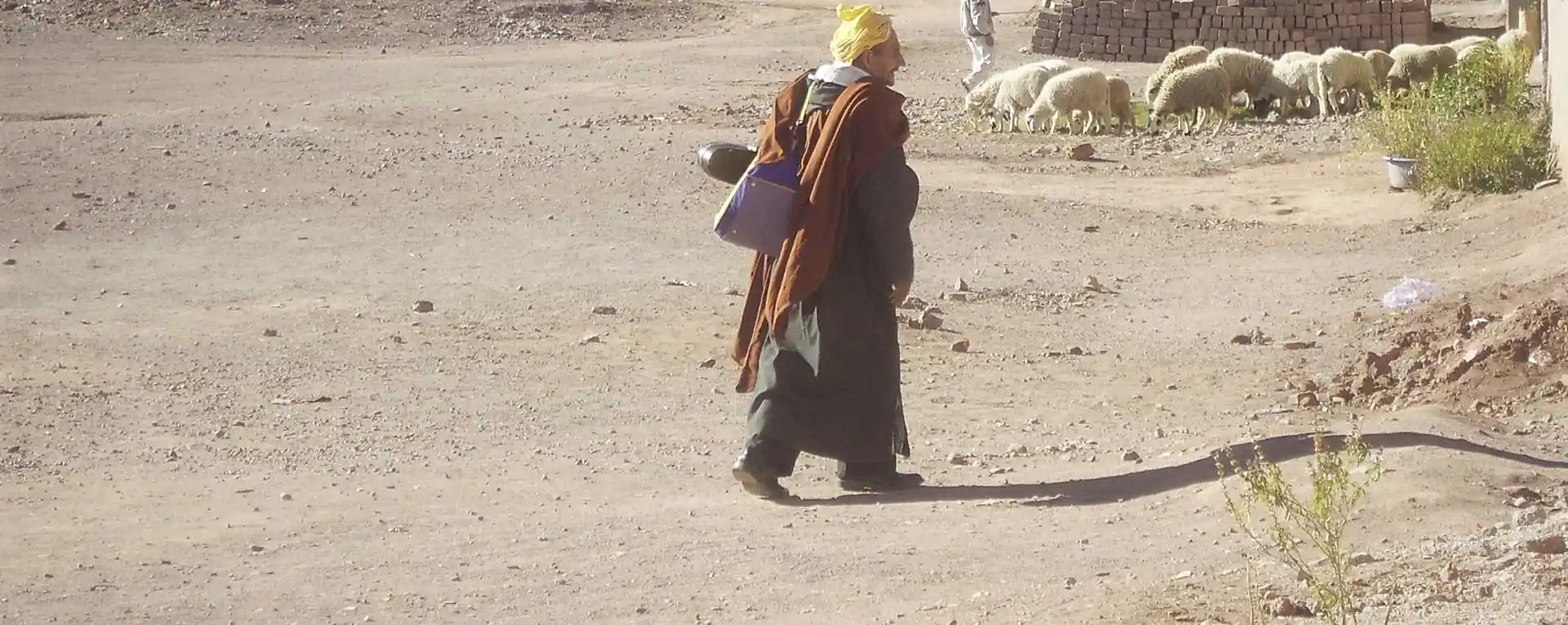
Troubadour, I have set out on the path of my ancestor
You can read the article while listening to the Raïs sing.
They walk from village to village, from street to street, carrying with them their instruments, their songs and a poetry nourished by the lives of men. In Ouarzazate, Abderrahmane and Mohamed still perpetuate the ancient figure of the Amazigh troubadour poet. A rare testimony to an art of wandering, passed down from generation to generation, but now increasingly fragile.
Abderrahmane, on the path of his ancestor
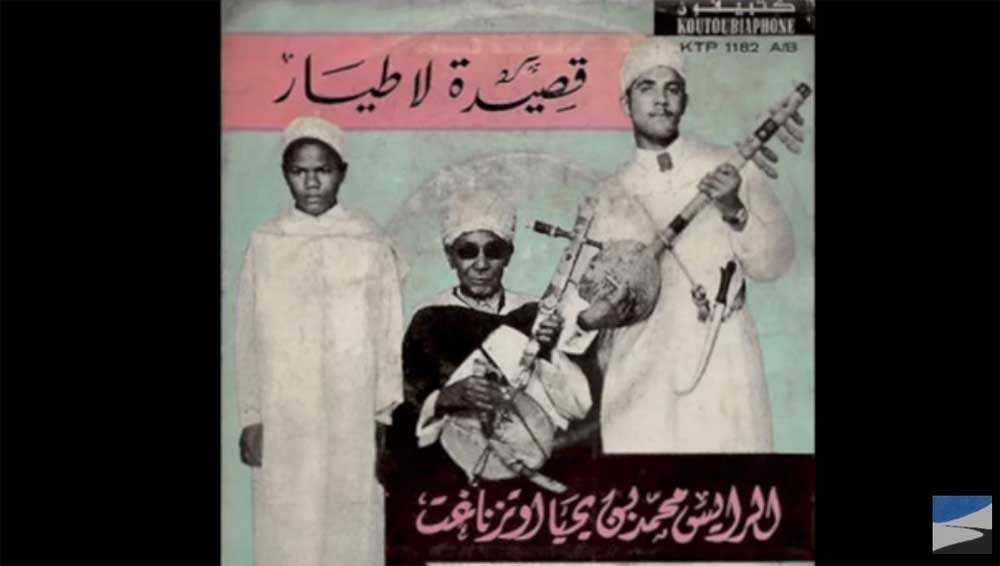
The late El Hadj Mohamed ben Yahya Outznakht is an emblematic figure who left his mark on Amazigh sung poetry. A poet, singer, dancer and composer, his songs are listened to particularly throughout the Souss-Massa-Drâa region. The death of this maestro was an early sign of the decline of an entire era, when the heroic narratives of the community were transmitted wholly through oral tradition.
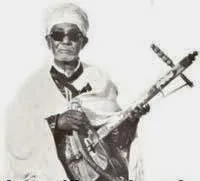
Fortunately, his grandsons have taken up the torch. They decided to remain faithful to this ancestral tradition. One of them, Abderrahmane, guided by his artistic talents, like his brothers, decided, as his ancestor had done before him, to follow the path of the troubadour poets traditionally known as Raïs.
Raïs (pl. Rrways): a professional poet, composer, musician and singer in the Amazigh tradition, historically itinerant. In the Souss, the Rrays notably accompanies his poetry on the ribab, a single-stringed bowed instrument.
He knew, however, that his ribab would not be an effective means of accumulating wealth, but he nevertheless chose to make it his livelihood. The Raïs was once a favoured guest in the villages, but the words of these poets are increasingly overtaken by the incessant changes in society. The dusty village tracks have given way to tarmac roads and concrete buildings. Willingly or not, the wandering poet is called upon to adapt to this new context.
Every morning, Abderrahmane prepares for his daily round. A golden turban wrapped around his head, a djellaba and white babouches. The whole crowned by a ribab, the single-stringed instrument of Amazigh music.
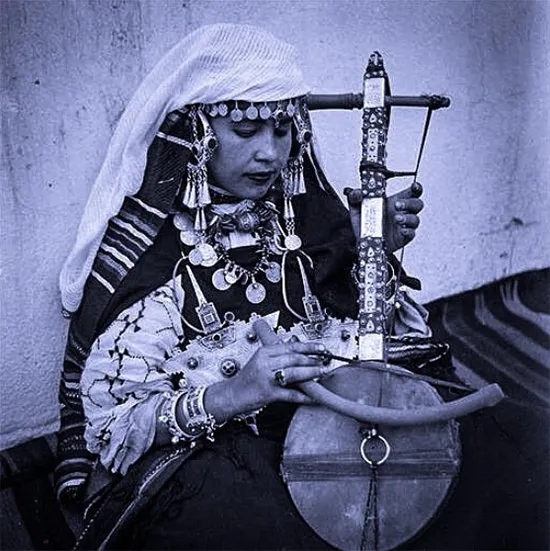
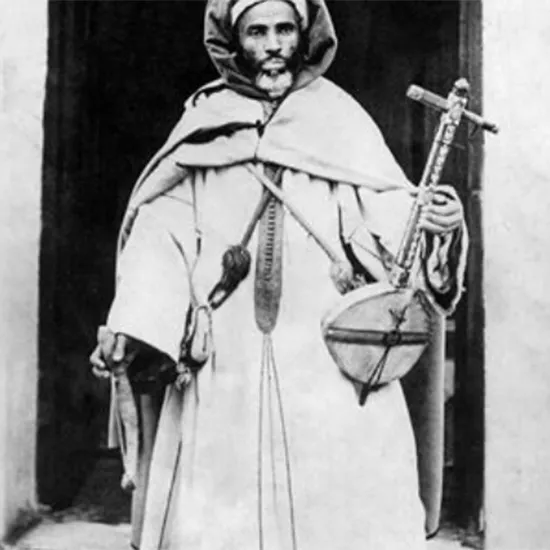
This troubadour poet then roams the streets and neighbourhoods of Ouarzazate. At random, he stops in front of café terraces and gives free rein to his ribab. Sometimes hailed by enthusiasts of Amarg — Amazigh song — Abderrahmane’s route is spontaneously punctuated by a multitude of songs. He makes his ribab and his body vibrate according to his fancy. The flow of poetry follows easily. He modulates his theme according to his audience and the needs of the moment. At times praising the generosity of one man. At others reproving the miserliness of another. Nostalgia, or the desire to bring the good old days back to life, leads Abderrahmane to give voice to songs that now seem anachronistic. Verses born of an Amazigh heritage. Yet, ironically, today they appear exotic to the uninitiated, even to those who belong to that same culture.
This daily round often ends with a meagre harvest. A few coins make up our artist’s takings. In the evening, Abderrahmane returns home.
A modest house shelters him and his family. There is no sign of luxury in this home inherited from his father. Everything speaks of the simplicity of the place and of those who live there. It was in this house that Abderrahmane, now around fifty years old, grew up. He remembers his youth, those good old days when conviviality and sharing reigned in the village, that time when the sounds of the ribab and the Benjou, drifting down from the neighbouring hill, broke the silence of summer nights in Tigmi Lejdid. The Raïs was then the star of every celebration in the douar.
These brief moments of escape into the past reveal the nostalgia in Abderrahmane’s eyes. An escape abruptly interrupted. Reality tears him away from his graceful reveries. The features of the artist fade and those of the man take shape. A worried father. For him, earning his daily bread is becoming increasingly difficult. He is forced to scrape by from one day to the next. Sometimes even to endure the insults of men and of time. But it is too late to turn back. He was born to be a troubadour poet. It is his destiny. He must persist in making a difficult living from a calling he loves. It is a difficult equation to solve, but one that embodies both the man and the artist.
Mohamed, the poet of the roads
Mohamed comes from the heights of the Atlas. His starting point is his village of Amougal, in the small town of Imilchil. This man of around seventy leads a free, wandering life. Driven by a thirst for poetry, he travels through the regions like the caravanners of old, one of the children of the travelled roads. Except that his motivation has nothing commercial about it. It is purely artistic. And his art is intrinsically bound to a very particular way of life, entirely devoted to bearing witness to every moment in the life of a community. He is its ambassador. He is the poet who wonderfully sketches the features of territories and of people living far away, somewhere.
“I am welcomed everywhere. I never speak badly of a place or of its inhabitants. It is the duty of guests to acknowledge openly the hospitality of those who honour them.”
Mohamed
A tambourine and a violin are his only equipment. There is something quite singular about this man. Tarmigte is a familiar place to him. For him, all places resemble one another.
He often lives far from his own people. Yet he retains the serenity of a man shaped by journeys. His words spontaneously evoke incidents experienced here and there. Marrakech, Agadir, Rabat, Zagora and others, so many towns travelled through by this traveller without luggage. Although singular in character, Mohamed remains rooted in the world from which he comes. He embodies the hopes and misfortunes of the inhabitants of Imilchil.
“Sometimes, in the middle of a song, I suddenly remember the orphans of my douar, the widows, the cold, the stinginess of the land…”
Mohamed
At that moment, the man’s profile comes clearly into view: Mohamed is that modest Amazigh man from the Imilchil region. Mohamed the father and grandfather. An old man worn down by the burden of time. To find an outlet for his torments, he sets his violin vibrating and melodies, enriched by the distinctive rhythm of High Atlas music, flow abundantly like its streams. These songs unleash within him a melancholy long repressed in his deepest reaches:
“Even as I walk, I hate you, O land! You who have led me far from my people, there is no country where one eats and drinks for free; he who does not work is a fraud…”
Mohamed
Gratitude is the character of poets
He lists in detail the advantages of travelling.
“I have neither money nor connections. I let destiny lead me. At every stop, I rely on people’s hospitality. I have never been disappointed.”
Mohamed
That is the secret that drives Mohamed towards distant lands. He has the courage to follow the road without worrying about whatever adversity may await him. This nomad, forever travelling, lives from day to day. But with the conviction that it is for him to live his life by moving from one place to another.
Confidence radiates from this seasoned poet:
A gesture of thanks concludes Mohamed’s solemn words. The man bends down to gather his belongings, makes a point of greeting everyone present while asking God’s blessing upon them. With a steady step, he begins another stage of a journey started many years ago. Other places are calling him. He is a man who lives freedom every day along the road of the troubadours.
Mohamed
Far from begging, Abderrahmane, Mohamed and other troubadour poets can never have their fill of this tradition. Driven by a passion almost to the point of intoxication, they are at once masters and prisoners of this ardour. It is not simply a journey from one place to another, but a voyage carried along by words, songs, the vibrations of strings and the passing of time. They know how to find the right words and the beautiful music. Their story is written upon the roads they have travelled. For as long as they live, they will continue walking towards other places. For as long as the fire of sung poetry burns within them, these troubadours will walk far, very far…
Read also: Music, the voice of the Amazigh soul and its future challenges
Listen

More to Explore

Leave a Reply