The recent death of Idir, an emblematic figure of Amazigh music, and the emotion his passing aroused remind us of music’s singular power to express the most intimate colours of a people’s identity and the history of the women and men who shape it throughout their long and often arduous journeys through life.
Whether echoing myths and legends, traditions and customs, wounds or hopes, Amazigh music, past and present, remains a faithful reflection of Amazigh identity.
Can this music, through the creative force of its genius, carry the past into the future? Can it move beyond regret, ease old wounds and make room for the reconciliations that are needed? Sudestmaroc.com asked Moha Mallal — poet, musician and painter rooted in the mountainous heart of our region — to share his perspective on these questions, which ultimately speak to the future of Morocco.
Sudestmaroc.com– The world of music has just lost one of its icons, Idir, the stage name of Hamid Cheriet, who died in France on 2 May 2020. Idir was a humanist ambassador for Amazigh music throughout the world. Could you briefly retrace his career and the nature of his artistic commitment? What messages did his songs convey?
Moha Mallal – Idir was one of the great pillars of Amazigh culture. He grew up in a family steeped in poetry: both his grandmother and his mother were poets. His famous song A Vava Inouva opened the doors of the world to him.
It was a song written and composed by Idir for the Kabyle singer Noura. But when the song was due to be performed live for the first time on Radio Algiers, Noura was not there, so Idir performed his own song himself.
From that first recording onwards, this beautiful song continued to be played on radio stations.
A production company based in Paris then invited Idir to record the song again. A contract soon followed, and he left his job as an engineer in the Algerian desert to begin a major artistic career in Paris — something that represented the dream of many North African artists in the 1970s.
Alongside other Algerian artists such as Maatoub Lounes and Ferhat Mhenni, Idir took up the cause of defending Amazigh culture, each in his own way. Idir was known for his respect for others, his moral integrity, his skill as a songwriter and composer, and above all for the strength of his choice of words. He was irreplaceable.
A Vava Inouva – Idir
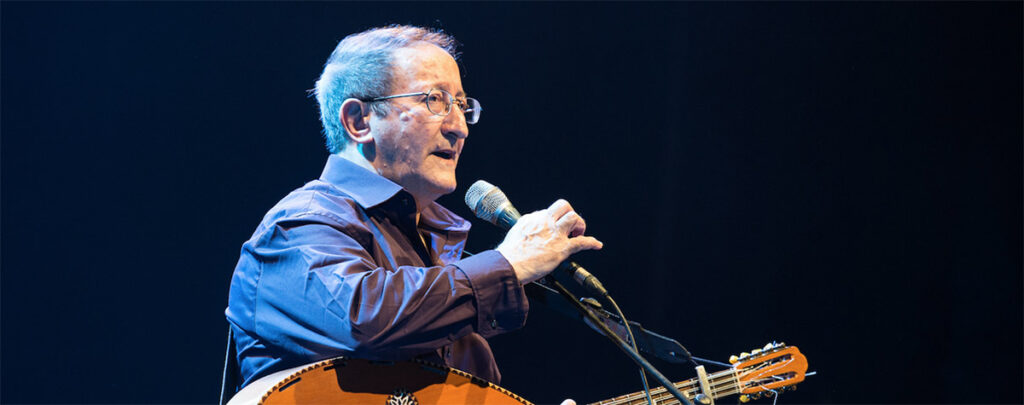
Idir
Morocco should have taken collective pride in the richness of Amazigh culture
Sudestmaroc.com– For many years, numerous Amazigh artists, yourself included, have placed their art at the service of promoting and strengthening Amazigh identity, particularly by using their mother tongue. Why is this so important? What place does the Amazigh dimension occupy in your own artistic journey?
Moha Mallal – We draw on our Amazigh identity, our language and our traditions because we feel that our culture is not sufficiently respected in our own country.
If that were not the case, if we felt that there were genuine recognition, we would not have this instinct to defend and preserve what lies at the heart of our identity.
If that respect existed, there would be no need for this struggle, nor for all the problems that accompany it and that continue to have a negative effect on Morocco’s progress.
Those responsible for official cultural policy have made serious mistakes regarding this extraordinarily rich human heritage. On the contrary, Morocco should have taken collective pride in this cultural wealth instead of attempting to erase it, as has been the case since independence.
Amazigh people were the first human inhabitants of the Mediterranean and of what would later become Morocco. Evidence of this can be found in rock paintings and engravings, including representations and Tifinagh writing. Amazigh culture would appear to be among the earliest cultures to have emerged on Earth. Contemporary archaeologists have supported this theory since the revolution brought about by genetic analysis and DNA studies.
This is how all the distortions of history begin to be defeated.
The question is why our leaders denied this great Amazigh civilisation for so long and did everything they could to erase it, while at the same time turning so forcefully towards the East, which has continually brought us hatred and fundamentalism.
This historical reality, which unfortunately remains so contemporary, is something the Amazigh — a people devoted to freedom and tolerance since time immemorial — can neither understand nor accept.
It is a question that will continue to be asked for a long time because it remains unanswered.
That is why Amazigh people who are conscious of the depth of this reality have clearly chosen to defend their human identity through their culture, in the face of all the ideologies that have attempted to silence its ideals of freedom and universality.
Tafsut – Moha Mallal
Amazigh culture cannot find its place in a purely folkloric approach
Sudestmaroc.com– Music in Morocco has always been immersed in great cultural diversity, nourished by Amazigh, Arab-Andalusian and African roots, among others. What is the state of this diversity in musical creation in Morocco today, both for you and for other artists, particularly younger ones? How does this diversity express itself?
Moha Mallal – The main source of inspiration for music in Morocco, as in other artistic fields, is Amazigh culture, whatever the language in which it is expressed.
Amazigh regions continue to preserve extraordinary rhythms such as Ahidous, Ahwach and Rwais, each of which contains considerable diversity. Within Ahidous, for example, we find rhythms such as Lmsaq, Tagouri, Amhray and Izli. These rhythms vary from one village to another.
We also find music accompanying agricultural work and harvesting, such as Tamgra, Arwa and Tawiza, as well as wedding songs performed over several days, with each day itself involving a variety of songs, some performed by women and others by men.
A patient observer of the rural Amazigh world would discover an endless profusion there, mirroring nature itself.
Unfortunately, this cultural wealth is dying year after year. We are losing all these songs, rhythms and customs, just as we are losing our kasbahs and, ultimately, our language.
Everything that constitutes Amazigh culture is neglected by the state except when tourism interests are involved. When that happens, our culture becomes a folkloric attraction, and its soul escapes because it can find neither the space it needs to live nor its truth within such an approach.
The diversity of Moroccan song and music comes from this Amazigh culture, despite neglect and lack of recognition by the authorities, and even despite the artists themselves.
Take, for example, those who defend the concept of Arab-Andalusian music, when originally it is Moroccan Amazigh music that came from El Gharnati and can be found in northern Morocco and Algeria even before it came to be performed in Arabic.
Algerian singers such as Dahman Alharrach, Alaanqa, Maatoub Lounes and many others illustrate this reality.
El Gharnati: refers to music originating in the city of Granada in Spain. In 1492, Muslims and Jews expelled from Granada following the Reconquista settled in several Moroccan cities, including Fez, Oujda, Tetouan and Rabat. They brought with them their literature, cuisine, customs and, above all, their music: Gharnati music.
Amazigh music in Morocco: between tradition and renewal
Sudestmaroc.com– How would you describe the Amazigh music scene in Morocco today? What are its main artistic trends, and who are its leading figures?
Moha Mallal – The Amazigh music scene in Morocco is extremely rich. To understand it properly, we need to distinguish between its two major currents — traditional and modern music — while also taking into account its vast geographical diversity.
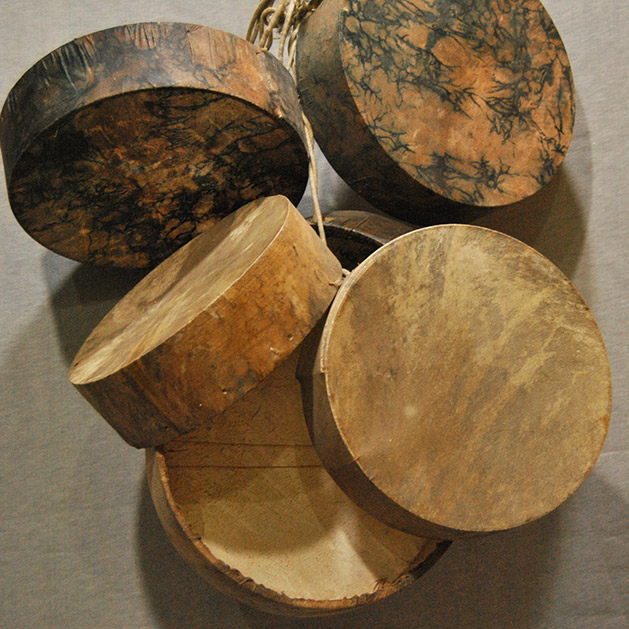
Traditional music is characterised by long poems accompanied by rhythmic instruments such as the bendir and drum.
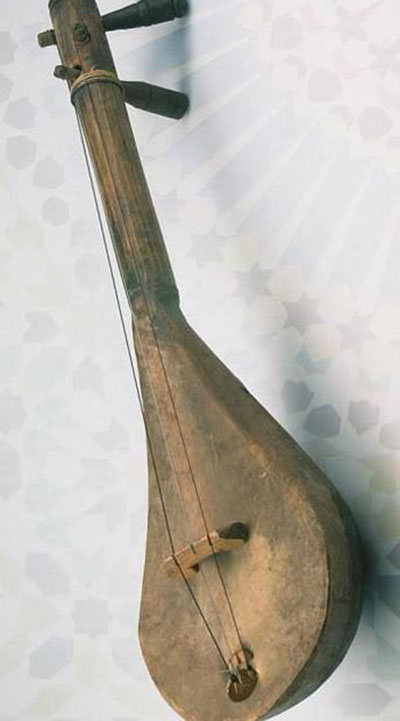
We find this form of music in Ahwach, Ahidous, Regda and Rekza, among the Imdyazen and Rways, as well as among the Chyukh, who add a particular melodic instrument: the flute in the Rif, the ribab in the Souss and the luthar in the Middle Atlas.
Amdyaz (plural: Imdyazen): among the Berbers, the term refers to an itinerant poet, singer or musician. A central figure in Amazigh poetry, the Amdyaz is regarded as a chronicler and historian of his society. Travelling from village to village, he conveys messages about current events and draws attention to particular issues or events.
BendirLutharRibab
Music occupies an important place in everyday communication in the Middle Atlas, which explains the abundance of songs produced there.
Ahidous has given us major singers such as Amlal Qddour, Bnnasr Oukhouya and Hadda Ouakki, and more recently Med Rouicha and Med Mghni. They created melodies accompanied by the luthar or violin.
Middle Atlas music nevertheless remains confined within a relatively limited range of rhythms, and we are still waiting for new approaches capable of modernising this style.
As for South-East Morocco, a region known in Amazigh as Assamer, its musical tradition historically relied only on the bendir as a rhythmic instrument.
The geographical position of the region, lying between the Souss and the Middle Atlas, allowed musical influences from both areas to resonate with its inhabitants.
Assamer: in Amazigh, the word describes a place exposed to the sun, where villagers gather during winter days. By extension, it became a place where matters concerning tribes, families and everyday village life were discussed. Because the south-eastern side of the High Atlas, from Ouarzazate to Errachidia, is continuously exposed to the sun, the region came to be known as Assamer. Jews called it Achamr. Source: Moha Mallal.
Mouha Ou Lhoussain Ahidous
Modern Amazigh music emerged with young singers from the Souss, including the group Ousman, Ammouri Mbark and Izenzaren, at the height of the Ghiwane movement.
Young artists influenced by Kabyle music later appeared in the Rif, including Walid Mimoun and Itran, followed at the end of the 1980s by artists such as Khaled Izri, Imtlaa, Numidya and Allal Chelih.
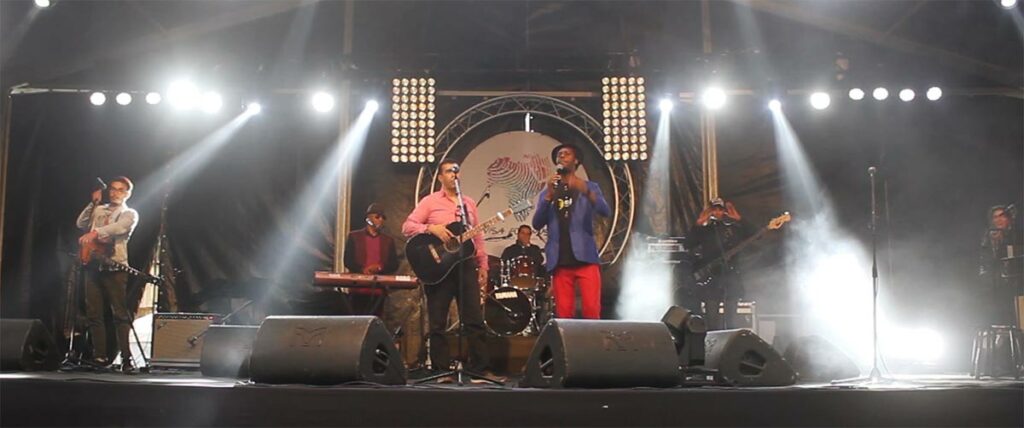
In South-East Morocco, in the Assamer, modern music did not emerge until the beginning of the 1990s, when I personally created the first recording studio, Azawan Sound, as well as my own band, Mallal.
That initiative planted the seed of modern Amazigh music in the South-East, with the singer Hemmu Kemus and others who followed later, including Nba Saghru, Tawargit, Amnay, Angmar, Luland, Khaled Badraoui, Tasuta n Imal and Tarula.
Moha Mallal and the band
Tawargit
Others today have taken up the baton, continuing the traditional melodies of Tamdyazt — Amazigh poetry — inherited from the 1970s, including Ouhachem, Chikh Yousf, Chikh Zaid, Med Ijoud, Elhoussaine Kheyi and many others.
Modern Amazigh music now develops along two main paths.
The first works from traditional Ahidous melodies while introducing modern instruments. The second adopts a more universal approach to instrumentation and to the composition of both poetry and music.
The traditional music, songs and rhythms specific to our region form a body of heritage that speaks to all of us.
The cultural awareness of artists from the Assamer gives our Amazigh music its own character, a genuine singularity rooted in our territories.
This led us to want to give a name to this particular musical identity, and we chose to call it Amun Style.
Amun Style: a musical identity rooted in South-East Morocco
Sudestmaroc.com– Could you explain the concept of Amun Style in greater detail?
Moha Mallal – Amun, or Tamunt, means union in our Amazigh language.
Historically, Amun is the first god of the Pharaohs, the god symbolising union and unification. Some ruins of the temple of Amun can still be seen today in Siwa, in southern Egypt. This is where an Imazighen community — an Amazigh community — lives, in the Siwa Oasis.
This reminds us that the Pharaohs are at the origin of the Amazigh people.
Amun: Amun, or Amon, is one of the principal deities of the Egyptian pantheon and the god of Thebes. His name means “the Hidden One” or “the Unknowable”, expressing the impossibility of knowing his “true” form. During the Greek Archaic period, the Egyptian Amun became identified with the Greek god Zeus. The people of Cyrene introduced him to the Greek world as Ammon-Zeus.
When I decided that we needed to give a name to the musical style we were developing in South-East Morocco, I shared with Nba from the group Saghru the idea of using the concept of Amun.
Our intention was to distinguish our musical style from others. It therefore needed a name capable both of bringing together all the styles of modern music in the Assamer and of carrying a strong meaning.
The term commonly used to describe our musical approach could have been fusion, but that word did not fully express what we wanted.
Amun Style begins with beautiful Amazigh words.
It is not necessarily politically committed music. Above all, it involves a constant search within musical composition and a creative exploration of the full wealth of our cultural heritage.
That said, the idea is not yet shared by the majority of singers, particularly among the younger generation. But I hope that, through the quality of our work, its example and its ability to inspire others, we will succeed in establishing the concept of Amun Style.
Amazigh music in search of beauty
Sudestmaroc.com– Amazigh culture radiates through its history, legends and traditions, architecture, crafts, songs and dances, as well as through the hospitality of its people. Yet Amazigh musical creation in Morocco, particularly among younger artists, often gives voice to the suffering and wounds of the past.
What balance do you think can be found between this need for remembrance and a more enthusiastic celebration of the beauty of Amazigh culture? Do you think Amazigh music in Morocco should move somewhat away from the political dimension of its commitment in order to contribute more fully to celebrating the richness of Amazigh culture?
Moha Mallal – As in every civilisation, we find artistic diversity.
Everyone pursues their own struggle according to their cultural background, their country, their culture and their field of creation.
Generally speaking, political music becomes particularly prominent among peoples who have suffered ideological domination and are unable to live their culture, identity and traditions freely.
We have seen this in the emergence of major currents in world music such as reggae, blues and jazz. In each case, there is an expression of cultural resistance and therefore of identity.
Amazigh music is marginalised at festivals and in the media, and it does not receive the encouragement given to Arabic-language or foreign music.
Take Moroccan radio stations, for example. They broadcast an enormous variety of songs in languages from all over the world, except in the language of the country itself: Amazigh.
Can this really be a coincidence when such exclusion has continued since independence?
The few songs shown on Amazigh television are folkloric songs, presenting a restricted and even negative image of Amazigh music.
Then an attempt is made to suggest that the music performed by young Amazigh artists is always politicised, whereas in reality it deals with every aspect of life, just as music does in every other country.
We sing about love, society, culture and philosophy, always with a profound search for beauty, both in our lyrics and in the music itself, which we are committed to making universal.
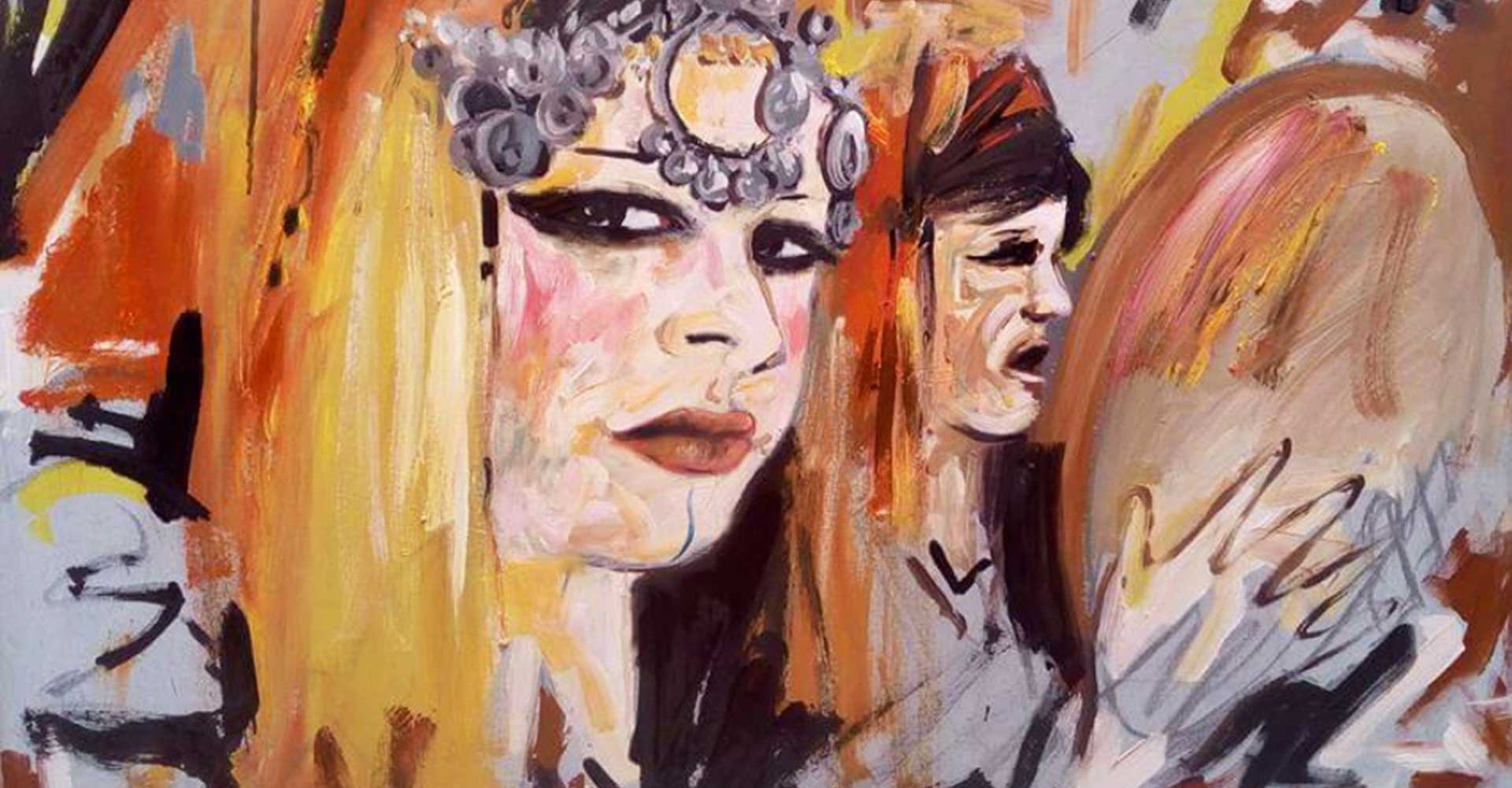
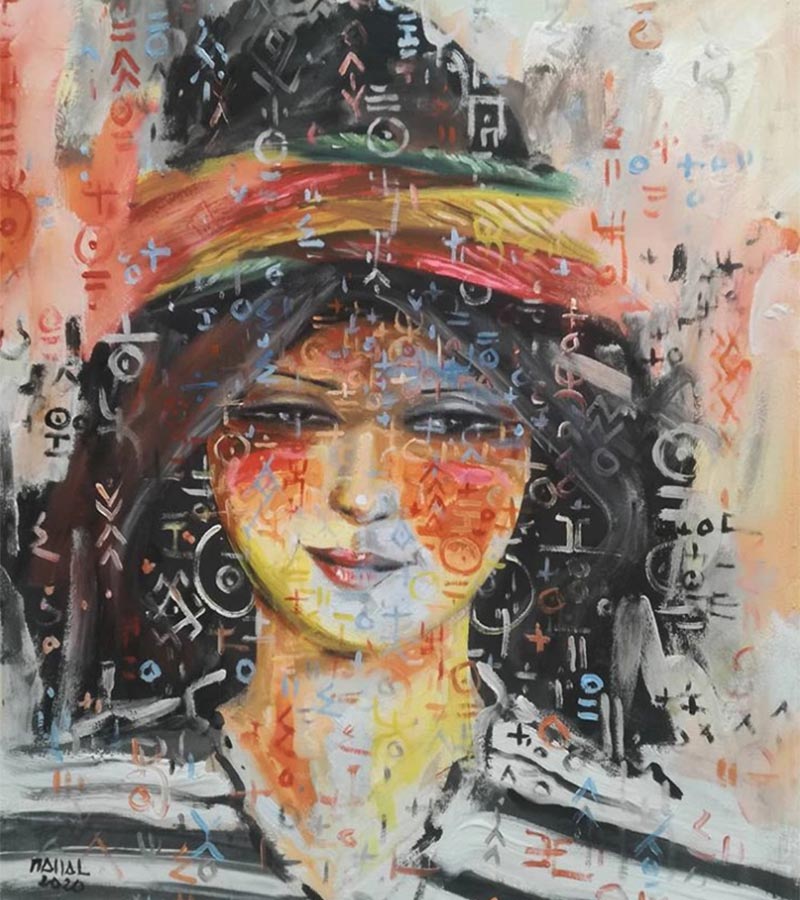
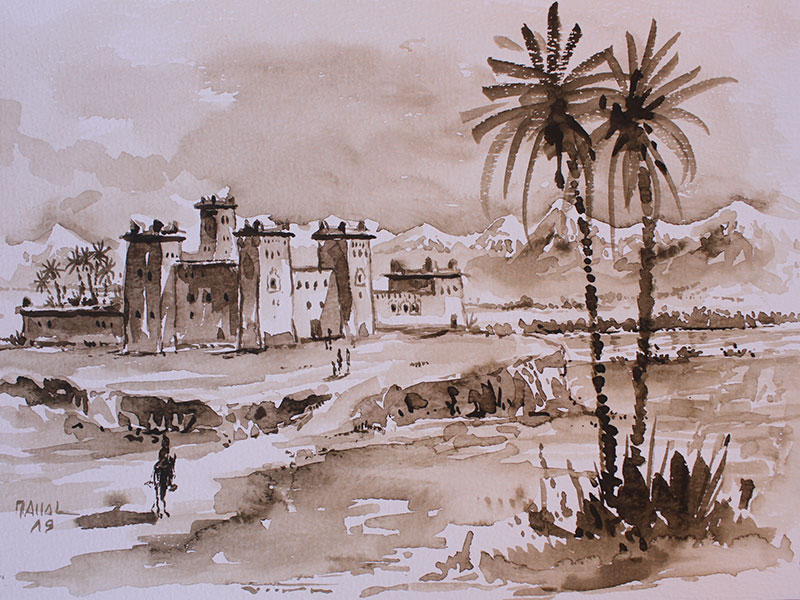
Paintings by Moha Mallal
Sudestmaroc.com– Staying with this idea of celebrating the richness of Amazigh culture, does the example of the late Idir — known for his gentle musical style — resonate in Morocco today? Does he influence contemporary Amazigh musical creation?
Moha Mallal – Idir’s influence can be heard very strongly in the style of many North African artists, and perhaps beyond.
The simplicity of his musical style immediately stays with the listener, as does the beauty of his words, rooted in Kabyle culture but also in the old stories that grandmothers tell their grandchildren beside the fire.
Personally, Idir played a major role in my own artistic development and in the love I have brought to making music and singing since 1983.
Sudestmaroc.com – Today, the world is facing a pandemic that reminds us that humanity shares a common destiny. As an experienced artist, how can Amazigh artistic creation contribute more fully to bringing the world’s cultures together in Morocco and encouraging the spirit of harmony, tolerance and openness that should accompany such encounters?
Moha Mallal – Amazigh culture is, in its very essence, a space of harmony and tolerance.
It is not Amazigh culture that could prevent cultures from meeting and complementing one another in Morocco, but rather those who refuse to recognise Amazigh culture as an original culture of the country — a culture that should be preserved on an equal footing with the other cultures that form Morocco’s heritage.
As long as the Imazighen remain marginalised in every sense of the word, I cannot see how genuine cultural complementarity or cultural democracy can exist.
We Amazigh speak languages other than Amazigh. We study languages that are far removed from our own. We sing in other languages without any self-consciousness.
But do others do the same?
“I cannot accept anyone trying to turn me into someone I am not.”
Idir
That said, Amazigh music in all its diversity belongs fully within the international repertoire of the world’s musical cultures.
And although this vast repertoire legitimately gives voice to human suffering, it exists above all to offer the pleasure of sharing cultures and discovering the different expressions of humanity they embody.
Its humanist message cannot be overlooked, especially in an age of technological modernity that is accelerating exchanges and therefore encounters between people.
Ultimately, harmony will one day be achieved through the shared determination of young artists in Morocco and elsewhere, Amazigh and non-Amazigh alike, to respect and share their linguistic and cultural diversity.
About Moha Mallal
Mohamed Mallal was born in 1965 in Tamlalte, a village in the Dadès Valley near the entrance to the Dadès Gorges at Boumalne. He holds a degree in the history of civilisations.
Visual arts teacher in Ouarzazate.
Poet, composer and performer.
Painter, watercolourist and caricaturist.
Writer: author of two poetry collections, Anzwum (Concern) and Afafa (Awakening), as well as History of the Visual Arts in Morocco, which was in preparation for publication at the time of the interview.
Screenwriter.
He has taken part in numerous exhibitions, workshops and musical performances in Morocco and abroad.
For more than twenty years, Éric Anglade has lived in a village of South-Eastern Morocco, where he explores and documents the region’s history, heritage, and living traditions. He founded sudestmaroc.com as a space for sharing fieldwork and cultural insight, bridging local knowledge with global perspectives. He also works alongside women carpet-weavers to help sustain their craft and welcomes travellers at Le Jardin de Yuda, his guesthouse envisioned as a meeting place for exchange and transmission.
Your subscription is confirmed. See you soon on sudestmaroc.com.
Receive our periodic newsletter, featuring our latest stories, research and publications on the memories, cultures and territories of South-East Morocco.
For more than twenty years, Éric Anglade has lived in a village of South-East Morocco, where he explores and documents the region’s history, heritage, and living traditions. He founded sudestmaroc.com as a space for sharing fieldwork and cultural insight, bridging local knowledge with global perspectives. He also works alongside women carpet-weavers to help sustain their craft and welcomes travellers at Le Jardin de Yuda, his guesthouse envisioned as a meeting place for exchange and transmission.







Leave a Reply