


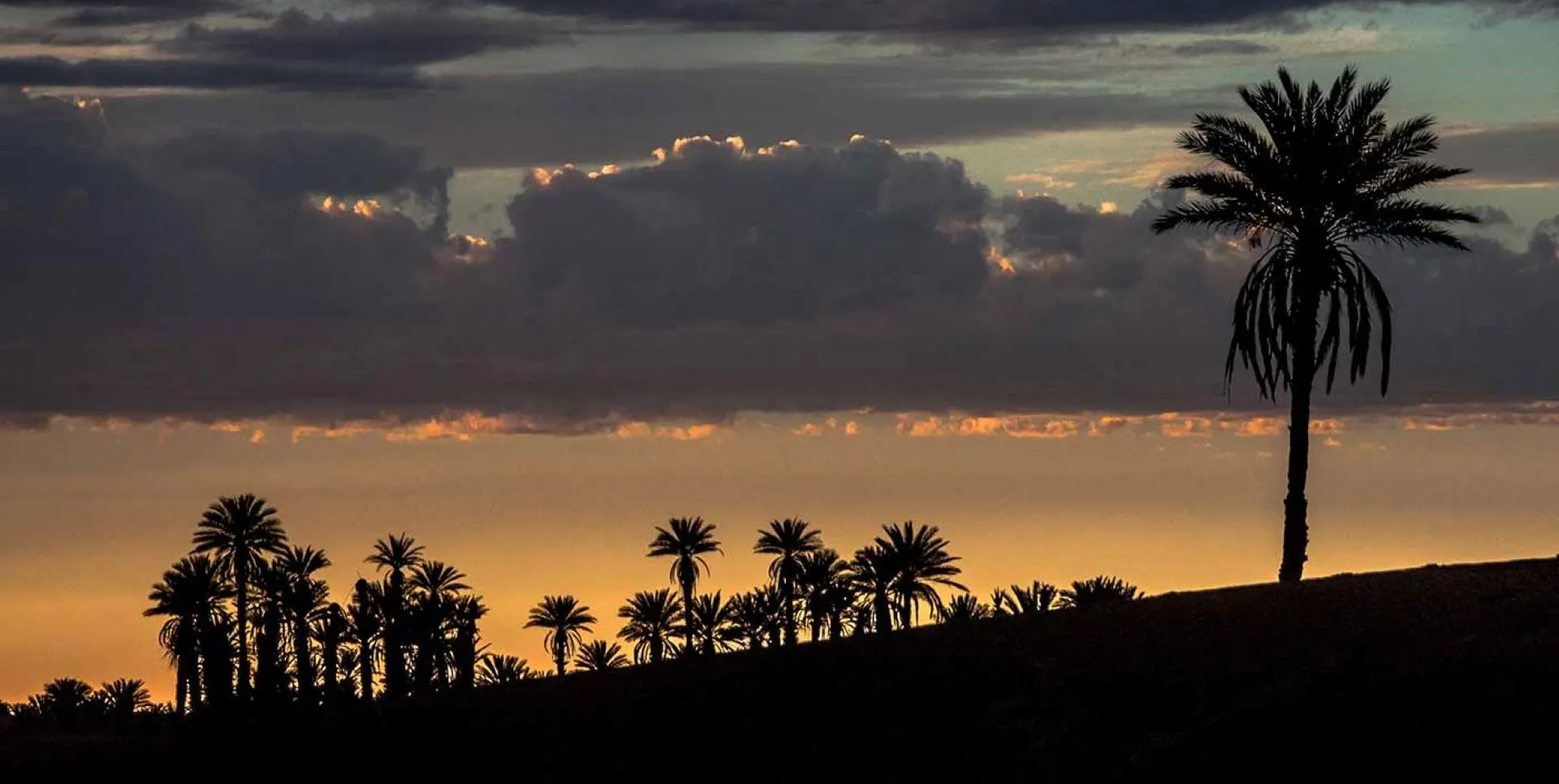
The earth cracks beneath the March sun. In the douars of the Middle Atlas, people scan an empty sky, questioning the absent clouds. Since 1920, a book has preserved, phrase by phrase, what the Amazighs then did to summon the rain: precise gestures, songs, wooden dolls dressed as brides. That book is Mots et choses berbères.
Overview
- A source from 1920, a perspective to be placed in context.
- Anzar: the founding myth. A tribal map of the rite.
- Taghonja: the bride that is fashioned.
- The variety of ritual objects.
- Ali the Hooded One among the Berabers.
- The prayer for rain: tazallit n-unzar.
- The rope and the black cow.
- The magic of knots: the little girl with bound hands.
- A system, not folklore.
- Editorial view.
A source from 1920, a perspective to be placed in context
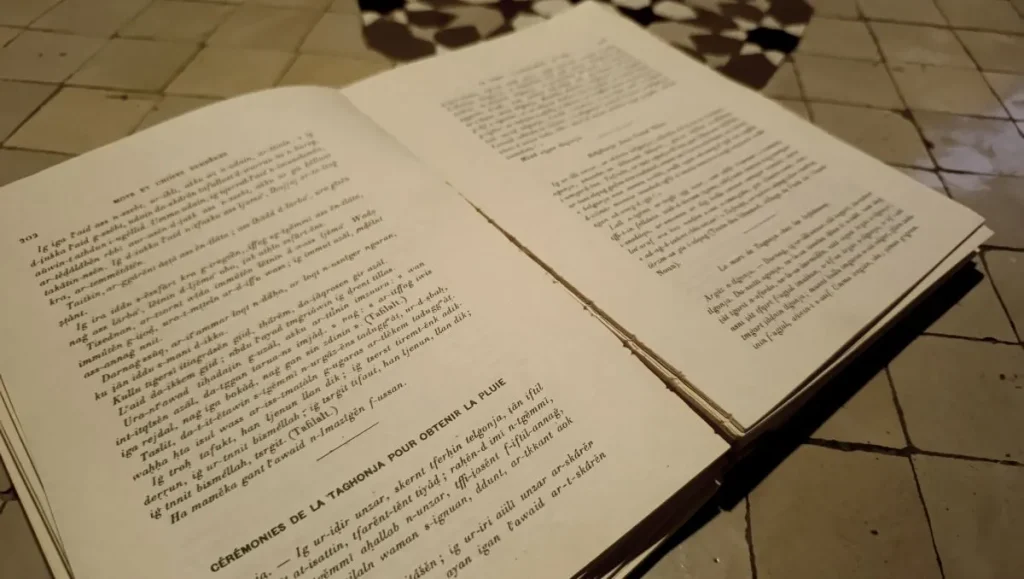
Émile Laoust (1876–1952), a linguist and one of the founders of modern Berber studies, published Mots et choses berbères in 1920, under the French Protectorate. In it, he recorded field notes gathered tribe by tribe, transcribed in Berber and then translated into French.
A century later, his chapter on the sky and the seasons remains one of the most precise sources on Amazigh rain rites — many of which have since disappeared or merged into other festivals. Laoust’s perspective inevitably bears the marks of his time. But the material he collected retains a value that nothing has replaced.
All quotations in this article are taken from his chapter ‘Le Temps, l’Atmosphère, le Ciel’.
Anzar: the founding myth
Before the spoon dressed as a bride, before the songs and the processions, there is a name: Anzar. Among the Amazighs, rain is not a meteorological phenomenon — it is a bridegroom who is awaited.
Laoust is categorical on this point:
‘Anzar personifies Rain. The word is masculine.’
Émile Laoust — Mots et choses berbères
This grammatical detail is no scholar’s triviality: it supports the entire symbolic structure of the rite. For if Anzar is masculine, then the ritual spoon — Taghonja — can only be a female figure. A bride who is dressed, carried in procession, led towards her celestial husband.
The union of Earth and Sky, in this reading, is no gratuitous poetic image: it obeys a universal logic of fertility, according to which nothing can grow without the meeting of the two principles. The same expectation can be found in the songs that women address directly to the deified spoon:
‘Stretch out your hands to the sky! Ask God for rain!’
This founding myth — Anzar the bridegroom, Taghonja the bride — provides the key to everything that follows: the diversity of the tribes, the variety of ritual objects, even the more troubling figure of Ali the Hooded One among the Berabers.
A tribal map of the rite
The rain rite has no single form. Each tribe, each valley, shaped it in its own way.
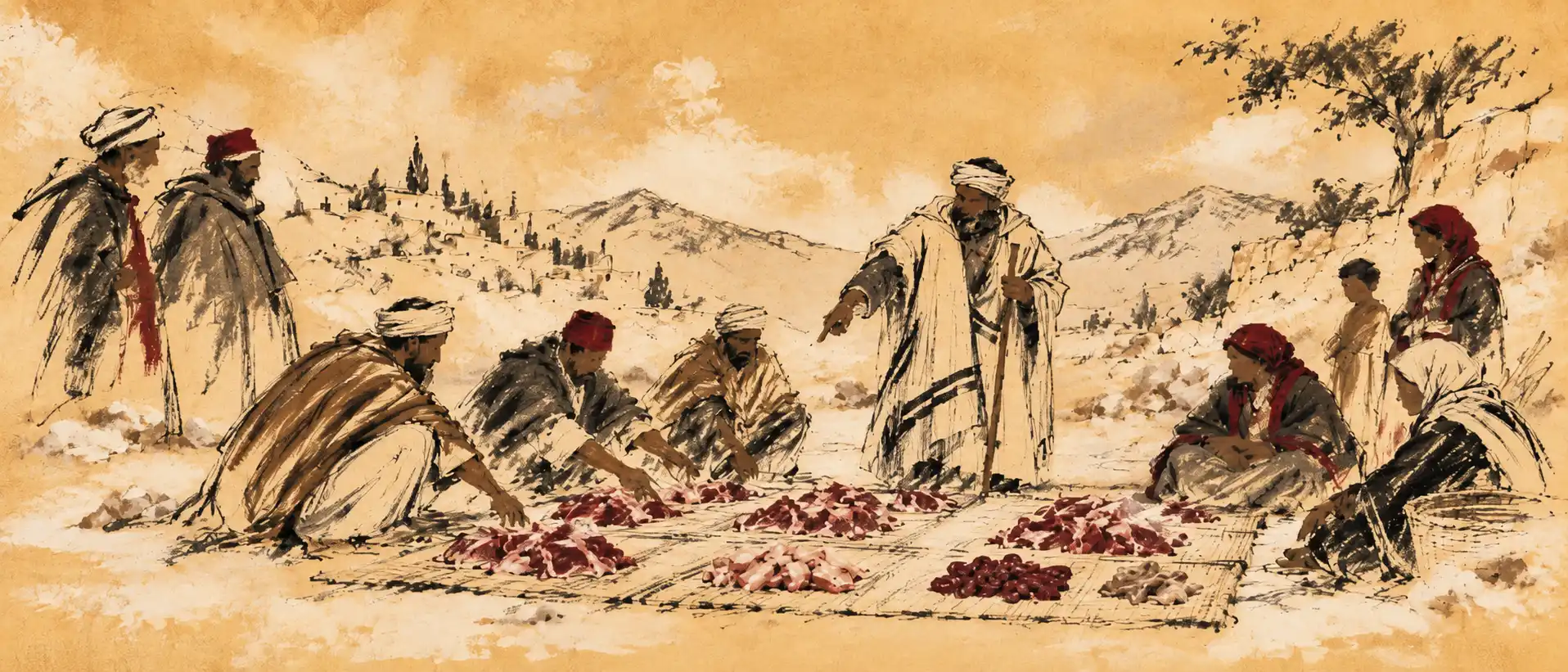
In Marrakech and the Haouz, pious widows dress the doll with the greatest care. In the Anti-Atlas, among the Ithamed of the Oued Noun, a lamb is led alongside the spoon. Among the Infedouaq, they go further still: Taghonja is given a miniature husband, fashioned from a pestle.
In the Tafilalt, the ceremony ends in a fight: the women battle until the doll is destroyed, and a fragment of it is kept in the family chest for its baraka. Further south, at Amsmiz and Imi n’Tanout, it is drowned instead — and the way it sinks into the water becomes an omen for the agricultural year ahead.
In Kabylia, even the name of the rite changes: Taghonja is no longer invoked, but Anzar himself, called upon in person:
‘Water! Water! O God, make it reach down to the roots!’
This variety is not disorder. It is evidence of a system alive enough to adapt to each landscape, without ever losing its symbolic core.
Taghonja: the bride that is fashioned
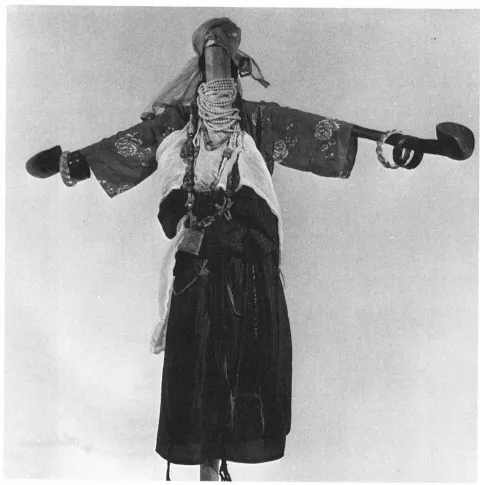
The name comes from a simple object: agenja, the large wooden spoon used for drawing water. From this domestic utensil, the Amazighs made a divinity.
The ceremony consists of dressing this spoon as a bride — a taslit — and carrying it through the douars, accompanied by songs and the collection of alms. Laoust sees in this an almost mechanical logic: through both its function and its form, the object that draws water calls down the water of the sky.
In Marrakech, making the doll is a genuine craft. A group of mature women, widowed or divorced and renowned for their piety, gather at the home of the most devout among them. They fasten two large ladles crosswise to the end of a reed, draw a face in black dye, apply red to the cheeks, and wrap the head in silk scarves. The procession sings:
‘Taghonja has uncovered her head! O Lord, wet her earrings!’
The procession stops outside the homes of notables, collects offerings, and drenches both the doll and those accompanying it with water. If necessary, it is repeated for three nights in succession.
What happens to Taghonja afterwards varies from one region to another. In Marrakech, she is simply dismantled. In the Tafilalt, the women fight until she is destroyed — it is said that without this battle, the rain would never fall. Elsewhere, she is buried, or drowned, while people carefully observe the way she disappears beneath the water.
One thing is striking in Laoust’s text: whatever the variant, Taghonja is never merely an accessory to be discarded without regard. Even when destroyed, she remains charged with baraka — hence the custom of keeping a fragment of the doll in the family chest.
The variety of ritual objects
The spoon is not the only object capable of calling down the rain. Laoust distinguishes several ritual objects, each carrying its own symbolic logic.
In some women’s ceremonies, the funnel takes the place of the spoon: it is turned upside down at the end of a stick, its widening shape recalling the very act of receiving water. The shovel, meanwhile, retains a direct connection with grain and harvests — Laoust calls it tasrif unnzar, ‘the Bride of the Rain’.
But the reed and the banner form the second great category of the rite, almost as widespread as the spoon itself. Reeds grow in damp places; by sympathy, it was thought, they could attract water. Their leaves, stirred by the wind, were even said to imitate the whistling sound that summons rain from the west.
Attached to the reed, a coloured cloth becomes a banner. It is raised on the rooftops, where it flutters until the rain finally wets it. At Ras el-Oued, the village chief himself plants the banner on his terrace before making the rounds of the houses to collect grain.
These objects are not mutually exclusive: spoon and banner are often combined in the same ceremony, each reinforcing the magical action of the other. Laoust notes that the invocation itself continues to be made in the name of the same divinity — even when the object changes, the name remains.
Ali the Hooded One among the Berabers
Among the Berabers of the Middle Atlas, the rite changes its face — literally. It is no longer a bride who is carried in procession, but a man: Ali the Hooded One.
The name varies from tribe to tribe — Ali son of Ali among the Ichqern, ‘Addji the Hooded One among the Izayan — but the effigy remains the same: the hood of a burnous stuffed with cloth and carried on a boy’s shoulder. Unlike Taghonja, here it is the men who conduct the ceremony.
Yet the ritual reproduces that of the spoon point by point: a procession around the douar, stops before the tents, sprinklings of water, the collection of offerings for a communal meal. Only the character and the songs accompanying him are different.
These songs tell a little scene: Ali, caught by violent rain out in the countryside, pulls up his hood and moves closer to the douar, where the dogs greet him as a stranger. ‘The rain drove him towards the douar!’ sing the Izayan.
Among the Aïth Seghrouchen, the rain becomes almost a domestic deluge:
‘We are drowning in water!’
Ali the Hooded One is therefore not a god who is implored, but a man who is acted out — driven away, soaked, dispossessed. The magic works by sympathy: to describe the downpour is already to summon it.

The prayer for rain: tazallit n-unzar
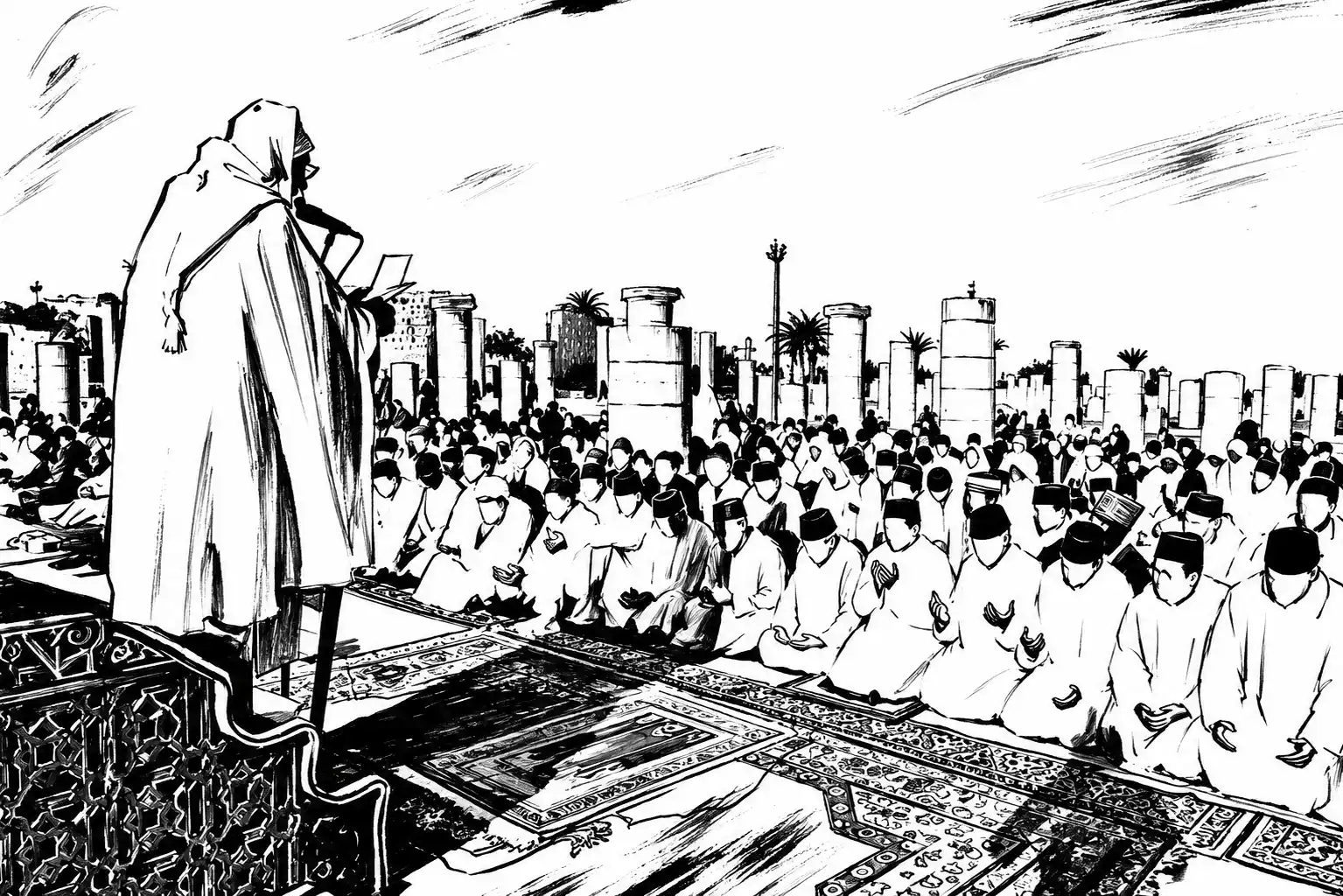
Islam did not erase these ancient practices; it gave them a liturgical form. The salat al-istisqa, the prayer for rain, becomes in Berber tazallit n-unzar.
Among the Aït Mzal, it is recited beside a river: an old man enters the bed of the wadi, wets his clothes, then leads the ceremony from a rock. Among the Mtougga, it takes place ten days after the official opening of the ploughing season, if the rain has still not come — sheep are sacrificed, couscous is shared at the mosque, and the fatha is recited by the fqih.
If this first prayer has no effect, people move on to the ‘great sacrifice’, tigersi moqqorn: the tolba and schoolchildren go to the zaouïa of a saint, where large livestock are slaughtered.
Among the Ida Gounidif, the ceremony is accompanied by an older rite: a black billy goat is sacrificed, small cairns of stones are built, then demolished by each participant after the prayer. The taleb concludes:
‘Pray for the light rain and the heavy rain!’
The official prayer and the magical gesture thus overlap without contradicting one another — Islam frames, without erasing it, the ancient Amazigh ritual substratum.
The rope and the black cow
Two ritual gestures, one playful, the other processional, share the same logic: to provoke rain through collective movement and reversal.
The rope game, jbad elhabel, resembles an ordinary tug-of-war — except that it is deliberately played during periods of drought. Men on one side, women on the other, they pull until the rope breaks: the sudden fall exposes what is normally concealed, provoking laughter and bawdy jokes. The game is repeated three times, then a fatha is recited. Among the Igliwa, someone even deliberately cuts the rope to take the women by surprise as they fall.
The procession of the black cow follows another, more solemn logic. The animal — tamugait idlan — is led around the village, the mosque or a sanctuary. Among the Aïth Bou Zemmour, an elderly woman leads it by the ear, three times around the school tent. Among the Aïth Ouirra, a basket is placed between its horns and a virgin’s belt around its belly.
The black colour is no accident: it is, Laoust writes, the colour of clouds heavy with rain. And if the animal happens to urinate during the procession, it is read as a certain sign — the rain will not be long in coming.
The magic of knots: the little girl with bound hands
The most intimate gesture in Laoust’s chapter is also the harshest. If the rain does not fall, it is believed, dark forces are holding the elements in chains. Untying bonds must therefore, by sympathy, release the rain.
Among the Ida Gounidif, children go from house to house collecting flour, then make their way to a threshing floor with an elderly devout woman. The women present undo the braids across their foreheads. In the centre of the circle, the old woman places a little girl chosen because she is poor and orphaned: she unbraids all her hair, then ties her hands behind her back.
The other children then run around her, shouting and singing:
‘Water, rainwater!’
Overwhelmed by the din, the little girl begins to cry — and her tears, far from being incidental, are precisely what is sought. Laoust states it without hesitation: the tears, he writes, constitute an equally important element of the rite.
The same motif can be found in the Souss and Anti-Atlas. Among the Aït Isaffen, the tolba take a little girl to the place of prayer, her hands remaining bound until the ceremony is over. Among the Isaggen, a young orphan girl is led in procession, her hands tied behind her back, around the shrine of Sidi Hajj Azza.
This rite troubles our gaze today. Laoust records it without judgement — and, in doing so, preserves it from oblivion.
A system, not folklore
Spoon, reed, banner, rope, black cow, bound hands: taken separately, these gestures resemble an inventory of curiosities. Placed side by side, in the light of the myth of Anzar, they reveal something else — a coherent cosmology, in which sky and earth can unite only through the mediation of a human gesture.
What Laoust documented in 1920 is therefore not folklore in the diminished sense of the word. It is a complete system of thought, in which magic, Islamic prayer and myth coexist without cancelling one another out.
Discover: Ali the Hooded One, the fugitive of the rain
Discover: Taghonja, the bride of the rain
Key points
- Anzar is a male divinity of rain; Taghonja, his symbolic bride, takes the form of a spoon dressed as a bride.
- The rite varies from tribe to tribe: Marrakech, the Tafilalt, the Infedouaq and Kabylia each have their own distinct version.
- Spoon, funnel, shovel, reed and banner all serve as ritual objects, often combined with one another.
- Among the Berabers of the Middle Atlas, a male figure, Ali the Hooded One, replaces Taghonja.
- The Islamic prayer tazallit n-unzar absorbed the older magical gestures without erasing them.
- Rope, black cow and the magic of knots all belong to the same logic: provoking rain through sympathetic magic.
Editor’s note
One closes Mots et choses berbères with one certainty: Amazigh rain rites did not merely seek water from the sky; they wove a demanding bond between human gesture and the fertility of the earth. That bond has, for the most part, disappeared. Traces remain — in a prayer still recited, in the name of a saint, in a spoon that can no longer be looked at in quite the same way.
One final point of vocabulary: the term ‘Berabers’, which Laoust uses for the Middle Atlas tribes among whom Ali the Hooded One is found, belongs to the Berber studies of his time. It groups together speakers of the Tamazight of the Middle Atlas and central High Atlas, as opposed to the Chleuhs of the Souss and Anti-Atlas, who speak Tachelhit. A classification from another age, but one found throughout the older literature of Berber studies — and one that therefore needed to be placed in context here.
More to Explore

For more than twenty years, Éric Anglade has lived in a village of South-Eastern Morocco, where he explores and documents the region’s history, heritage, and living traditions. He founded sudestmaroc.com as a space for sharing fieldwork and cultural insight, bridging local knowledge with global perspectives. He also works alongside women carpet-weavers to help sustain their craft and welcomes travellers at Le Jardin de Yuda, his guesthouse envisioned as a meeting place for exchange and transmission.

Leave a Reply