


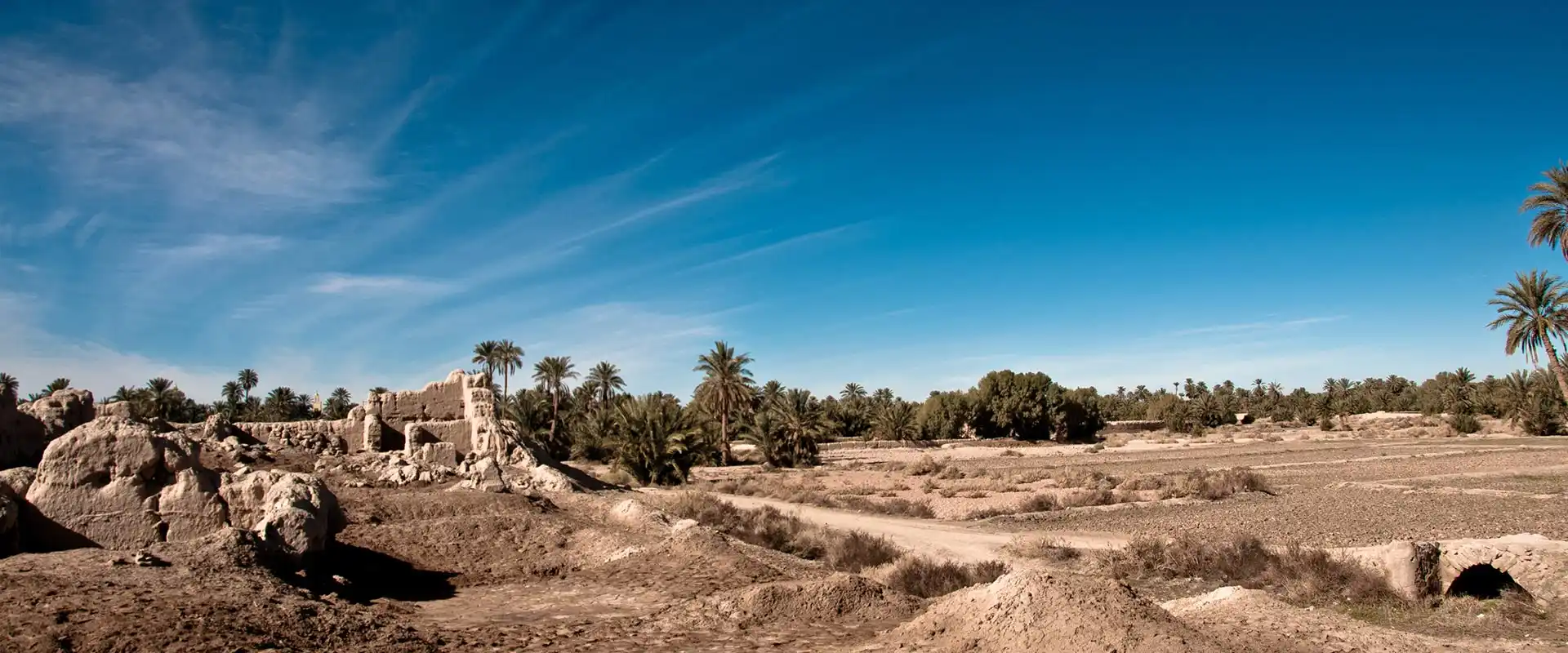
The Tafilalet region, the sleeping beauty of the desert
Between the valleys of the Ziz and the Gheris, at the gates of the Sahara, Tafilalet is one of the great historic territories of South-East Morocco. A caravan crossroads, a land of ksour and palm groves, home to Sijilmassa and cradle of the Alaouite dynasty, for centuries it was one of Morocco’s political, commercial and cultural centres. Then the routes of the world shifted. Tafilalet fell asleep. What remains today of this memory, and upon what might its awakening be built?
Overview
- Tafilalet, between the Atlas, oases and Sahara.
- The ksar, home and political organisation of Tafilalet.
- Amazighs, Arabs, Jews and Haratine: intertwined histories.
- Sijilmassa, the great caravan city of Tafilalet.
- Tafilalet, cradle of the Alaouite dynasty.
- When the routes of the world shifted towards the Atlantic.
- From the bled siba to ‘useless Morocco’.
- A region long relegated to the margins.
- The tribal spirit, heritage or obstacle to modernity?
- Nature and memories to imagine a new destiny.
Situated on the northern edge of the Sahara, Tafilalet was, throughout its history, a place where nomadic populations, drawn to arid expanses, met and then mingled with sedentary communities accustomed to living within the embrace of the oases and their palm groves. Tafilalet was the meeting point of two worlds that shaped Morocco, that of the mountains and that of the desert. It was also one of the territories where Amazigh populations and Arab populations arriving from the East met, confronted one another and eventually mingled.
Tafilalet was, finally, a hinge, a bridge between the rest of Morocco and the lands beyond the desert, towards the vast Bilad al-Sudan, the ‘land of the Blacks’ of medieval Arab geographers, which designated the territories lying south of the Sahara. From there came gold, enslaved people and many other goods carried by the long caravans linking the Maghreb to the kingdoms of the Sahel.
For many centuries, the region was therefore the setting for a flourishing economic, cultural, religious and political life. And because it stood on the great caravan routes linking the Maghreb to Sahelian Africa, Tafilalet saw the rise of the prosperous city of Sijilmassa, followed by palaces, powerful zaouias, warriors and conquering leaders. Above all, Tafilalet was the land where the Alaouite dynasty was born, the dynasty that still reigns over Morocco today under King Mohammed VI.
What remains today of this glorious past? In truth, not very much: architectural treasures scattered and forgotten, some of them abandoned and whose very names fade beneath the winds; a few stories still shared among elderly men sitting alone beneath the gateways of the ksour, far from the interest of the young.
Several hundred years ago, Tafilalet fell asleep.
What, then, happened?
Tafilalet, between the Atlas, oases and Sahara
First, we need to clarify which Tafilalet we are talking about.
Historic Tafilalet should not be confused with the present-day administrative region of Drâa-Tafilalet, created in 2015 and considerably larger. It refers first and foremost to the great oasis area organised around the lower valleys of the Ziz and the Gheris, particularly around Rissani and Erfoud, and may, in its broader sense, extend up the Ziz valley towards the High Atlas and out towards the Saharan margins.
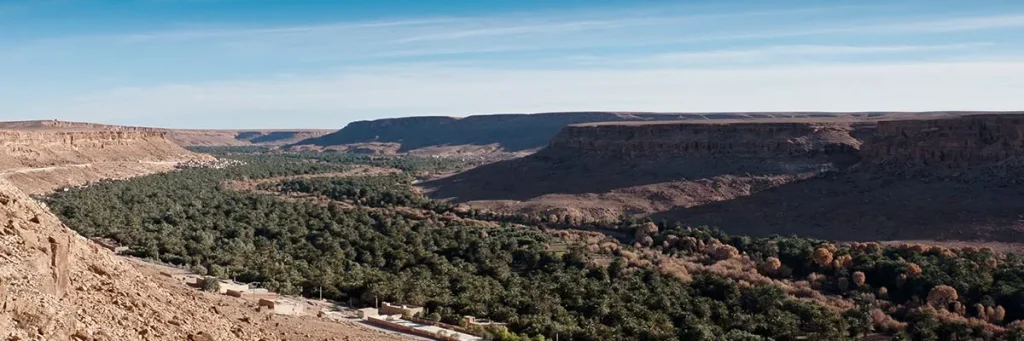
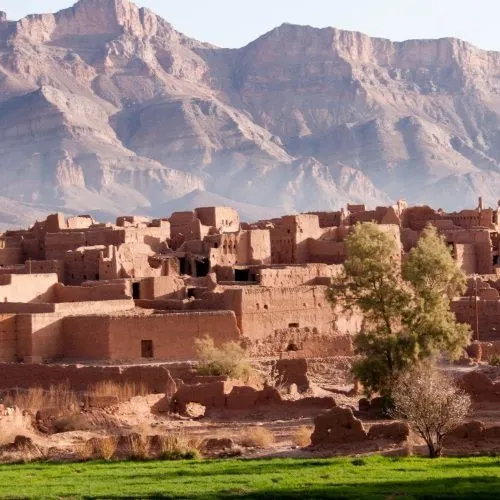
Tafilalet is, above all, a land ruled by an imperious nature. Bordered to the north and west by mountain ranges, the region consists mainly of rocky plateaux, those hamadas where even the smallest vegetation struggles to survive, together with a few patches of steppe on the mountain slopes.
Two great wadis, the Ziz and the Gheris, descend from the Atlas and feed a succession of palm groves before disappearing at the edge of the desert. Date palms dominate these oases, providing food and income while also forming one of the defining elements of both the landscape and oasis society.
Tafilalet is characterised by very low rainfall, forcing its inhabitants to devote much of their effort to organising the irrigation of the lands where they settled and to defending control over them. Irrigation required enormous labour: levelling the ground, building dams, digging and maintaining canals, distributing water and ploughing deeply into the few areas of usable soil.
And despite all this, agricultural production often remained below what was needed for the population’s subsistence.
The ksar, home and political organisation of Tafilalet
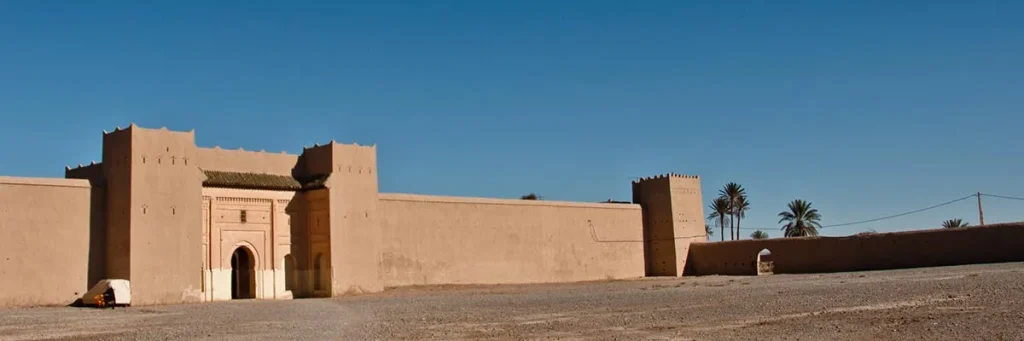
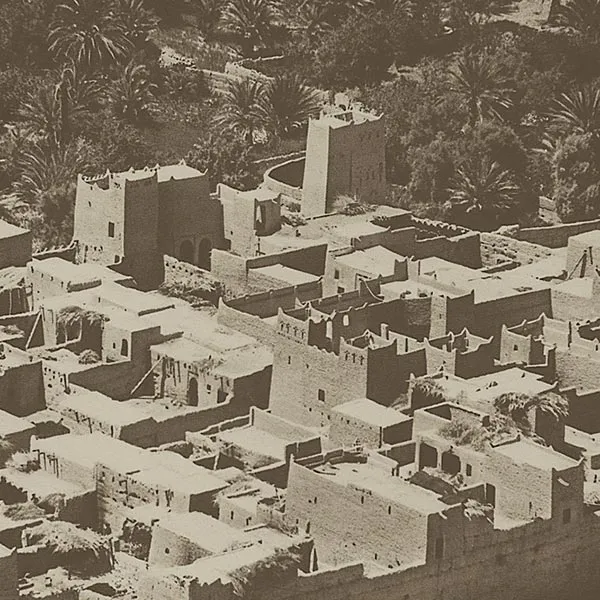
The long ribbon of Tafilalet’s palm groves is accompanied by a chain of ksour, those fortified villages whose earthen architecture remains one of the most recognisable features of South-East Morocco.
The ksar illustrates the response of Tafilalet’s populations to the difficult conditions they faced: insecurity and rivalries between groups, the concentration of economic life around the oasis, the scarcity of water, and the need to unite and protect a community around shared resources.
The ksar was therefore more than simply a place to live. It was also a social and political unit, organised around community institutions, collective rules and an assembly, the jemaa, responsible in particular for managing common interests.
Organised in this way, each community, bound to its ksar and cultivated lands, managed its relations with neighbouring ksour and nomadic tribes. Systems of protection could bind sedentary populations to more powerful groups in return for payment or alliances, within a balance of power that shifted according to circumstances.
Amazighs, Arabs, Jews and Haratine: intertwined histories
The Amazigh are the region’s principal long-established population. Several large confederations and tribal groups played a determining role here, among them notably the Aït Atta, whose historic heartland lies around the Saghro massif, and the Aït Yafelman, established throughout the eastern High Atlas and its margins.
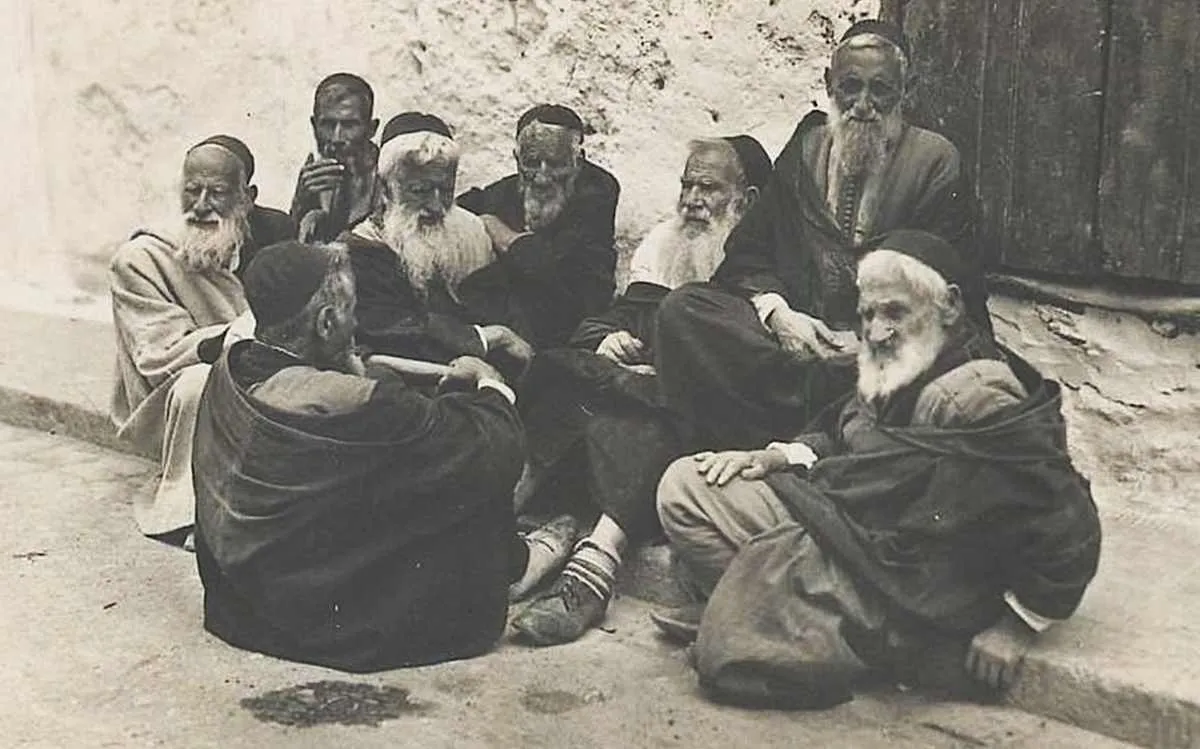
Alongside the Amazigh populations of Tafilalet lived numerous Jewish communities for many centuries. Their presence is ancient and they played an important role in the region’s commercial exchanges. In the Middle Ages, Sijilmassa itself was home to a Jewish community connected to trading networks linking the Maghreb, Egypt, the Mediterranean world and the trans-Saharan routes.
Tafilalet is also home to long-established Haratine communities, deeply connected to the history of the oases. Their origins have given rise to very different interpretations, and it would be reductive to present them simply as the descendants of enslaved people brought from sub-Saharan Africa. Oasis societies experienced migrations, intermingling and a wide range of social statuses over the centuries. The Haratine played an essential role in agricultural work and the maintenance of the palm groves, sometimes within relationships of social dependence whose nature varied from one place and period to another.
Trans-Saharan trade also brought to Morocco men and women who had been enslaved, often referred to locally by the term laâbid. These movements were fuelled both by trade and by war and conquest. The expedition sent in 1591 by the Saadian Sultan Ahmed al-Mansour against the Songhai Empire and towards Timbuktu forms part of this long history of relations between Morocco and the lands lying south of the Sahara.
As for Arab populations, their presence in Tafilalet did not result from a single wave of arrival. The first Arab-Muslim conquests reached the Maghreb from the second half of the seventh century onwards, but their rule soon met with Amazigh resistance and revolts.
It was within this context that Sijilmassa was founded in the middle of the eighth century, associated with Kharijite groups and the Zenata Miknasa. Little by little, the influence of the city drew towards it populations, merchants, scholars and travellers from increasingly distant lands.
From the middle of the eleventh century onwards, the great migrations of Arab Bedouin tribes, often grouped together under the name of the Hilalian migrations, in turn transformed the Maghreb. Other groups, among them the Banu Maqil, later moved progressively into southern Morocco.
Over the centuries, Tafilalet thus became a territory of settlement, confrontation but also intermingling, where Amazigh, Arab, Saharan, Jewish and African identities ultimately combined to form an extraordinarily diverse society.
Read also: Sijilmassa, the mythical city that made the true heart of the Maghreb shine
Sijilmassa, the great caravan city of Tafilalet
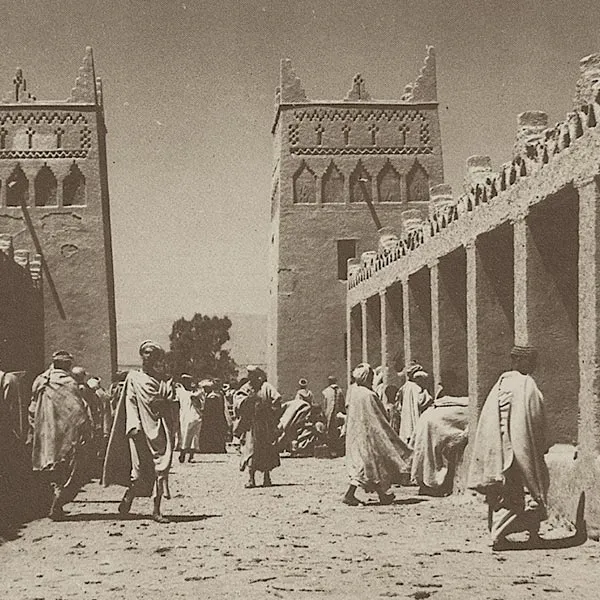
It is important to keep in mind the extraordinary reach of Sijilmassa.
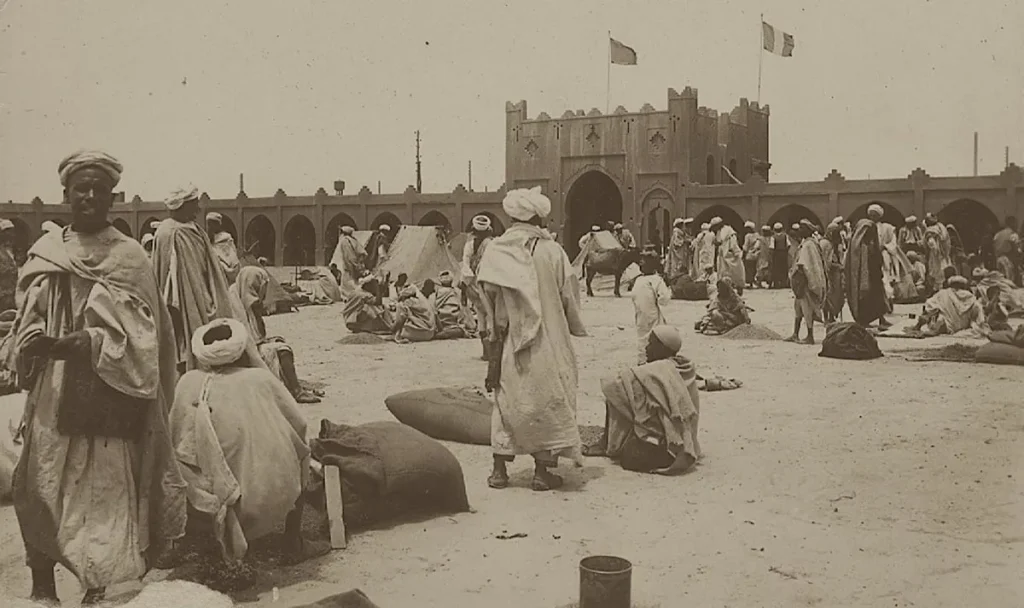
Founded in the eighth century near present-day Rissani, it was for several centuries one of the principal caravan ports of the Sahara. From the ninth to the thirteenth century in particular, it was one of the great meeting places for merchants from the Maghreb, Al-Andalus, the Muslim East and the Bilad al-Sudan.
It was an economic heart, a crossroads and a magnet drawing towards it a cosmopolitan world of powerful figures, adventurers, merchants, scholars, religious men and conquerors…
The wealth generated by the gold trade was immense. Caravans linked Sijilmassa in particular to the cities and kingdoms of the Sahel, carrying gold, enslaved people and other goods northwards, while salt, textiles, manufactured objects, horses and many other products travelled south.
In his work Surat al-Ardh — The Configuration of the Earth — the tenth-century Arab traveller and geographer Ibn Hawqal described the magnificence of the medieval city:
‘Sijilmassa is situated in a magnificent location and has a distinguished population. It lies on a river, the Ziz, which rises in summer like the Nile… It is enough to sow for one year: the crop from this sowing is harvested and, by continuing to irrigate the fields in the following years, the same harvest can be obtained for seven years… At Sijilmassa, one also sees vast palm groves, very fine orchards and gardens… The inhabitants are generous and prosperous; they distinguish themselves from the people of the Maghreb by their appearance and their behaviour… One finds among them a taste for learning, modesty and reserve, a certain elegance of bearing, the practice of virtuous qualities, kindness and moderation.’
This economic prosperity was accompanied by intellectual, scientific and religious influence, as evidenced by the city’s scholars, its private libraries and those of its zaouias.
But Sijilmassa did not disappear overnight.
From the end of the fourteenth century and into the fifteenth, the major routes of trans-Saharan trade began to shift. The city gradually lost its central role to other routes, notably that linking Tlemcen, Touat and Timbuktu. Its former commercial function nevertheless survived in other ksour and centres of Tafilalet.
The sleep had begun.
Tafilalet, cradle of the Alaouite dynasty
Tafilalet is also the territory from which the Alaouite dynasty, represented today by King Mohammed VI, originated.
According to dynastic tradition, Hassan ad-Dakhil, ancestor of the Alaouites, settled in Tafilalet in the thirteenth century. The family’s descent from the Prophet Mohammed gave it the status of chorfa and a religious authority that was progressively accompanied by growing economic and political influence.
At the beginning of the seventeenth century, Morocco was experiencing major political crises. The Saadian Sultanate was in decline, the kingdom was fragmenting and several regional, tribal and religious powers were competing for control of territories and trade routes.
In 1631, the inhabitants of Tafilalet called upon Moulay Cherif to resist, in particular, the growing power of the Zaouia of Dila. His son Moulay Mohammed subsequently extended the family’s influence far beyond Tafilalet.
The Zaouia of Dila: a Moroccan Sufi brotherhood founded around 1566, which played a major role in Moroccan political and religious life during the seventeenth century. It reached its height around 1659, controlling a large part of northern Morocco and having its leader, Muhammad al-Hajj ad-Dila’i, proclaimed sultan in Fez.
But it was ultimately Moulay Rachid ben Cherif, himself born in Tafilalet, who transformed this regional power into a Moroccan dynasty. From 1666 onwards, he progressively imposed his authority, took Fez and began the reunification of the kingdom.
The rise of the Alaouites therefore restored Tafilalet, for a time, to a leading political role.
But accession to the sultanate forced successive Alaouite rulers to move ever farther away from their region of origin. Fez, Meknes and then Marrakesh became the centres from which Moroccan power radiated.
Tafilalet had given Morocco a dynasty.
And that dynasty, in order to rule Morocco, had to leave Tafilalet.
When the routes of the world shifted towards the Atlantic
The other upheaval was economic.
The decline of trans-Saharan trade was neither sudden nor linear. Caravans continued to cross the Sahara for several centuries and Tafilalet retained significant commercial activity for a long time. But the great routes of the world were changing.
From the fifteenth century onwards, Portuguese maritime expansion along the African coast began to open new routes that enabled Europeans to reach the markets and products of West Africa directly.
During the sixteenth and seventeenth centuries, the Portuguese, Dutch, English and then French established an increasing number of trading posts along the Atlantic coasts of Africa. In 1659, Saint-Louis in Senegal thus became one of the first major French trading posts on the West African coast.
Little by little, the ocean was competing with the desert.
Goods that for centuries had travelled north across the Sahara on the backs of camels could now reach European ships directly. Morocco and its major caravan ports did not immediately lose their position as intermediaries between Europe and sub-Saharan Africa, but that position was becoming less indispensable.
Traffic along the trade routes of both the Drâa and Tafilalet gradually declined.
As exchanges contracted, land and water became even more decisively the principal sources of wealth. During the eighteenth century, the advance and sedentarisation of powerful groups such as the Aït Atta profoundly altered the balance of power in the oases of the Ziz and the Drâa.
This movement of withdrawal, as radical as it was vital, weakened the social and economic ecosystem that for centuries had allowed very different communities to live from the circulation of people and goods.
The Moroccan historian Larbi Mezzine, a leading specialist on Tafilalet, has shown how decisively the eighteenth century marked a turning point in this respect. Under the reign of Sidi Mohammed ben Abdallah, the future Mohammed III, beginning in 1757, Morocco turned its interests still further towards its Atlantic coasts and trade with Europe.
Saharan trade slowly declined, like a flame grown tired of shining for want of a gaze.
From the bled siba to ‘useless Morocco’
Tafilalet sank into a lingering sleep.
But it would be misleading to reduce the political history that followed to a simple opposition between a Morocco subject to the Sultan’s authority and another plunged into ‘anarchy’.
The notion of bled siba referred to territories whose relationship with the Makhzen varied considerably. Some tribes refused taxation or the permanent presence of representatives of central power while nevertheless recognising the Sultan’s religious or symbolic authority. Alliances, opposition and submission changed according to periods and balances of power.
This complexity was later simplified by part of colonial historiography into an almost absolute opposition between bled makhzen and bled siba.
The bled siba: an expression used to describe territories in which the temporal authority of the Makhzen was contested, intermittent or negotiated. Often translated as ‘land of dissidence’, the term does not mean that these territories lacked political or social organisation.
From 1912 onwards, the French colonial conquest — described at the time by the French authorities as ‘pacification’ — progressively imposed military control over the territories of the South-East. Tafilalet itself was at the centre of clashes and difficult episodes in this conquest.
Marshal Lyautey, the first French Resident-General in Morocco, drew a distinction between a Maroc utile, a ‘useful Morocco’ concentrated around the plains, cities and major economic routes, and a Maroc inutile, an ‘useless Morocco’ comprising in particular mountain and Saharan regions whose occupation appeared to require military resources out of proportion to their immediate economic value.
A terrible expression.
Because words sometimes end up weighing upon the territories they claim merely to describe.
A region long relegated to the margins
Today, Errachidia is the capital of the administrative region of Drâa-Tafilalet, created in 2015 and comprising the provinces of Errachidia, Midelt, Tinghir, Ouarzazate and Zagora.
But an administrative region is not enough to create an identity.
More than a decade after its creation, there is still at times a sense that the pieces of this immense region have been brought together more successfully on a map than within a collective project capable of giving them a shared direction.
No valiant prince is likely to come to piece together a fragmented identity and redraw the shape of a destiny.
And perhaps that is for the best.
Because the question is no longer which prince will awaken Tafilalet.
But whether Tafilalet will one day know how to awaken itself.
The tribal spirit, heritage or obstacle to modernity?
It is certain that, since the eighteenth century, Morocco’s centres of power have progressively moved away from Tafilalet, just as it is clear that, generation after generation, many members of the region’s elite have done the same.
But the responsibility of the population itself can also be questioned.
The French historian Henri Terrasse, in an interpretation deeply marked by his own period, notably associated the spirit of the siba with a form of reluctance towards modernity. This interpretation has since been considerably nuanced: the siba cannot simply be equated with a refusal of change, any more than tribal organisation alone can explain the economic decline of a territory.
Yet the question is difficult to avoid entirely.
The geopolitical and ultimately civilisational upheavals of the eighteenth and nineteenth centuries clearly stunned Tafilalet, as they did so many other regions of Morocco. Feelings of abandonment and decline must have weighed heavily upon the morale of the population and, above all, encouraged the young people of these territories to do everything they could to leave these peripheries, too far removed from the noise of the world.
At times struggling to imagine itself beyond its local affiliations, Tafilalet society remained for a long time fragmented between ksour, tribes, valleys and territories.
Meanwhile, another movement was advancing: that of the construction of a modern state, and then of a nation.
The populations of Morocco faced the challenge of making Morocco. The path towards that goal, inevitably chaotic, laborious and painful, spoke to Moroccans of a project of shared citizenship across every territory of the country.
It did not ask them to erase their old identities. It asked them to decide what could be built with them.
Too often, perhaps, through fear of the future, fear of renewal, and an inability to believe in its own capacity for innovation and creativity, Tafilalet preferred the indolence of the logic of a vanished past.
Nature and memories to imagine a new destiny
Perhaps one day the region will finally open its eyes, without the help of a prince, seized by a new desire to continue the work of its own existence.
Perhaps it will then see that what were once its constraints — the nature that surrounds it, with its deserts, mountains, valleys and oases — have today become more than assets?
Perhaps it will also understand that its long history, this vast necklace of episodes, stories, adventures and heroes, represents more than a collection of memories?
Sijilmassa, the ksour, the palm groves, the ancient irrigation systems, Amazigh, Arab, Jewish and Saharan memories, the caravan routes, the knowledge and skills of the oasis: all this forms a heritage whose density few territories can claim to equal.
This is not about imprisoning Tafilalet within its past, nor about turning its history into scenery.
It is, on the contrary, about understanding that this history can once again become a resource: for passing knowledge on, creating, travelling differently, protecting the oases, and developing a cultural and tourism economy rooted in the territory rather than imposed upon it.
Nature and memories: these are the true, unalterable riches of Tafilalet and the Drâa alike.
Together, these riches can become the foundations of a contemporary regional identity. They can become a source of pride, and therefore of confidence, for an entire population.
Above all, nature and memories could become the pillars of a new economy.
If the beautiful region of Tafilalet so wishes, it will wake, and then awaken to its new destiny.
Key points
- Historic Tafilalet, organised around the valleys of the Ziz and the Gheris, should not be confused with the present-day administrative region of Drâa-Tafilalet, which is considerably larger.
- At the gates of the Sahara, Tafilalet was for centuries a major crossroads between Morocco, the Maghreb and sub-Saharan Africa, thanks to the trans-Saharan trade routes.
- Founded in the eighth century, Sijilmassa became one of the principal caravan cities of the Maghreb and contributed to the economic, religious and cultural influence of the entire region.
- Tafilalet is also the cradle of the Alaouite dynasty, which emerged as a political power in the region during the seventeenth century before extending its authority across Morocco.
- The gradual shift of the major trade routes towards the Atlantic coasts contributed to the decline of Tafilalet.
- Today, its oases, ksour, landscapes and Amazigh, Arab, Jewish and Saharan memories can form the foundations of a new project for the territory.

More to Explore

Leave a Reply