
Fint Oasis: a secluded valley on the doorstep of Ouarzazate
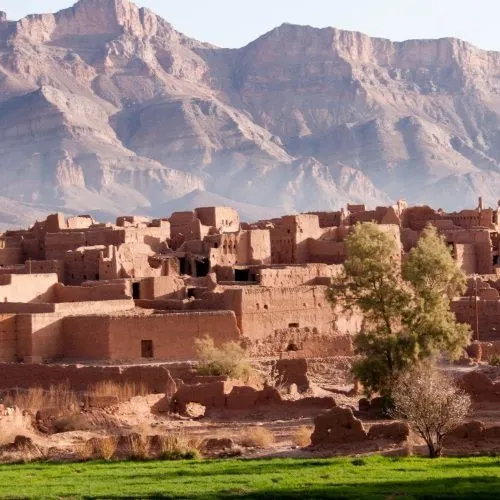
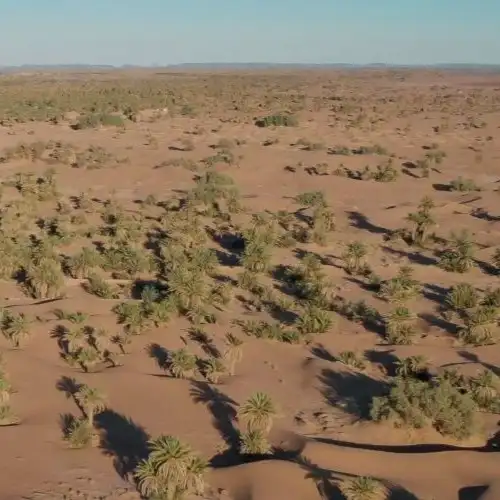
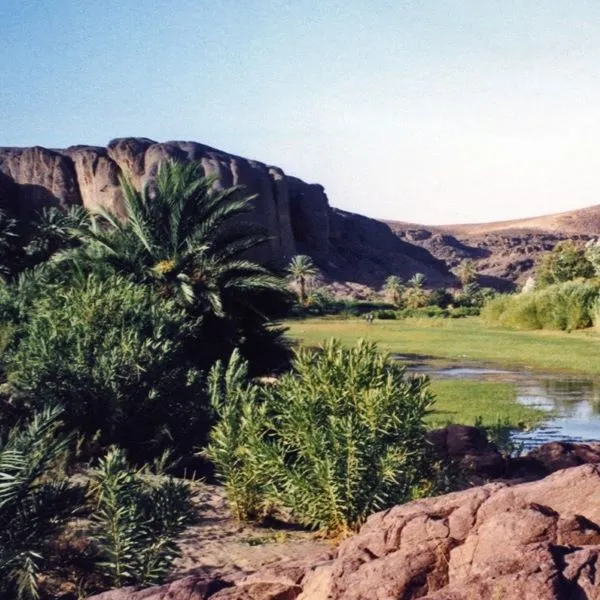
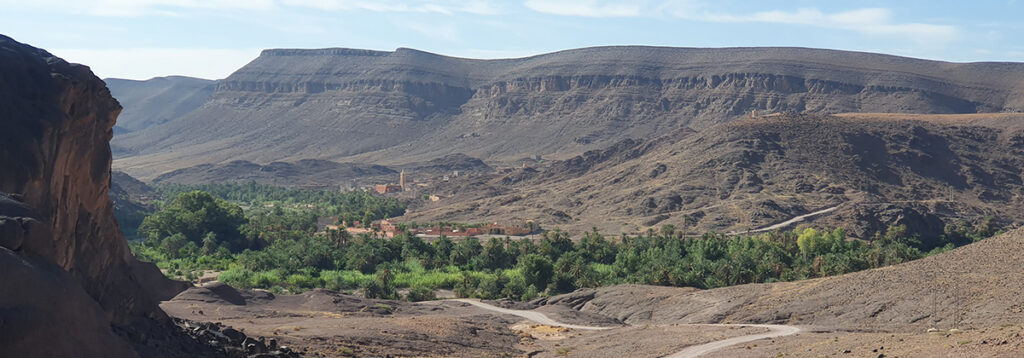
Just a few kilometres from Ouarzazate, Fint Oasis emerges at the bottom of a mineral valley, like a long ribbon of green winding between dark hills. Palm trees, irrigated gardens and earthen villages follow the course of the wadi through a landscape of striking contrasts.
Easy to reach from Ouarzazate, Fint offers the chance to leave the city behind, walk among the cultivated plots and discover one of the region’s most beautiful oasis landscapes.
Why visit Fint Oasis?
Discover an oasis emerging from a mineral landscape
The approach is one of the most striking moments of the visit. From the plateau, there is little to suggest that an oasis lies ahead. The road crosses expanses of dark rock and arid hills before suddenly overlooking a valley filled with palm trees, gardens and earthen houses.
A frequently repeated local interpretation links the name Fint to the Amazigh expression n’Fint, understood to mean “hidden”. Although this etymology would require firmer linguistic confirmation, it perfectly captures the impression created by the landscape: a valley concealed from view until the very last moments of the approach.
Walk through a living oasis
Unlike a garden laid out for visitors, Fint remains a place where people live and work. Paths wind between small cultivated plots, date palms, fruit trees, vegetable gardens and the houses of the different villages.
Irrigation depends on the circulation and sharing of scarce water resources. Agriculture is mainly geared towards local needs, with dates, figs, grapes, cereals, vegetables and fodder crops grown according to the plot, the season and the amount of water available.
Slow down just a few kilometres from Ouarzazate
Its proximity to Ouarzazate means Fint can easily be visited in half a day without organising a long excursion. Yet the oasis feels isolated enough to offer an immediate break from the city.
Rather than rushing from one attraction to another, Fint is best suited to a slow walk, a locally prepared lunch or a few hours spent beneath the palm trees. It is particularly rewarding for travellers who want to understand a place rather than simply tick off sights.
Read more : Fint Oasis as told by its elders…
Understanding Fint Oasis
A valley made up of four villages
Fint is not a single village but a group of four douars spread along the wadi. Their names appear with different spellings depending on the transcription: Wangarf, Taherbilte or Taharbilt, Timoula and Belghizi or Balghizi.
This linear settlement pattern is directly shaped by the geography of the valley. Houses are grouped on slightly higher ground, while the gardens occupy areas closer to the water. The result is a narrow oasis stretching over several kilometres rather than one vast, continuous palm grove.
A history preserved through oral memory
With relatively little written documentation available, much of Fint’s history has been passed down through family stories. Testimonies collected from Lhaj Elhassane Aghlane recall the gradual arrival of families from the Drâa Valley, the Tata region and other parts of south-eastern Morocco, driven by drought, epidemics, famine or tensions between tribes.
According to this local memory, the earliest dwellings were established on the rocky slope of Tassegdelte, high enough to offer protection from flooding along the wadi. Remains of old buildings and dwellings sometimes described as troglodytic are still reported around the oasis, although their precise identification and present condition deserve further verification on site.
The accounts also describe Fint as a Black Amazigh community formed through successive migrations and deeply rooted in the valley. This history should not be used to reduce its inhabitants to a fixed category: it belongs to the particular social memory of Black communities in southern Morocco and to the many human movements that have shaped the country’s oases.
Fint under Glaoua authority
During the period of caïdal rule and later the French Protectorate, Fint lay within the Glaoua sphere of influence. Local elders recall two amghars, based in Taherbilte and Timoula, who acted as intermediaries for Glaoua authority.
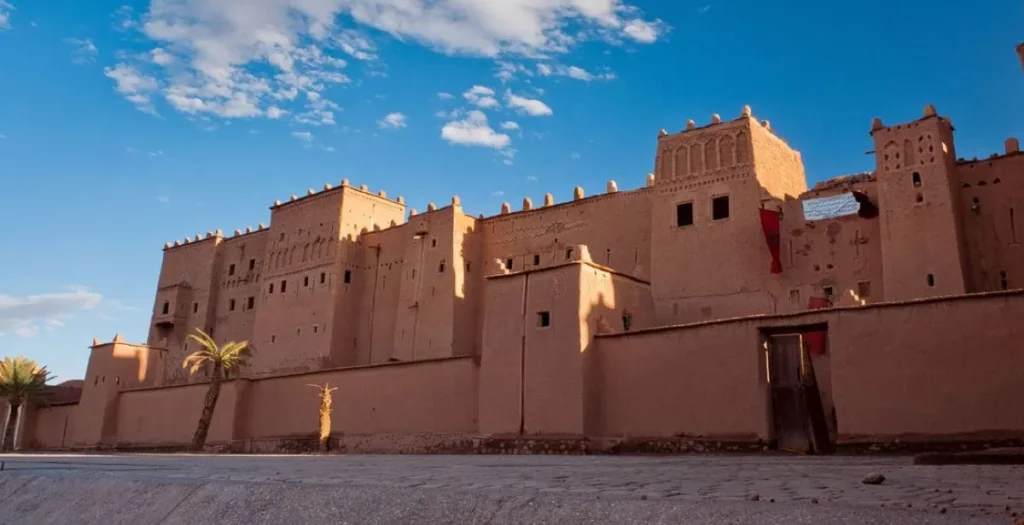
Lhaj Elhassane Aghlane’s testimony describes levies, confiscations and forced labour imposed on local families. Men and boys could be called upon to plough fields, help with harvests or work on buildings belonging to Glaoua representatives based in places such as the kasbahs of Taourirt and Tifoultoute.
This history reminds us that the peaceful appearance of the oasis also conceals a past marked by unequal power relations. Some inhabitants once worked as khammès — sharecroppers traditionally paid one fifth of the harvest — on land held by neighbouring groups.
A once more diverse society
The memories collected in Fint also mention the former presence of several Jewish families, at a time when Jewish communities lived in many villages around Ouarzazate. They were particularly involved in trade and in exchanges connecting the oases with neighbouring market towns.
Little trace of this presence is visible in the landscape today. Yet it shows that despite its apparent isolation, Fint was part of the wider economic, social and religious networks of southern Morocco.
Water: the source and fragility of the oasis
Life in Fint depends entirely on the wadi and the water flows that feed its gardens. During favourable periods, water runs through the irrigation channels, cultivation resumes and vegetation spreads across the plots. During prolonged droughts, cultivated areas shrink and some families have to seek additional sources of income elsewhere.
The elders’ accounts contrast years of hardship with times of abundance, when gardens flourished, livestock prospered and the inhabitants gathered to celebrate the moussem of Sidi M’hend Ou Moussa. This festival combined a religious ceremony, a shared meal and an opportunity to renew ties with other communities in the region.
Read more: The Glaoua: the extraordinary history of a small Berber tribe from the Atlas
What to see at Fint Oasis?
Take in the oasis from above
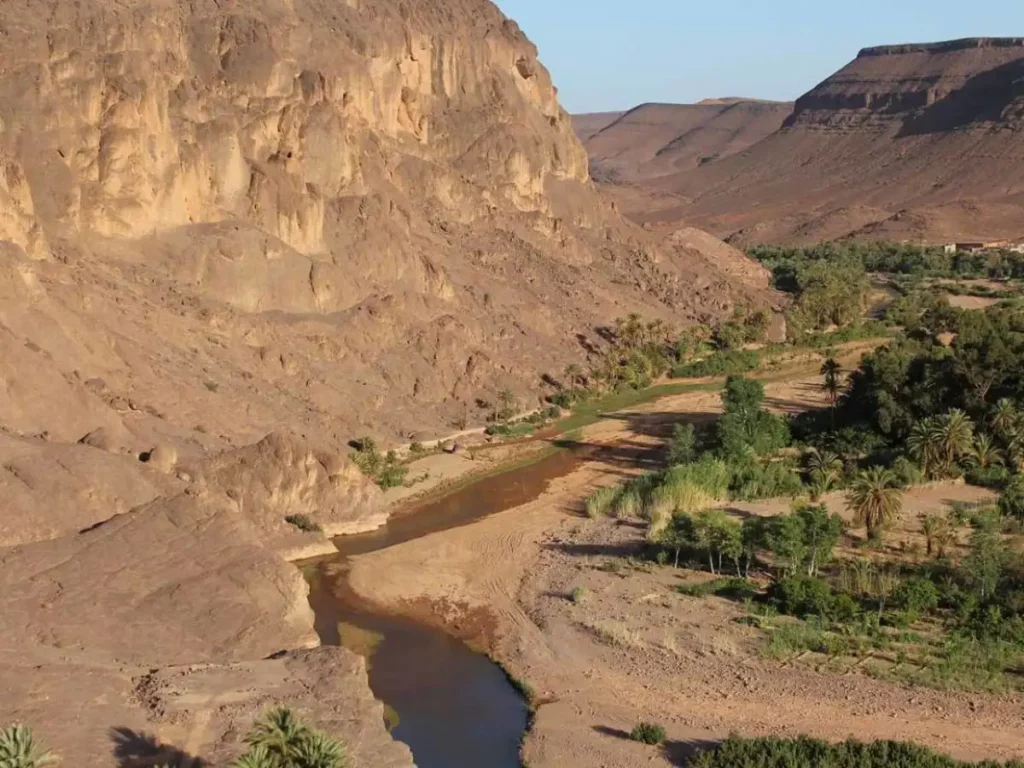
Before descending into the valley, take a moment to stop and look. From above, the structure of Fint becomes immediately clear: a narrow ribbon of vegetation follows the wadi, while villages and gardens occupy the available ground between the water and the rocky slopes.
Morning light and late afternoon are particularly good times to appreciate the contrast between the palm trees, dark hills and earthen houses.
A local guide can also accompany you on a walk into the hills above the valley after crossing the gardens along the wadi.
Looking for a guide to visit Fint Oasis? Contact us
Walk among the gardens
The best way to discover Fint is on foot. Several paths connect the villages, either following the wadi or passing between cultivated plots. A two- or three-hour walk is already enough to observe the crops, irrigation systems, bread ovens, earthen walls and different layers of vegetation.
There is not always continuous signposting. A resident or local guide can help you find the most interesting paths while avoiding accidentally entering private fields.
Look for traces of the old settlement
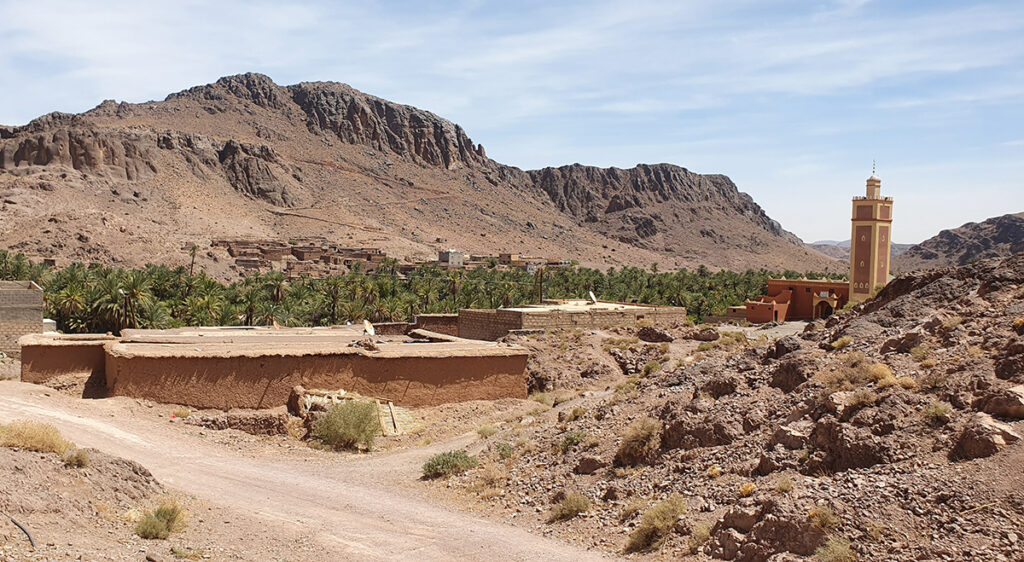
On the higher ground, traces of older buildings survive and are associated in local memory with the community’s earliest settlements. Some cavities and ruins are sometimes described as former troglodytic dwellings.
These areas have not been restored and are not systematically secured. They should be approached with caution, without climbing on earthen walls or entering weakened structures.
Understand Fint’s connection with cinema
Its proximity to Ouarzazate has also given Fint a place in the region’s film history. The oasis and surrounding landscapes have been used as locations, including for scenes associated with Lawrence of Arabia and Prince of Persia. Oasis Studios Morocco, a production complex, was also established in 2016 on the heights near the oasis.
This cinematic aspect remains secondary to the experience of visiting Fint. Unlike the large studios and purpose-built sets around Ouarzazate, the oasis is first and foremost worth discovering for its landscape, agriculture and villages.
Visit Fint with respect for the oasis
Fint is an inhabited and cultivated landscape, not a tourist park. Paths may pass alongside houses and workplaces or close to local residents going about their daily activities.
A few simple principles should therefore be respected:
- ask permission before photographing people or the inside of a house;
- stay on the paths and do not walk through cultivated plots;
- do not pick fruit unless invited to do so;
- take care not to damage irrigation channels or small water structures;
- take your rubbish away with you;
- avoid treating water areas as swimming spots;
- agree clearly on the price before accepting a guided visit, meal or other service.
Meeting local people can be one of the most rewarding aspects of a visit to Fint, but these encounters should always be based on clarity and respect, without treating everyday life as a spectacle.
Looking for a guide to visit Fint Oasis? Contact us
A lire : Telouet, le berceau des seigneurs de l’Atlas
How to get to Fint Oasis?
From Ouarzazate
From central Ouarzazate, head towards Tarmigt on the southern bank of the wadi, then follow the direction of Zaouit Sidi Othmane and the signs towards Fint. Routes suggested by navigation apps may vary and the condition of some tracks can change, so it is sensible to check the road before leaving the built-up areas.
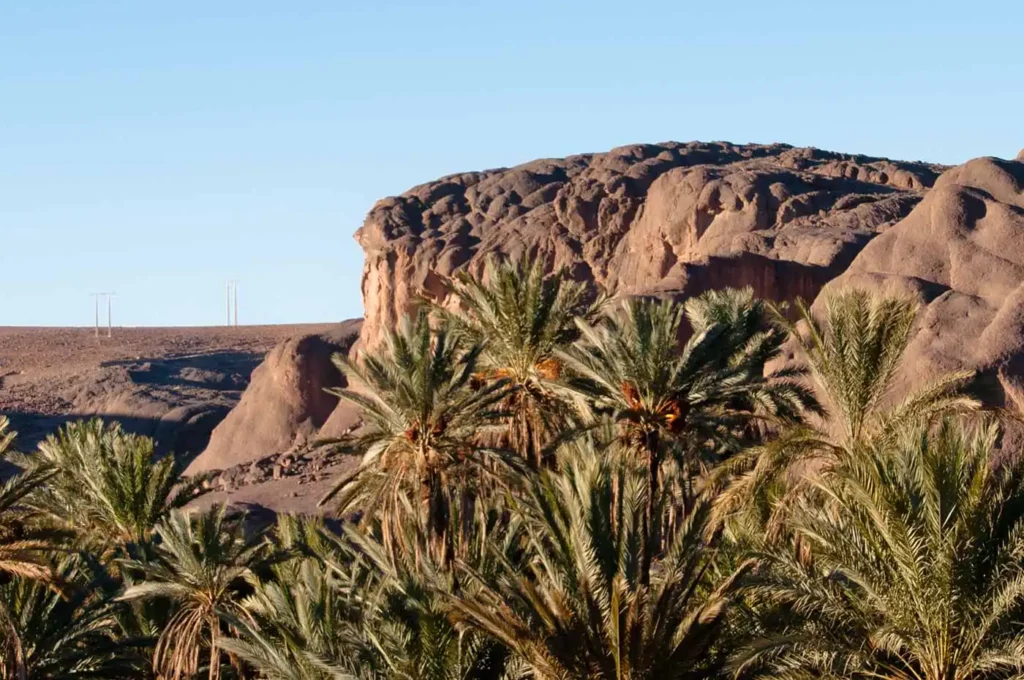
The final kilometres cross a stony landscape before descending towards the oasis. Drive slowly, particularly in a low-clearance vehicle. The total journey generally takes between 30 and 45 minutes.
By taxi or private driver
Booking a taxi from Ouarzazate is the simplest option for visitors without their own vehicle. Agree in advance on:
- the total price;
- waiting time;
- where you will meet for the return journey;
- whether a guide or lunch is included.
It is not advisable to travel to Fint without arranging your return journey, as taxis are not guaranteed to be available in the oasis.
By bicycle
Fint can also be reached by mountain bike from Ouarzazate. The return trip covers around 30 kilometres depending on the route, with stony sections and considerable exposure to the sun. A reasonable level of fitness, plenty of water and a suitable bicycle are essential. Guided cycling excursions are also available from Ouarzazate.
Read more : Skoura Palm Grove, the quintessential oasis
Where to stay in Fint?
A small number of guesthouses and inns welcome visitors in the oasis or near the villages. When arranged in advance, it may also be possible to have lunch in a local family home.
Accommodation options remain limited and can vary with the seasons. If you plan to stay overnight, it is best to book ahead and check:
- access to the property;
- whether dinner is available;
- hot water and heating in winter;
- payment arrangements;
- return transport.
Spending a night in Fint offers the chance to experience the oasis after the day visitors have left, when the light fades across the surrounding hills and daily life continues around the houses and gardens. Travellers looking for more comfort and a wider choice of accommodation may prefer to stay in Ouarzazate and visit Fint during the day.
Looking for advice? : Contact us
A lire : La légende des princesses chrétiennes d’Aït Ben Haddou
Beyond Fint Oasis
Head back to Ouarzazate
Fint fits naturally into a day spent exploring Ouarzazate. A visit can be combined with the Kasbah of Taourirt, the Cinema Museum or a walk through the city’s older neighbourhoods.
A balanced itinerary is to explore Ouarzazate in the morning before heading to Fint for a walk and lunch. During hotter periods, reversing the order is preferable so you can enjoy the cooler morning temperatures in the oasis.
Explorer les paysages du cinéma
The Atlas film studios in Ouarzazate, the old sets built around the city and the landscapes near Fint all reflect the importance cinema has acquired in both the economy and the image of the region.
Fint should not, however, be reduced to a natural film set. Its place within the wider territory, its memories and its agriculture deserve far more attention than a simple list of films shot there.
For further information: Contact us
A lire : Le Roi de la moisson : rites et légendes du blé berbère
Planning a visit to Fint Oasis? Have a question or need information?
Use our contact form.
We will be happy to answer your questions.