


Lhaj Mohamed Elghachi, a life shaped by Ahwach in Ouarzazate
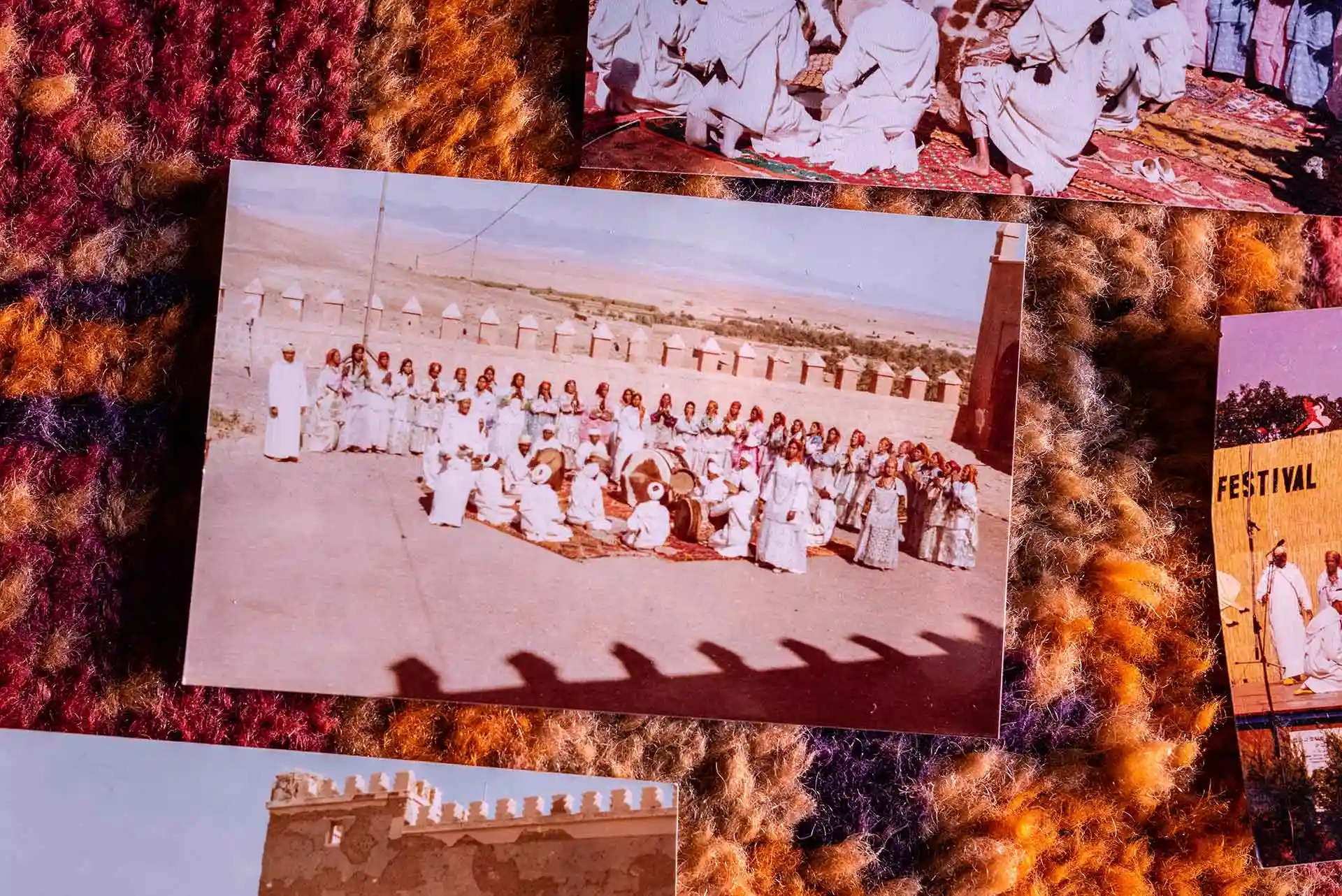
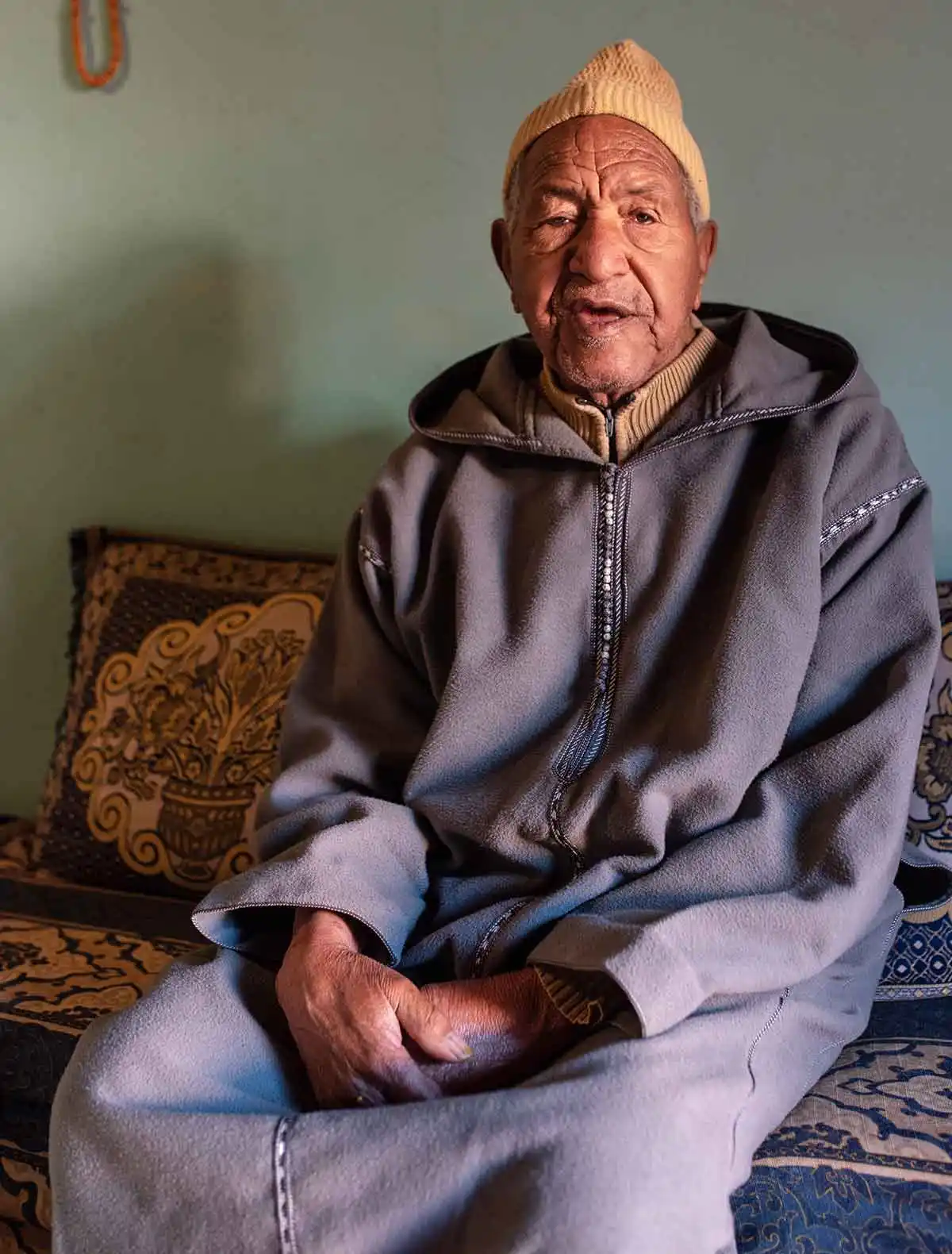
In 2019, when we recorded his testimony, Lhaj Mohamed Elghachi was 95 years old. From his childhood in Tifoultoute, his life had been inseparable from Ahwach, the collective Amazigh art in which sung poetry, percussion and dance come together. A troupe leader, witness to the era of the Glaoua, performer at royal ceremonies and later an ambassador for Ahwach beyond Morocco, he carried within him the memory of the great festive nights of the villages of the South. Now deceased, he remains one of the major figures of this tradition in Ouarzazate.
Overview
- The Kasbah of Tifoultoute, the beating heart of Ahwach.
- A child of the Kasbah of Tifoultoute.
- An early and ardent passion.
- The beginning of a long adventure.
The Kasbah of Tifoultoute, the beating heart of Ahwach
When Mohamed was born, in the 1920s, the Kasbah of Tifoultoute was under the authority of the caïds of the Glaoua tribe, who then dominated the region and, during the French Protectorate, were involved in the campaigns referred to by the colonial authorities as the ‘pacification’ of South-East Morocco.
In those turbulent times, Mohamed, originally from the village of Alougoum in Tata Province, lived in the hamlet of Tikirt near Ouarzazate. His family was well known for making baroud, or gunpowder, and for its skill in handling firearms, particularly the traditional rifle. Thanks to this expertise, the caïd of Tifoultoute brought them to his side and held them in high esteem.
The Glaoua chiefs had a particular taste for moments of entertainment that silenced, for a while, the deafening sound of rifles amid the fierce struggles then opposing local caïds from rival clans. The masters of the Kasbah of Tifoultoute had their own musicians, storytellers and poets… They had a particular fondness for Ahwach song and dance.
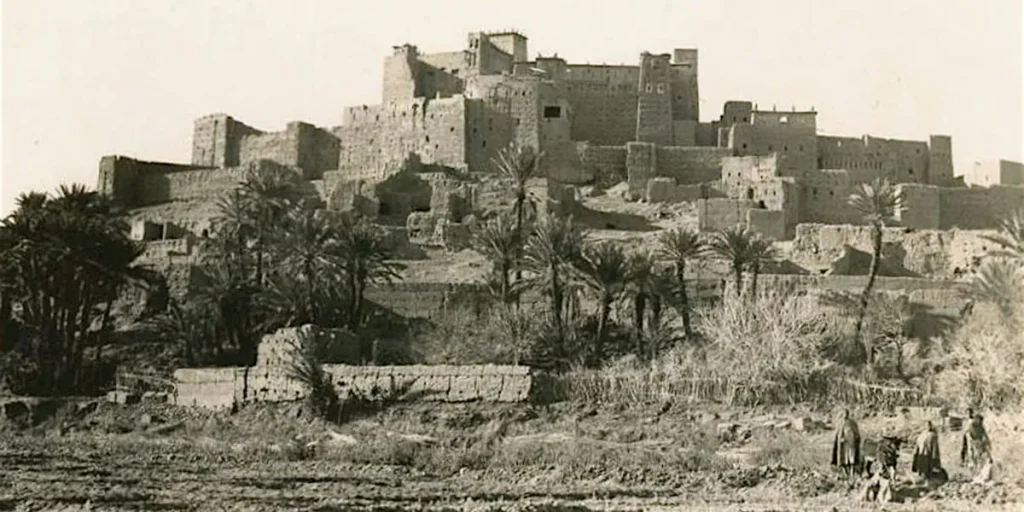
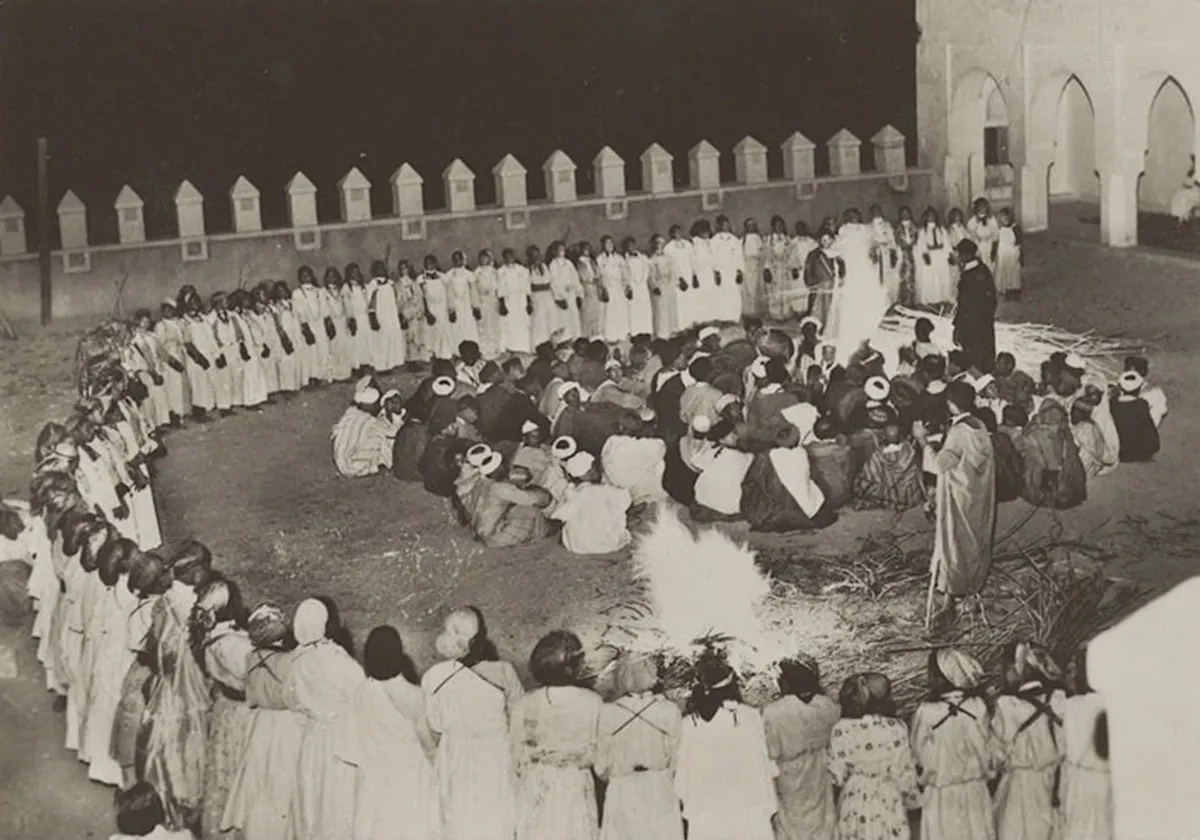
According to Mohamed’s recollections, at that time all the women of the village were expected to take part in the Ahwach ceremonies organised by the caïd. The amghars, or village chiefs, ensured that this instruction was respected through registers listing the participating women from each household.
Sumptuous Ahwach celebrations were regularly organised in honour of local guests or high-ranking foreign visitors passing through the territory. Gathered around the Glaoui, they watched the ceremonies from the terrace of the kasbah, surrounded by an ostentatious splendour that displayed their elegance and power as all-powerful notables.
The Glaoui himself supervised the Ahwach celebrations with the eye of a connoisseur, appreciating the metaphors of the words and savouring the gestures of the dancers. Their wives and the women of their households missed none of the spectacle, discreetly enjoying the festivities from behind the windows of their rooms.
A child of the Kasbah of Tifoultoute
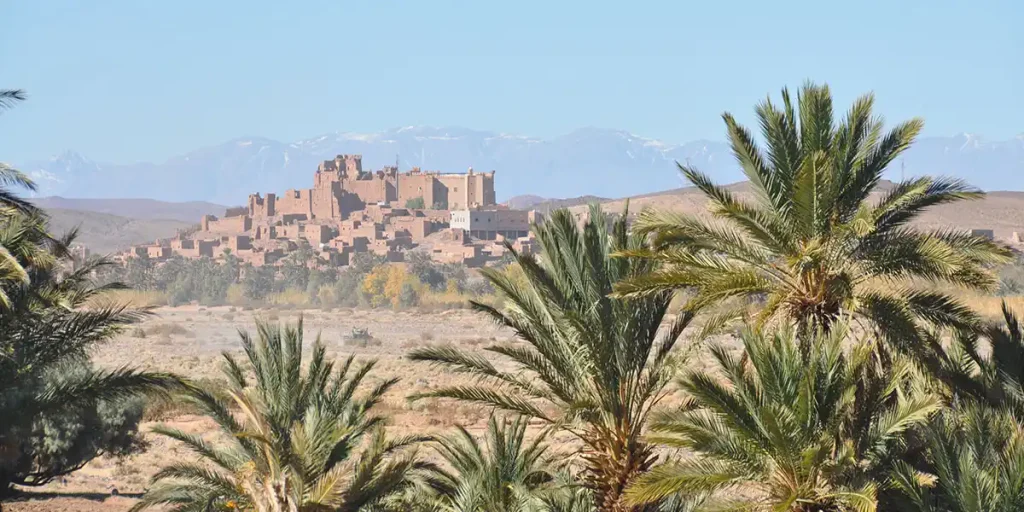
For Mohamed as a child, the Kasbah of Tifoultoute was both a lively and a fabulous place in which to grow up. He often spent time with his father as he carefully made gunpowder, an occupation that aroused no interest in him whatsoever.
What filled him with joy were his escapades through the surrounding countryside, in this wild landscape that inspired both wonder and fear.
Mohamed still remembered the periods of warfare between the tribes of the region, the days when the Kasbah of Tifoultoute was besieged by an enemy tribe and the courage of its defenders, who succeeded in driving the attackers back. He remembered the horsemen leaving the kasbah to fight a rebellious village or subdue a rival chief.
Such times of war formed part of tribal life, and the Kasbah of Tifoultoute was merely one stage among many. These vigorous men who fought with such fury certainly had hot blood, yet their lives flowed, paradoxically, into a soothing sensuality, for once night fell their rage subsided amid the scenes of Ahwach.
Bodies relaxed and the imagination embroidered beautiful poems. Men and women shared these sensual moments in which the vibrant emotions of life were celebrated. All experienced a form of transcendence, in the hope of recovering something of their full and complete individuality.
These nocturnal festivities intoxicated Mohamed from childhood.
He was enchanted by the music, the rhythm and the poetry. The sound of the instruments, the clapping of hands and the stamping of feet carried his wonder to its height. At first merely a curious spectator, he always dreamed of one day directing such a celebration, borne along by an excitement that grew through the night before dying away with the first light of dawn.
An early and ardent passion
An ardent passion for Ahwach took hold of Mohamed from childhood.
He often missed his lessons at Quranic school to attend Ahwach celebrations. At every performance, the little boy discreetly slipped into the midst of the troupe, indifferent to the adults’ reprimands. Driven by curiosity, his presence became less and less discreet, until the caïd himself began to regard this innocent obsession with indulgence.
Mohamed watched, imitated and gradually learned fragments of the songs. He accustomed his small body to light movements punctuated by sudden jolts, hand-clapping and rhythmic beats on the tambourine.
The exhilarated child would parade like a conductor before an imaginary audience.
Ahwach celebrations became for him a ritual he would never miss.
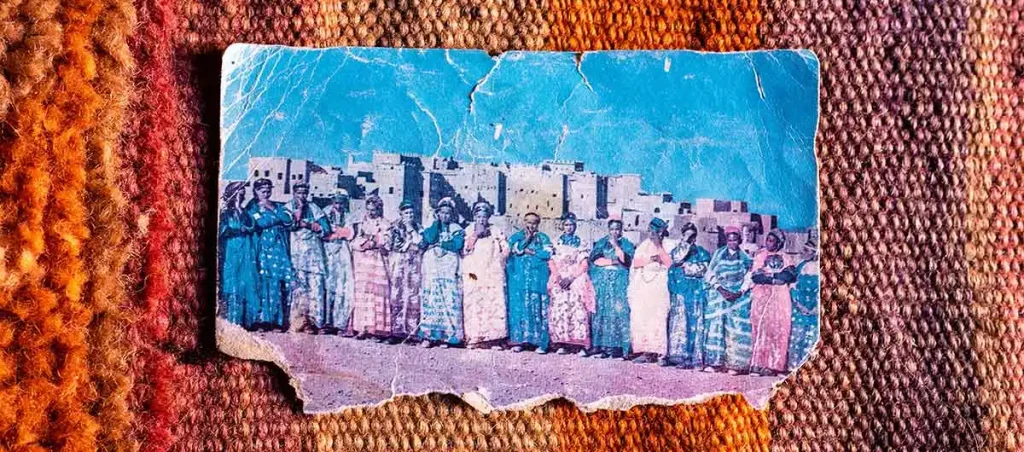
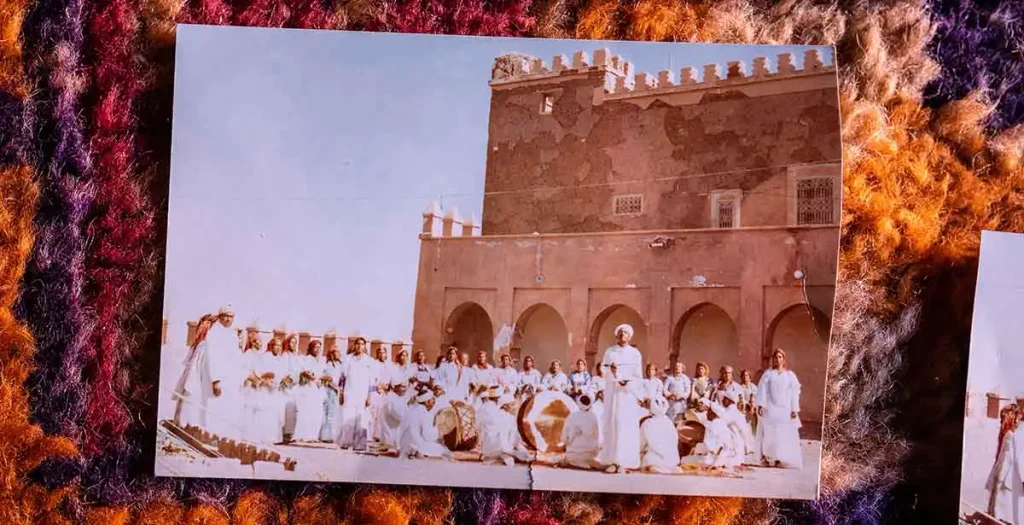
As an adolescent, the beauty of the words and the sound of the drums haunted him. Ahwach became part of his very being.
But reality forced him back to earth. He began working on construction sites to earn a living, a profession that took him to different regions of Morocco. He very quickly demonstrated considerable ability and eventually became a site foreman for a French building and public works company.
Yet the enchanting atmosphere of Ahwach within the walls of the kasbah remained with the young Mohamed: magnificent women in their finest clothes, men dressed in white djellabas, and the master of ceremonies standing proudly at the centre of the troupe, wearing a white turban and carrying a dagger as a sign of power, for on that night he was a true lord.
The lord of song, who directs, fascinates and enchants his world.
Voluptuous nights lit by the fire of palm branches beneath the pale light of the moon. The light of Amazigh poetry illuminates the faces. The whole kasbah frees itself and shines.
Such were the magical nights of the villages of the South, celebrating a mythical dance whose origins disappear into the mists of time.
The beginning of a long adventure
Mohamed finally yielded to the call of his passion.
He periodically returned home and, towards the end of the 1930s, formed his own Ahwach troupe: around twenty women and thirty men, carefully selected.
He then led his new troupe to other great Ahwach gathering places, where competition between tribes was fierce, particularly with the troupes of the kasbahs of Telouet and Taourirte, other strongholds of the Glaoua caïds known as the ‘houses of the Makhzen’.
Women and men came from villages throughout Ouarzazate, travelling for days on donkeys or mules to take part in these festivities, which became almost like arenas of artistic rivalry.
Each participant strove to display an unrivalled talent for improvising verse before the masters.
Mohamed impressed through his charisma as a leader. Demanding perfection in the smallest details — the dancers’ costumes, the quality of the musical instruments, the originality of the poems, the harmony between song, dance and music — he built a formidable reputation throughout the region.
In the years following independence, the late King Mohammed V visited Ouarzazate Province from 20 to 26 February 1958. The Tifoultoute Ahwach troupe, under Mohamed Elghachi’s direction, was present to celebrate this historic visit.
It marked the beginning of a regular presence at official ceremonies in Morocco and abroad.
Taking part in the celebrations for the marriage of Prince Moulay Abdellah, brother of the late Hassan II, in November 1961 left a lasting impression on Lhaj Mohamed. He was fascinated by the royal atmosphere of the ceremony, a luxurious stay during which he met personalities from very different backgrounds.
The event most deeply engraved in Lhaj Mohamed’s memory, however, was his encounter with the late King Hassan II in Ouarzazate.
He recalled:
‘We were preparing the performance. I was directing my troupe when the late Hassan II took me by the shoulder and asked me to hand him the tambourine. He struck it a few times. Then he asked me to take the drum and accompany him in the same rhythm. The King led us for a while as the tempo increased. Before leaving, he told me to preserve the authenticity of Ahwach. He was a true connoisseur of Ahwach and of all Morocco’s musical traditions.’
Ahwach was then discovered by a new audience as it began to be performed far from the village squares, particularly in hotels and during official ceremonies.
It became an object of fascination, but also increasingly a spectacle, offered for the pleasure of the eye.
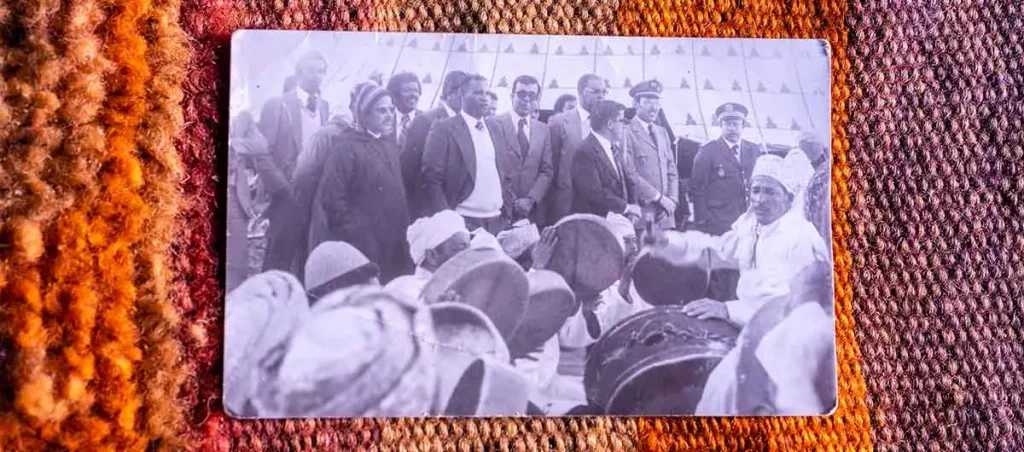
As an ambassador for Ahwach, Lhaj Mohamed travelled throughout Morocco and abroad: France, Greece, Spain…
He spoke with particular pride of his stay in the United States in 1984, alongside delegations representing traditional arts from various Arab countries:
‘When we went onto the stage, which had been decorated with carpets from every region of Morocco, our costumes, our songs and our dances astonished the audience. They all stood up to applaud us. The organisers congratulated us warmly, amazed by the beauty of our traditional arts represented by the Ahwach of Ouarzazate.’
What remains of those times?
Dreams, songs, dances and the joy of living through the festive nights of the villages of the South!
All of that is gone.
Today only nostalgic memories remain, with a slight taste of bitterness.
Lhaj Mohamed concluded:
‘After more than seventy years of celebrations, almost all the women and men who accompanied me on this long adventure have died. The kasbah has become a ruin; it no longer has a master, the last of them left long ago. In our turn, we shall return to our Lord. But Ahwach never dies.’
In the autumn of his life, recounting the good old days softened the monotony of old age.
For Lhaj Mohamed Elghachi, his memories were a radiant light that would only go out at the end of his days.
Read also: The Glaoua, the extraordinary story of an Amazigh tribe of the High Atlas

More to Explore

Leave a Reply