


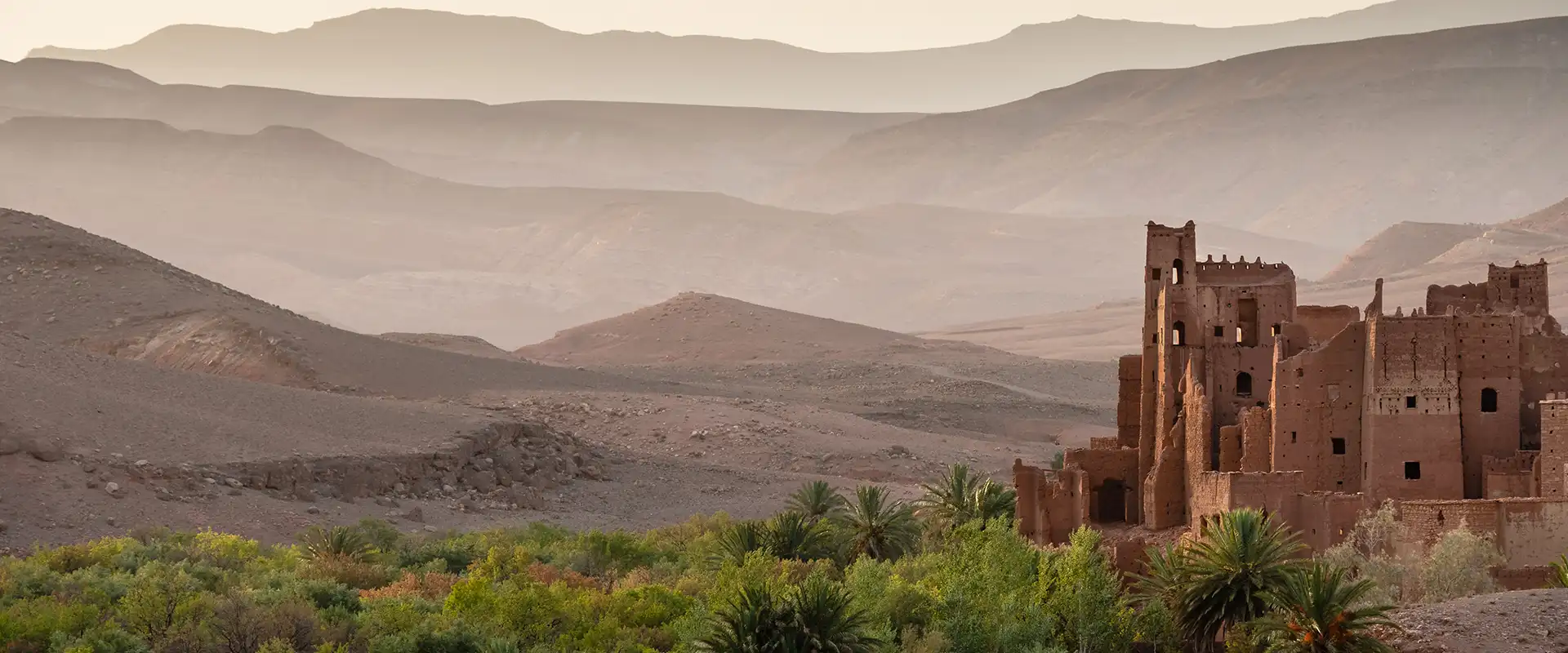
In 1921, Jacques Majorelle left Marrakech for the High Atlas and discovered the “Glaoui country”, meaning the territories under the authority of the Glaoua tribe and their leader at the time, Thami El Glaoui. He would return for an extended stay in Anmiter in 1928, at the precise moment when the very substance of his painting began to change: gold and silver entered his works in an attempt to convey a light that pigments alone no longer seemed able to capture. A century later, some of the landscapes he painted can still be found.
Overview
- Before blue, there was the mineral world.
- In the summer of 1921, the horizon finally becomes a path.
- Anmiter, a place to which Majorelle returns.
- Majorelle knows that something is emerging.
- When gold and silver become colours.
- Finding the landscape behind the painting.
- From metal to blue, the same search for light.
- In the breath of the Atlas.
Before blue, there was the mineral world
When Jacques Majorelle arrived in Marrakech in October 1917, at the invitation of General Lyautey, he was no longer a beginner. Trained in Nancy and then in Paris, he had travelled in Spain, Italy and above all Egypt. Light and colour had already occupied a central place in his artistic research for several years.
Marrakech, however, offered him another world. He first lived in a small house in the medina, then, from 1919 to 1923, rented Dar Ben Daoud, an old palace near Bab Doukkala. He painted the souks, the gates, craftsmen and crowds, and discovered Moroccan architecture, its volumes and its singular relationship with shadow and light.
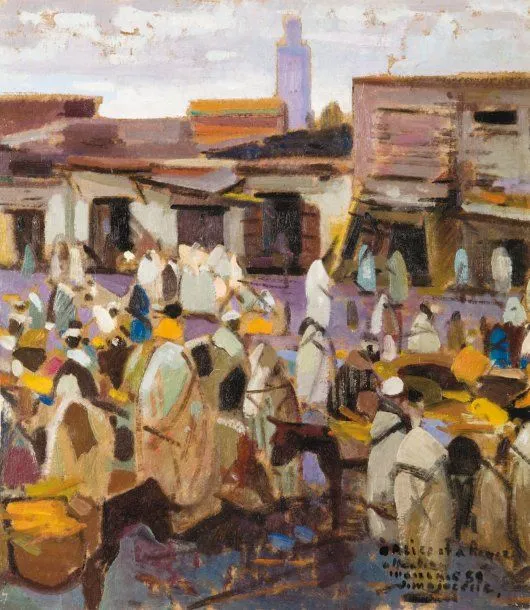
But behind Marrakech, there is the Atlas.
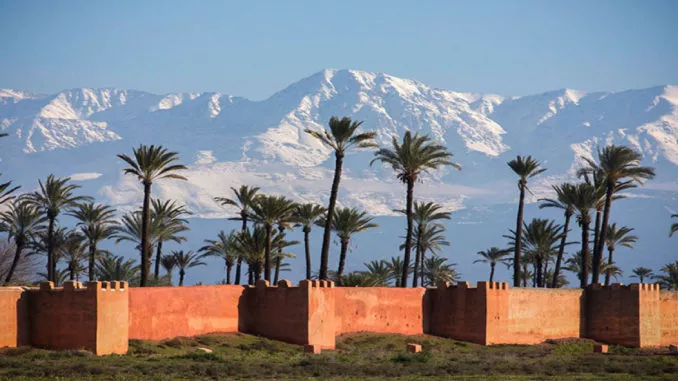
During the first years of his stay in Morocco, the French military authorities did not allow foreign civilians to travel freely beyond a certain perimeter around the city. Majorelle therefore remained in Marrakech and looked into the distance. From roofs, terraces and ramparts, his gaze crossed the plain towards those mountains he imagined being able to reach one day.
The image deserves our attention: a painter already engaged in a search for light contemplating, in the distance, a mountain he cannot yet reach.
Nothing allows us to claim that Majorelle decided to set out for the Atlas with an artistic project already fully formed. But a movement is already beginning: before the actual journey came that horizon, the desire to cross it and perhaps the intuition that, beyond Marrakech, another stage in his life as an artist awaited him.
In the summer of 1921, the horizon finally becomes a path
Majorelle obtained permission to travel from the Pasha Thami El Glaoui. On 2 August 1921, he left Marrakech with his wife Andrée and an escort for a four-month journey through the High Atlas. His route took him, among other places, to Telouet, stronghold of the powerful Glaoua tribe, the Ounila Valley where the village of Anmiter lies, the ksar of Aït Ben Haddou, and the high valleys of the Atlas.
The journey has to be understood in the context of its time. The French Protectorate was then only nine years old. Although some regions had become accessible to Europeans under protection, the military conquest of Morocco was far from complete. Glaoui country nevertheless occupied a particular position: the power exercised by the El Glaoui family and its alliance with the French administration made journeys possible that would have been far more difficult only a few years earlier.
Majorelle then discovered a world rooted in time. The valleys through which he travelled had long been inhabited, cultivated and crossed. Villages, kasbahs, granaries, paths, seguias and cultivated land bore witness to an ancient organisation of the territory, linked notably to the camel caravans that travelled to Marrakech from the Saharan South.
What was changing at the beginning of the 1920s was the possibility for an outside gaze to enter these valleys, bring back images of them and, above all, allow those images to circulate far beyond them.
Majorelle painted a great deal. He returned from this first journey with enough work to present, as early as January 1922 at the Galerie Georges Petit in Paris, an exhibition entitled One Hundred Paintings of Morocco and the Atlas — Glaoua Region. In these early works, his concern for drawing and architectural precision remained very strong.
But this journey brought nothing to a close. By June 1922, he was already setting off for other valleys of the Atlas. He would return regularly to these mountains, notably to the Tagoundaft region of the High Atlas and to Adouz.
The horizon glimpsed from Marrakech had become one of his territories of painting.
Anmiter, a place to which Majorelle returns
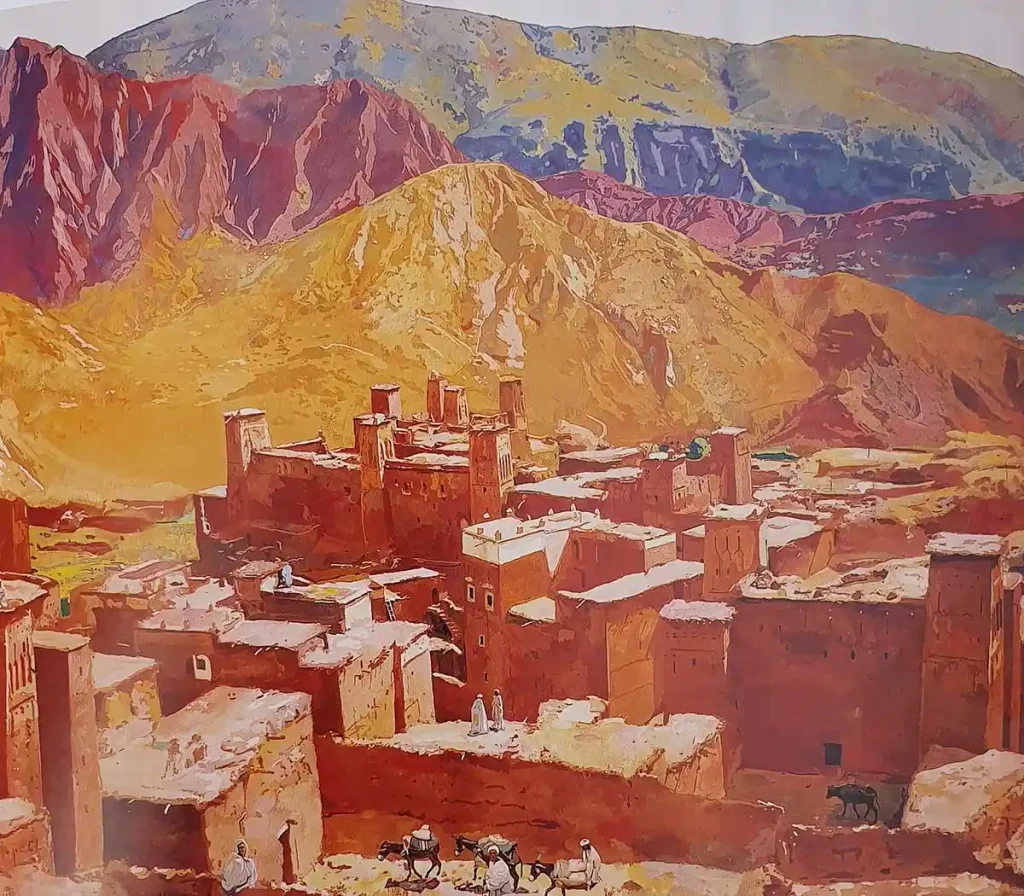
Anmiter — often found under the older spelling Anemiter in the titles of his works — gradually acquired a particular place within this geography.
Majorelle discovered it during his journeys through Glaoui country, then returned to the Ounila Valley over the following years. He would paint Anmiter again much later, proof that the place was never merely a stage along a route.
But it was in 1928 that something decisive seems to have happened there.
From June to September, Majorelle spent four months in Anmiter. He worked there intensively before continuing towards Ouarzazate at the end of the year. Several important works devoted to the valley date from this period: kasbahs, villages, passers-by, architecture and landscapes became so many variations on the same territory.
Anmiter was no longer merely a motif. The painter settled there to search for something he could feel taking shape within him.
The memory of his presence remains alive in the village today.
One house can be visited. According to family memory, Jacques Majorelle stayed here. A small interior door is presented as the one that led to his studio; several painted motifs surviving on the walls of the sitting room are also attributed to him by the family.
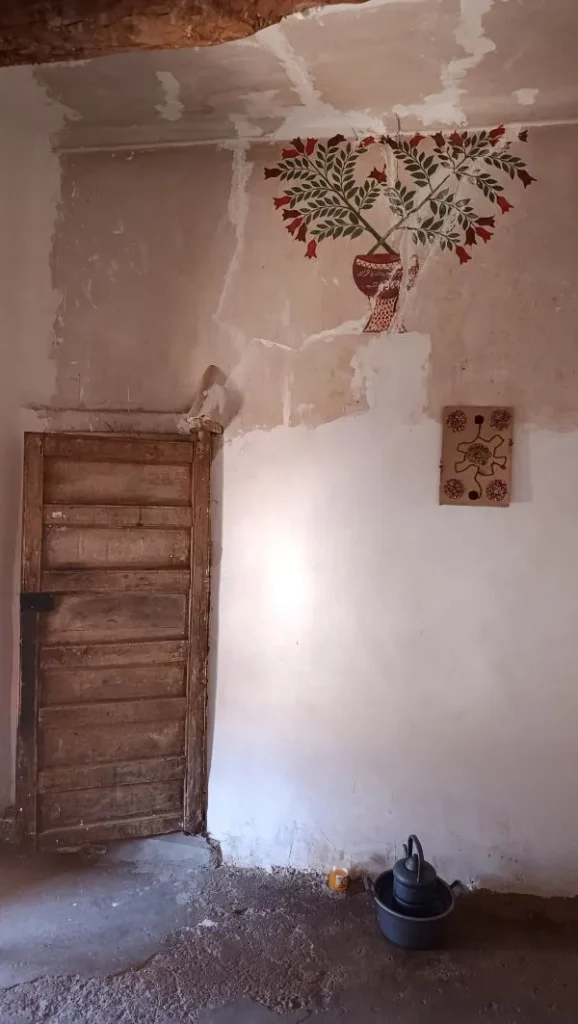
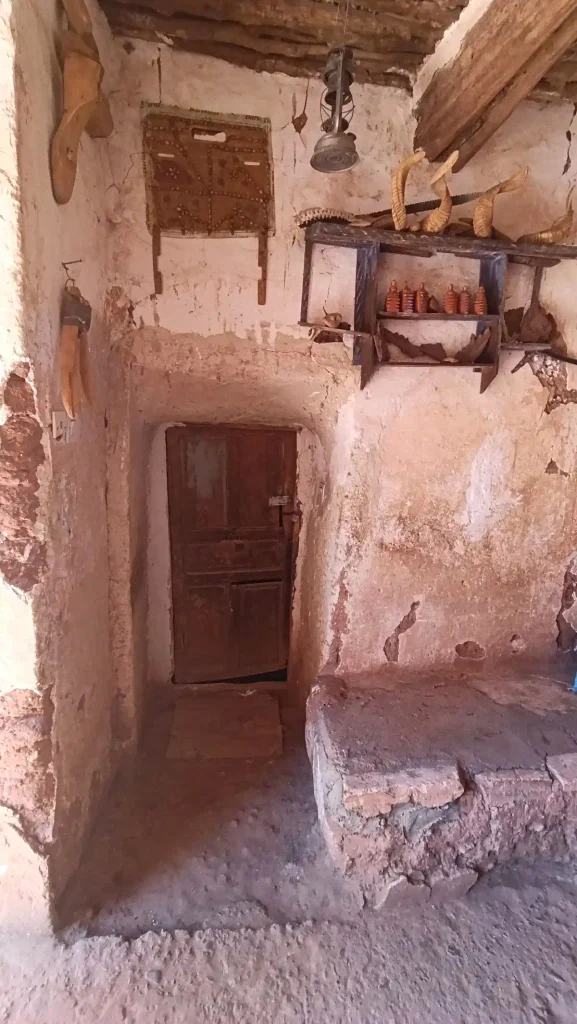
No official document establishes that Majorelle stayed in this particular house, and nothing allows the wall paintings to be authenticated as his work. Yet the sense of his former presence in Anmiter is still very much there, and the memory preserved by this family carries an echo of it today, resonating with the surrounding landscapes that he would so conscientiously reproduce on his canvases.
Majorelle knows that something is emerging
It was precisely in Anmiter in 1928 that Majorelle profoundly changed the way he used colour to convey what his gaze perceived of reality.
Already during his first stay in the Atlas a few years earlier, he had written to his father about the strange feeling that gripped him deep within whenever he found himself present in these lands:
“I do not remember ever having been as alone as I am today. This feeling has nothing distressing about it, since I am master of my solitude, and it has a very great charm. I have often thought that one had to be alone in order to feel deeply, and yet I have always avoided opportunities to be so. I do not complain of it; I cannot live without friends, nor without affection, without devotion close to me; but I know that in doing so I deprive myself of many emotions that are dear to me.”
Jacques Majorelle
During this new stay, it was to his wife that he wrote to tell her just how intensely he was working. But he doubted.
“The drawings are progressing, taking the desired turn, and I am beginning to disentangle myself a little from the difficulties of the beginning. I am at work by eight o’clock and stop for only an hour and a half for lunch. That does not prevent me from producing shit. But that was to be expected, given that I am searching within something entirely new, and using some rather showy techniques. I am floundering, but I am persisting; something will have to come out of it.”
Jacques Majorelle
This letter is crucial. Until then, his stays in the Atlas might have been seen simply as a particularly fertile period in the career of a painter attracted by the landscapes and colours of Morocco. His own words tell another story.
Majorelle knows that he is searching. He knows that something is emerging.
His problem is not to find new subjects to paint. Everything around him captivates his eye and seems worthy of being borne witness to before the world. No, his problem becomes painting itself. Majorelle, isolated among the massive mountains of the Atlas, becomes aware that oil, gouache or watercolour no longer allow him to convey this reality.
He knows that he is leaving behind processes he has mastered in order to move, in his own words, towards something “entirely new”. The work is difficult, the first results disappoint him, but he persists.
This is where gold and silver appear.
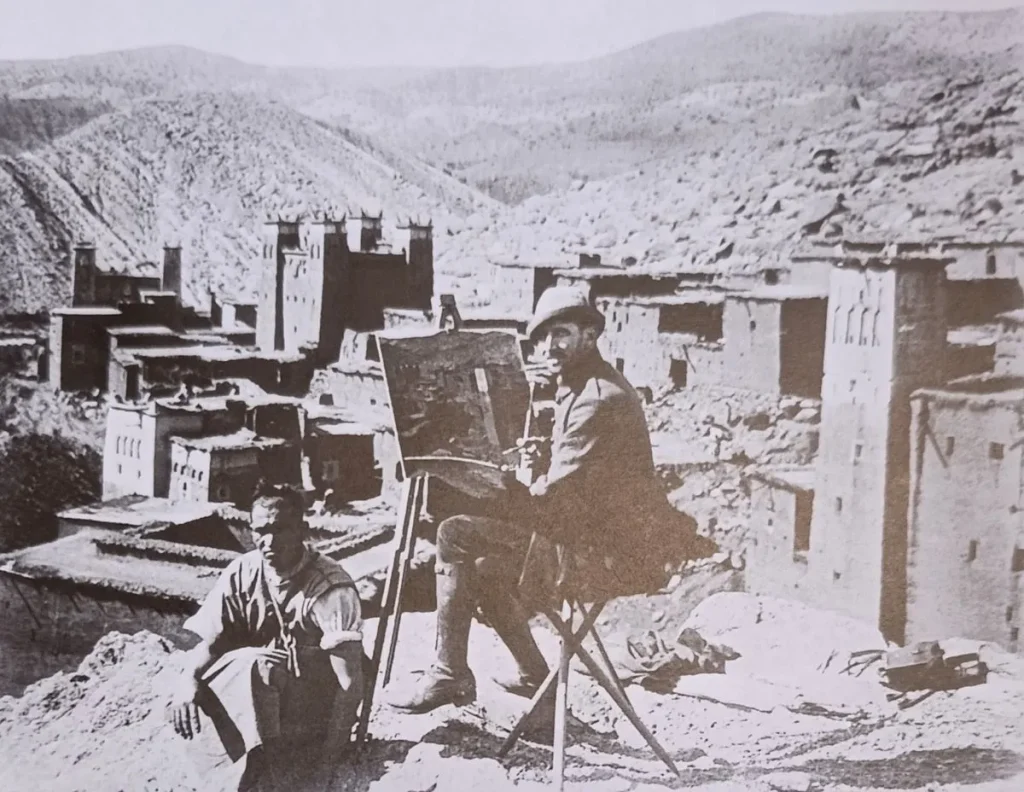
When gold and silver become colours
In April 1929, Robert Boutet looked back at Majorelle’s new works and tried to understand the “rather showy techniques” the painter had mentioned a few months earlier.
The use of gold and silver in painting was obviously not an invention of Majorelle’s. Manuscripts, icons, Persian art and the decorative arts had used them for centuries. His originality lay elsewhere. It lay in the function he gave to metal.
In his first experiments, the highlights of gold and silver still retained something decorative. But Majorelle experimented, modulated, began again. Gradually, according to Boutet, the metals ceased to be mere ornament and came to play within the composition “the role of colours”.
The distinction is fundamental. Gold is no longer there simply to gild. Silver is no longer there merely to enrich the surface. They enter into the very construction of the landscape.
But Robert Boutet goes further in his interpretation of this pivotal moment in the painter’s art. He directly links this research to what Majorelle encounters in the Atlas, this mineral kingdom surrounding him with the metallic glints of mica and quartz, light seeming to cling to the rocks, the shimmer of the sky and luminous dust seeming to run across the pisé walls. He explains that the use of gold and silver goes beyond their function as colour:
“In the sky, it sets shivers of silver that are echoed by the mica and quartz in the rocks; it scatters flecks of gold across the leprous surface of the pisé walls, and all of it is airy, elusive. This dust of metallic atoms surrounds you, overwhelms you, without your being able to fix it…”
Robert Boutet – April 1929
Such is the essence of the Atlas that imposes itself upon Jacques Majorelle: mineral matter which, under certain light, appears itself to become light.
This is what the Atlas imposes upon Jacques Majorelle: mineral matter which, under certain light, appears itself to become light.Such is the essence of the Atlas that imposes itself upon Jacques Majorelle: mineral matter which, under certain light, appears itself to become light.
The ordinary means of painting no longer suffice. Majorelle introduces this mineral matter into the painting. Gold. Silver. Metal reduced to powder and mixed into the painted substance.
The change might seem merely technical. It is far more profound.
With a traditional pigment, the painter represents light. With metallic powder, he introduces into the work a material that actually reacts to external light. According to the time of day, the angle of illumination or the position of the viewer, gold and silver flare, fade, catch a gleam and then lose it. Light is no longer merely represented. Something of it is physically replayed by the painting.
Majorelle therefore did not invent the pictorial use of precious metals. But in Anmiter, he seems to have developed his own way of making light emerge from mineral matter.
And this process responds very precisely to the landscape in which he is working. The High Atlas is a world of bare rock, stratified slopes, mica, quartz, mineral earth and pisé architecture that seems itself to rise from the relief.
Majorelle does not arbitrarily lay gold and silver over this world.
He searches within the material of the painting for an equivalent to the material of the Atlas.
Finding the landscape behind the painting
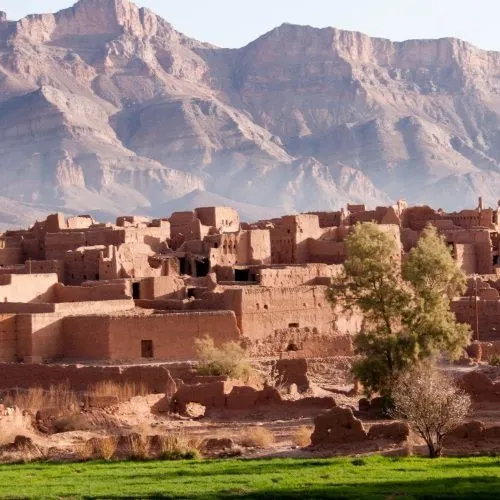
This search makes the comparisons we were able to make in Anmiter between Majorelle’s paintings and the landscape today all the more striking. For they immediately show that his pictorial experimentation did not begin with an imaginary South. Majorelle looked with precision.
A kasbah erased by time
In one of the paintings made in Anmiter in 1928, a large kasbah dominates almost the entire composition. Behind it rises a mountain with a very particular profile: a slightly off-centre summit, a long slope descending towards the right and a clearly identifiable rocky break on the left. An irrigation channel can be distinguished at the bottom of the painting.
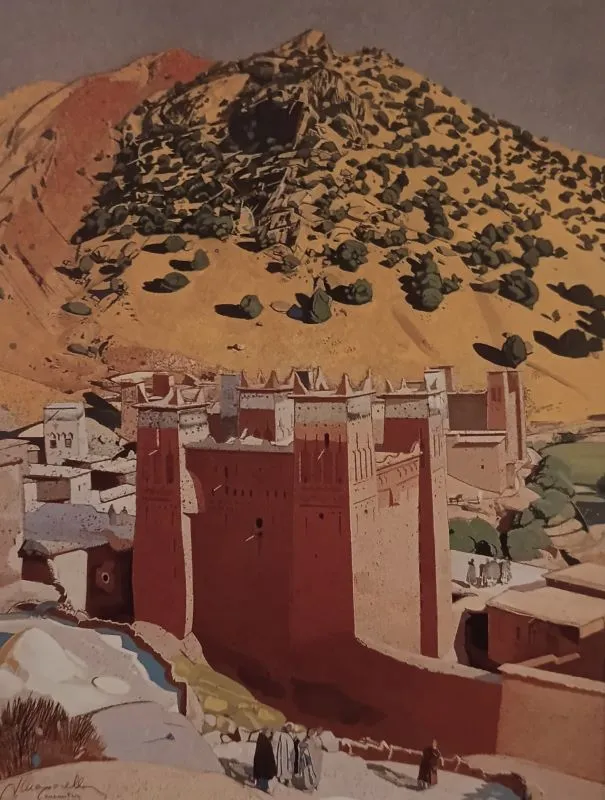
Almost a century later, the same relief is still there. The correspondence is precise enough to recognise not only the mountain, but the overall organisation of the viewpoint.
At its foot, however, time has been at work. The great earthen structure that occupied the centre of the painting no longer dominates the landscape as it did in 1928. Buildings have disappeared or collapsed; above all, vegetation has taken over much of the foreground. The irrigation channel still runs today through a mass of gardens and trees that conceals part of the old architecture.
Between the two images, the painting thus acquires an almost documentary value: it preserves the state of an inhabited landscape that the relief alone would no longer allow us to reconstruct.
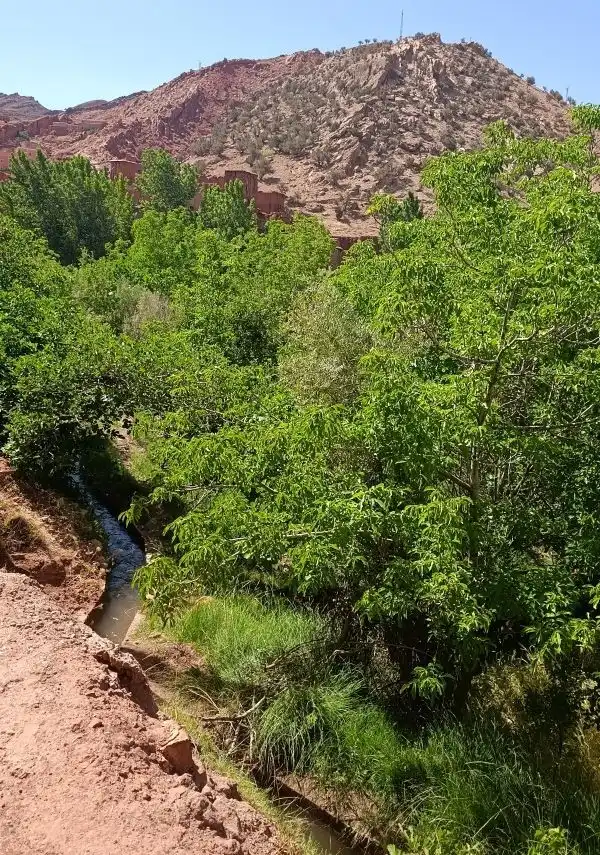
A vanished building in the mountains
Looking at another painting made that same year is even more unsettling.
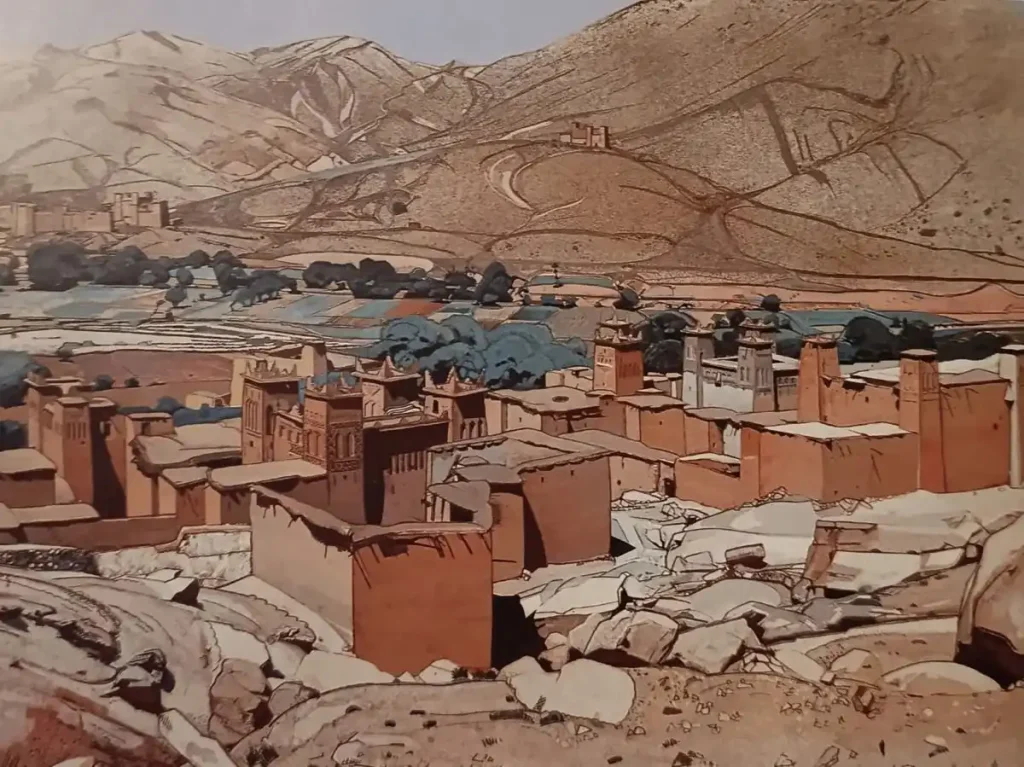
We find the great rocky slope descending from the right, the pass in the centre, the lighter reliefs to the left, the cultivated land at the bottom of the valley and the relationship between the villages established on either side.
In the foreground of the painting, Majorelle represents a very dense mass of earthen architecture, punctuated by towers and large fortified residences. Today, many lie in ruins; some have disappeared, while new buildings have been added to the village.
The gardens remain. The same ribbon of vegetation, through which the river flows, still separates the architecture from the mineral world that towers above it.
One detail might easily have been taken for artistic licence. On the small hill in the centre of the composition stands an isolated building that no longer exists today. An elderly resident of Anmiter confirmed that such a building once stood there.
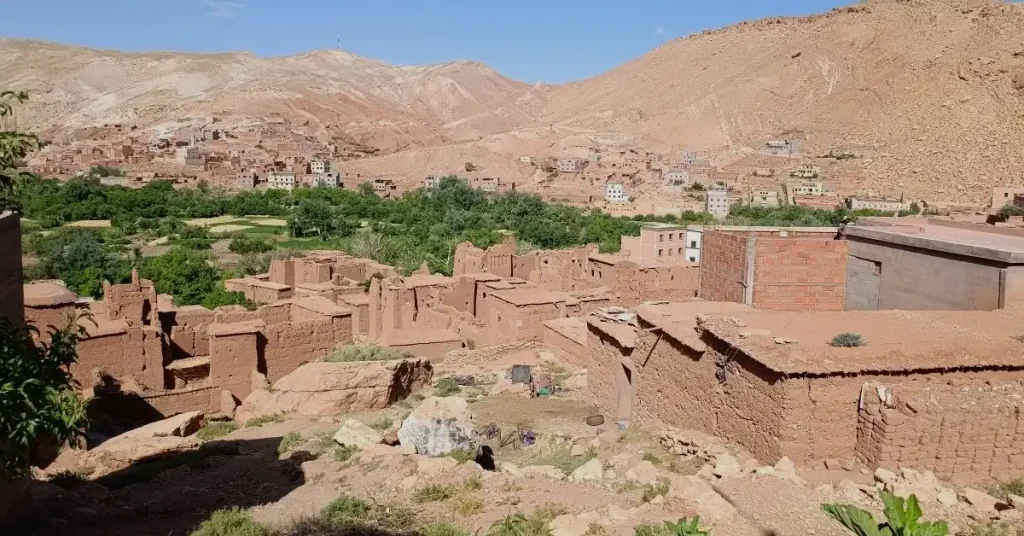
From metal to blue, the same search for light
While Majorelle travelled through the Atlas, another place was taking shape in Marrakech.
In the early 1920s, he chose a plot of land beyond the ramparts, at the edge of the palm grove, built his home there and began developing what would become the Jardin Majorelle.
His stay in Anmiter in 1928 did not precede the birth of the garden: it already existed when Majorelle was experimenting with gold and silver in the Ounila Valley. But the two approaches can be considered together.
In the Atlas, Majorelle searches for new means of bringing the light of a landscape into the substance of the painting.
In Marrakech, he gradually transforms a real space. He plants, moves and combines vegetation, creates perspectives, lays out pools and orchestrates the encounter between architecture, plants, water and light.
In 1931, he had his modern studio built by Paul Sinoir. Then, in 1937, the vivid colours he had long used on his canvases spread extensively across the architecture of the garden: doors, windows, balustrades, pots and walls. Among them, an ultramarine blue of extraordinary intensity came to dominate, soon becoming inseparable from his name.
Majorelle blue was born.
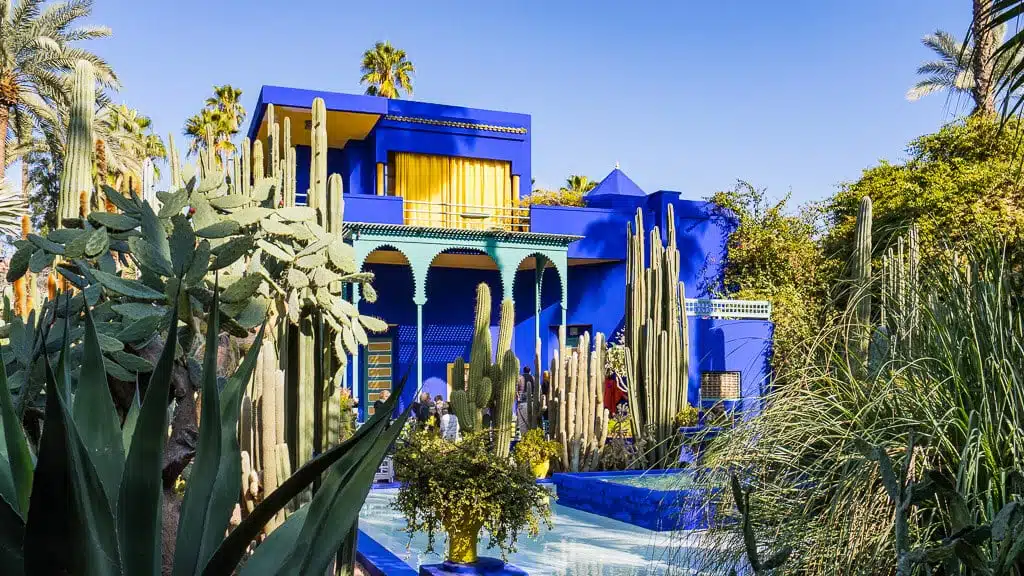
This blue, now known throughout the world, appears less as an isolated invention than as another stage in a much longer creative journey.
In 1928, in the Atlas, Majorelle had tried to go beyond pigment by introducing into his works a material capable of catching light. A few years later, in Marrakech, it was no longer only the painting that received a substance or a colour capable of radiating that light. It was the wall. Then the entire garden. Vegetation cuts across the blue, the sun crushes or ignites it, shade cools it, water answers it. Like the metallic powders used in his paintings of kasbahs, the colour is never quite the same because it lives through the light that falls upon it.
Blue is no longer the culmination of a simple search for colour. It can be seen as one of the successive answers found by a painter who never stopped seeking new ways of making light emerge from matter.
In the breath of the Atlas
To return to Anmiter today is therefore to encounter another Majorelle, different from the one to whom the garden in Marrakech brought worldwide fame.
First there is the man who, from Marrakech, looks towards a mountain he cannot yet reach. Then the man who reaches it in 1921. Then the one who returns, again and again, until he settles for four months in Anmiter in 1928, working from morning to night, searching, failing, beginning again, writing that he is “floundering” but persisting.
And finally there is the painter confronted with an essentially mineral world: rock, mica, quartz, earth, pisé walls that seem themselves to rise from the mountain.
The landscapes he once painted and that we have found again show how precisely he looked at this world. Majorelle does not create an imaginary Atlas. He begins with the real.
But there, within the Atlas, he seeks to remain completely faithful to that reality: the instant when sunlight strikes rock, when mica glitters, when quartz catches a gleam, when a pisé wall almost ceases to be an opaque mass and becomes light.
Mineral matter enters the painting.
Long before the blue to which his name would forever be attached, he had understood in the High Atlas that colour alone is not always enough to paint light. Sometimes matter itself must take possession of it.
In the breath of the Atlas, Majorelle makes light emerge from mineral matter. And through that light, his paintings remain bound to the reality from which they were born.
Editorial view
The fame of the Jardin Majorelle has almost ended up hiding another Majorelle from view: the one who, in the High Atlas, searches, doubts and experiments in order to render a light that the usual processes of painting no longer allow him to capture. In Anmiter, in 1928, mineral matter literally enters his works. Long before the blue that would become known throughout the world, this may be where the deeper thread of his work reveals itself: making light emerge from matter.
Key takeaways
- Jacques Majorelle discovered the “Glaoui country” in 1921, after several years spent looking towards the Atlas from Marrakech.
- He returned for an extended stay in Anmiter in 1928, where he worked for several months and himself wrote that he was searching within something “entirely new”, using techniques he had not yet mastered.
- It was during this period that he developed his use of gold and silver in his works, no longer as mere ornament, but to make them play the role of colours capable of catching and returning light.
- The landscapes found again in Anmiter today show how faithful Majorelle remained to the actual structure of the places he painted: reliefs, villages, gardens and even certain buildings that have since disappeared can still be identified.
- The future Majorelle blue therefore appears not as a rupture, but as another stage in the same search: finding within matter new ways of making light emerge.
Sources
- Musée Yves Saint Laurent Marrakech, Le Maroc de Jacques Majorelle.
- Robert Boutet, Les Kasbahs de l’Atlas peintes par Majorelle, La Vigie Marocaine, April 1929.
- Jacques Majorelle Rétrospective, Musée des Beaux-Arts de Nancy.
- Félix and Amélie Marcilhac, works devoted to Jacques Majorelle and catalogues raisonnés of his paintings.
- Fondation Jardin Majorelle.
- Sudestmaroc.com field research in Anmiter.
More to Explore

For more than twenty years, Éric Anglade has lived in a village of South-Eastern Morocco, where he explores and documents the region’s history, heritage, and living traditions. He founded sudestmaroc.com as a space for sharing fieldwork and cultural insight, bridging local knowledge with global perspectives. He also works alongside women carpet-weavers to help sustain their craft and welcomes travellers at Le Jardin de Yuda, his guesthouse envisioned as a meeting place for exchange and transmission.

Leave a Reply