


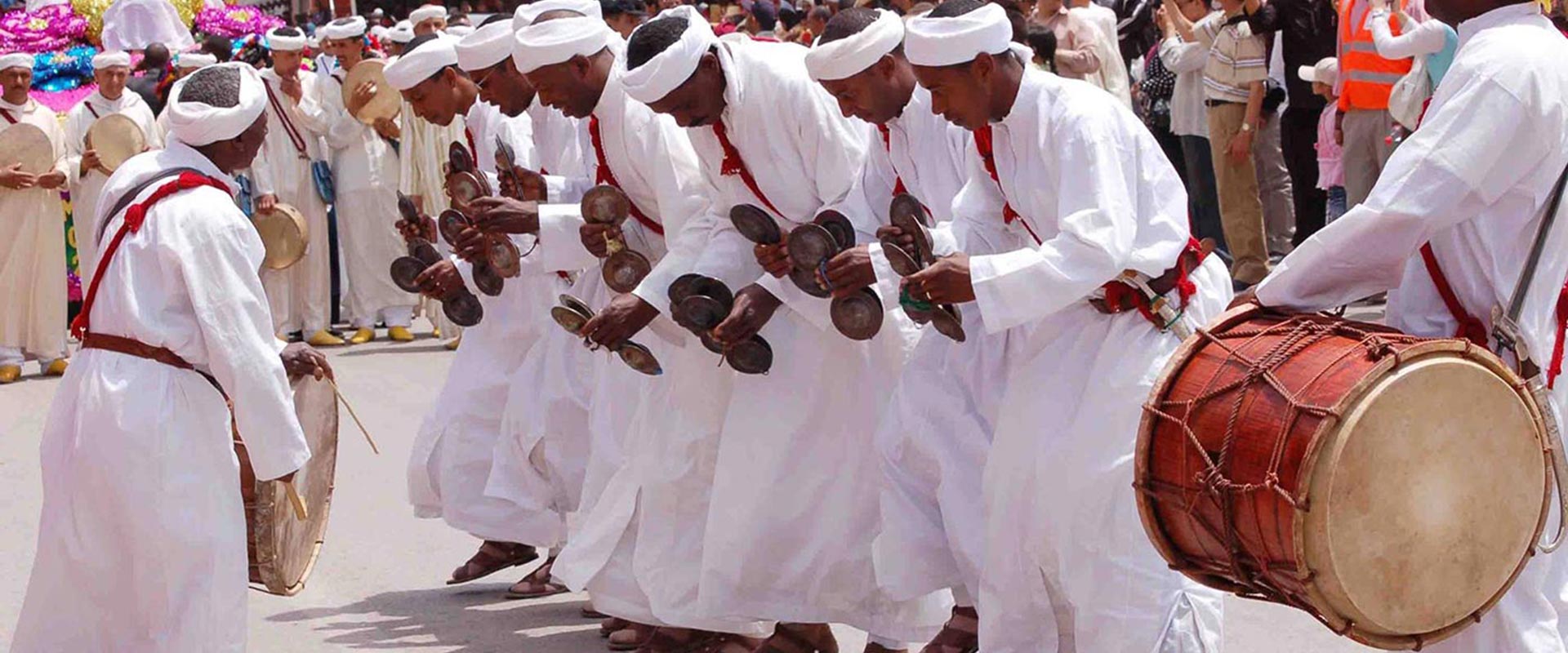
The living heritage of the Gnawa of Lalla Mimouna
You can read this article while listening to the Raïs chant.
Within the mosaic of Moroccan identity, the Gnawa hold a singular place. Their presence strengthens the country’s uniqueness, but above all gives greater depth to its soul. Known for their music, the Gnawa community carries within Morocco the echoes of sub-Saharan Africa. In this sense, it is the rightful heir to the distant suffering of slavery, which for centuries reached into every corner of the kingdom.
The Gnawa are also the bearers of an ancestral mysticism in which the arts of healing mingle with those of dialogue with the divine. Scattered throughout Morocco, Gnawa communities follow different traditions that distinguish them from one another. One of these traditions is associated with a mythical ancestral figure named Lalla Mimouna, revered as a central figure of their identity.
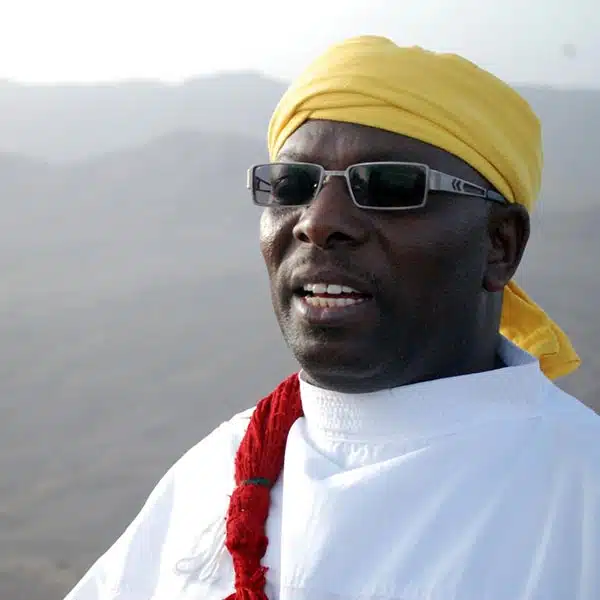
Near Tinghir, in the Todgha Valley, one such Gnawa community still lives today, regularly making the colours of its heritage resound. M’bark El Haouzi is its Amghar. He agreed to answer the questions of Sudestmaroc.com.
M’bark El Haouzi – I am the Amghar of the Gnawa of Todgha, and I have devoted my life to preserving and promoting this culture, which came close to disappearing in the early 1980s.
At the time, there was little interest in this culture and the danger of its disappearance was very real. In 1994, while completing my degree in French Language and Literature, I wrote my dissertation on The Gnawa Festival – Performances and Theatrical Games in the Errachidia Region.
Two years earlier, in 1992, during an annual festival in Igli, I had put a few questions to the late Messaoud Oubelkhir. He was then one of the finest Gnawa performers in southern Morocco and a true custodian of Gnawa memory and traditions.
He was renowned for his performances and his distinctive style. Before answering me, he asked why I was asking these questions. I told him that I wanted to carry out an academic study of Gnawa activities and traditions in South-East Morocco.
He then took my hand and said:
“Now that there is someone who will write down our traditions and save them from oblivion, I can die in peace.”
Messaoud Oubelkhir
I promised him then that I would devote myself to preserving and promoting Gnawa heritage.
Sudestmaroc.com – Can you outline the history of the Gnawa community of South-East Morocco: its origins, when and why it arrived in this part of the country, particularly in the Drâa Valley, Tafilalet and Todgha?
M’bark El Haouzi – The arrival of the Gnawa in Morocco took place in two main waves.
The first occurred during the reign of Ahmed Al-Mansour Dahbi. Born in Fez in 1549 and dying in Marrakesh in 1603, he was the sixth sultan of the Saadian dynasty. During his reign, from 1578 to 1603, he brought large numbers of Black people from what was then known as the Sudan — today Mali, Senegal, Niger, Mauritania and Guinea.
His aim was to make them work in sugar mills such as those of Essaouira and Marrakesh. At the end of his reign, these slaves revolted, destroyed the sugar works and subsequently dispersed throughout the country.
Some found themselves in the service of religious zawiyas, while others served sheikhs — the chiefs of the many rural tribes — or the Sultan’s representatives, the caïds, who kept them as domestic slaves.
All of them, scattered throughout rural Morocco, are Berber-speaking.
Etymology of the word Gnawa: according to Delafosse (1924), the Berber expression akal-n-iguinaouen, meaning “land of the Blacks”, gave rise to the words Guinea and Ghana and, through phonetic similarity, later to the word Gnaoua. By extension, Gnaoua would therefore mean a Black person, or someone coming from the land of Black people — in other words, sub-Saharan Africa.
Source: Wikipedia.
The urban Gnawa and their culture of trance
A second wave brought what are known as the urban Gnawa. They are called this because they arrived at the time when Morocco’s major cities were being established. They came from Moulay Ismaïl’s royal guard and were known as the Bukhara. They arrived with the caravans of the Saharan trade at the end of the 18th century and throughout the 19th century.
They brought with them a form of music whose very purpose is therapeutic. It is a culture of trance. These Gnawa are Arabic-speaking.
It should not be forgotten, however, that Black populations had already been living in the Maghreb since antiquity. Many historians attest to their presence, particularly in the various oases of South-East Morocco, where they lived as peaceful cultivators of date palms and the land. They were given the name Haratine.
Haratines — isemghan in Berber, singular asemgh — sometimes referred to historically as Black Moors, are Black inhabitants of the Sahara whose social status has varied according to region.
Source: Wikipedia.
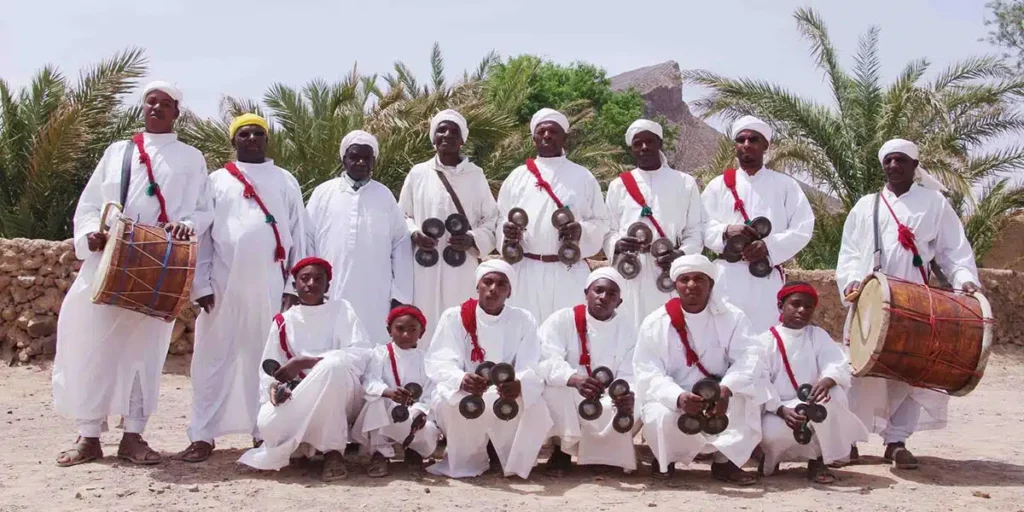
As for our own Gnawa community, which arrived very early in South-East Morocco, we formed close ties with the Berber tribes of the Aït Atta and followed them wherever they went and wherever they settled.
Sudestmaroc.com – How did this community live in South-East Morocco? What position and role did it occupy within local society, and what relationships did it have with other population groups?
M’bark El Haouzi – Our community formed close ties with the Aït Atta very early on. The Saghro massif is their ancestral land, the cradle of their confederation.
We have always had good relations with them, but our ancestors, as Black people, experienced slavery or servitude.
It is important to point out that there are many different names for these Black populations. They do not all share the same origins, but all were, in one way or another, victims of slavery.
Two main terms can be distinguished: Ikabliyen and Ismkhan, also known as Ignaoun. The latter term was used for Black people attached to noble families as domestic slaves. Later, however, it became a local designation. Thus Gnawa, Ignaoun, Ismkhan and Ismgan are terms with equivalent meanings whose use differs from one region to another.
Those designated by the first term remain marginalised and continue to bear the status once assigned to them. This is why, in Todgha, the terms Ikabliyen and Haratine still carry a strongly pejorative connotation: they refer to Black men whose task was to work in the fields — in other words, to be slaves.
These relationships stem from the dual origin of Moroccans. Broadly speaking, Moroccans are made up of white Berbers and Black Haratines, descendants of former slaves uprooted from sub-Saharan Africa. The latter continue to be assigned an inferior status and are, in practice, exploited by the former.
Faced with this situation, we have seen significant emigration of Black people away from the villages, either abroad or towards Moroccan cities, where working conditions are better and wages higher.
But no one has come to replace those who left, and this has represented a loss for the local economy because villages have gradually been deprived of part of their workforce.
It would nevertheless be wrong to believe that Black people are subjected to violence; the exploitation is economic. It should also be said that, until quite recently, these people lived in deeply impoverished communities and, left to themselves, did not receive the assistance they needed to overcome the hardships that weighed upon them.
A Gnawa community proud of its origins
Sudestmaroc.com – The Gnawa are commonly referred to by the term “Laâbid”, literally meaning “slave” in Arabic. Why was this term used, and how was it experienced by members of the Gnawa community?
M’bark El Haouzi – The terms Laâbid, Issamkhan and Issamgan are all associated with the period of slavery. They were given and used by white people to assert their superiority, exercise power and domination over Black people, and marginalise them.
The right term is Ignawen, the plural of the Amazigh word agnaw. It is used to refer to Black populations who came from distant lands and settled in the southern regions of Morocco.
These populations spoke languages that the inhabitants of these regions could not understand.
I would say that these racist names lay behind the erosion of our traditions in the regions of South-East Morocco until relatively recently.
That said, today the Gnawa community no longer attaches importance to these names, because its members are conscious of the value of their heritage and proud of their origins and identity.
Sudestmaroc.com – The Gnawa of South-East Morocco are far less well known than those of Essaouira or Marrakesh. How do you explain this? What differences can be observed between these various Gnawa communities scattered across Morocco?
M’bark El Haouzi – The Gnawa of Sidna Bilal have been extensively studied and are indeed much better known in the media. The fact that they live in large cities has undoubtedly played a role.
Their name also helps explain their prominence, since Sidna Bilal was the Prophet Muhammad’s first muezzin.
Their music belongs to a culture of trance with a therapeutic purpose. They use a three-stringed instrument with a low register. Their calendar is lunar and their ritual, which always takes place at night, is held at the end of the month of Sha‘ban because they believe that, with the arrival of the sacred month of Ramadan, all the djinn are chained.
This practice of trance has attracted considerable interest from anthropologists, and Moroccan society quickly accepted these Gnawa because trance already formed part of the country’s cultural background, among the Aïssawa, the Hmadcha and the Derkaoua.
Gnawa of Lalla Mimouna, from father to son
Among the Gnawa followers of Lalla Mimouna, one is Gnawa from father to son. We are therefore Gnawa families.
By contrast, among the followers of Sidna Bilal, a person can become Gnawa by undergoing initiation into therapeutic practices. This makes these Gnawa communities more accessible to study and easier to enter, since anyone can become Gnawa.
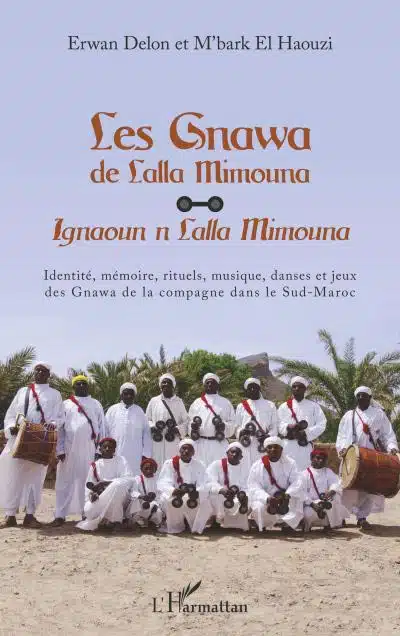
This is why our book provides an exceptional testimony, allowing readers to discover the heritage of the Gnawa of Lalla Mimouna, which until now has remained in the shadow of the Gnawa of Sidna Bilal.
Sudestmaroc.com – What cultural traditions are specific to this Gnawa community of South-East Morocco?
M’bark El Haouzi – The Gnawa of South-East Morocco are known as the followers of Lalla Mimouna, or the Gnawa of the Companion.
They are called this because they venerate Lalla Mimouna, who is known here as the Companion. She is an ancient African deity in whose honour — and in whose company — the Gnawa carry out all their activities.
She is therefore truly the faithful and inseparable companion of the Gnawa: the one who comforts, the one who heals, and the one who accompanies them throughout their lives.
This tradition can be found in several regions of Morocco, including the greater Souss and northern Morocco, and even in Algeria.
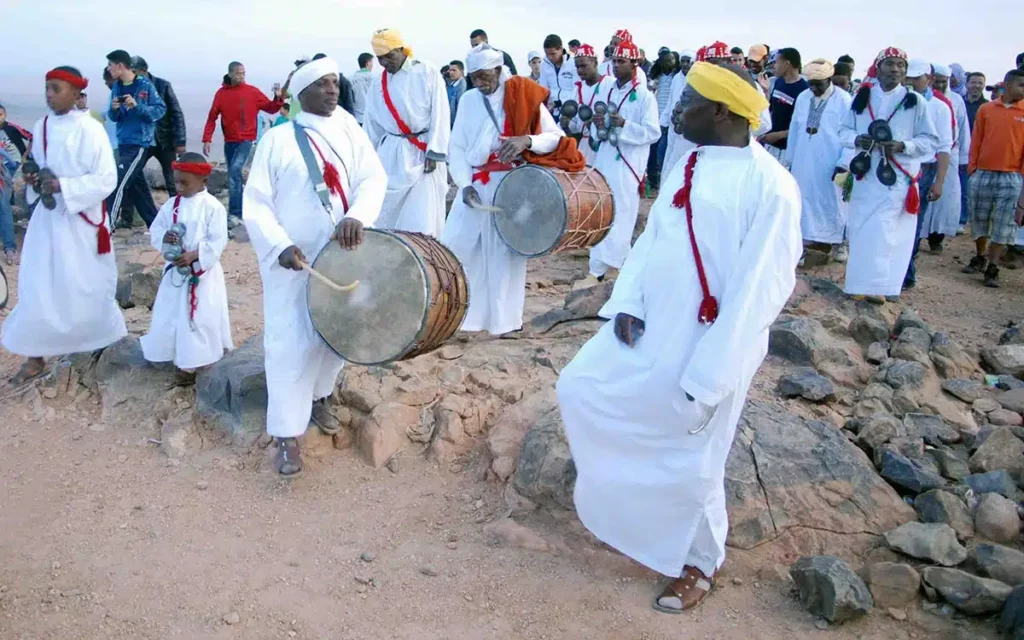
The music of the Gnawa of the Companion is called Ganga in Berber. Groups regularly set out on ritual alms-collecting tours, and every year they all make the pilgrimage to Lalla Mimouna.
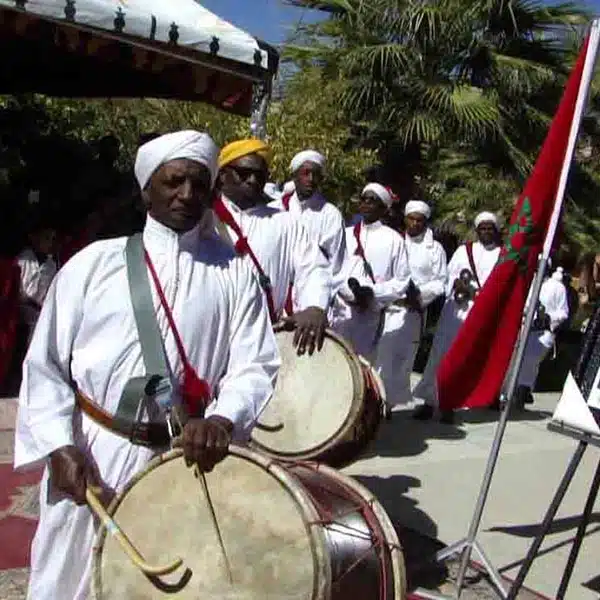
Our musical instruments are drums and castanets. Two drummers set the rhythm for the dancers.
These dances and this music are our heritage, and we want to preserve them intact.
Sudestmaroc.com – How does the annual pilgrimage to Lalla Mimouna take place?
M’bark El Haouzi – Tradition tells us that Lalla Mimouna once stayed on a mountain near the douar of Tamsermass, in the rural commune of M’cissi, within the caïdat and cercle of Alnif, Tinghir Province, in South-East Morocco.
A sanctuary was later built there to commemorate her presence.
The Gnawa journey to the sanctuary of Lalla Mimouna always takes place at the beginning of spring, more precisely during the first week of March according to the agricultural calendar.
It is a ritual journey, a stage through which all the faithful must pass. For them, it is a customary tradition inherited from their parents, but it is also a time of prayer, of seeking forgiveness for their sins and blessings upon their lives.
Throughout the three days of the journey, the sacred and the divine remain ever present.
The Gnawa seek to return to a mythical time, one that their earliest ancestors, torn from their homeland, may have remembered and longed for.
It should also be noted that the Aït Atta Berber tribes adopted the belief in Lalla Mimouna and take part in her pilgrimage.
Sudestmaroc.com – In the past, Gnawa music and dance were an important part of the cultural landscape of South-East Morocco, alongside Ahidous, Ahwach and other traditions. What values and messages did this music and dance convey?
M’bark El Haouzi – Women attach great importance to visits from the Gnawa. They ask Lalla Mimouna for baraka for their children, or for fertility for themselves.
Women often enter into trance during Gnawa visits. These trances have a therapeutic purpose, allowing an overflow of emotion to be released.
Gnawa tours are also a special moment for villagers, a celebration in which they take part — a time of spectacle. The Gnawa offer them entertainment, but there is also the entire mystical dimension bound up with the veneration of a woman: Lalla Mimouna.
Villagers regard the Gnawa as bearers of baraka, which is why they take part in their rituals in such numbers.
Preserving the mystical dimension
Sudestmaroc.com – Today, Gnawa music is often reduced to something purely folkloric and appears to have lost its mystical symbolism. Is this really the case, or do these traditions still survive? And how, in your view, can this cultural heritage — which belongs to the collective history of South-East Morocco and of Morocco as a whole — be given greater recognition?
M’bark El Haouzi – We are indeed witnessing a folklorisation and commercialisation of the Gnawa phenomenon.
In such a context, it is easy to heed the siren call of money and leave the mystical dimension behind.
Among the Gnawa of the Companion, we remain extremely attentive to this mystical symbolism. It is essential. The Gnawa venerate Lalla Mimouna with all the spirituality this implies, and it is equally important to respect the Tagnaouite values.
These are the values we seek to convey: decency between the sexes and between generations, mutual aid and unity within the douar, and universal peace.
Finally, if this heritage is to be preserved and promoted, support from the authorities is essential. They need to realise how fortunate their region is to have Gnawa communities within it.
The Gnawa must be given greater visibility by involving them in cultural events and by making them one of the cultural emblems of the region.
In these difficult times, it is more necessary than ever for political leaders to support the ancestral heritage that we continue to keep alive from one generation to the next.
Find out more
Les Gnawa de Lalla Mimouna, by M’bark El Haouzi and Erwan Delon, published by L’Harmattan.
More to Explore


For more than twenty years, Éric Anglade has lived in a village of South-Eastern Morocco, where he explores and documents the region’s history, heritage, and living traditions. He founded sudestmaroc.com as a space for sharing fieldwork and cultural insight, bridging local knowledge with global perspectives. He also works alongside women carpet-weavers to help sustain their craft and welcomes travellers at Le Jardin de Yuda, his guesthouse envisioned as a meeting place for exchange and transmission.

Leave a Reply