


Fint Oasis, as told by its elders
Behind the palms and gardens of Fint lies another oasis, preserved in memory: a world of migrations, forced labour, drought and abundance, Jewish families, saints and collective celebrations. Born in 1933, Lhaj Elhassane Aghlane is one of the last elders able to recount that world from within.
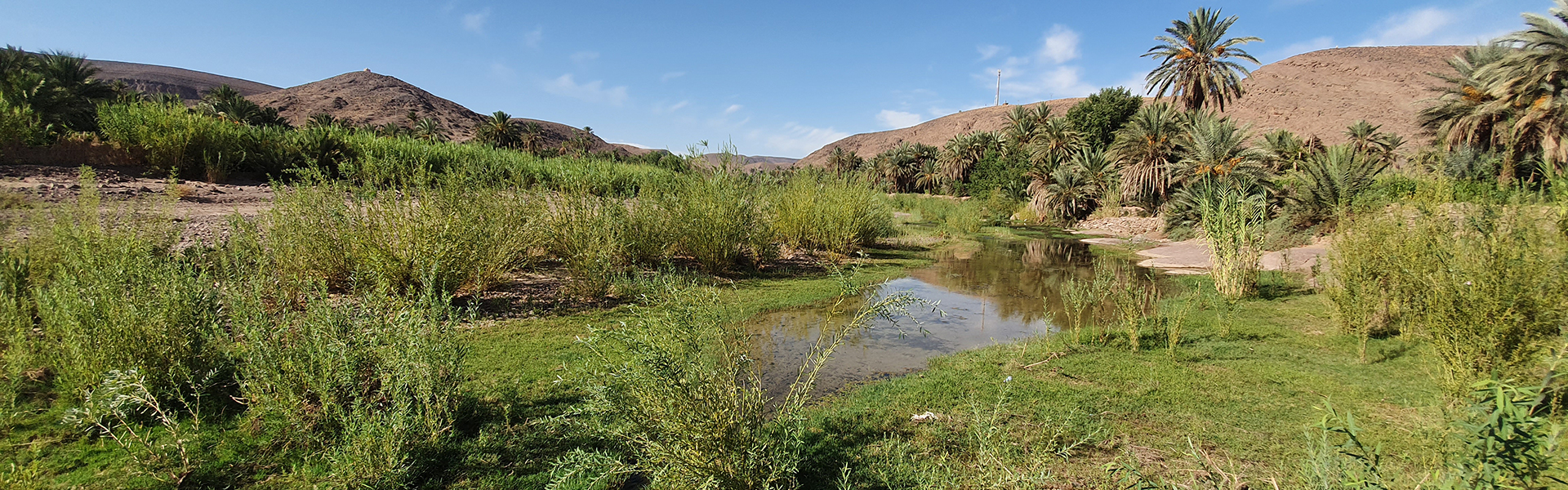
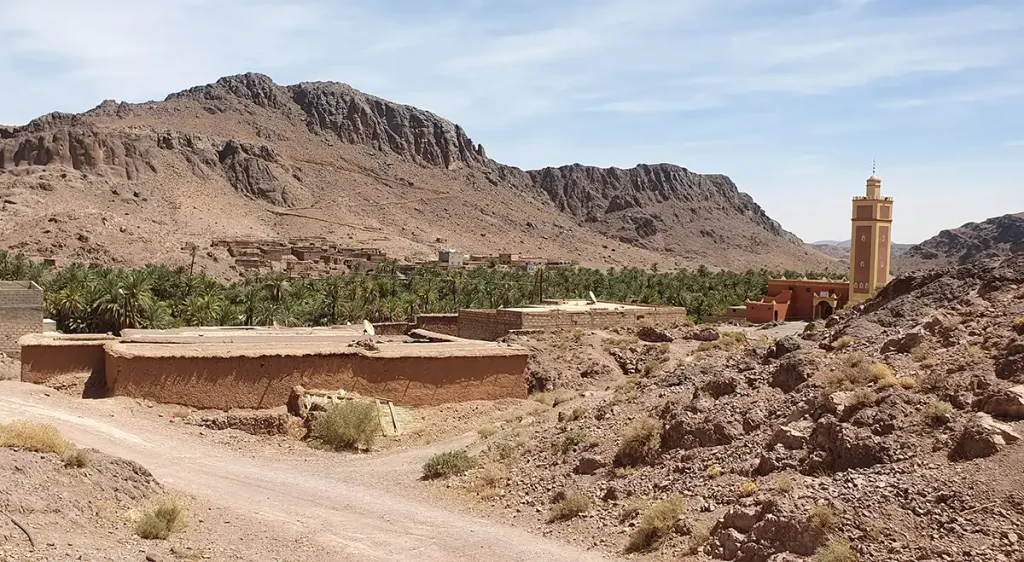
Today, the village of Fint is no longer the oasis it once was; time, the vagaries of the climate and the movements of populations have never ceased to transform it. Its old ruins, its fields and its valley seem silent, almost asleep, when first glimpsed, yet they hold a long history inscribed in collective memory and told through the many voices of its women and men. A collective history transmitted orally, where the real, the legendary and the mythical merge, where stories are woven together, intertwined, forgotten and reconstructed to tell the world the story of Fint Oasis.
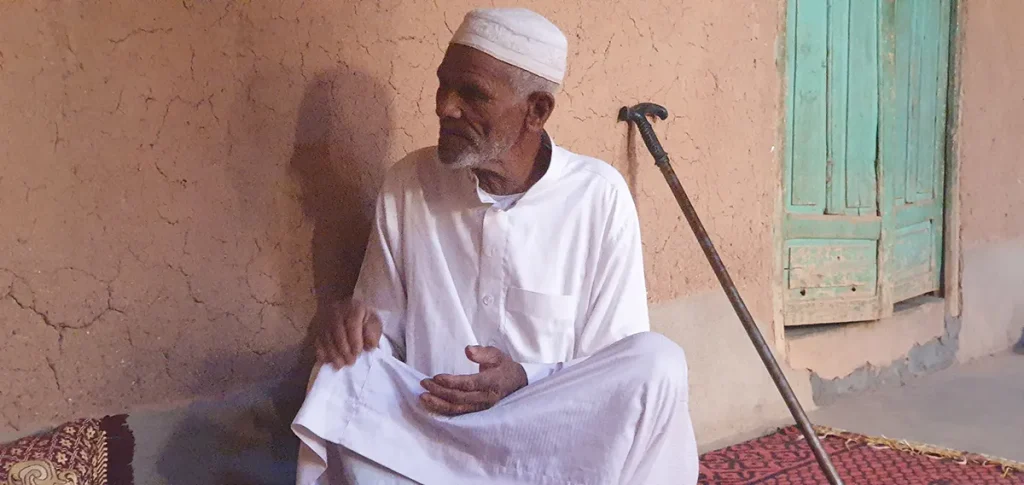
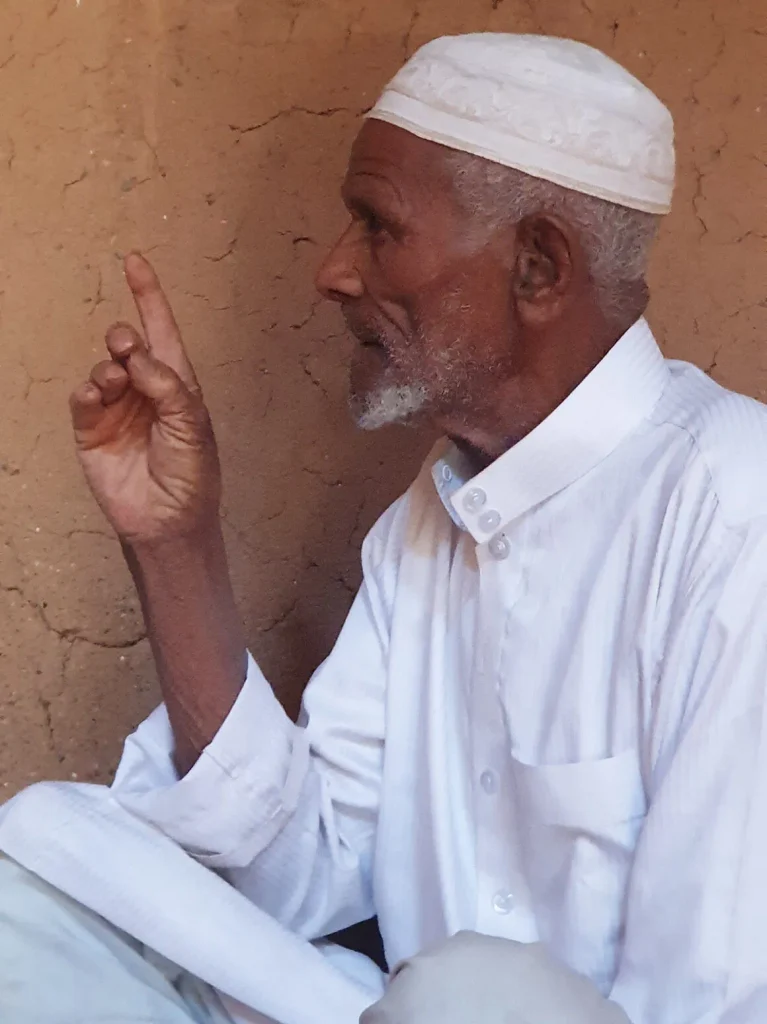
Lhaj Elhassane Aghlane, born in 1933, is one of the few elders of Fint still alive. He bears witness to the tribal life of former times. His account brings the lived past back to life and makes it present through words charged with emotion and imbued with nostalgia for those days when Fint
‘lived to the rhythm of the seasons and of the labour of men who neglected not the smallest plot of land in order to secure their subsistence.’
Lhaj Elhassane Aghlane
Fint, the origins of an Amazigh tribe
Most of Fint’s families are said to have arrived, one after another, from the Drâa region and other parts of South-East Morocco, particularly from the Tata region, fleeing drought, epidemics, famine and tribal tensions. An Amazigh community settled permanently in this secluded place, which at the time offered rudimentary but sufficient living conditions thanks to the intermittent waters of the Oued Fint.
‘We come from Alougoum, in the Tata region. The other families of Fint arrived from other regions. Only one family is said to be native to the place; the Harbouli family, known as Aït Baha Ali.’
Lhaj Elhassane Aghlane
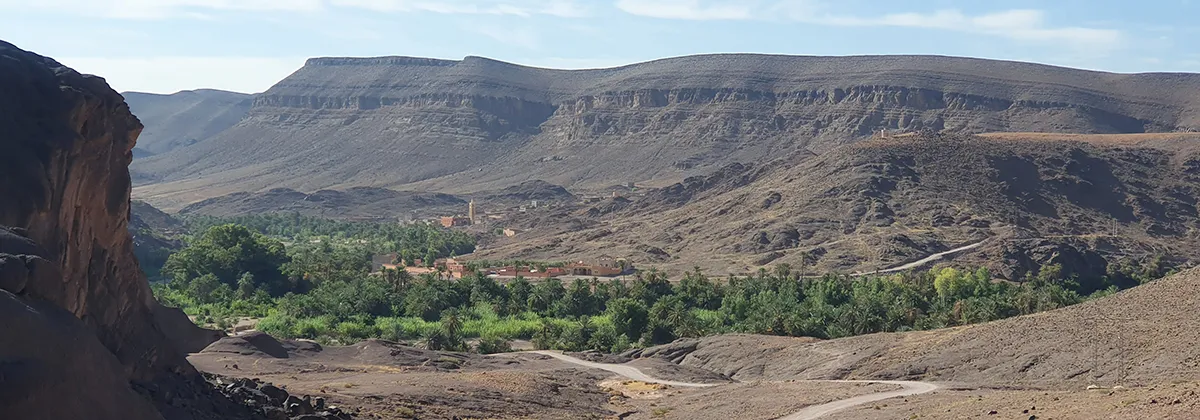
The first inhabitants settled on the northern bank of the Oued Fint. Modest earthen houses were built a few metres above the valley, against the rocky slope of Tassegdelte, sheltered from the devastating floods that inundated the oasis during seasons of heavy rain.
For a long time, Fint Oasis was inhabited solely by a Black population.
. Oral history, however, recalls the presence of a wealthy light-skinned Berber family that left Fint more than a century ago. This family is said to have had links with the saint Sidi M’hend Ou Moussa, whose trade they managed until they finally left Fint following a major invasion of mosquitoes.
Two powerful village chiefs exercised their authority over Fint during the period of the French Protectorate and the caïdal system in Morocco: the amghar Hammou N’Ali Oubaha of the village of Taherblit and M’hend Ou R’hou of the village of Timoula. Both were auxiliaries of the Glaoua caïds who dominated the High Atlas and the South-East of Morocco.
At that time, Fint did not escape the dictates of Caïd El Glaoui, whose official residence was in the Kasbah of Telouet. The inhabitants of the oasis were at the mercy of the seizure of property and anything else of value.
‘The Iglioua — Glaoua in Amazigh — stripped us of our possessions: fields, livestock, burnouses, djellabas, silver daggers, camels… They took everything they could lay their hands on.’
Lhaj Elhassane Aghlane
The Glaoua khalifas, notably Si Mohamed, established in the Kasbah of Taourirte, and Ou-Tzggart in the Kasbah of Tifoultoute, exercised absolute power over the tribes. Forced labour was compulsory for every boy over the age of twelve. This was private forced labour, consisting of assistance during ploughing, harvesting or building work in the service of the Glaoua masters.
‘A crier sent to Fint by the khalifa would publicly call on people to take part in the forced labour. Every man in our tribe had to provide four days of work. Anyone who failed to fulfil this obligation had to pay a tax or had one of his possessions confiscated. During Pasha Thami El Glaoui’s visits to Ouarzazate, we would go out to welcome him, men and women dressed according to the customs of official celebrations worthy of the Pasha’s rank; the men in white djellabas, turbans and babouches; the women in a light white cloth fastened at the shoulder with fibulae adorned with filigree decoration mixed with other types of ornament, “leqtib”, or that brightly coloured red and yellow headscarf. We made do with a few dates for food. All the tribes of Ouarzazate gathered at the Kasbah of Taourirte, where the Pasha was staying. We sang and danced Ahouach day and night in honour of the Pasha throughout his stay.’
Lhaj Elhassane Aghlane
A rustic way of life in a centuries-old oasis
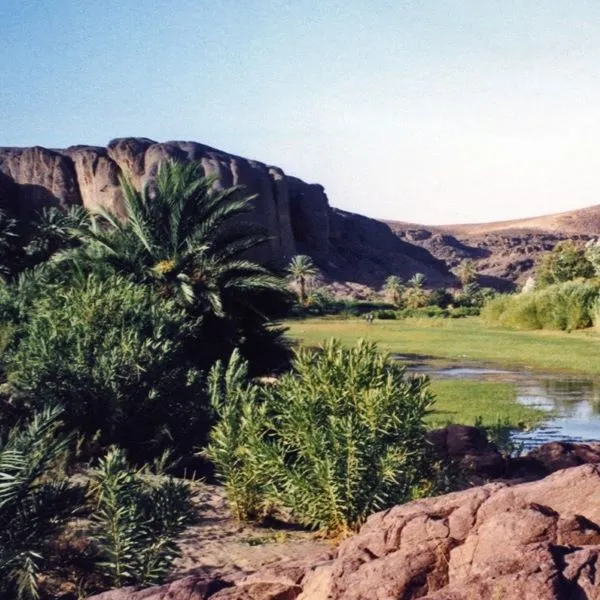
For centuries, the inhabitants of Fint cultivated plots of land along the banks of the wadi, which irrigated orchards where vines, fig trees and date palms grew — the providential tree above all others… Dates were a staple food that ensured the survival of families, particularly in times of scarcity.
Traces confirm the centuries-old presence of this population in the oasis.
‘My father died at the age of 110. He used to tell me that, even when he was a child, the large cemetery and a mosque in which more than 400 men prayed already existed.’
Lhaj Elhassane Aghlane
The Black population, although living exclusively in Fint, did not own a large proportion of the agricultural land cultivated within its territory. Neighbouring light-skinned Berber tribes such as Taguenezalt and Ighelss owned it. The inhabitants of Fint worked there only as khammas, or sharecroppers, receiving just one fifth of the harvest as payment.
Times were often hard because of recurrent droughts and epidemics. The inhabitants sold their land in order to survive:
‘We sold our land in exchange for a bowl of barley. At that time there was no flour. We went to Ouarzazate to beg for a little barley flour. We made soup with dried turnips cooked in earthenware pots. As for clothes, there were almost none. We dressed in patched rags made from worn American cloth. At night, we covered ourselves with mats made from palm leaves. Despite these conditions of poverty, we were strong; we worked our land, tended our meagre herds, searched for wood…’
Lhaj Elhassane Aghlane
Read also: The Skoura palm grove, the oasis par excellence
Jewish families also lived within the Fint tribe: Boubssou, Boutkjtatt, Ben Ouenza… These families enjoyed a relatively privileged social position. They practised moneylending and trade.
‘Jewish families lived in Fint. There were many Jews in other villages around Ouarzazate, particularly Tazroute, Taourirte, Aouerz, Telmasla, Tamassinte, Tikirte… They were richer than we were. The Glaoua caïds treated them with indulgence.’
Lhaj Elhassane Aghlane
Hard times gave way to periods of rain, when water irrigated the fields and replenished the channels, valleys and springs. These waters filled the hearts of Fint’s inhabitants with joy as they watched their oasis come back to life; greenery covered the pastures and every garden bore fruit. The little oasis, whose economy rested on subsistence farming and pastoralism, suddenly entered a time of abundance:
‘We raised sheep, oxen and cows. Flowers grew everywhere and wild beehives full of honey abounded in the surrounding countryside. Deer ventured as far as the villages. Wolves, foxes and hares multiplied…’
Lhaj Elhassane Aghlane
In gratitude to God for his generosity and for these times of abundance, and remaining faithful to their ancestral customs, the inhabitants of Fint organised a traditional celebration every year: the Moussem of Sidi M’hend Ou Moussa, a descendant of the famous saint of southern Morocco, Sidi Ahmed Ou Moussa, whose zaouïa stands in a village bearing his name, in the commune of Tazeroualt, Province of Tiznit.
This ceremony was celebrated each year on the first Friday at the mausoleum of this local saint.
The moqadem of the mausoleum, the local representative of authority or a kind of deputy, managed the saint’s property, including palm trees leased to third parties, animals sold and other assets. These resources formed a fund belonging specifically to the mausoleum of Sidi M’hend Ou Moussa.
On the eve of the moussem, the date of the ceremony was announced in Ouarzazate so that the other tribes would know when it was to take place. It was an opportunity to celebrate Fint’s rootedness in its traditions and to renew its ties with the other tribes.
‘The moqadem of the zaouïa records all the mausoleum’s resources in a notebook. We sent emissaries to the weekly souk in Ouarzazate to announce the date on which the moussem would take place. Every family in Fint contributed towards organising the ceremony. We bought a cow to sacrifice as an offering to the saint. A communal meal was prepared; dishes of couscous known as “maârouf” were generously offered to all our guests. Tribes arrived from everywhere, bringing goats and sheep to sacrifice on the saint’s tomb. They sang and danced Ahwach all night.’
Lhaj Elhassane Aghlane
Those days are gone. In Fint Oasis, the bearers of tradition now serenely live out the twilight of their lives. The history of Fint is more than a memory. It has become part of the heritage, richness and identity of South-East Morocco.
What to do in Fint Oasis: a secluded valley on the doorstep of Ouarzazate

More to Explore

Leave a Reply