


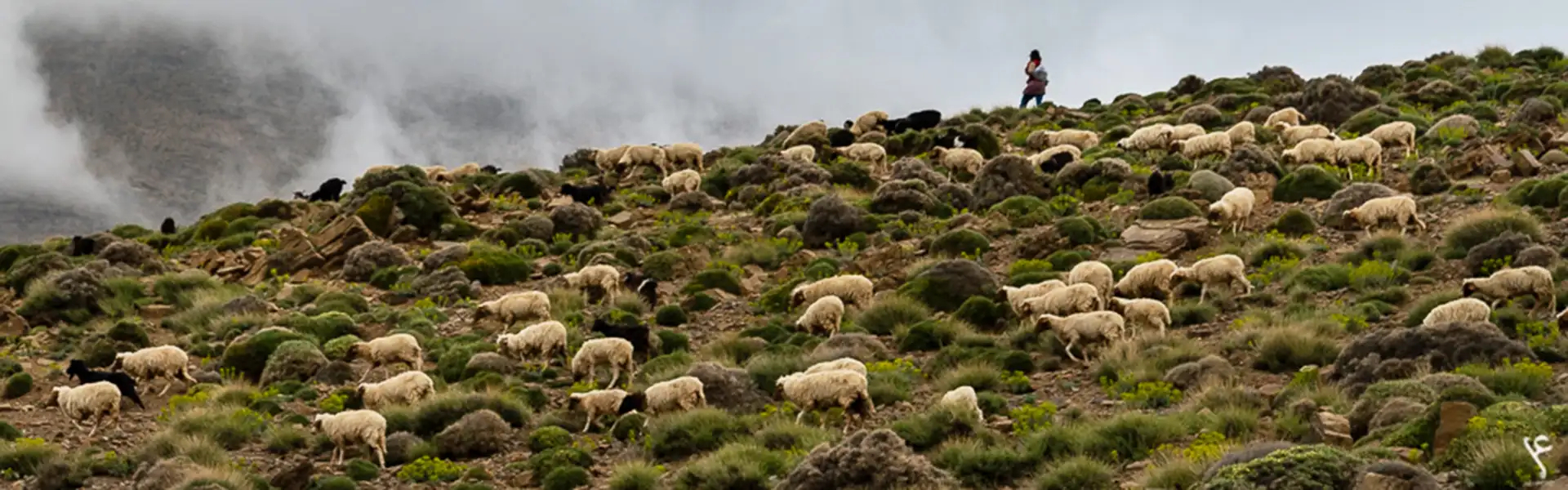
Jean-Pierre Datcharry is well known for organising long camel-caravan journeys across Morocco. Based in a small village near Ouarzazate, he travels across the country several times a year with groups of hikers, introducing them to the beauty and diversity of its landscapes.
Over the years, his journeys naturally brought him into contact with the nomadic shepherds of South-Eastern Morocco, and he has maintained close ties with them and their families ever since. Like many others, he has witnessed the decline of mountain shepherding and reflects here on what might be done to prevent the disappearance of one of Morocco’s oldest ways of life.
Jean-Pierre Datcharry – I first met shepherds and their families among the nomadic tribes of the Aït Atta confederation as they passed through Aït Bouguemez territory. That was 37 years ago. At the time, I was living in a small village in the upper Aït Bouguemez Valley and working as a mountain guide for travel agencies based in Marrakech and France.
I became very fond of this community and once accompanied one of their transhumances. It gave me an opportunity to share their daily life and get to know them closely.
I then organised my first trek with a group of foreign travellers along a transhumance route, following one of the families as they moved with their herd. The experience made such a strong impression on the travellers that I decided to organise this kind of trek every year. I have now been doing so for 35 years.
Sudestmaroc.com – Why did shepherds from the Aït Atta tribes practise transhumance through Aït Bouguemez territory?
Jean-Pierre Datcharry – The original territory of the nomadic Aït Atta tribes lies in the Jbel Saghro massif, although they also expanded southwards into the Drâa Valley and northwards towards the Atlas, particularly in the case of the Aït Atta Oumalou.
The Jbel Saghro, or Adrar Saghru in Amazigh, is a mountain massif in southern Morocco rising to 2,712 metres. It lies east of Ouarzazate, around 70 kilometres south of the Central High Atlas, overlooking the Drâa valleys to the west and south and the Dadès Valley to the north. It forms the eastern part of the Anti-Atlas.
More Info : Le djebel Saghro (ou Adrar Saghru en amazighe) est une montagne du Sud marocain qui culmine à 2 712 m d’altitude. Il se situe à l’est de Ouarzazate, à 70 km au sud du Haut Atlas central, dominant les vallées du Drâa à l’ouest et au sud, et celle du Dadès au nord. Il constitue la partie orientale de l’Anti-Atlas. / Source : Wikipedia
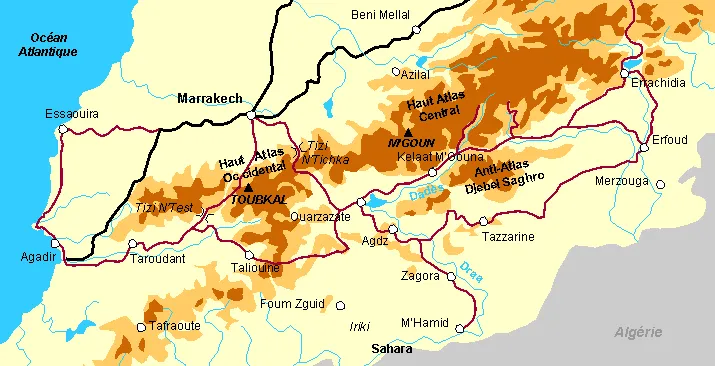
Some Aït Atta groups established agreements with the tribes of the Aït Bouguemez Valley allowing them to use mountain pastures during the summer on the northern side of the High Atlas, beyond the M’Goun massif. The climate there was less harsh than in the Jbel Saghro.
These pastures were already used by the herds of the Aït Bouguemez communities themselves, as well as by Aït Mohammed families living farther north.
It is important to remember that there was a time when these tribes were in conflict, sometimes virtually at war, particularly over access to grazing land. Each had its own strengths, but the Aït Atta were renowned as formidable fighters.
These disputes were eventually settled in the 1940s under the authority of the French Protectorate. An agreement between the different parties was signed in the small town of N’Kob.
This allowed Aït Atta shepherds and their herds to practise transhumance into Aït Bouguemez territory and reach its greener mountain slopes. In return, the Aït Bouguemez tribes were able to spend the winter in the Jbel Saghro, among the Aït Atta, escaping the harsh snow for the milder temperatures closer to the Sahara.
These reciprocal movements of shepherd families and their herds still take place every year.
The transhumance treks have also proved very popular with hikers who love Morocco, so I organise a second trek in autumn to accompany the Aït Atta herds on their return journey.
Sudestmaroc.com – When exactly do these transhumances take place?
Jean-Pierre Datcharry – Aït Atta herds are allowed onto the Aït Bouguemez pastures from 1 June each year until the first snow arrives. The grazing area is known as Tamda and lies near Lake Izourar.
During May, before the herds arrive, the pastures are guarded by a group representing the three communities concerned — the Aït Bouguemez, Aït Mohammed and Aït Atta — to make sure that no shepherd enters the grazing area early with his animals.
There is no fixed period for Aït Bouguemez herds entering Aït Atta territory, because the Aït Atta lands are so extensive.
For my part, I organise the outward transhumance treks in May so that we reach the destination at the appropriate time. We usually arrive at the entrance to the grazing area a few days before it officially opens and make camp at the foot of the Tizi n’Tighrist pass, at an altitude of around 2,600 metres.
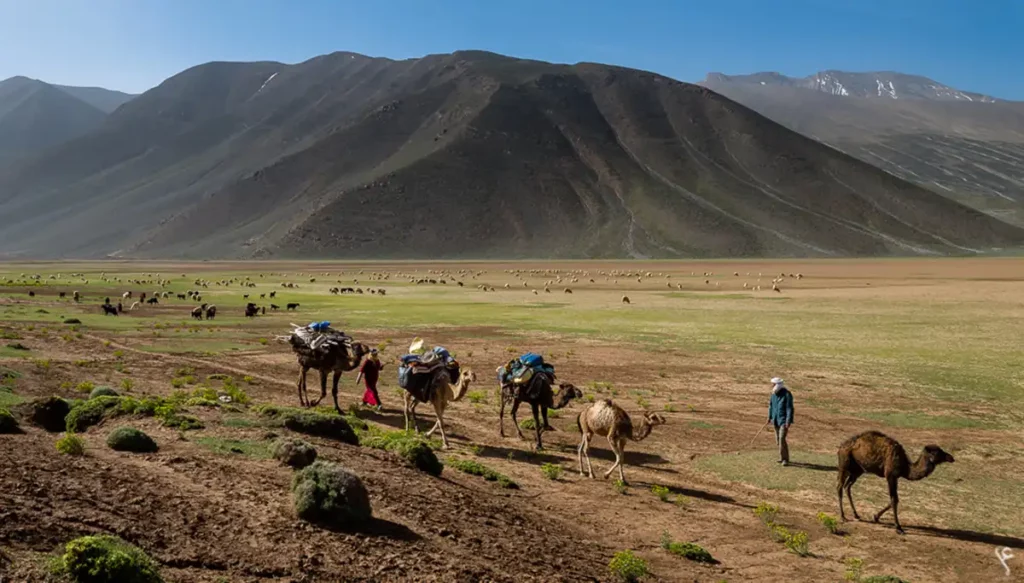
Today, fewer than ten small herds make the journey
In the past, the grazing areas available to Aït Atta herds were allocated to the different tribes by drawing lots. At that time, almost 50 tribes — and therefore around 50 herds of more than 600 animals each — would come to take advantage of the more favourable pastures of the valley.
Today, fewer than ten much smaller herds, of around 150 animals each, make the transhumance every year.
This year, we encountered only six families, three fewer than the previous year. And during the journey, the tribe we were accompanying sold all its sheep after meeting a livestock trader.
Sudestmaroc.com – Why are the herds gradually disappearing?
Jean-Pierre Datcharry – The decline began about ten years ago and now seems inexorable.
Nomadic families are no longer willing to endure an ancestral way of life whose conditions have become too difficult. Transhumant life is increasingly rejected by women and by younger generations, for whom the attractions and opportunities of modern life now outweigh what the nomadic way of life has to offer.
Another factor is the fragmentation of herds when an inheritance is divided after the death of a family head. As herds become smaller, they generate less income and are increasingly unable to meet the growing costs and expectations of everyday life.
There are also fewer people available to look after the animals. In the past, children and young people became involved in the collective work from an early age.
Sudestmaroc.com – How could this decline be reversed?
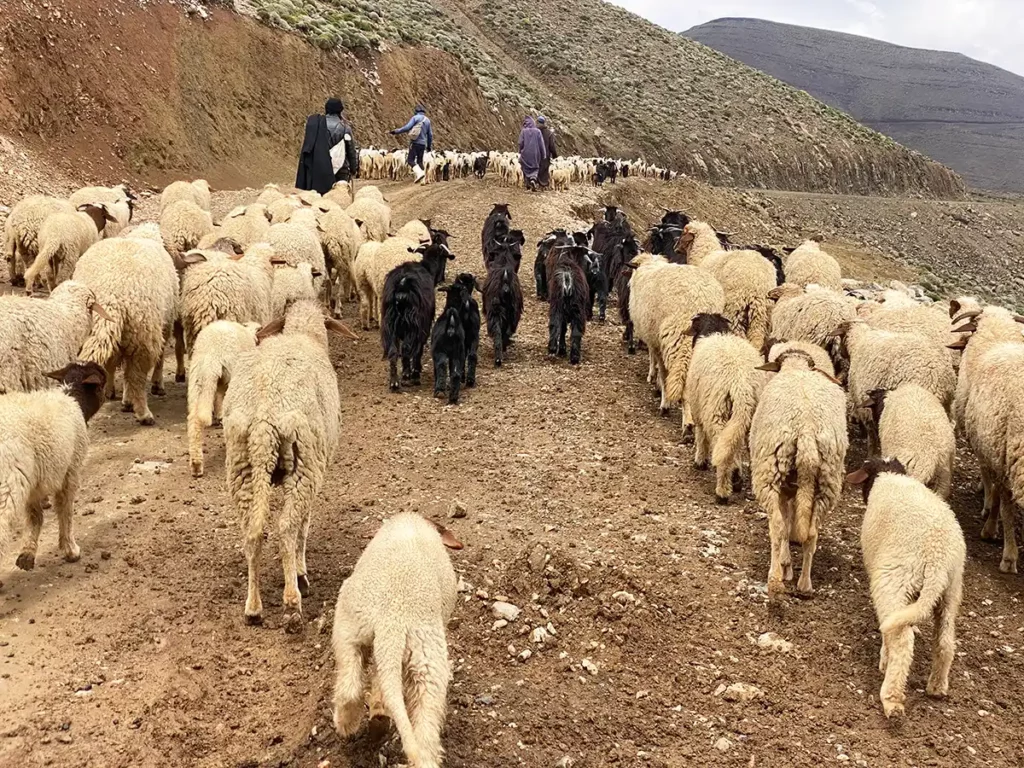
Jean-Pierre Datcharry – In my view, one solution would be for families to pool their herds. Families today are much smaller units than the large tribal groups of the past, and I have often suggested this idea to the nomads I meet.
If each family contributed its sheep to a larger shared herd, managing the animals throughout the year would become easier and, above all, more profitable. The heads of the different families could take turns looking after the herd, leaving them free to pursue other complementary economic activities.
Families could then settle permanently in towns, as many have already done in N’Kob. This would make it easier for children to attend school and for families to access basic public services.
In truth, however, the idea has met with little enthusiasm. Almost all of them have already decided to give up shepherding.
They no longer find meaning in their identity as shepherds and nomads
Sudestmaroc.com – Is the Moroccan government doing anything to halt this decline?
Jean-Pierre Datcharry – A few years ago, the public authorities made efforts such as improving tracks and installing water points. But these measures seem to have come too late, or at least to be insufficient.
With nomadic shepherds increasingly turning away from their traditional way of life, the real challenge is no longer simply logistical. What is needed is a renewed recognition of the value of a tradition that is now in danger of disappearing.
Pooling resources and herds may seem the logical way to make the activity more efficient and economically viable again. But we also have to understand that these shepherds no longer have the energy, or even the confidence, to organise themselves collectively and try to keep this way of life alive.
They no longer find the same meaning in their identity as shepherds and nomads, and they want a completely different life for their children.
Sudestmaroc.com – What could be done in practical terms?
Jean-Pierre Datcharry – The first priority is to raise awareness within Moroccan society of the disappearance of one of the country’s oldest traditions.
The initiative launched by the Moroccan NGO We Speak Citizen to create a Shepherds’ House in the Aït Bouguemez Valley is a step in that direction. Drawing attention to the realities faced by mountain shepherds can help people understand the nature of the difficulties they encounter.
It would then become clear that improving the recognition and social status of nomadic shepherds within Moroccan society is essential if their occupation is to survive.
Further reading: The shepherd, the forgotten pearl of Morocco’s cultural heritage
A major NGO specialising in agricultural issues should also become involved in supporting shepherds as they move towards the kind of shared organisation that is now essential.
By working together, each group would be in a stronger position to improve working and living conditions, preserve local breeds, manage seasonal movements more effectively and gain greater bargaining power when selling their animals.
For many years, Morocco has encouraged the development of cooperatives, particularly in agriculture and crafts. But we have to recognise that the cooperative model is not particularly well suited to nomadic shepherd communities.
A different form of organisation needs to be invented: one that is more flexible, closer to realities on the ground and better suited to people who are deeply attached to open spaces and freedom.
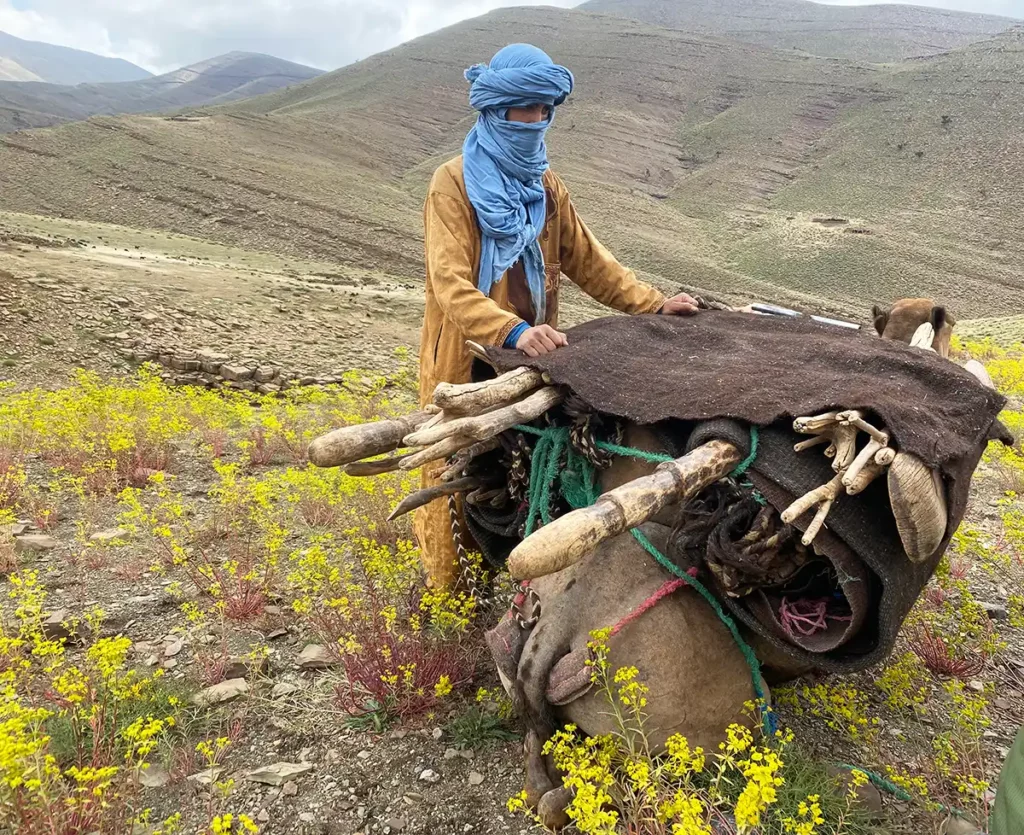
Creating a quality label for mountain-raised lamb should be a priority
Sudestmaroc.com – Yet there are countries, France for example, where mountain shepherding has survived and young people are still choosing to work in the sector.
Jean-Pierre Datcharry – Of course it works in France, and it could work in Morocco.
We have to remember that the sheep market is extremely important in Morocco. During the Eid al-Adha preceding this interview, Morocco imported nearly a million sheep from Spain through a subsidy scheme. At the same time, we are watching nomadic shepherds — particularly young people — abandon their occupation for low-paid jobs.
There is a great deal of money in the sheep market, and some of that value should also benefit the mountain shepherds who are the custodians of this tradition.
If we can properly promote the quality of meat from sheep raised on mountain pastures — animals that graze on thyme, wormwood and other mountain plants — it should be possible to command higher prices.
Creating a quality label for this meat, something along the lines of “Atlas Morocco Sheep”, should therefore be a priority for the Moroccan authorities.
I am convinced that consumers in the country’s major cities would be prepared to pay more for their meat, just as some already do for free-range chicken or eggs, provided they had a guarantee of where the sheep came from and that they had been raised on pasture throughout their lives.
Several different actors therefore need to come together around the challenge of keeping mountain shepherding alive. What is at stake is the preservation of an important figure in Morocco’s cultural heritage.
Helping shepherds to pool their herds could also allow their families to settle permanently.
We should accept the idea that shepherds’ families may settle in one place so that women and children can enjoy living conditions more suited to present-day needs. Each family could contribute its animals to a shared herd, while only the men would continue the seasonal movements, joined by younger people who actively choose to become shepherds.
Finally, establishing genuine professional and social recognition for shepherds, including health coverage and retirement provision, would be a major step forward and could encourage younger generations to follow in their parents’ footsteps.
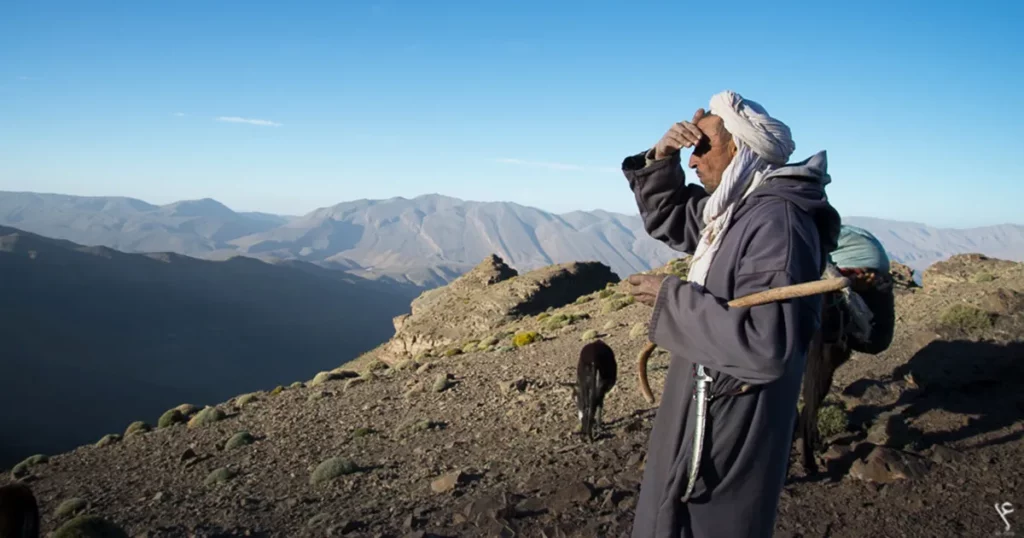
The shepherd awakens something essential within us
Sudestmaroc.com – While waiting for the situation to change, what can you do personally to help preserve this way of life?
Jean-Pierre Datcharry – At my own modest level, apart from the advice I try to share with them, there is not a great deal I can do.
The transhumance treks I have organised for many years do provide some income for the nomadic families we accompany. I have also often employed young people from these tribes as camel handlers or guides through my agency, Désert et Montagne Maroc.
But perhaps the most important thing is that, by organising these annual treks alongside the migrating herds, I try to make both foreign and Moroccan travellers aware of the remarkable lives of these shepherd families, who remain partly nomadic and represent one of the many faces of Morocco.
I have seen how people who experience these transhumances, sharing the daily lives of mountain shepherd families for several days, come away amazed and deeply moved.
Perhaps it is because the shepherd and the nomad carry something within them that touches something essential in us, some truth about ourselves.
Perhaps it is a trace, a memory of our origins.
Or perhaps it is something that speaks to our future.
Discover

For more than twenty years, Éric Anglade has lived in a village of South-Eastern Morocco, where he explores and documents the region’s history, heritage, and living traditions. He founded sudestmaroc.com as a space for sharing fieldwork and cultural insight, bridging local knowledge with global perspectives. He also works alongside women carpet-weavers to help sustain their craft and welcomes travellers at Le Jardin de Yuda, his guesthouse envisioned as a meeting place for exchange and transmission.
3 responses to “The challenge of keeping Morocco’s shepherding tradition alive”
One year, in spring, we had the privilege of accompanying a nomadic family on this transhumance and were able to witness the very difficult living conditions of the nomads. One can easily understand their desire to have a life more in line with our time and their willingness to settle down. As for the rest, Jean Pierre is absolutely right about the solutions to undertake.
The topic is very broad and holds great symbolism for all the ancestral activities in the life of Moroccans, especially the Amazigh people who strive to proudly preserve their identity.
Congratulations to the magazine sudestmaroc.com for raising the issue of the shepherd’s activity, and especially for choosing to highlight a prominent “nomad” named Jean-Pierre Datcharry, who is arguably one of the foremost experts today on transhumance routes and major treks in the nomadic regions of Morocco. Jean-Pierre Datcharry is not merely engaged in tourism despite managing a travel agency and an authentic hotel staffed almost exclusively by women and men from neighboring Berber villages. What he offers are travel experiences faithful to the ancestral customs of the Berber tribes of these lands he has fallen in love with—journeys with profound knowledge and a big heart.
As someone involved in travel and tourism in Morocco for around twenty years, I don’t know many individuals who organize camel trekking expeditions in the manner of Jean-Pierre Datcharry—treks as authentic as those of the nomadic caravans of yesteryears.
Returning to the topic raised in the interview, thinking about saving the life of the shepherd in Morocco is truly a sign of serious work that should engage all of us, citizens, and especially the leaders and officials of this country, if we all dream of preserving an identification with this great and historic nation that is Morocco. Preserving the tradition of transhumance and other original customs, or becoming modern and all identical to any other modern country, would be without any appeal.
I am also convinced that we could save the shepherd’s activity and transhumance by offering these individuals and tribes a better life, firstly by valorizing their activities and above all by ensuring the education of their children.
Once again, I thank you and I salute Mr. Jean-Pierre Datcharry.
Jean-Pierre, following in the footsteps of René Euloge, has a profound and intimate knowledge of these nomadic populations of the Atlas Mountains. His vision and proposals to maintain transhumance go far beyond a mere issue of pasture; it is simply his fight and his love to defend this country and these people who have lived in harmony with their environment for many years. Succeeding in maintaining transhumance is also one of humanity’s challenges and a hope for our children.

3 comments
One year, in spring, we had the privilege of accompanying a nomadic family on this transhumance and were able to witness the very difficult living conditions of the nomads. One can easily understand their desire to have a life more in line with our time and their willingness to settle down. As for the rest, Jean Pierre is absolutely right about the solutions to undertake.
The topic is very broad and holds great symbolism for all the ancestral activities in the life of Moroccans, especially the Amazigh people who strive to proudly preserve their identity.
Congratulations to the magazine sudestmaroc.com for raising the issue of the shepherd’s activity, and especially for choosing to highlight a prominent “nomad” named Jean-Pierre Datcharry, who is arguably one of the foremost experts today on transhumance routes and major treks in the nomadic regions of Morocco. Jean-Pierre Datcharry is not merely engaged in tourism despite managing a travel agency and an authentic hotel staffed almost exclusively by women and men from neighboring Berber villages. What he offers are travel experiences faithful to the ancestral customs of the Berber tribes of these lands he has fallen in love with—journeys with profound knowledge and a big heart.
As someone involved in travel and tourism in Morocco for around twenty years, I don’t know many individuals who organize camel trekking expeditions in the manner of Jean-Pierre Datcharry—treks as authentic as those of the nomadic caravans of yesteryears.
Returning to the topic raised in the interview, thinking about saving the life of the shepherd in Morocco is truly a sign of serious work that should engage all of us, citizens, and especially the leaders and officials of this country, if we all dream of preserving an identification with this great and historic nation that is Morocco. Preserving the tradition of transhumance and other original customs, or becoming modern and all identical to any other modern country, would be without any appeal.
I am also convinced that we could save the shepherd’s activity and transhumance by offering these individuals and tribes a better life, firstly by valorizing their activities and above all by ensuring the education of their children.
Once again, I thank you and I salute Mr. Jean-Pierre Datcharry.
Jean-Pierre, following in the footsteps of René Euloge, has a profound and intimate knowledge of these nomadic populations of the Atlas Mountains. His vision and proposals to maintain transhumance go far beyond a mere issue of pasture; it is simply his fight and his love to defend this country and these people who have lived in harmony with their environment for many years. Succeeding in maintaining transhumance is also one of humanity’s challenges and a hope for our children.
Leave a Reply