


Izza, Artisan of the Earth
In Gueddara, a potters’ village in the Skoura palm grove, Izza learnt as a child to work the earth in her father’s workshop. What began as a game gradually became the craft on which her family depends. Abdeljalil Didi recounts the daily life of a woman potter, between physical labour and gestures of creation.
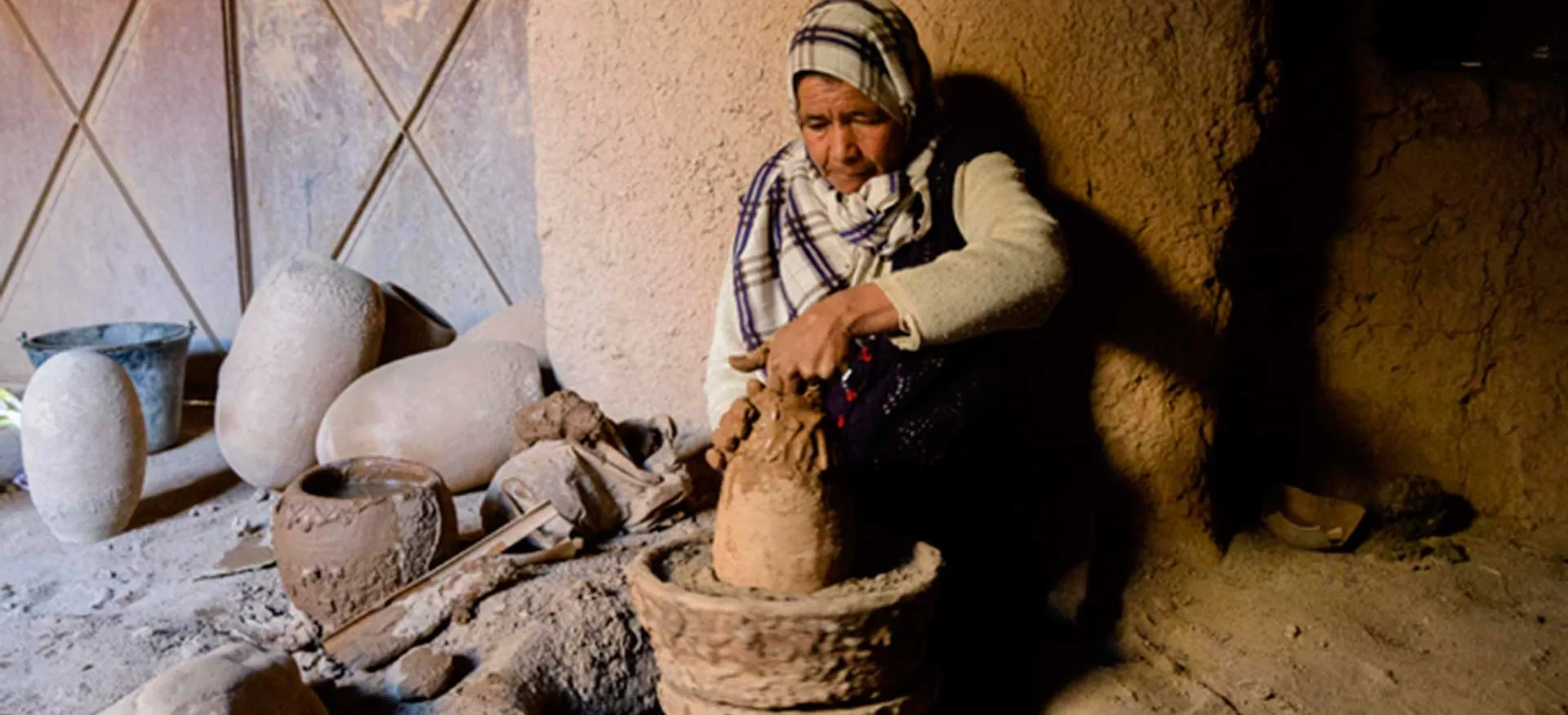
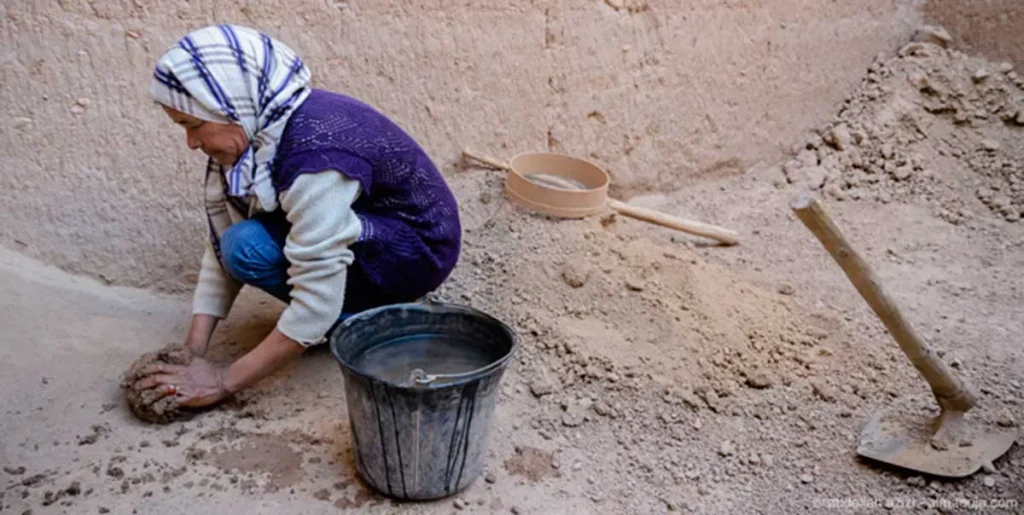
Izza was born in Gueddara, the potters’ village of Skoura. Illiterate, because in those days only boys were allowed to attend school, Izza spent her childhood in her native village. With few distractions, she went every day to her potter father’s workshop. At first, she tried to make herself useful to her father and brother. She amused herself by sieving the earth and kneading it. Above all, it was a game for her, filling her time by making small clay jugs and little bowls… as though she were building sandcastles by the sea.
When play becomes a trade
The years passed, and through habit Izza gradually acquired the skills of a potter. Her father, weakened by age and illness, no longer had the strength to work. As the eldest child, it fell to her to earn the family’s bread. Her fate was sealed: she would become a woman potter. It is a responsibility she has borne for more than seven years. Now aged thirty-six, she practises a trade that demands considerable physical strength every day.
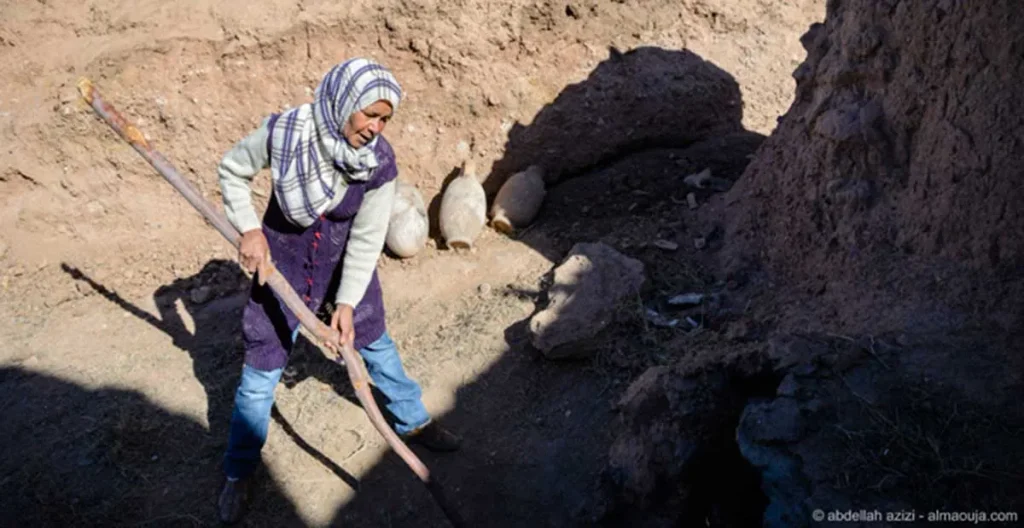
Izza no longer lives in a world ruled by fragility, whether physical or emotional. Behind her slight frame lies a strength one would scarcely suspect. She digs into the wadi in search of the layer of earth she needs, a pit that the waters of Oued Elhejjaj soon cover again whenever the floods return. But Izza simply begins once more. Around three kilometres from her home, another long and difficult journey awaits her, accompanied by her brother.
“I can go down to the wadi and dig. I feel safe there because it is very close to the road. But I cannot venture alone into other, more distant places. My brother goes there, or else we go together.”
Izza
Heaps of different kinds of earth are piled up in the corners of Izza’s workshop. She takes a long dried tamarisk branch, cut at one end, and uses it to pound the earth. At first sight, there is something almost ironic in seeing such a slender body attempting to crush dry clods of earth into powder, a task that by its very nature requires great physical strength. Yet Izza knows how to handle her tool. She swings it through the air before bringing it down on the pile of earth, pulverising it blow after blow.
From earth to water jar
From extracting the clay to firing the finished pieces, almost every stage takes place on site. The pottery is thus born from the very earth surrounding the village, through a succession of gestures in which physical strength counts for as much as skill.
Digging, carrying the earth on a donkey’s back, sieving it, kneading it with the feet, shaping it, gathering dry grasses nearby, lighting the kiln, firing the jars… A whole series of exhausting tasks to which Izza devotes herself without showing any sign of fatigue.
Courageous and patient she may be, but her rough hands, her breathlessness and her premature lines say much about the weight she carries.
“It is hard! When I was a child, my mother and I used to fetch water from Ouled Merzoug or Douaher, villages in Skoura about thirty minutes from here. We went there on foot and came back with the jars full of water on our bent backs…”
Izza
Read also: Fadma Ait Hmam, a Berber woman with a talent for painting
A note of candour runs through Izza’s words. Habit has perhaps made the burden of her life seem ordinary. With a revealing remark, Izza lets slip something of the hardship she has endured:
“In this work of drudgery, even the donkey breaks its back after five years. Once it is exhausted, we get rid of it and find another.”
Izza
The time to create
Once the jar reaches its final stage, a feminine touch adds a note of beauty. Izza takes a feather, dips it into a bowl of fine earth mixed with water and uses it to colour her jar. She draws palm trees with a naïve hand, forms born from her imagination. Her body, exhausted by a succession of gruelling tasks, at last finds an outlet for its fatigue: a moment of rest and gentle creation.
At sunrise on another day, Izza gathers herself once more, cuts into the ground, carries the earth, sieves it, shapes it, making water jars, earthen braziers and bowls. Simple objects that whisper of the hardship, courage and candour of the woman who made them.
This is the story of Izza, artisan of the earth, quietly marked out by time on the banks of Oued Elhejjaj, in the potters’ village of Gueddara.
Read also: The story of the women of Taznakhte woven into their looms

More to Explore

Leave a Reply