


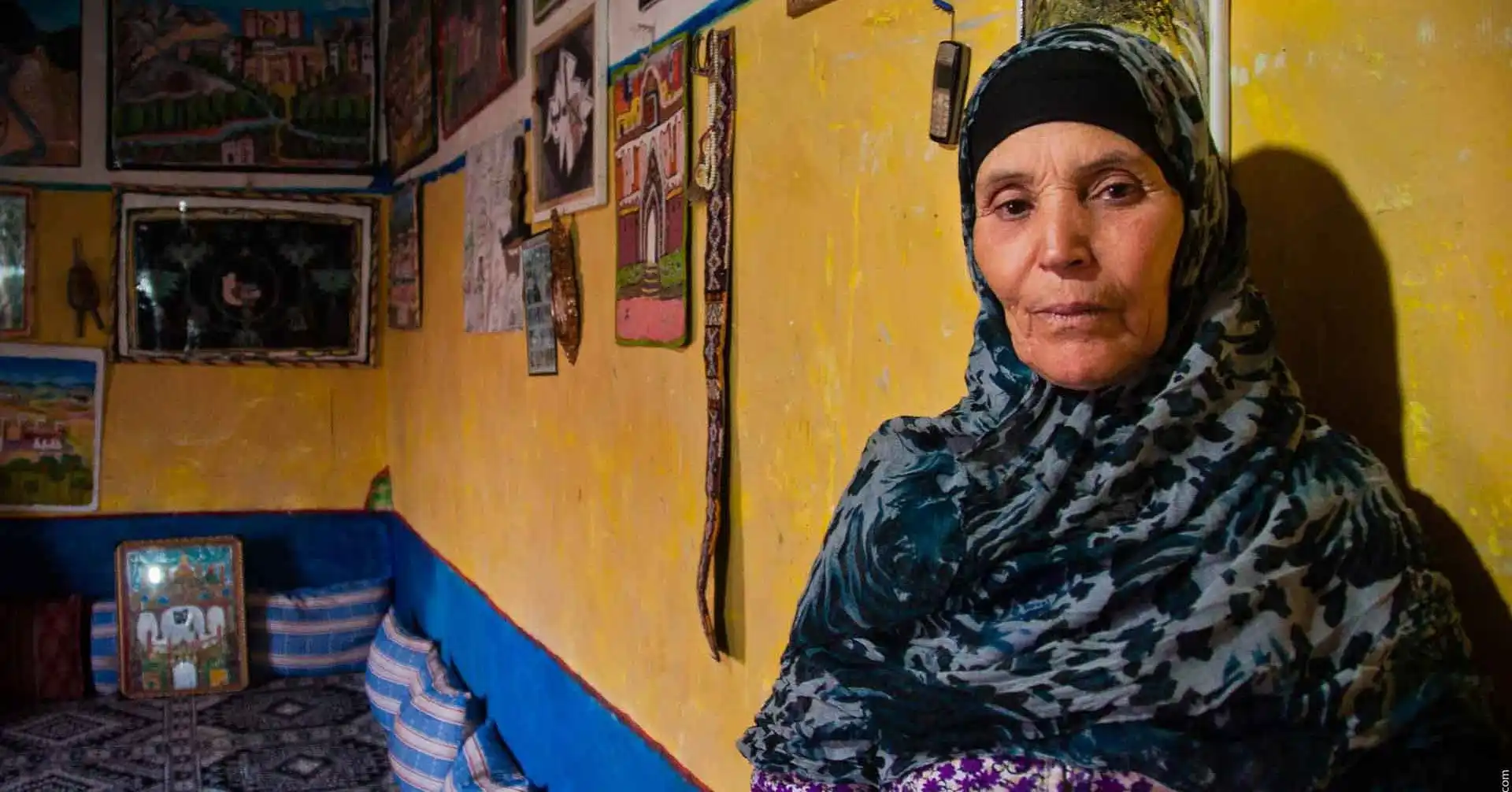
Fadma Ait Hmam, a Berber woman with a talent for painting
In Kourkouda, near Taznakhte, Fadma Aït Hmam spent much of her life weaving, tending to domestic tasks and living a pastoral life before discovering painting later in life. With no artistic training, she began to set down on canvas the colours, landscapes and figures of her everyday world. Abdeljalil Didi recounts the unexpected blossoming of a vocation.
She discovered this hidden treasure within herself at the age of fifty-five. Just as time was beginning to trace a few lines across her face, Fadma moved against the current and gave free rein to her imagination, painting life and colouring it in her own way. She has roots in the Iznaguen tribe, certainly, but also the wings of a self-taught artist learning to master the brush.
A life far from the easel
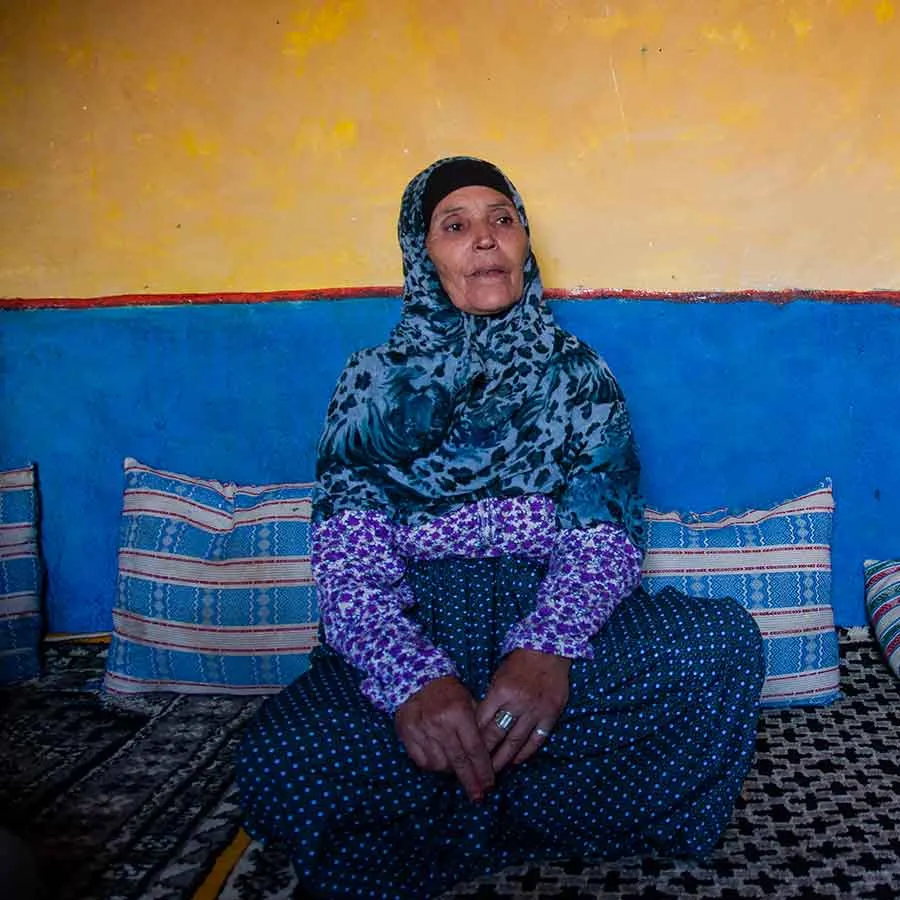
Today, Fadma is a grandmother. She cradles her nephews and nieces. She also cradles the memories of a life lived across the plains, mountains and fields of Iznaguen, her native village.
She looks back on her former life: a Berber girl whose world seemed confined to the boundaries of her own homeland. She wove beautiful carpets, tended a small herd nearby, fetched water from the river or the wells…
The years follow one another and merge together. Fadma reaches the age of married life. A hurried maturity. She leaves her village to live with her husband in Kourkouda, a small village 25 kilometres from Taznakhte. It is her destiny. She does not complain. Her duty as a faithful wife and responsible mother is fulfilled.
What remains of a life that was hers? The storm of time has swept everything away.
At fifty-five, painting becomes a spring
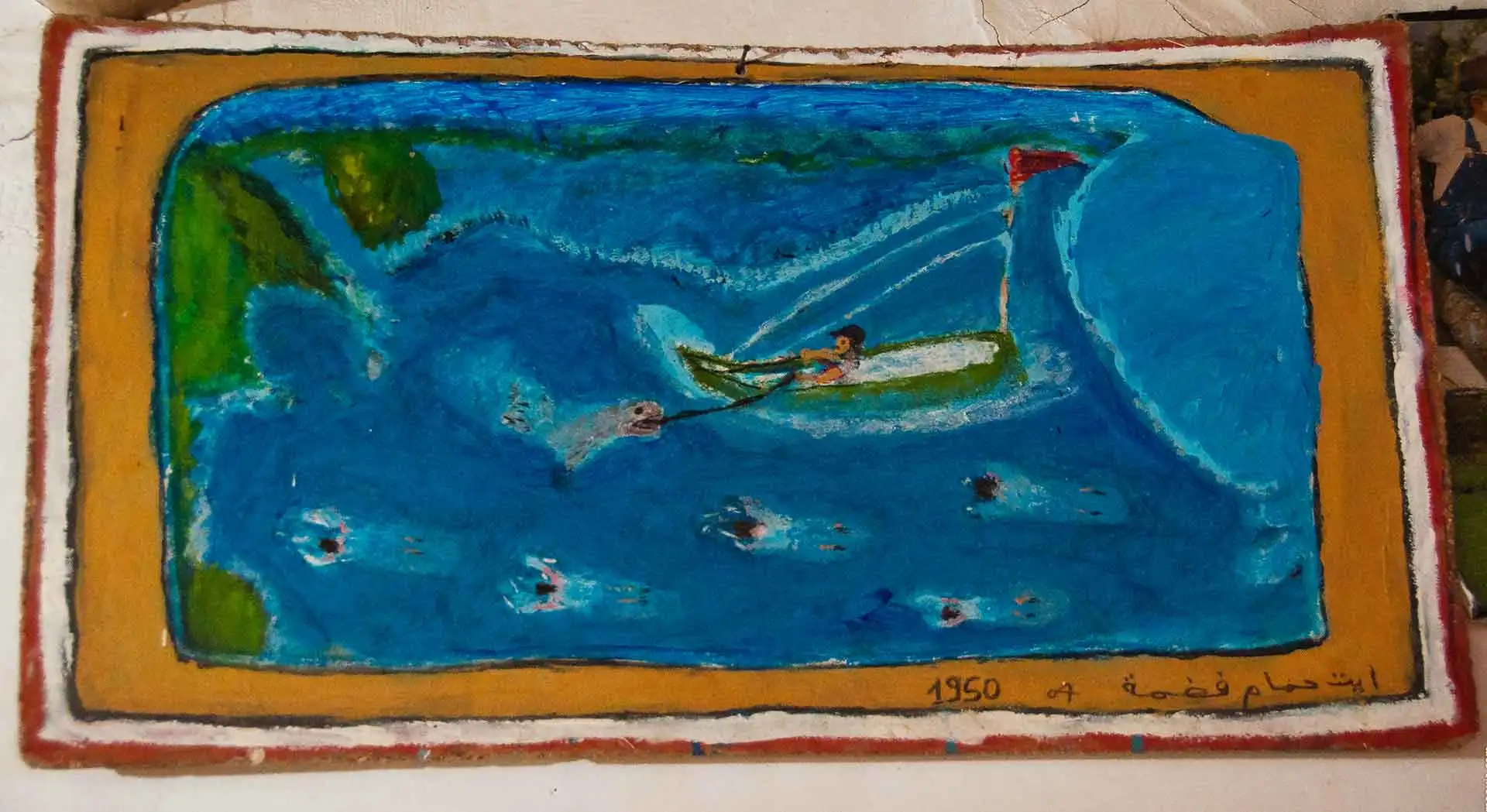
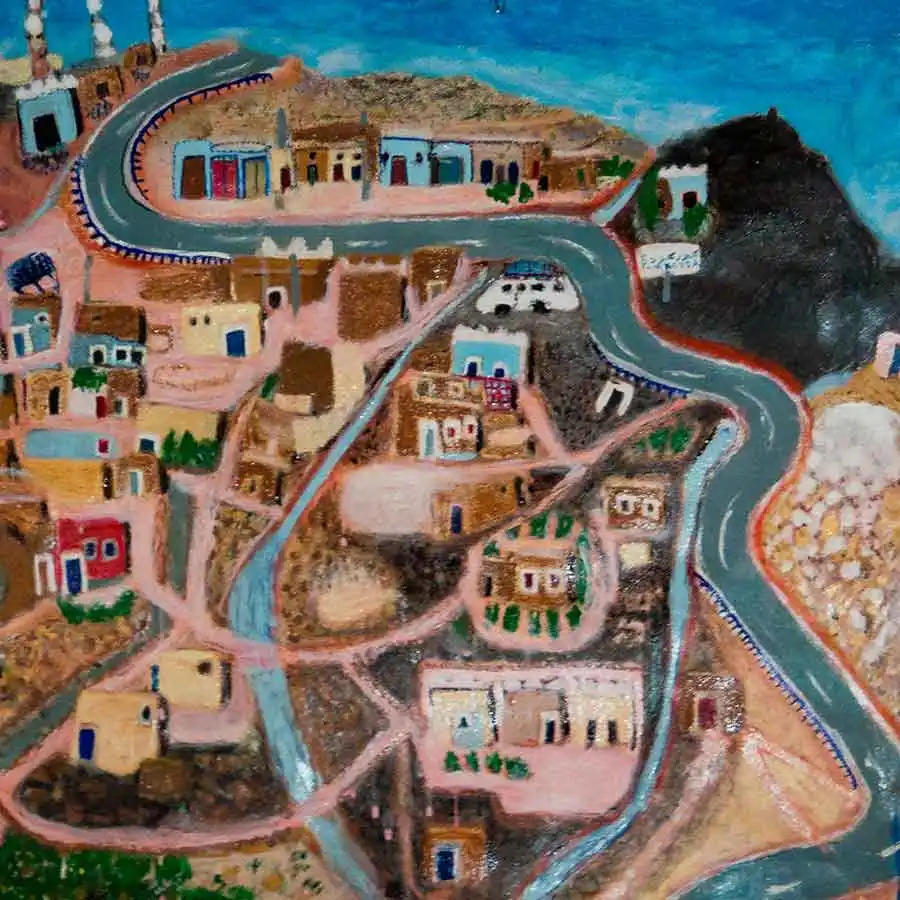
Her childhood and youth are now only images in her memory, rising into the light of remembrance before disappearing again into the opacity of oblivion, as though into an abyss. Without ever having foreseen it, or even thought of it once in her life, Fadma found her spring: painting. With her brush, she paints the words of her pain, revives her childhood memories and softens moments of bitterness.
At sixty-two, Fadma’s life has become a fountain. Her fertile imagination flows abundantly onto the canvas in the form of flowers, gardens, mountains and kasbahs. Much of what she has lived through, and much of the world around her, rises again to the surface, stirred by the desire to tell her life and her thoughts. In her home, one room serves at once as a guest room, a painting studio and an exhibition space for her work.
When literacy classes reveal an artist
Her discovery of painting is a recent story. In 2007, she was attending literacy classes at the school in her douar.
One day, the teacher asked his pupils, all of them women, to copy letters and words into their notebooks. Using coloured pencils, Fadma, still a novice at writing, scribbled something onto the page. Impressed by the drawing of a pupil more than twenty-seven years his senior, the teacher brought to light a talent that had until then remained hidden. He gave Fadma brushes, paints and canvases.
Since then, painting has become both a passion and a habit. Once finished, her paintings are hung in her guest room. Very shy by nature, she never dares to travel alone to take part in exhibitions.
In June 2012, the Professional Federation of Handicrafts paid tribute to her during the second handicrafts gathering held in Ouarzazate, in the presence of Mr Saleh Benyettou, Governor of Ouarzazate Province.
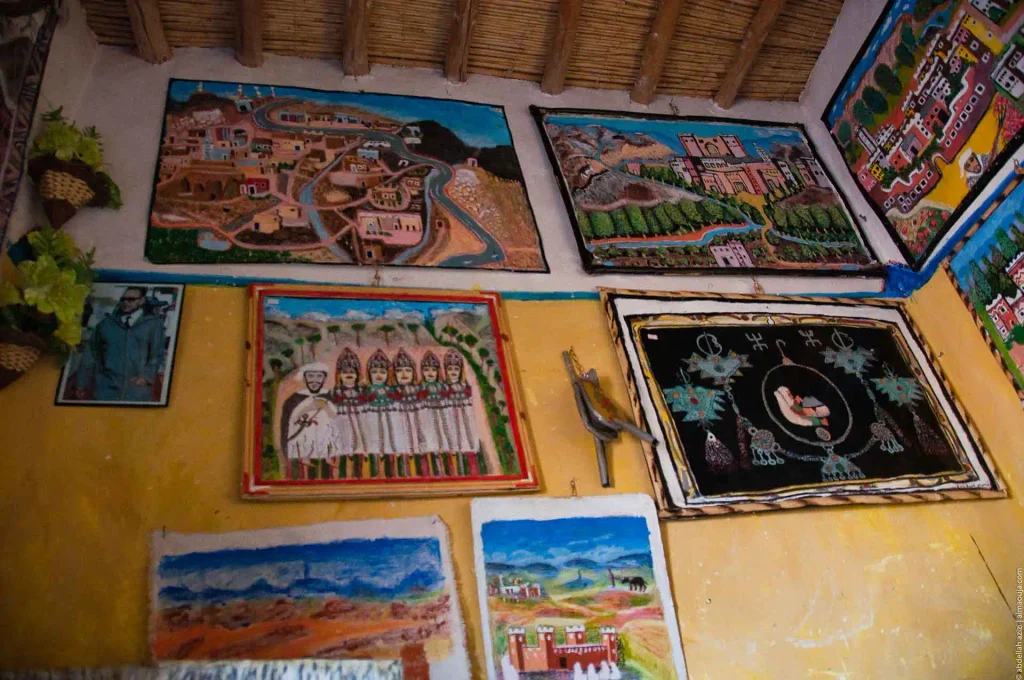
There is something striking about meeting a Berber woman who has become a painter at the age of sixty-two. Usually, women from the villages of the South are the favoured backdrop of postcards and photographs. Fadma chose instead to stand before the easel and draw her own world. Neither age nor time has diminished her talent.
Read also: The story of the women of Taznakhte woven into their looms
Crédit Photographie : Abdellah Azizi
www.azifoto.com
Editorial note
Since that meeting, Fadma Aït Hmam’s paintings have left the walls of her home. Her work has notably been shown in Rabat alongside that of the women weavers of Taznakhte, and later in a 2019 exhibition devoted to Les Tisseuses — The Weavers. Some of her works have also entered the international art market.
The portrait drawn by Abdeljalil Didi several years earlier therefore retains something precious: the story of the first steps of a woman who discovered painting late in life, before her work itself began to travel.

More to Explore

Leave a Reply