Near Ouarzazate, the earth of Tazouda yielded the bones of a dinosaur nearly 180 million years old. A remarkable discovery, a museum full of promise — and the beginning of an extraordinary story.
Overview
Morocco at the hinge of drifting continents.
Morocco, a storehouse of the history of life on Earth.
A discovery of worldwide scientific significance.
The urgent need to let this cultural jewel shine in Tazouda.
There are beautiful stories whose endings keep us waiting, as though to heighten still further our desire to one day savour the gifts of the Providence that inspired them. The story of the Tazouda dinosaur is one of those beautiful stories. It has cast a rare light over the territories of South-East Morocco — a light that deserves to be brought fully into view.
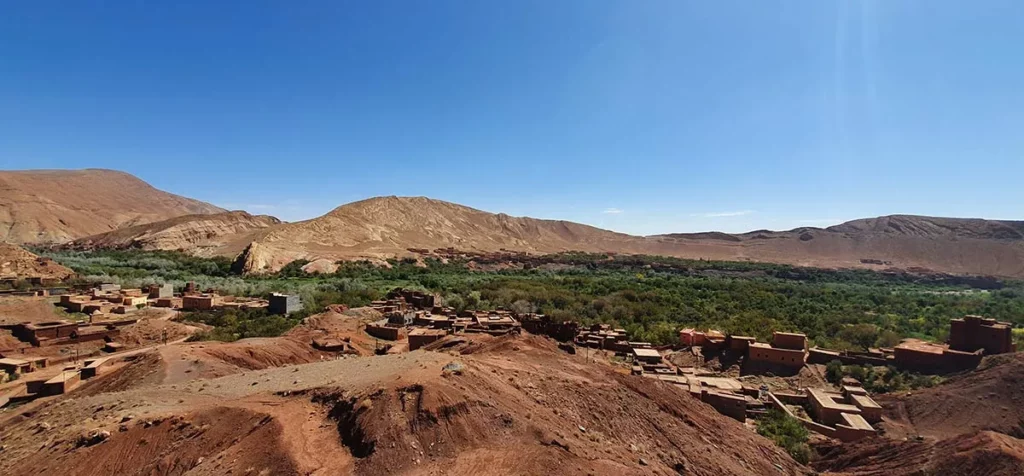
Located just a few kilometres from Ouarzazate, in the foothills of the High Atlas, the village of Tazouda one day saw emerge from its brown earth the bones of what would later be identified as the skeleton of the oldest dinosaur ever discovered in Morocco.
News of the discovery in 1998, followed by the results of excavations carried out between 2001 and 2007, made such an impression on the local population that everyone’s imagination — adults and children alike — began to sketch out a future in which this mysterious animal had a place, an animal that Hollywood had already turned into something of a hero.
The Tazouda dinosaur does indeed carry many promises. Above all, it offers a formidable lever for the development of the village and its surroundings through its obvious tourist appeal, helping to fill guesthouses and hotels. But it can also provide scientists with a source of knowledge about the history of our Earth, while offering schools a remarkable teaching resource.
And finally, this dinosaur adds another reason for Moroccans to take pride in the richness of their heritage.
The village of Tazouda, rural commune of Imi N’Oulaoune, Province of Ouarzazate
Dinosaur: the word derives from two Greek roots: deinos (δεινός), meaning “terrible”, and sauros (σαύρα), meaning “reptile” or “lizard”.
We knew the region was rich in fossils. We knew of the drawings engraved into rock by ancient hands. What we had not suspected was that South-East Morocco — this natural treasure of valleys, mountains, oases and deserts — had also once sheltered the hero of the most distant ages, the emblematic figure of those vast epochs when human beings did not yet exist on Earth.
And yet, nearly 180 million years ago, dinosaurs here in Tazouda breathed their last, sprawled on the sandy ground in a bend of a river. Their bodies disappeared and their bones slowly became covered with sediment.
Long afterwards, what remained of them allowed the aptly named Tazoudasaurus naimi to be reconstructed.
Morocco at the hinge of drifting continents
In those distant times, the dinosaurs inhabiting the lands that would one day become Morocco probably had little to complain about when it came to their natural surroundings.
The climate suited them well: tropical, warm and humid. Today’s rocky plateaux were covered in lush vegetation, crossed by numerous rivers and streams. Dinosaurs fed on the leaves of trees such as araucarias and large cypresses, as well as on giant ferns.
The Atlas Mountains had not yet formed. We are here at the heart of the geological era known as the Mesozoic, which extended from around 250 to 65 million years ago, a great period in the history of our planet formerly known as the Secondary Era.
The Mesozoic, from the Ancient Greek mesos (μέσο), “middle”, and zōon (ζῷον), “animal”, was formerly known as the Secondary Era or the Age of Reptiles. It was a geological era during which mammals and dinosaurs appeared.
Imagine Morocco at the beginning of this Secondary Era.
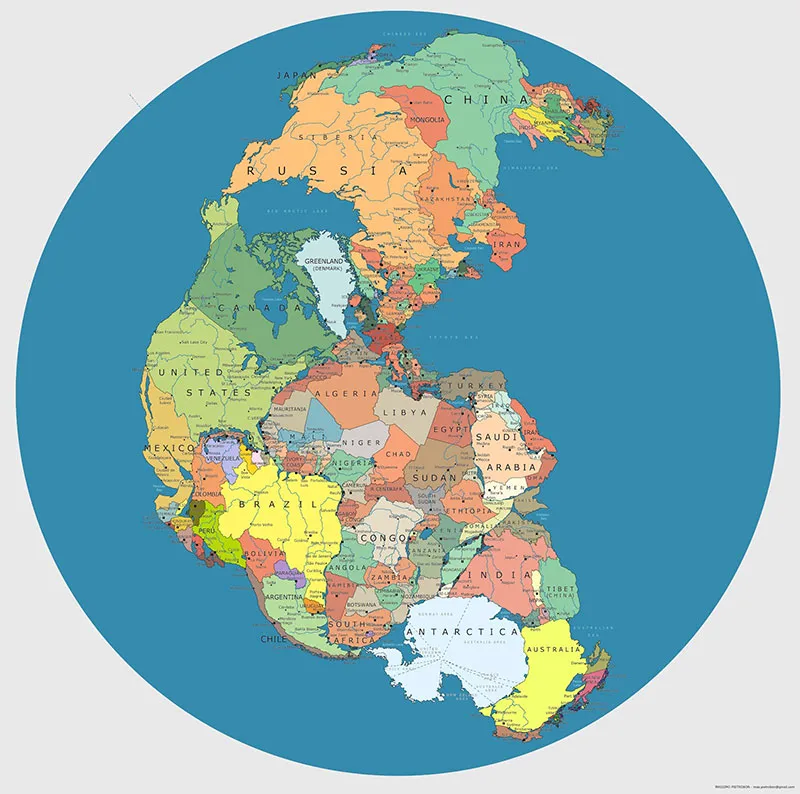
Over the preceding 200 million years, all the emerged landmasses had come together into a single block, an immense continental mass that we now call Pangaea, surrounded by a single ocean.
Morocco found itself isolated somewhere near the centre of this vast mass. The climate was dry and arid. Further south, the lands had just undergone an ice age lasting some 20 million years. Temperatures swung between extremes.
And then, for reasons unknown, as though obeying some invisible clock, this solitary continent began its slow dislocation. It twisted at its centre, almost splitting into two, and soon into five pieces.
The waters of the surrounding ocean seeped between the rocky masses. A marine corridor formed and, erosion after erosion, from east to west, from what would become Arabia to lands now lying in Central America, a new sea emerged: the Tethys. Much later, as its two extremities narrowed, it would become the Mediterranean Sea.
Morocco, once lost amid desert lands, came once more under the spell of the waves — and its climate changed.
Pangaea, literally “all lands”, takes its name from the Ancient Greek pan (πᾶν), “all”, and gaia (γαῖα), “earth”, which became pangaea in Latin.
Representation of current countries on the map of the Pangaea continent imagined by Pietrobon – Source: slate.fr
Morocco, a storehouse of the history of life on Earth
The presence of these great reptiles in Morocco had already been confirmed by numerous discoveries, as had that of the earliest terrestrial vertebrates, amphibians, still older reptiles and the first mammals.
Scientists know it: because of its geographical position, Morocco is a remarkable storehouse of the history of life on Earth.
The bones of the first large sauropod dinosaur were discovered in 1925 near El Mers, in the eastern Middle Atlas. In 1934, French scientists uncovered impressive footprints at the Aït Iouaridene site.
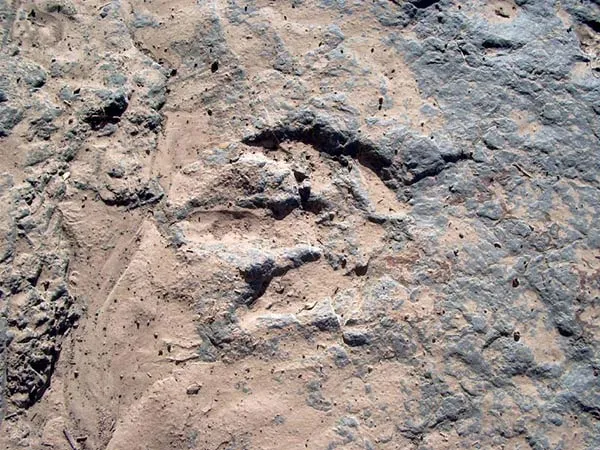
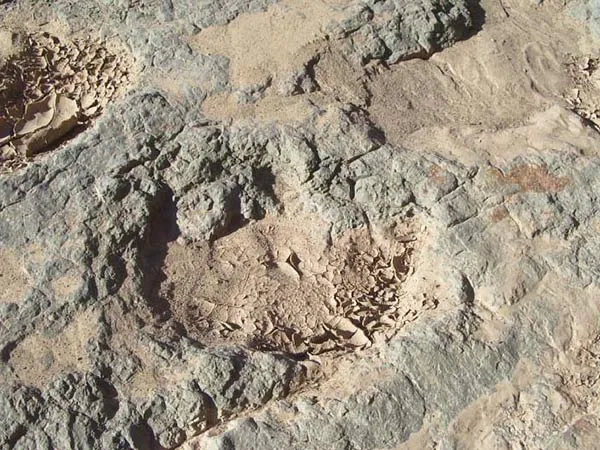
Between Demnate and Aït Bou Guemez, in the High Atlas, long dinosaur trackways have been found. Some footprints measure 115 centimetres long and 75 centimetres wide and belonged to herbivorous quadrupeds. Others are smaller but no less impressive, with three imposing toes, and were left by bipedal carnivorous dinosaurs.
These footprints, frozen into limestone ground once covered by water, bear witness to the extraordinary abundance of dinosaur life in Morocco, particularly in the regions that would later become the Atlas Mountains.
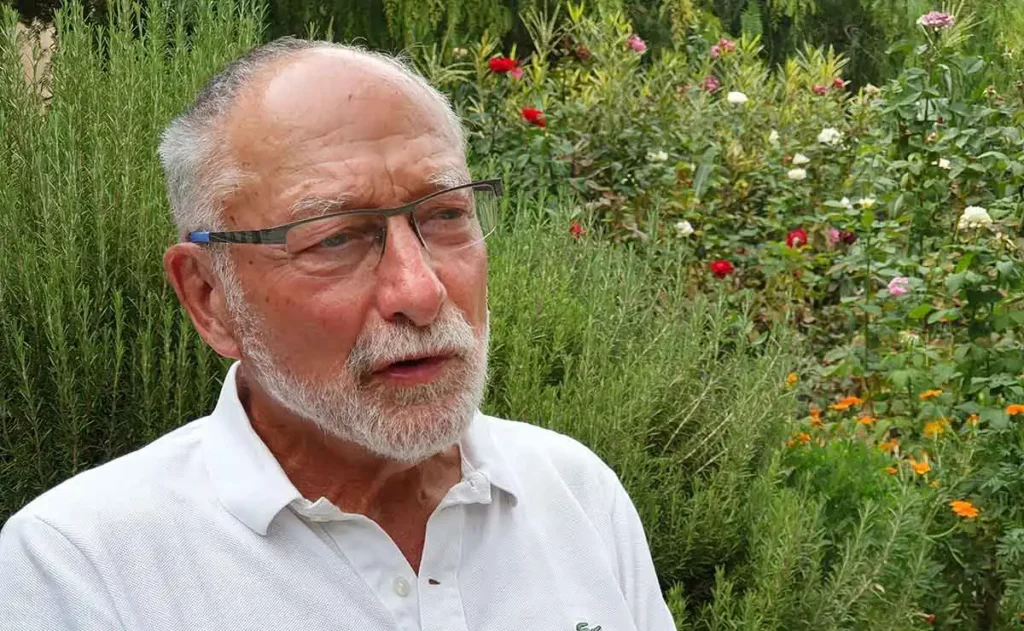
Michel Monbaron is an expert on the subject, and his scientific career is closely linked to the presence of dinosaurs in Morocco.
A Swiss geologist, he has been exploring the steep slopes of the High Atlas since 1976. In July 1979, near Tilougguit, he discovered the first bones of the “giant of the Atlas”, a massive dinosaur more than 18 metres long and six metres high, with fore and hind limbs measuring some 3.5 metres.
What makes the discovery particularly remarkable is that the skeleton is almost complete, apart from the end of the tail. Rarer still, it includes bones from the animal’s skull — extremely fragile elements that are often missing from such finds.
The specimen was named Atlasaurus imelakei and remains the most complete dinosaur skeleton of its kind found in Morocco.
Michel Monbaron, travelling in Morocco
A few years later, Michel Monbaron joined Najat Aquesbi, then head of the Geology Museum at Morocco’s Ministry of Energy and Mines; Professor Philippe Taquet of the Muséum national d’Histoire naturelle in Paris; Dale Russell of the Center for the Exploration of the Dinosaurian World in the United States; and Ronan Allain, a researcher at the same Paris museum.
Together they took part in the excavation of the bones at Tazouda, Monbaron’s task being to establish the most precise possible dating by studying their geological environment.
Plant debris — remains of ferns, cycads and conifers — had indeed been found alongside the bones.
It was Michel Monbaron who established a time frame of roughly 190 to 175 million years ago, towards the end of the Early Jurassic, thereby giving one of the finds — an almost complete jaw — the distinction of representing, at the time, the oldest known fragment of a sauropod skull anywhere in the world.
A discovery of worldwide scientific significance
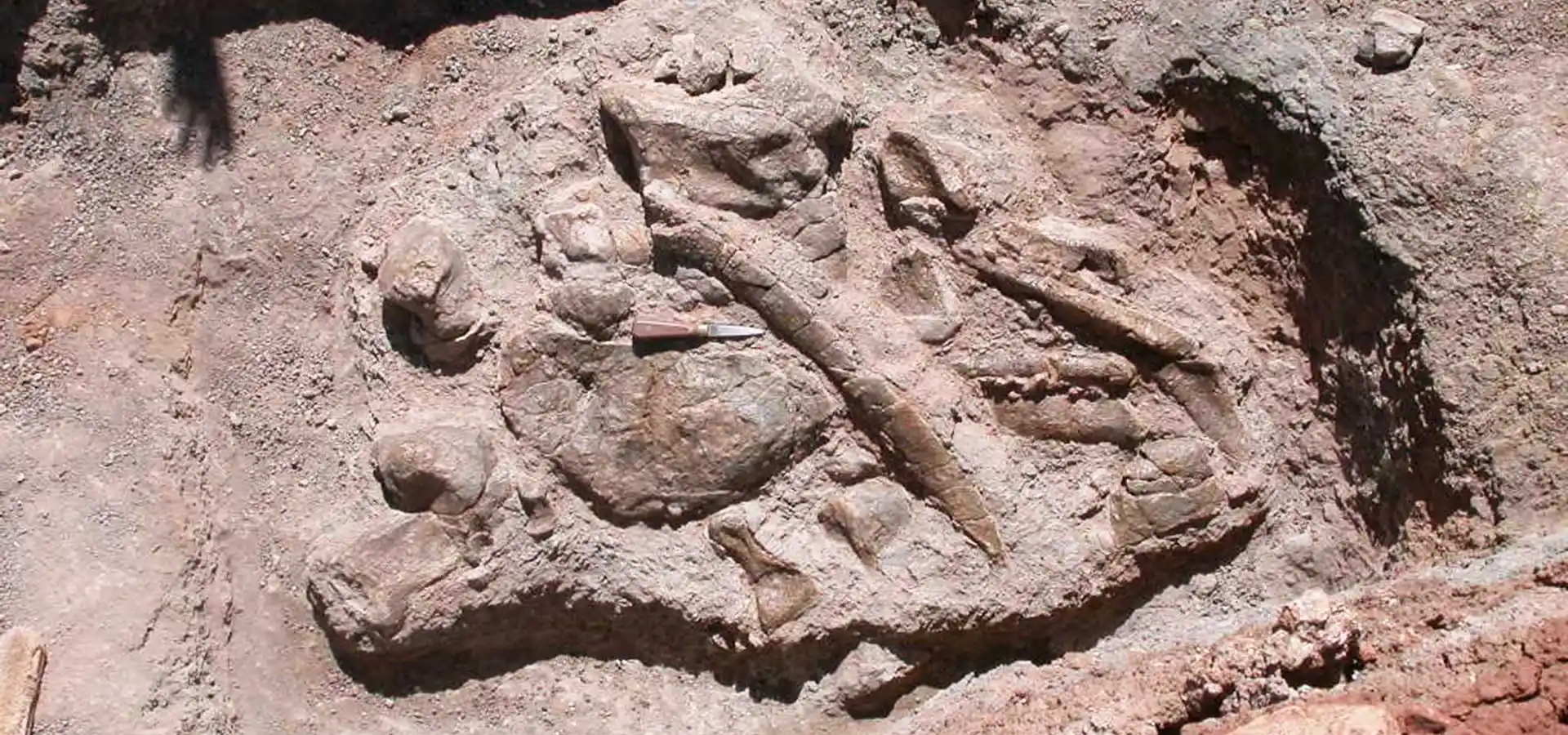
Between 2001 and 2007, excavations directed by Ronan Allain confirmed the exceptional importance of the Tazouda site. Nearly 600 dinosaur bones in a very good state of preservation were recorded, including elements of a skull and a lower jaw bearing 17 teeth.
Two dinosaurs were identified.
The first was a previously unknown herbivorous sauropod, named Tazoudasaurus naimi. The bones belong to at least ten individuals, ranging from juveniles to adults.
The second was a previously unknown bipedal carnivorous theropod, which was named Berberosaurus liassicus.
Tazoudasaurus naimi: the genus takes its name from Tazouda, the place where it was discovered, together with the Greek sauros, meaning “lizard”. The epithet naimi derives from the Arabic word for “slender”, referring to the relatively small size of this dinosaur.
What makes the discovery so exceptional is that continental deposits dating from the Early Jurassic — between roughly 199 and 176 million years ago — survive in very few places on Earth.
As a result, the history of dinosaurs from this period remains poorly understood. The scientific significance of the Tazouda discovery therefore reaches far beyond Morocco.
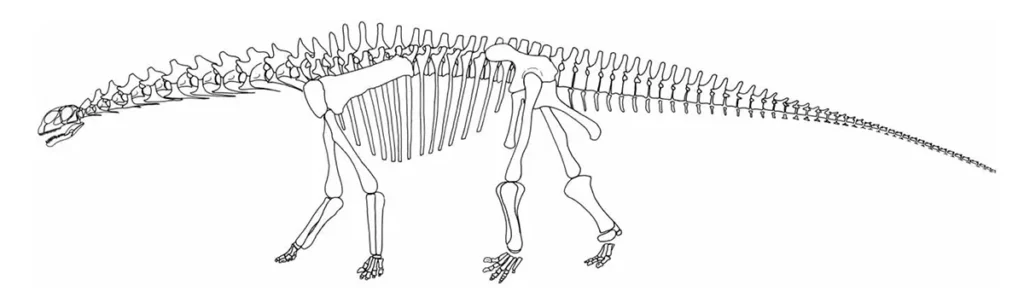
Reconstruction of the Tazoudasaurus naimi skeleton
Source: Karin Peyer and Ronan Allain (2010), “A reconstruction of Tazoudasaurus naimi (Dinosauria, Sauropoda) from the late Early Jurassic of Morocco”.
Michel Monbaron explains:
“The location and richness of the Tazouda deposit more than justified the construction of a museum on the very site of the discoveries, opening up some highly unusual possibilities… Visitors can reach the fossil-bearing slab itself and admire, in the very place where they were found, the shoulder blades, femurs, vertebrae…”
Michel Monbaron
Museums that allow the public to see fossils at the very place where they were discovered are extremely rare, and Tazouda was intended to become the first of its kind in Morocco.
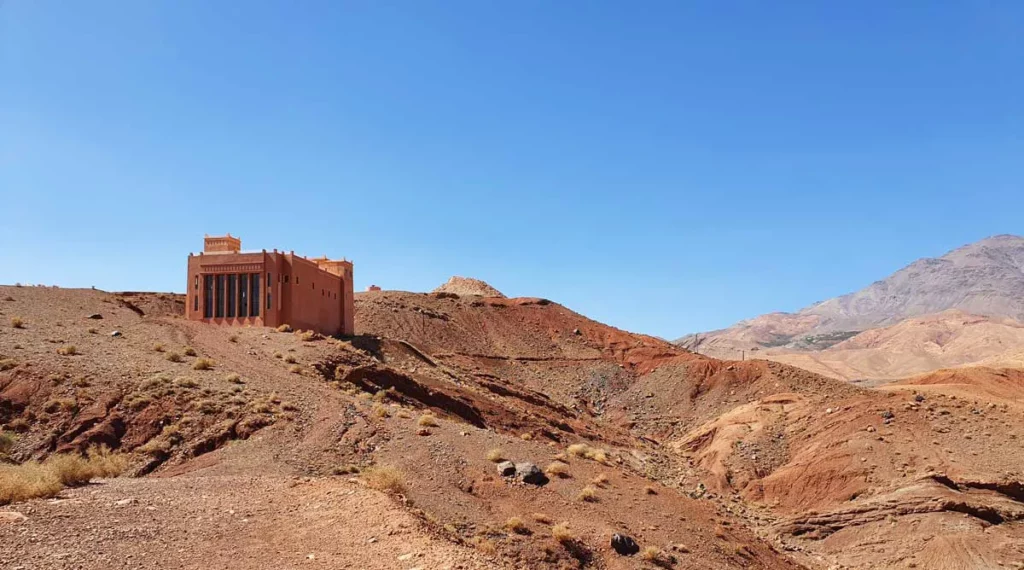
The building itself had already been constructed, notably thanks to a substantial financial donation from two French patrons, Danièle and Armand de Ricqlès. An association had been created to oversee the project and a scientific committee established, but the interior of the museum remained unfinished.
Moussa Masrour, coordinator of the museum’s scientific committee, explained that visitors would eventually be invited to follow a discovery trail beginning at the excavation site itself, with casts recreating the principal finds.
A life-size reconstruction of Tazoudasaurus was also planned.
Display cases would contain fossils, while information panels would explain the evolution of species and the environment in which the dinosaurs lived.
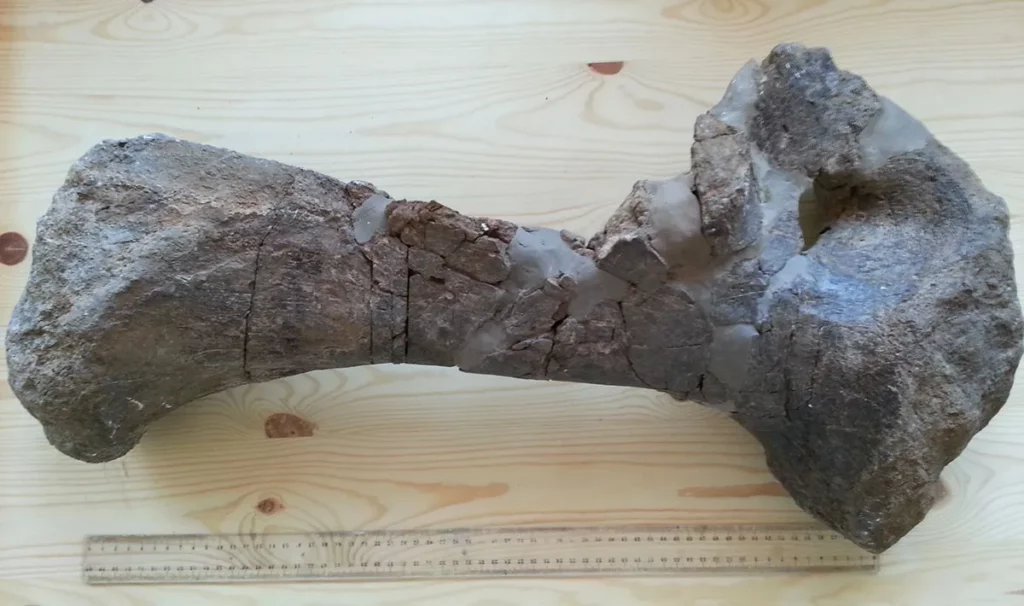
Tazoudasaurus naimi pubic bone
Once completed, the Tazouda museum was intended to complement the future museum at Azilal, on the other side of the Atlas Mountains, where the imposing skeleton of Atlasaurus imelakei would be presented to the public.
The Azilal museum was due to open in 2020 and become the focal point of the M’Goun Geopark, a vast territory promoted under the innovative UNESCO Global Geopark label, awarded in 2014, with the ambition of offering the public an exceptional presentation of the mineral, fossil and natural wealth of this extraordinarily history-rich region.
Linked in this way, the two museums devoted to Morocco’s dinosaurs would bring back into the light the lives once led by these great reptiles, which disappeared some 65 million years ago — in an age when the Atlas Mountains did not yet exist and plains frequently covered by water supported abundant plant and animal life.
The building of the future Tazouda dinosaur museum
South-East Morocco is indeed filled with traces of our planet’s immense past and remains an important reservoir of discoveries for international palaeontology.
Moussa Masrour also cites the Fezouata area around Zagora, where the remains of an exceptional Ordovician fauna can be observed, a site of worldwide scientific importance; the Kem Kem beds, with their extraordinarily diverse fossils of dinosaurs, spinosaurs, crocodiles and turtles; and the Agdz region, with its stromatolites.
The urgent need to let this cultural jewel shine in Tazouda
Completion of the museum devoted to Tazoudasaurus naimi had been postponed several times — first from 2011, then from 2015 — and no firm opening date was known.
Yet the future appeared full of promise.
The official responsible for the project, Lhouceine Maaouni, Provincial Director of Energy and Mines in Ouarzazate and the new president of the Tazouda Association, confirmed to us that, despite the accumulated delays, the project was once again moving forward, notably under the impetus of the Governor of Ouarzazate Province, Abderzak El Manssouri, a committed supporter of museum development.
All that remains is to hope that those responsible for the Drâa-Tafilalet Regional Council will finally open their eyes to the riches that Nature — and therefore Providence — has bestowed upon the region entrusted to them; and that they will take inspiration from their counterparts in Béni Mellal-Khénifra, who showed both vision and effectiveness in establishing the M’Goun Geopark, a remarkable tool for showcasing and promoting a territory.
Everything seemed at last to be falling into place for this cultural jewel to open its doors to the public and begin to shine on the lands of Tazouda.
First and foremost, it would benefit the local population, who placed great hopes in it — and rightly so — as what could become the flagship tourist attraction of Ouarzazate Province and a source of pride for the Drâa-Tafilalet region, and indeed for Morocco as a whole.
One day, the Tazouda dinosaur will truly awaken from its slumber and, before everyone’s eyes, receive the honours it is due.
This article was originally published in 2019.
P.S. — August 2026 Seven years later, the Tazouda dinosaur has still not awakened from its slumber. The museum is there, but remains empty. The skeleton that was taken to Rabat is no longer in Tazouda. And the beautiful building, raised around so much hope, now stands largely silent, with little but the wind passing through it.
For more than twenty years, Éric Anglade has lived in a village of South-Eastern Morocco, where he explores and documents the region’s history, heritage, and living traditions. He founded sudestmaroc.com as a space for sharing fieldwork and cultural insight, bridging local knowledge with global perspectives. He also works alongside women carpet-weavers to help sustain their craft and welcomes travellers at Le Jardin de Yuda, his guesthouse envisioned as a meeting place for exchange and transmission.
Your subscription is confirmed. See you soon on sudestmaroc.com.
Receive our periodic newsletter, featuring our latest stories, research and publications on the memories, cultures and territories of South-East Morocco.
For more than twenty years, Éric Anglade has lived in a village of South-East Morocco, where he explores and documents the region’s history, heritage, and living traditions. He founded sudestmaroc.com as a space for sharing fieldwork and cultural insight, bridging local knowledge with global perspectives. He also works alongside women carpet-weavers to help sustain their craft and welcomes travellers at Le Jardin de Yuda, his guesthouse envisioned as a meeting place for exchange and transmission.






Leave a Reply