


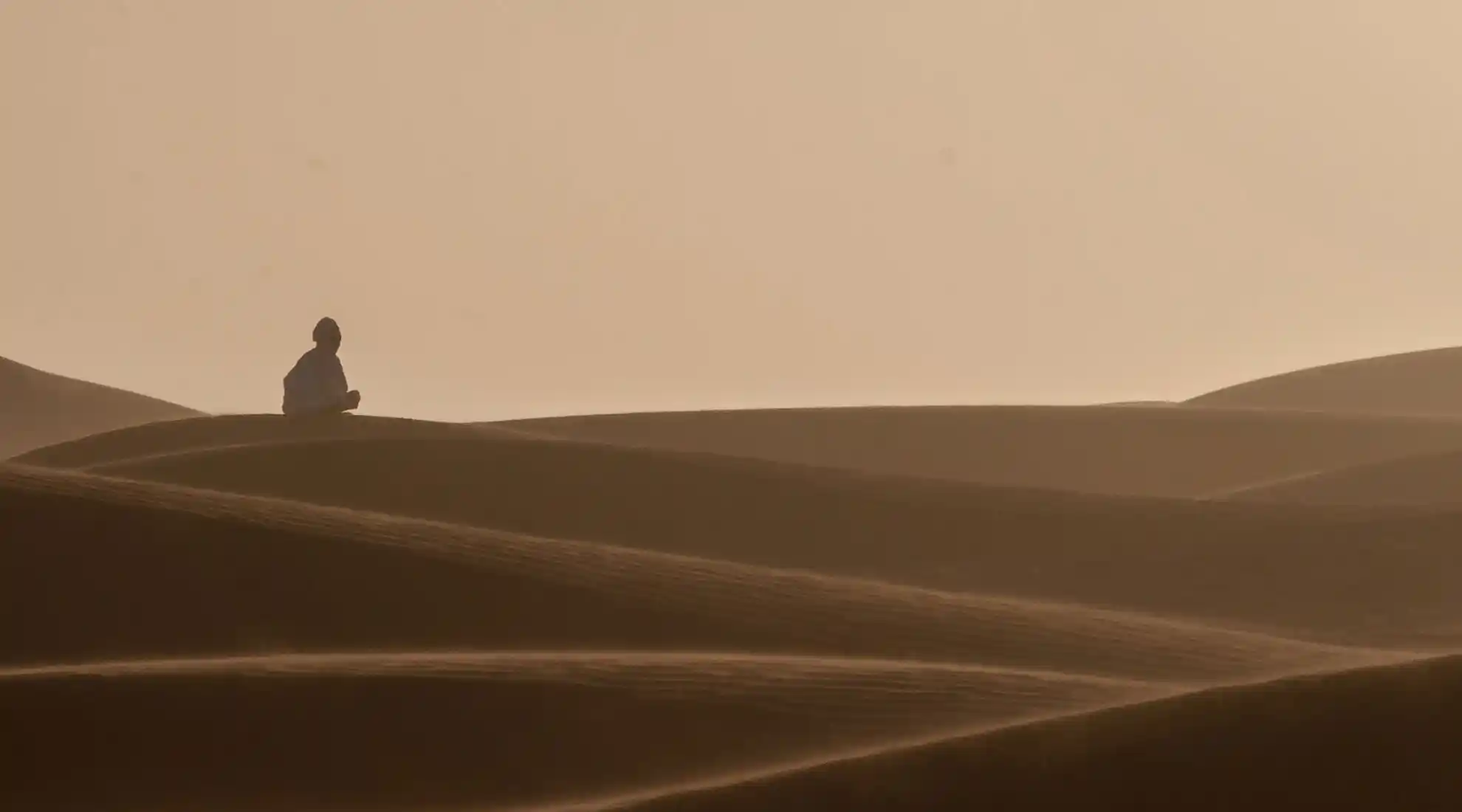
The Sahara, a mirror of the human adventure in Africa
Far from being the empty and motionless space imagined from afar, the Sahara has been, for thousands of years, a land of movement, encounters and transformation. Peoples, beliefs, languages, trade routes and ambitions have crossed there, making the desert not a margin of African history, but one of the places where the human adventure on the continent can be read most vividly.
Overview
- Once, the Sahara offered humankind a garden vibrant with life.
- The Sahara, crucible of the Berber peoples.
- The desertification of the Sahara and the birth of great nomadism.
- A history that must continually be told for what it reveals about our humanity.
Only the dunes seem to embody the reassuring movement of life, to such an extent that some have sought in this motionless eternity the one place where they might finally escape, forget everything about themselves and others, even lose themselves, erase their very existence. Adorned with the trappings of myth and exoticism, the desert displays a haunting beauty precisely because it is paradoxical, its charm becoming an abundant source of inspiration that provokes the senses, thought, and even the spirit.
And yet the desert tells its own story and reveals its secrets to the sincere gaze of an attentive traveller or someone accustomed to its landscapes. The French writer and poet Edmond Jabès bears witness:
‘Do not try to read in the desert. You would find there all the books buried in the dust of their words.’
Edmond Jabès
In reality, the Sahara Desert is a space where ethnic groups and peoples, customs and beliefs have constantly met and mingled. Every form of human desire has been exchanged there, alongside ideas and dreams, weaving over the centuries a majestic web between a Nature that remains imperious and human beings fiercely mounted upon their perpetual quest for wandering and refuge, clinging to their atavistic thirst for adventure, their insatiable need for power and wealth, or forever suspended in their aspiration to re-enchant their existence upon this Earth of suffering.
The word Sahārā means ‘vast area devoid of vegetation’ in Arabic.
The name Tiniri — or Ténéré — means ‘a vast extended plain, without mountain or dune, a flat desert’ in Tamasheq, the Tamazight language spoken by the local Berber populations also known as the Tuareg.
Ultimately, this immense territory, apparently empty, has represented an essential component of African history, both as a frontier and as a bridge between all the regions that surround it, from north to south and west to east, from the Maghreb to Egypt and across the countries of sub-Saharan Africa.
Once, the Sahara offered humankind a garden vibrant with life
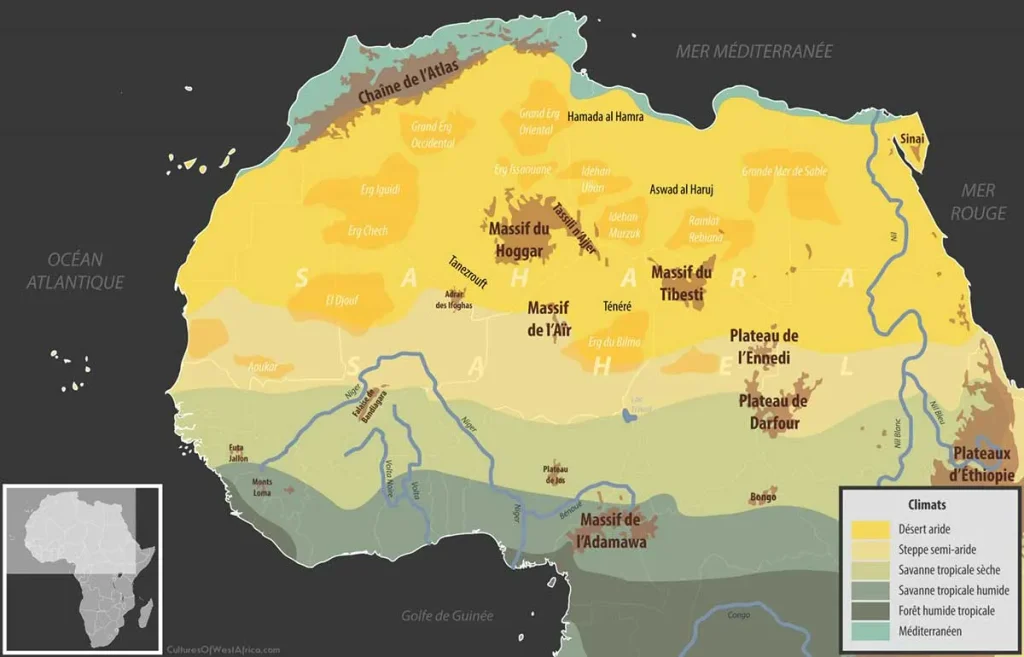
The Sahara is an immense desert covering most of northern Africa. Extreme scarcity of water, dwindling rainfall and an abundance of sand are the principal characteristics of this space. Yet the Sahara as we see it today bears little resemblance to what it once was. It is the territory of an extraordinary history of natural metamorphoses to which human life has continually sought to adapt.
One hundred million years ago, the Sahara lay beneath the waters of the palaeo-ocean Tethys. The regular cycle of glaciations then caused its lands to alternate between extreme aridity and luxuriant vegetation. But nearly 10,000 years ago, it settled for a time into more benevolent forms, becoming covered with lakes, rivers, forests and vast wooded savannahs or grassy plains inhabited by elephants, giraffes, great predators, crocodiles, hippopotamuses… There, human beings hunted and fished, harvested and gathered what nature placed abundantly at their disposal. The oldest testimonies to have reached us date back 8,000 years and consist of engravings on rock depicting hunters armed with bows and arrows pursuing game.
It was in this generous Sahara that human beings experienced, as other groups would elsewhere on the planet, the extraordinary existential transformation that gradually turned them into settled farmers and nomadic herders. Here, the Neolithic Revolution flourished. Domestic cattle began to appear in the engravings scattered across this still-green Sahara. Slender, dark-skinned people wearing small beards lived alongside others of lighter complexion, probably arriving from the East and bringing with them the horse and, later, the dromedary.
The Sahara, crucible of the Berber peoples
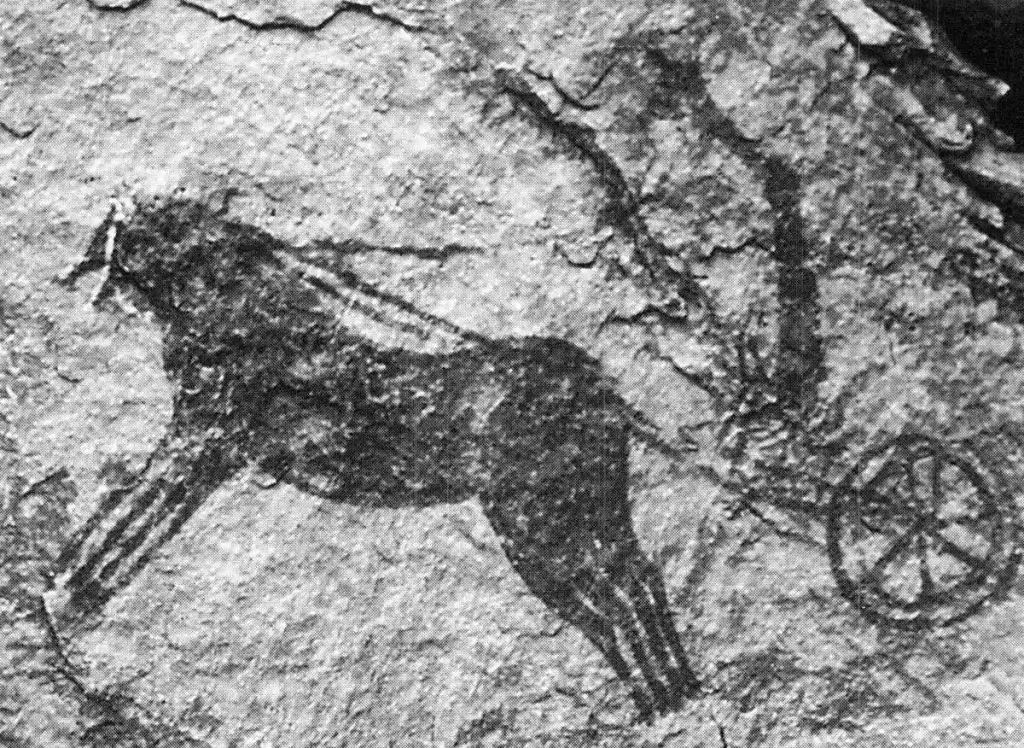
Around 6,000 years before the present, the Sahara entered a new phase of aridity that would steadily intensify until our own time. Hippopotamuses and elephants disappeared from the rock paintings of this period and were replaced by a form previously unknown there: the horse, shown harnessed to a two-wheeled chariot driven by warriors armed with javelins and shields.
The Prehistory of humankind slowly draws to a close and moves towards Antiquity. Human beings continue their adventure, forming peoples here and there, brought together by a shared language and common cultural practices. The Berber adventure can begin. The heart of the Sahara becomes its crucible, beating to the rhythm of the mingling of these emerging peoples. Funerary monuments and rock art now form the archive of all these human adventures born of the desert.
The first to develop an organised society with its own rules, customs and values are known as the Bovidian Proto-Berbers. Not only renowned as excellent hunters, they gradually asserted an identity as fearless warriors, endowed with a certain nobility of spirit carrying within it the germs of that Berber elegance which would unfold and flourish over the centuries. These early Berber peoples would evolve into others subsequently known as Libyans, Garamantes and Gaetulians. One particular group would become emblematic of the Sahara. Known at the time as the Imohagh, they would later be called Tuareg by the Arabs. A people whose faces were veiled, they preserved the use of Libyco-Berber writing, which would become Tifinagh, from Antiquity to the present day.
Others still, such as the Zenata and the Sanhaja, confederations of nomadic Berber tribes of the Sahara, would exert a major influence on the history of North Africa. The Zenata were directly involved in the foundation of Sijilmassa, the great medieval city of the Sahara. The Sanhaja, meanwhile, were at the origin of the powerful Almoravid dynasty, which ruled during the eleventh and twelfth centuries over the whole of the western Maghreb and the land of Al-Andalus on the Iberian Peninsula.
The Sahara would witness the emergence of many other great cities, such as Tegdaoust, capital of the Berber kingdom of Aoudaghost in present-day Mauritania, founded in the ninth century and conquered by Ghana in 990; the city of Tahert in Algeria, whose name derives from the Berber word meaning ‘lion’; Tadmekka, meaning ‘resembling Mecca’ in Berber; or Essouk, ‘market’ in Arabic, the former capital of the Adagh in Mali, populated predominantly by Berbers. There was also Ghadamès in Libya, known as the ‘Pearl of the Desert’, and finally Chinguetti in Mauritania, renowned as the ‘city of libraries’.
During the Middle Ages, the Sahara witnessed the formation of several empires, including those of Ghana and Mali, the Songhai Empire in West Africa, and the Kanem-Bornu Empire, extending across territories that today belong to Niger, Libya and Chad. These empires based their power on their mastery of Saharan life and therefore on the trade in gold and other goods along the trans-Saharan routes.
Read also: Sijilmassa, the mythical city that made the true heart of the Maghreb shine
The desertification of the Sahara and the birth of great nomadism
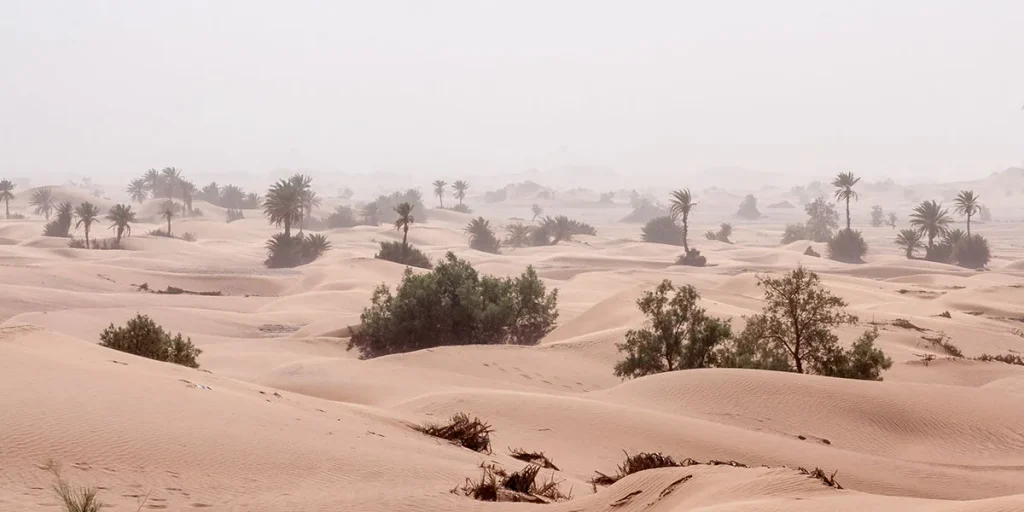
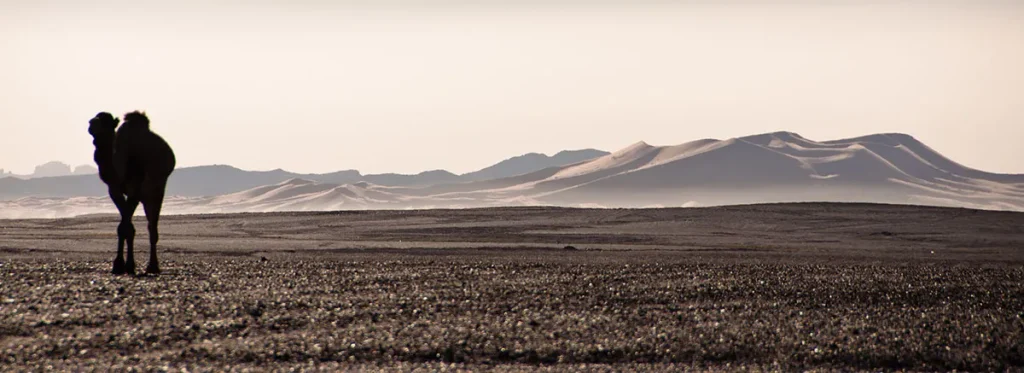
Over the centuries, the Sahara transformed from savannah into barren desert. This long period of drought led to the disappearance of much of its plant and animal biodiversity. Saharan populations were therefore forced to migrate towards more favourable peripheral regions, gathering in the oases along the edges of the desert, the rare patches of greenery where cereals and vegetables could still be cultivated. This transformation in the relationship between people and the territory in which they lived marked the emergence of great nomadism in the Sahara. Now inhabited by nomads determined to remain free by adapting to the harshness of the desert, the Sahara would henceforth become an ocean crossed by caravan routes.
At first, these tracks across the desert were known as the chariot routes, such as the one opened by the Berber Garamantes between the cities now known as Tripoli and Gao. The arrival of the Phoenicians and the creation of Carthage nearly 2,800 years ago launched the slave trade across the desert sands, which, alongside gold and salt, would become one of its most lucrative forms of commerce. The Greeks and Romans developed trading posts throughout North Africa, but it was from the Muslim conquest, beginning in 647, that cultural and commercial relations between the Maghreb and Saharan and sub-Saharan Africa would expand on every level.
At the beginning of the eighth century, Ibadi Berbers became the principal architects of the expansion of long-distance trade. They established all the elements necessary for this commerce, opening various caravan routes and controlling caravan terminals both north and south of the Sahara, a position they maintained until the middle of the thirteenth century.
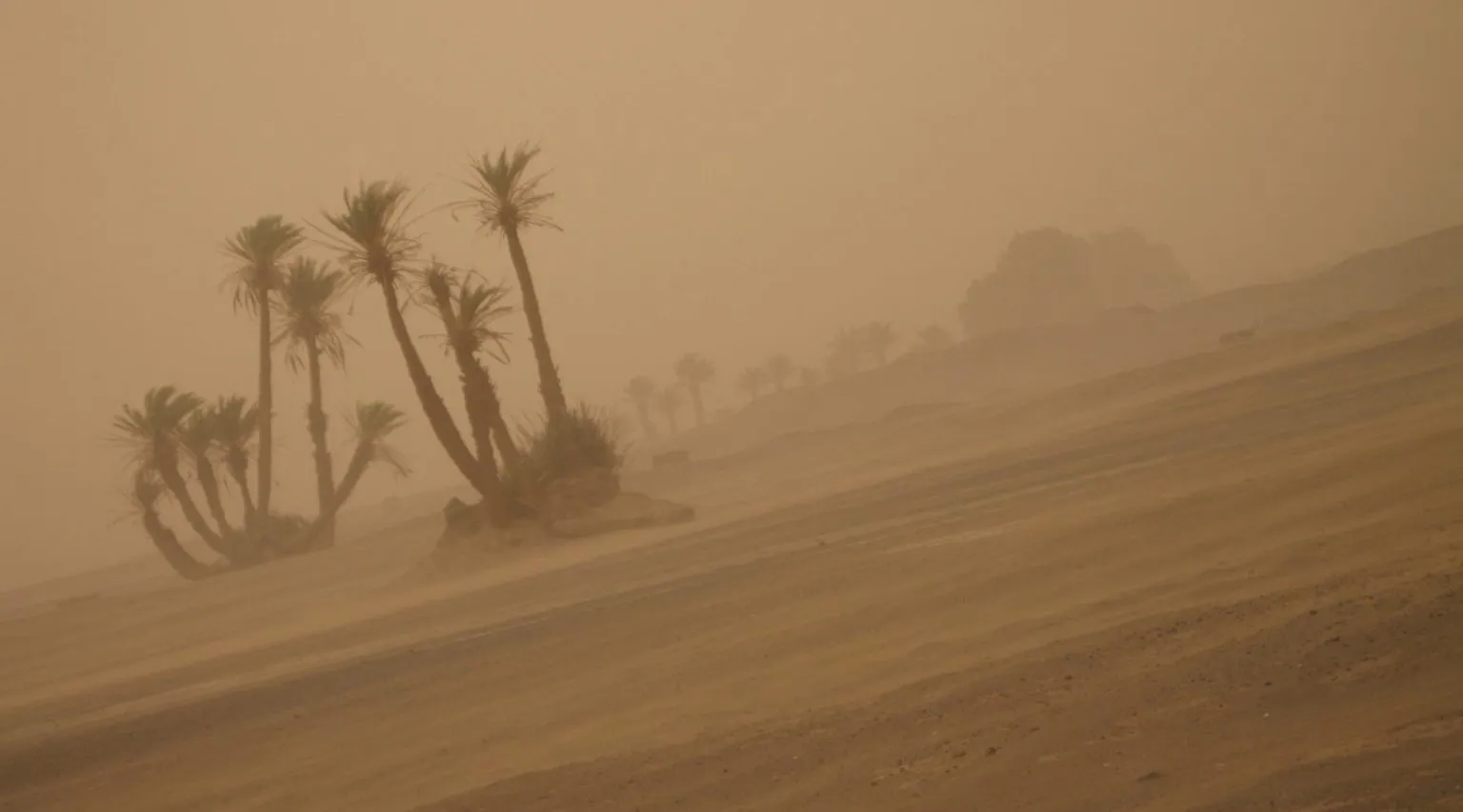
The progressive development of maritime trade and colonial expansion would bring about the lasting decline of trans-Saharan exchanges and the gradual impoverishment of the populations involved. The arrival of Europeans would revive interest in the Sahara to some extent, above all through the prism of exoticism, without ever enabling it to recover its former splendour. Interest in the mineral resources beneath the Saharan soil would remain an inescapable constraint.
A history that must continually be told for what it reveals about our humanity
Sudestmaroc.com will tell, article by article, the story of this extraordinary Sahara, forever evolving since the dawn of time: birthplace and place of growth of peoples and civilisations, a space of human encounter and intermingling, a crossroads of ambitions and aspirations. A journey through time to explore the history of our humanity in Africa, and the African dimension within the humanity of the Maghreb and Morocco in particular.
An illumination capable of fostering recognition and reconciliation with our shared history, so that once again, upon the satin sands of the great Sahara, the thousand-coloured reflections of the true face of our humanity may shimmer.
Key points
- The oasis is the product of a collective intelligence based on shared water, adaptation and solidarity.
- In Morocco, oases are declining because of climate change, rural exodus, overuse of resources and the loss of traditional knowledge.
- Preserving oases means more than planting palm trees: it means sustaining a civilisation and its balances.
- The oasis carries within it principles that may help shape the future: restraint, shared responsibility and a more balanced relationship with the living world.

More to Explore

Leave a Reply