


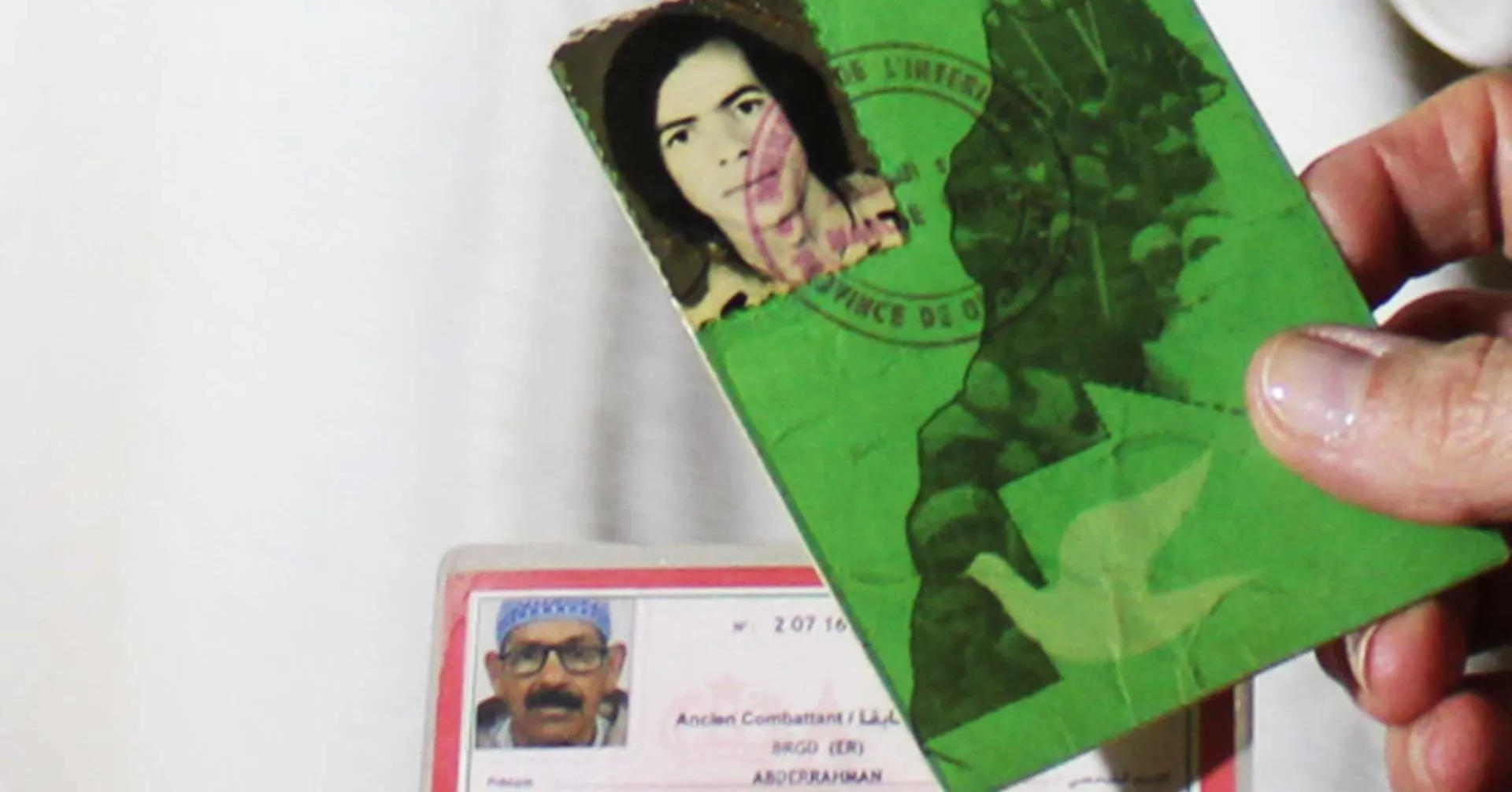
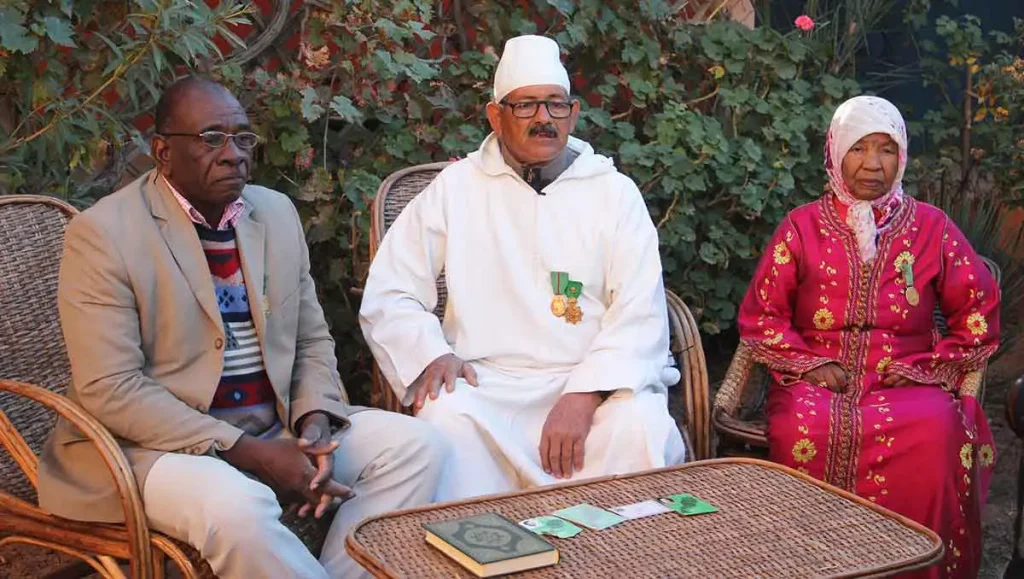
Ouarzazate at the heart of the Green March: three participants tell their stories
In November 1975, across all the provinces of Morocco, delegations were formed before setting out for the South. Like streams flowing from different territories, their convoys converged on Tarfaya and towards the same horizon. Among those who left from Ouarzazate were Mouloud Jghou, Abderrahmane Moussa and Fatoma Ghouate. Recorded in 2019, more than forty years after the events, their memories tell of the preparations, the journey, life in the camps and the crossing of the border. Three personal accounts brought together in a written document and a rare video.
Article written in 2019, republished and expanded in 2026.
Overview
- The Green March of 1975: a few key points.
- In Ouarzazate, the call to join the Green March.
- Delegations from across Morocco.
- From Ouarzazate to Tarfaya, the road of the convoys.
- In the Tarfaya camp, a collective life takes shape.
- 6 November 1975: walking towards the border.
- In Abderrahmane’s memory, Ouarzazate moves to the front.
- Tamimounte, a woman in the memory of the marchers.
- Mouloud remembers the soldiers on the hills.
- Fatoma recalls the women walking alongside the men.
- Three voices of the Green March preserved on video.
The Green March of 1975: a few key points
After Morocco gained independence in 1956, the Kingdom continued the process of recovering territories that remained under Spanish administration. Tarfaya was reintegrated in 1958, followed by Sidi Ifni in 1969. The question of Western Sahara, still administered by Spain, nevertheless remained unresolved within the wider process of decolonisation. Morocco then brought its claims before international institutions and asked the International Court of Justice to rule on the links that had existed, before Spanish colonisation, between the territory and the Kingdom. In its advisory opinion delivered on 16 October 1975, the Court recognised the existence of legal ties of allegiance between the Sultan of Morocco and certain tribes of Western Sahara. It nevertheless considered that the evidence examined did not establish a link of territorial sovereignty capable of setting aside the application of the principle of self-determination.
In the hours that followed, King Hassan II announced the organisation of a peaceful march towards the Sahara. The departure was set for 6 November 1975. According to the official Moroccan chronology, 350,000 volunteers, including 35,000 women, took part in the Green March. The call to the population prompted an extraordinary mobilisation. In cities, villages and rural areas, women and men registered to join the delegations being formed in each province. In Ouarzazate, as elsewhere, many felt that history had suddenly summoned them to a rendezvous.
‘There remains, my dear people, only one thing for us to do. We must undertake a Green March from the North of Morocco to its South, and from its East to its West… We must, my dear people, act as one man, in order and discipline, and reunite with our brothers.’
The late King Hassan II
In Ouarzazate, the call to join the Green March
The provinces of South-East Morocco were widely represented. Participants from Ouarzazate, Errachidia, Tinghir and Zagora joined the other provincial delegations making their way south.
Mouloud Jghou, Abderrahmane Moussa and Fatoma Ghouate, all three from Ouarzazate, were among them. Decades later, each retained a deeply personal memory of the days during which preparations for the Green March were under way.
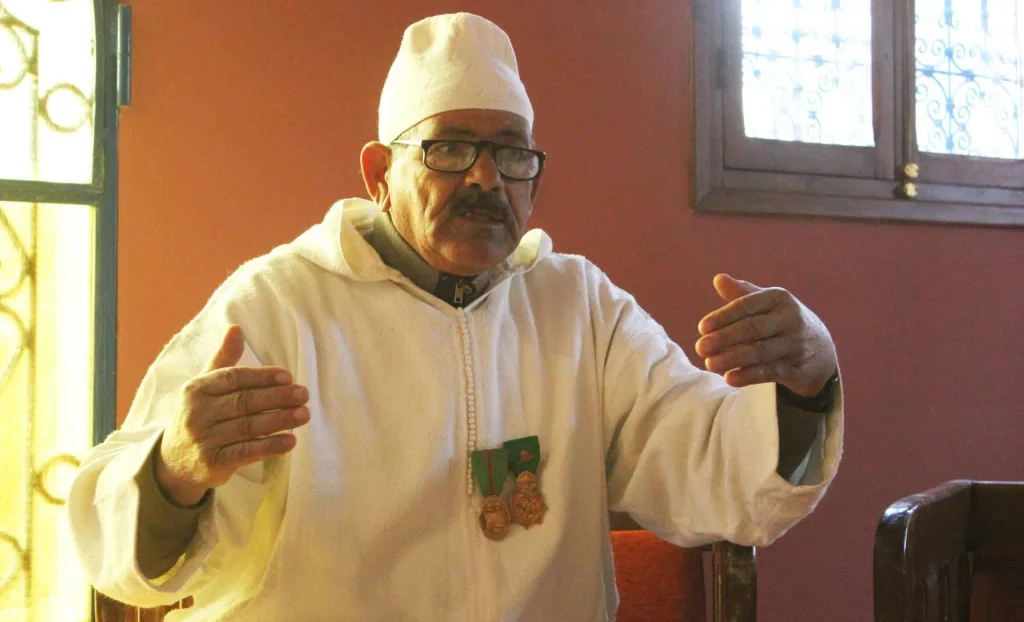
Abderrahmane Moussa was 25 years old in 1975. At the time, he worked as a tour guide. He remembers a genuine collective fever in Ouarzazate: conversations, registrations and preparations seemed to revolve around a single idea, that of taking part in the March. He registered as a volunteer and joined the provincial delegation.
Mouloud Jghou was then living in France. Newspapers, radio and television there were reporting on the preparations. Like many Moroccans living abroad, he followed events from a distance. But the emotion stirred by the announcement of the March was such that he decided to return to Morocco and register as a participant as soon as he arrived.
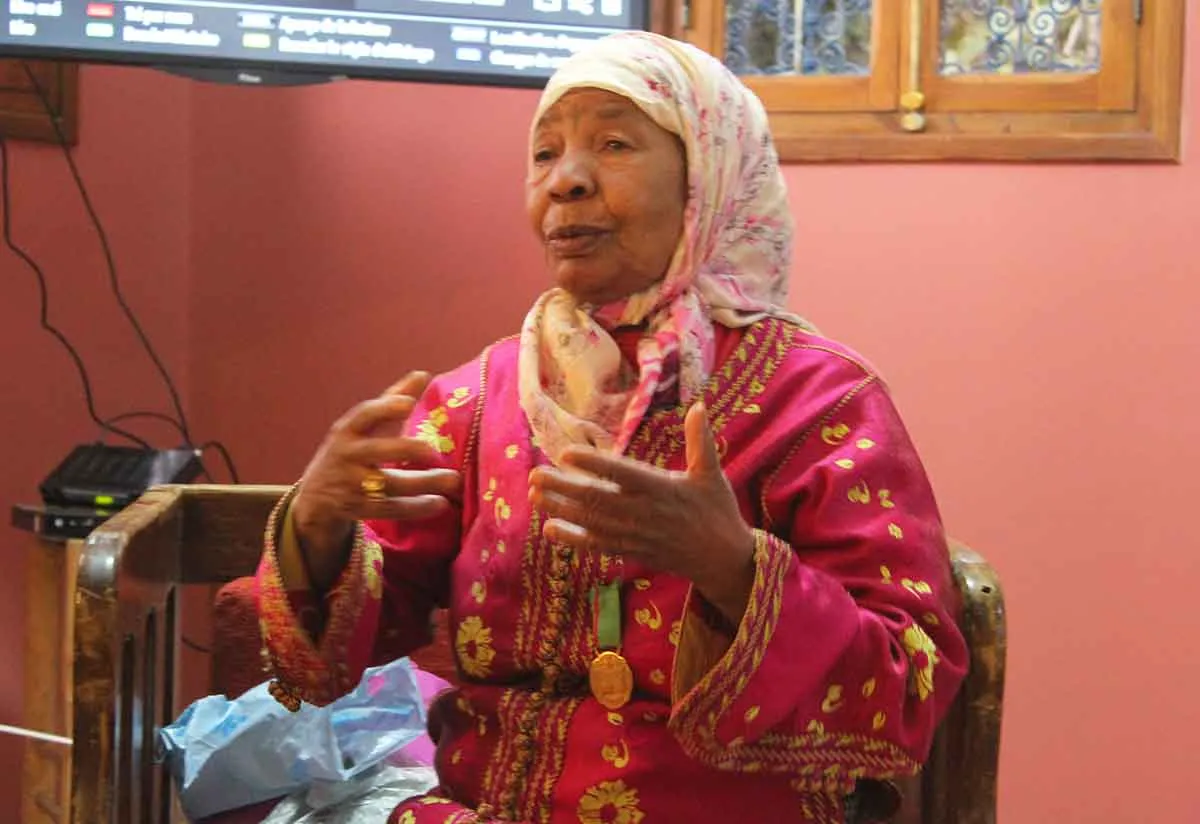
Fatoma Ghouate, a native of the Kasbah of Taourirte, also answered the call. Her decision was not the result of long reflection: she recalls simply following the momentum of the moment and the conviction that she had to take part, alongside the men, in an event that was mobilising the entire country.
Delegations from across Morocco
The participants were grouped according to their province of origin. Each delegation was identified by a letter: Errachidia bore the letter A and Ouarzazate the letter B, according to the memories gathered from the three witnesses.
This organisation gave the Green March its distinctive form. The movement did not begin in a single place. It arose simultaneously in every region of the country.
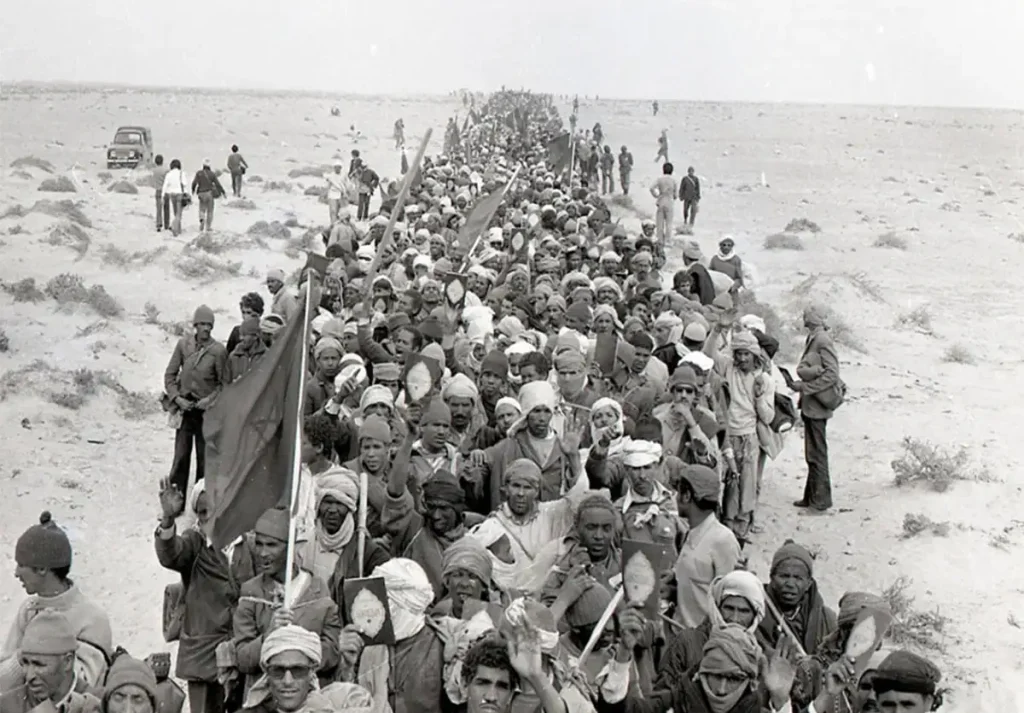
Groups formed in cities, oases, valleys and rural areas. They then joined the main roads, gradually merging into a much larger whole. Like streams descending from territories far removed from one another, the delegations converged towards the South until they formed a single human river.
The volunteers from Ouarzazate thus set out as part of their own convoy, with their own leaders, their own organisation and the sign by which their province could be recognised.
From Ouarzazate to Tarfaya, the road of the convoys
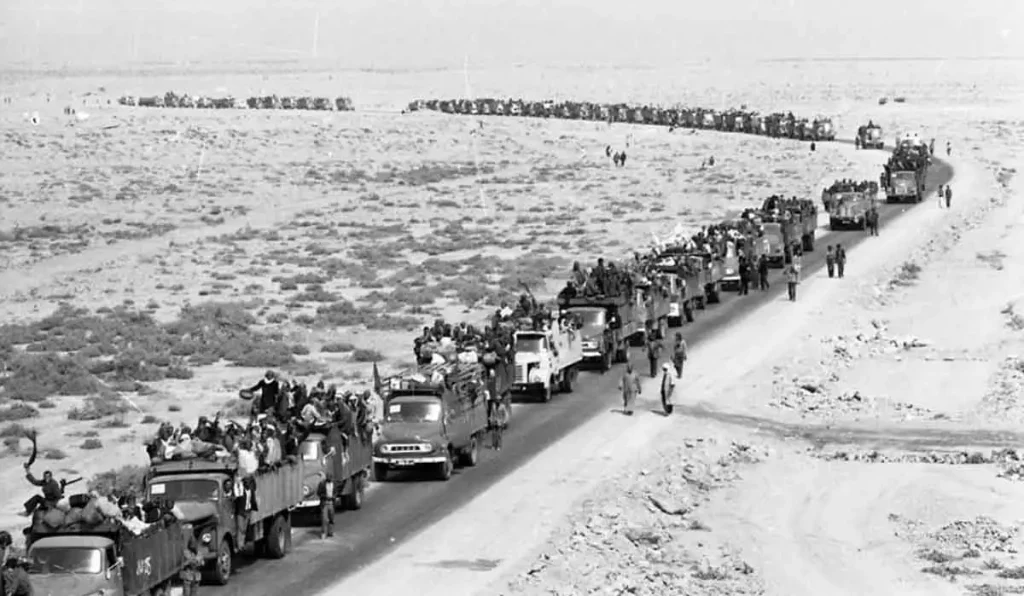
The convoys from Ouarzazate and Errachidia passed through Agadir, Tiznit and Guelmim, among other places, before continuing towards Tarfaya. To avoid congestion, several hours separated the passage of the different groups.
The lorries regularly stopped outside towns and villages. Throughout the journey, inhabitants gathered along the roadsides to greet the participants. Fatoma particularly remembers these crowds cheering the convoys and sometimes sharing part of their provisions with the marchers.
As the lorries moved on, the landscapes changed and the distances grew longer. But the road itself was already part of the event. The songs, flags and gatherings encountered in every town and village gave the participants the feeling of being carried along by a mobilisation that extended far beyond their own delegation.
Tarfaya was the last major stopping point before the border. An immense network of camps had been set up around the town to accommodate volunteers arriving from all over Morocco.
The camp allocated to the province of Ouarzazate was, according to the witnesses, beside the ocean, around seven kilometres from the centre of Tarfaya. The Royal Armed Forces and the civil administration had put in place an organisation intended to receive, supply and supervise the participants.
In the Tarfaya camp, a collective life takes shape
Mouloud recalls being given responsibility for a section of the Ouarzazate delegation. He had to keep the list of members up to date, organise the distribution of provisions and respond to the daily needs of his section. In his memory, supplies were shared without difficulty and everyone contributed, in their own way, to the life of the group.
Abderrahmane also recalls the importance of supplies: water, bread, vegetables, fish and dates were brought into the camps. He also remembers military aircraft sometimes dropping sacks of bread over the camp.
Fatoma describes a collective life that quickly took shape beneath the tents. The women notably built traditional earthen ovens in which to bake bread. She would go out to collect wood and sometimes return with meat and dates given to her by Moroccan soldiers.
She remembers with amusement that she ate a great deal during her stay and put on a noticeable amount of weight. Behind the immensity of the national mobilisation, her account reveals a very concrete reality: finding wood, preparing meals, baking bread and sharing provisions.
As the days passed, the camp became a temporary city. The groups arriving from different regions brought with them their songs, dances and traditions. Amazighs, Arabs and Sahrawis came together in shared celebrations in which each delegation displayed a part of its own territory.
For the three witnesses, then, the Green March was not simply a progression towards a border. It was also the experience of an immense community, made up of people who did not know one another but were learning to live, wait and act together.
6 November 1975: walking towards the border
On the evening of 5 November, King Hassan II addressed the participants gathered in the South and the Moroccan population as a whole:
‘Tomorrow, you will cross the border. Tomorrow, you will begin your March.’
The late King Hassan II
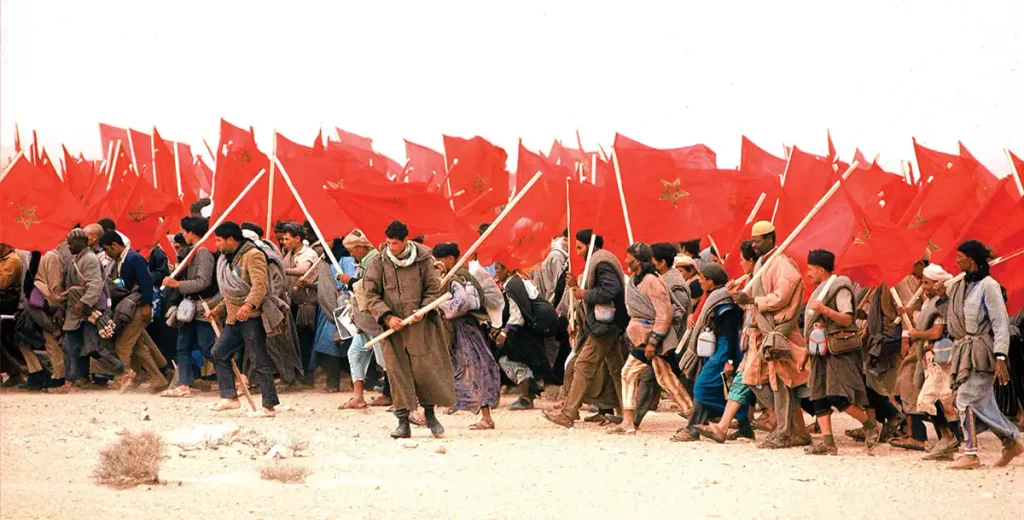
The following day, the delegations left their camps and advanced towards Tah and the border line. The participants walked unarmed, carrying Moroccan flags and copies of the Qur’an.
It is from this point onwards that the three testimonies become particularly valuable. They do not offer a bird’s-eye view of the event, but rather what each person saw, heard or felt from within the crowd.
In Abderrahmane’s memory, Ouarzazate moves to the front
Abderrahmane brings back to life the moments he spent in the camp:
‘Those in charge supplied us abundantly with all kinds of food: water, bread, vegetables, dates, fish… Military C-130 aircraft sometimes dropped sacks of baguettes over the camp…’
Abderrahmane Moussa
Abderrahmane recalls that the Errachidia convoy was initially ahead of the Ouarzazate convoy. Explosions heard in the distance are said, however, to have caused a moment of hesitation among the first marchers, who feared Spanish gunfire.
According to his account, the Ouarzazate delegation then passed them and took the lead in the procession, followed by the delegation from Kénitra. Its members advanced as far as the barbed wire marking the border and were among the first to cross it.
‘We received the order to advance from Tarfaya towards Tah, the border line. The Errachidia convoy took the lead in the procession, but the sound of gunfire discouraged them from advancing. They thought it was shelling by the Spaniards. So they fell back. We, the Ouarzazate convoy, passed them and took the lead, followed by the Kénitra convoy. We marched with determination towards the border, where we were the first to remove the barbed wire erected by the Spanish coloniser. A woman from our group named Fadma Mohamed Taberhout, known as Tamimounte, perhaps 45 years old and from the village of Iguernane, agilely and bravely climbed the wall of a building until she reached the dome. She tore down the Spanish flag and put the Moroccan flag in its place. This woman embodied the exaltation that drove us all in the heat of the moment: to be the first man or woman to sacrifice ourselves for our homeland…’
Abderrahmane Moussa
This memory remains that of a participant who stood at the heart of the movement. It should be received as such: not as a military or administrative report, but as the direct memory of a man swept along, with the others, by the intensity of the moment.
Tamimounte, a woman in the memory of the marchers
Abderrahmane also associates that moment with the name of a woman from the Ouarzazate delegation: Fadma Mohamed Taberhout, known as Tamimounte, whom he says came from the village of Iguernane.
In his memory, this woman, then in her forties, climbed a building near the border and replaced a Spanish flag with the Moroccan flag.
As he tells it, the gesture expressed the exaltation driving the marchers and the desire of each person to place themselves at the very front. The memory of Tamimounte is one of the most singular fragments of his testimony. Her identity, her life and her role would now deserve an investigation of their own, in order to compare this memory with the accounts of her family and any surviving archives.
Mouloud remembers the soldiers on the hills
Mouloud recalls walking a distance of around fourteen kilometres in the border area. He remembers seeing Spanish soldiers and military vehicles on the higher ground, without any direct confrontation taking place.
Mouloud believes he remained in this area for seven or eight days. As is often the case with accounts gathered several decades after an event, the duration and precise sequence of the different stages would need to be compared with the archives. This chronological uncertainty takes nothing away from the value of his memory: that of a long wait, beyond the barbed wire, in an area under the watch of Spanish forces.
Fatoma recalls the women walking alongside the men
Fatoma emphasises the presence of women at the very front of the March. They advanced and crossed the border alongside the men, sharing the same conditions and the same uncertainties.
She particularly remembers the nights, when lights and explosions would suddenly illuminate a vast part of the sky. She describes them as fireworks fired by Spanish soldiers. Their appearance sometimes caused a wave of fear among the participants.
One such episode is said to have brought on the labour of a pregnant marcher. According to Fatoma, she named her son Massir, formed from massira, the Arabic word for march.
Like the story of Tamimounte, this birth belongs to that parallel memory of great events: a memory made up of names, gestures and individual destinies that official accounts do not always preserve.
After crossing the barbed wire and reaching the point assigned to them, the participants are said to have gathered to pray and give thanks to God.
Three voices of the Green March preserved on video
Mouloud Jghou, Abderrahmane Moussa and Fatoma Ghouate do not tell exactly the same Green March. Each has retained their own images of it.
Mouloud remembers his hurried return from France, the responsibility for his section and the advance beyond the barbed wire. Abderrahmane recalls the fever of the preparations in Ouarzazate, the advance of the convoys and the gesture attributed to Tamimounte. Fatoma tells of the inhabitants gathered along the roads, the ovens built in the camp, the provisions shared and the women walking alongside the men.
Their memories nevertheless come together in their evocation of a collective movement on an exceptional scale. Behind the 350,000 participants remain as many personal experiences, often passed down only within families.
The video produced by Sudestmaroc.com allows us to rediscover the voices, faces and intonations of the three witnesses. It is not simply an illustration of the article: it is its central archive.
These three inhabitants of Ouarzazate took part in an event that has become a major page in the contemporary history of Morocco. In recording their words, the aim is not merely to commemorate the Green March, but to preserve what the great historical narratives sometimes allow to disappear: the concrete memory of the women and men who lived through them.
Key points
- In 1975, participants in the Green March were organised into provincial delegations before travelling south in convoys.
- Mouloud Jghou, Abderrahmane Moussa and Fatoma Ghouate were part of the delegation formed in Ouarzazate.
- Their memories tell us as much about the organisation of the March as about its everyday dimension: the lorries, the camps, making bread, the songs and the solidarity between participants.
- The written account is complemented by a video bringing together the three witnesses, produced by Sudestmaroc.com.
More to Explore

For more than twenty years, Éric Anglade has lived in a village of South-Eastern Morocco, where he explores and documents the region’s history, heritage, and living traditions. He founded sudestmaroc.com as a space for sharing fieldwork and cultural insight, bridging local knowledge with global perspectives. He also works alongside women carpet-weavers to help sustain their craft and welcomes travellers at Le Jardin de Yuda, his guesthouse envisioned as a meeting place for exchange and transmission.

Leave a Reply